How to Translate English Videos to Russian with AI




Jump to section
Jump to section

Share
Share
Share
AI Video Translator, Localization, and Dubbing Tool
Try it out for Free
💡 Translate any English video to Russian in minutes with Perso Dubbing. Free trial — no credit card required.
Answer-First Opening
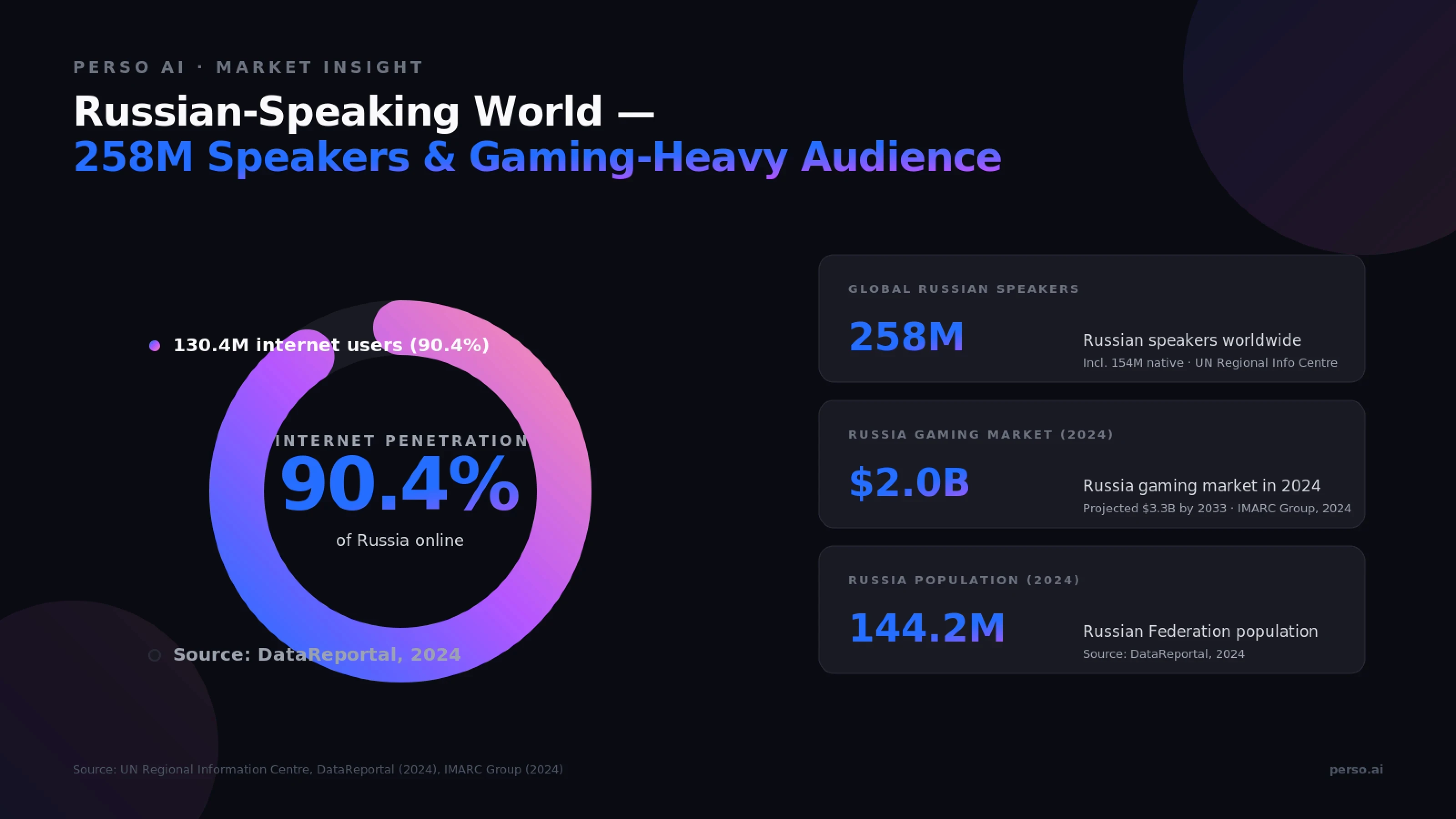
Russian reaches 258 million speakers worldwide — including 154 million native speakers plus tens of millions of second-language speakers across the Russian Federation, CIS countries, and the global Russian diaspora (UN Regional Information Centre). Perso Dubbing translates English videos to Russian with AI dubbing in three steps, handling Russian's 6-case grammar system, 3-gender noun agreement, and formal/informal pronoun choice (ты vs Вы).
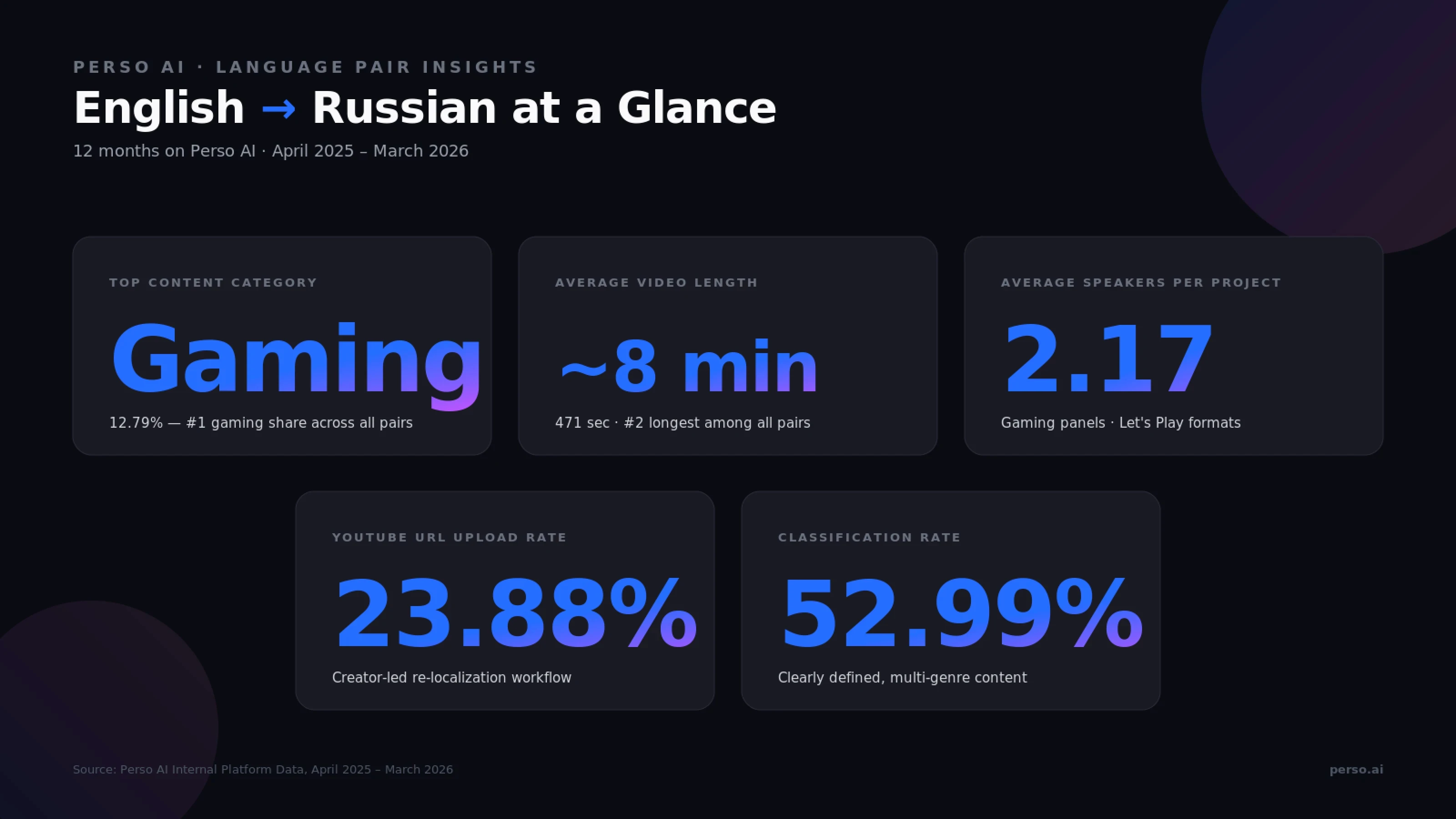
English → Russian shows one of the most distinctive content signatures on Perso Dubbing: Gaming is the leading content category at 12.79% — the highest gaming-content concentration across all language pairs — followed by Comedy (5.79%), News/Current Affairs (4.80%), and Science/Technology (3.62%).
The platform handles long-form content well — projects average 471 seconds (~8 minutes), the second-longest average video length across all language pairs, with 2.17 average speakers per project reflecting interview, panel, and Let's Play gaming formats.
Source: Perso Dubbing Internal Platform Data, April 2025 – March 2026
How do I translate an English video to Russian with AI?
Perso Dubbing translates English videos into Russian in three steps:
Upload your English video (MP4, MOV, AVI, MKV) or paste a YouTube URL — ~30 seconds
Select Russian as the target language and choose optional features (voice cloning, lip-sync, multi-speaker) — ~15 seconds
Review & Export the dubbed video in MP4, WebM, or MOV (plus SRT/VTT subtitles)
The entire pipeline runs end-to-end without manual handoffs.
Step 1 — Upload notes
For English → Russian, direct file uploads dominate at 70.04%, with YouTube URL imports at 23.88%. This blend reflects gaming creators, news organizations, and studios uploading polished content alongside creators localizing existing English YouTube content for Russian-speaking audiences. Max file size is 5 GB, with audio-only formats (MP3, WAV, M4A) supported for podcast workflows.
Step 2 — Optional features at language selection
Voice cloning — preserves the original English speaker's tone in Russian, valuable for serialized content and gaming creator continuity
Multi-speaker detection — automatic (English → Russian projects average 2.17 speakers per project, among the higher multi-speaker rates on the platform, reflecting interview, panel, and Let's Play formats)
Lip-sync — used in 2.49% of projects, applied selectively for the small share of streaming and on-screen dialogue content
Step 3 — Review & export notes
Edit the Russian script line-by-line in the built-in editor. This is particularly useful for adjusting grammatical case endings (the 6-case system affecting every noun and adjective), gender agreement (masculine, feminine, neuter), and formality (informal ты vs formal Вы) — all of which English does not natively encode.
Before / After: Traditional English-to-Russian studio dubbing requires voice casting, studio booking, and post-production sync work spanning several days. AI dubbing delivers the same output in minutes, while preserving the speaker's voice through cloning.
🎬 Ready to try it? Upload your first English video and get the Russian dub in minutes.
Why English → Russian reaches a uniquely engaged gaming and digital audience
English → Russian dubbing has become a strategic localization corridor for gaming creators, news outlets, and global content distributors targeting Russia and the broader Russian-speaking world (CIS, diaspora, and former Soviet states).
Source: UN Regional Information Centre, DataReportal (2024), IMARC Group (2024)
Why Russian content matters globally
The numbers behind the Russian-speaking opportunity:
Metric | Value | Source |
|---|---|---|
Russian speakers worldwide | 258 million total (including 154 million native speakers) | UN Regional Information Centre |
Russian Federation population (Jan 2024) | 144.2 million | DataReportal, 2024 |
Russia internet users (Jan 2024) | 130.4 million (90.4% penetration) | DataReportal, 2024 |
Russia social media users | 106.0 million (73.5% of population) | DataReportal, 2024 |
Russia gaming market (2024) | $2.0 billion (projected $3.3B by 2033) | IMARC Group, 2024 |
The three demand engines
1. Gaming and Let's Play creators. Russia's gaming market reached $2.0 billion in 2024 (IMARC Group), projected to grow to $3.3 billion by 2033. On Perso Dubbing, Gaming is the leading content category at 12.79% — the highest gaming-content share across all language pairs on the platform — reflecting how English-speaking gaming creators localize content for Russian-speaking gaming audiences. The 2.17 average speakers per project further matches Let's Play and multiplayer commentary formats.
2. News and current affairs. News/Current Affairs makes up 4.80% of English → Russian projects — a meaningful share that reflects ongoing demand for English news, analysis, and current-events content translated into Russian for global Russian-speaking audiences.
3. Comedy and entertainment. Comedy accounts for 5.79% of English → Russian projects — the second-largest category — reflecting sketches, stand-up, and entertainment content adapted for Russian viewers across Russia, CIS, and diaspora communities.
Perso Dubbing's data matches the gaming-heavy, multi-speaker Russian signature
English → Russian projects on Perso Dubbing show a distinctive long-form, gaming-leaning pattern:
471.4 seconds average length (~8 minutes) — second-longest among all language pairs (only Korean → English is longer)
2.17 average speakers per project — multi-speaker formats common (gaming panels, interviews, Let's Play)
2.49% lip-sync activation — low, consistent with voice-over and gaming commentary rather than on-screen dialogue
70.04% direct file upload — professional creator and studio workflow signature
52.99% classified rate — a clearly defined, multi-genre content mix
What makes English-to-Russian translation technically unique?
English → Russian is one of the language pairs where source and target share Subject-Verb-Object (SVO) word order, simplifying syntax. The challenge shifts to case system, gender agreement, verb aspect, and Cyrillic script.
English vs Russian — Linguistic Comparison
Feature | English | Russian |
|---|---|---|
Word order | SVO — "She watches videos" | SVO with flexibility — "Она смотрит видео" (similar order; flexible thanks to cases) |
Script | Latin alphabet | Cyrillic alphabet (33 letters) |
Grammatical cases | None (word order signals function) | 6 cases (nominative, genitive, dative, accusative, instrumental, prepositional) — affect every noun, pronoun, adjective |
Gender | No grammatical gender (mostly) | 3 genders — masculine, feminine, neuter — affect agreement |
Formal pronouns | Single "you" | ты (informal singular) · Вы (formal singular / plural) |
Verb aspect | Tense-based (past, present, future) | Aspect-based: perfective (completed) vs imperfective (ongoing) — paired verbs for the same action |
Articles | Definite "the" / indefinite "a/an" | No articles |
Sources: Slavic linguistics references; Russian Academy of Sciences materials.
The four-step conversion problem
Converting English audio into Russian requires AI to perform four distinct operations:
Transcribe English accurately — including idioms, contractions, and gaming/news slang
Apply case endings — every Russian noun, pronoun, and adjective shifts ending based on its grammatical role (subject, object, possession, location, etc.)
Match gender agreement — articles, adjectives, and past-tense verbs must match the noun's masculine, feminine, or neuter gender
Select verb aspect — the model must choose between perfective and imperfective forms based on whether the action is completed or ongoing
Why the case system matters
Russian's 6-case system carries meaning that English encodes through word order and prepositions. The phrase "I see the cat" (accusative — Я вижу кота) versus "I am the cat" (instrumental — Я являюсь котом) shows how case endings convey different grammatical relations. Skilled translation preserves this through correct case selection.
Cyrillic script
Russian uses the Cyrillic alphabet (33 letters), distinct from Latin. Perso Dubbing's Russian output preserves Cyrillic accuracy across the entire script, with editors able to verify specific terms in the built-in editor.
Content categories shaping English-to-Russian dubbing
Perso Dubbing's 12-month data reveals a uniquely gaming-leaning content mix for English → Russian — with Gaming leading by a wide margin and supplemented by comedy, news, and science/tech content.
Content category breakdown
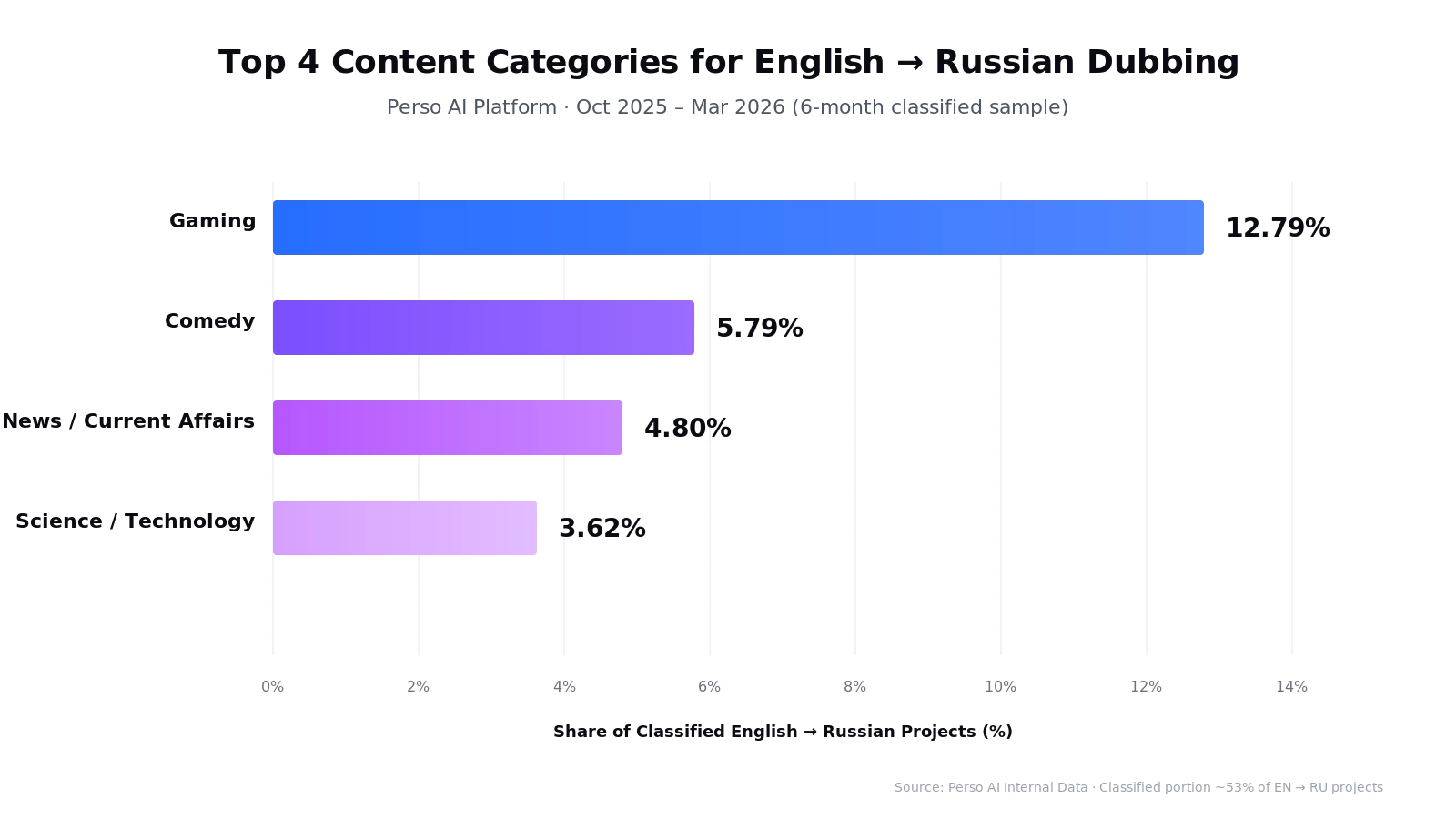
Source: Perso Dubbing Internal Data · Oct 2025 – Mar 2026 (6-month classified sample)
Gaming (12.79%) — The leading content category for this language pair, and the highest gaming-content concentration across all language pairs on Perso Dubbing. Let's Play videos, gaming reviews, esports content, and gaming tutorials from English-speaking creators reaching Russian gamers
Comedy (5.79%) — Sketches, stand-up comedy, and humor channels adapted for Russian-speaking audiences
News / Current Affairs (4.80%) — News reports, analysis, and current-events content from English-language outlets translated for Russian audiences
Science / Technology (3.62%) — Tech tutorials, science communication, and STEM content adapted for Russian learners
Note: Category data reflects approximately 53% of English → Russian projects that received AI category classification (feature active from October 2025).
Format characteristics
English → Russian projects share a long-form, multi-speaker, gaming-leaning signature:
Average video length: 471 seconds (~8 minutes) — second-longest among all language pairs (after Korean → English)
Average speakers per project: 2.17 — among the higher multi-speaker rates, reflecting gaming panels and Let's Play formats
Lip-sync activation: 2.49% — low, consistent with voice-over commentary rather than on-screen dialogue
Direct file upload: 70.04% — professional creator and studio workflow
Classified rate: 52.99% — clearly defined content mix
What this means for creators and studios
If you're producing English content for Russian-speaking audiences, your workflow will likely involve:
Long-form file uploads (6–15 minute episodes typical)
Gaming, comedy, news, or science/tech as primary genres
Multi-speaker content (gaming panels, interview formats)
Voice cloning for serialized gaming creator content
Case-system and gender agreement adjustments during script editing
Perso Dubbing's English → Russian pipeline supports this gaming-heavy, multi-genre workflow.
How does Perso Dubbing handle English-to-Russian dubbing?
Perso Dubbing is an AI-powered video dubbing and translation platform supporting 33+ languages. Its English → Russian pipeline is tuned for the Russian-speaking content economy — gaming creators, news outlets, comedy channels, and tech content distributors reaching Russia, CIS countries, and the global Russian diaspora.
Direct English-to-Russian translation with case-system handling
Generic translators often produce literal output that ignores Russian's grammatical case system, leaving readers with awkward or incorrect noun and adjective endings. Perso Dubbing's direct English → Russian model applies case endings, gender agreement, and verb aspect contextually across the entire script.
Cyrillic script accuracy
Russian uses the Cyrillic alphabet (33 letters). Perso Dubbing's Russian output preserves Cyrillic accuracy and applies appropriate transliteration for proper nouns, technical terms, and brand names that should remain in Latin script.
Voice cloning preserves creator identity
For long-form gaming content, serialized commentary, news shows, and comedy creators, voice continuity across episodes matters. The platform clones the original speaker's vocal characteristics (pitch, timbre, speaking pace) and applies them to the Russian output, supporting both single-speaker and multi-speaker formats.
Multi-speaker detection (averaging 2.17 voices per project)
English → Russian projects average 2.17 distinct speakers — among the higher multi-speaker rates on the platform, fitting gaming panel commentary, Let's Play formats, news interviews, and comedy sketches. Speaker changes are detected automatically, with distinct Russian voices assigned to each.
Formality and aspect-aware output
Unlike generic translators, Perso Dubbing's Russian output handles formality (ты vs Вы) and verb aspect (perfective vs imperfective) contextually. Editors can refine specific lines in the built-in script editor for character-specific tone or aspect choices.
Long-form export flexibility
Output formats include MP4, WebM, MOV for video, plus SRT, VTT, ASS for subtitle files. This supports re-upload to YouTube, Russian-language platforms, gaming streaming services, or export as separate deliverables for streaming and social media distribution.
Frequently Asked Questions
How accurate is AI English-to-Russian video translation?
Perso Dubbing achieves high translation accuracy for English-to-Russian dubbing, validated across gaming, comedy, news, and science/technology content. Accuracy is higher for scripted content than unscripted material with heavy slang. English → Russian shows one of the most distinctive content signatures on the platform with Gaming as the leading category at 12.79%.
Does Perso Dubbing handle Russian's 6-case grammar system?
Yes. Perso Dubbing's direct English → Russian model handles case endings contextually — every noun, pronoun, and adjective receives the correct ending for nominative, genitive, dative, accusative, instrumental, or prepositional case based on its grammatical role. Editors can refine specific terms in the built-in script editor.
How long does it take to dub an English video into Russian?
AI dubbing delivers Russian versions in minutes rather than the days required by manual studio dubbing. The average English-to-Russian project on Perso Dubbing is 471 seconds (about 8 minutes) long — second-longest among all language pairs. The entire pipeline runs end-to-end on the platform.
Can Perso Dubbing handle gaming content with multiple speakers (Let's Play, panel commentary)?
Yes. English → Russian projects average 2.17 speakers per project — among the higher multi-speaker rates on Perso Dubbing — reflecting how gaming creators use the platform for Let's Play, panel commentary, and multiplayer content. Speaker changes are detected automatically.
Does Perso Dubbing use Cyrillic script for Russian output?
Yes. Perso Dubbing's Russian output uses the standard Cyrillic alphabet (33 letters) and handles transliteration for proper nouns, technical terms, and brand names that should remain in Latin script. Editors can adjust specific terms in the built-in script editor.
What content types perform best for English-to-Russian dubbing?
Gaming, comedy, news, and science/technology content all perform strongly on Perso Dubbing. Gaming alone accounts for 12.79% of all English-to-Russian projects — the leading category for this pair and the highest gaming-content concentration across all language pairs on the platform. With Russian reaching 258 million speakers worldwide (UN Regional Information Centre), scripted long-form content benefits most from professional AI dubbing.
Ready to translate your English video to Russian?
Start your first English → Russian dubbing project in minutes. Free trial — no credit card required.
Start dubbing your English video now →
Data source: Perso Dubbing Internal Platform Data, April 2025 – March 2026. Market figures sourced from UN Regional Information Centre, DataReportal (2024), and IMARC Group (2024) as cited inline. This post is part of Perso Dubbing's Language Pair Guide series. For broader AI dubbing trends, see our Q1 2026 AI Dubbing Language Trends Report.
💡 Translate any English video to Russian in minutes with Perso Dubbing. Free trial — no credit card required.
Answer-First Opening
Russian reaches 258 million speakers worldwide — including 154 million native speakers plus tens of millions of second-language speakers across the Russian Federation, CIS countries, and the global Russian diaspora (UN Regional Information Centre). Perso Dubbing translates English videos to Russian with AI dubbing in three steps, handling Russian's 6-case grammar system, 3-gender noun agreement, and formal/informal pronoun choice (ты vs Вы).
English → Russian shows one of the most distinctive content signatures on Perso Dubbing: Gaming is the leading content category at 12.79% — the highest gaming-content concentration across all language pairs — followed by Comedy (5.79%), News/Current Affairs (4.80%), and Science/Technology (3.62%).
The platform handles long-form content well — projects average 471 seconds (~8 minutes), the second-longest average video length across all language pairs, with 2.17 average speakers per project reflecting interview, panel, and Let's Play gaming formats.
Source: Perso Dubbing Internal Platform Data, April 2025 – March 2026
How do I translate an English video to Russian with AI?
Perso Dubbing translates English videos into Russian in three steps:
Upload your English video (MP4, MOV, AVI, MKV) or paste a YouTube URL — ~30 seconds
Select Russian as the target language and choose optional features (voice cloning, lip-sync, multi-speaker) — ~15 seconds
Review & Export the dubbed video in MP4, WebM, or MOV (plus SRT/VTT subtitles)
The entire pipeline runs end-to-end without manual handoffs.
Step 1 — Upload notes
For English → Russian, direct file uploads dominate at 70.04%, with YouTube URL imports at 23.88%. This blend reflects gaming creators, news organizations, and studios uploading polished content alongside creators localizing existing English YouTube content for Russian-speaking audiences. Max file size is 5 GB, with audio-only formats (MP3, WAV, M4A) supported for podcast workflows.
Step 2 — Optional features at language selection
Voice cloning — preserves the original English speaker's tone in Russian, valuable for serialized content and gaming creator continuity
Multi-speaker detection — automatic (English → Russian projects average 2.17 speakers per project, among the higher multi-speaker rates on the platform, reflecting interview, panel, and Let's Play formats)
Lip-sync — used in 2.49% of projects, applied selectively for the small share of streaming and on-screen dialogue content
Step 3 — Review & export notes
Edit the Russian script line-by-line in the built-in editor. This is particularly useful for adjusting grammatical case endings (the 6-case system affecting every noun and adjective), gender agreement (masculine, feminine, neuter), and formality (informal ты vs formal Вы) — all of which English does not natively encode.
Before / After: Traditional English-to-Russian studio dubbing requires voice casting, studio booking, and post-production sync work spanning several days. AI dubbing delivers the same output in minutes, while preserving the speaker's voice through cloning.
🎬 Ready to try it? Upload your first English video and get the Russian dub in minutes.
Why English → Russian reaches a uniquely engaged gaming and digital audience
English → Russian dubbing has become a strategic localization corridor for gaming creators, news outlets, and global content distributors targeting Russia and the broader Russian-speaking world (CIS, diaspora, and former Soviet states).
Source: UN Regional Information Centre, DataReportal (2024), IMARC Group (2024)
Why Russian content matters globally
The numbers behind the Russian-speaking opportunity:
Metric | Value | Source |
|---|---|---|
Russian speakers worldwide | 258 million total (including 154 million native speakers) | UN Regional Information Centre |
Russian Federation population (Jan 2024) | 144.2 million | DataReportal, 2024 |
Russia internet users (Jan 2024) | 130.4 million (90.4% penetration) | DataReportal, 2024 |
Russia social media users | 106.0 million (73.5% of population) | DataReportal, 2024 |
Russia gaming market (2024) | $2.0 billion (projected $3.3B by 2033) | IMARC Group, 2024 |
The three demand engines
1. Gaming and Let's Play creators. Russia's gaming market reached $2.0 billion in 2024 (IMARC Group), projected to grow to $3.3 billion by 2033. On Perso Dubbing, Gaming is the leading content category at 12.79% — the highest gaming-content share across all language pairs on the platform — reflecting how English-speaking gaming creators localize content for Russian-speaking gaming audiences. The 2.17 average speakers per project further matches Let's Play and multiplayer commentary formats.
2. News and current affairs. News/Current Affairs makes up 4.80% of English → Russian projects — a meaningful share that reflects ongoing demand for English news, analysis, and current-events content translated into Russian for global Russian-speaking audiences.
3. Comedy and entertainment. Comedy accounts for 5.79% of English → Russian projects — the second-largest category — reflecting sketches, stand-up, and entertainment content adapted for Russian viewers across Russia, CIS, and diaspora communities.
Perso Dubbing's data matches the gaming-heavy, multi-speaker Russian signature
English → Russian projects on Perso Dubbing show a distinctive long-form, gaming-leaning pattern:
471.4 seconds average length (~8 minutes) — second-longest among all language pairs (only Korean → English is longer)
2.17 average speakers per project — multi-speaker formats common (gaming panels, interviews, Let's Play)
2.49% lip-sync activation — low, consistent with voice-over and gaming commentary rather than on-screen dialogue
70.04% direct file upload — professional creator and studio workflow signature
52.99% classified rate — a clearly defined, multi-genre content mix
What makes English-to-Russian translation technically unique?
English → Russian is one of the language pairs where source and target share Subject-Verb-Object (SVO) word order, simplifying syntax. The challenge shifts to case system, gender agreement, verb aspect, and Cyrillic script.
English vs Russian — Linguistic Comparison
Feature | English | Russian |
|---|---|---|
Word order | SVO — "She watches videos" | SVO with flexibility — "Она смотрит видео" (similar order; flexible thanks to cases) |
Script | Latin alphabet | Cyrillic alphabet (33 letters) |
Grammatical cases | None (word order signals function) | 6 cases (nominative, genitive, dative, accusative, instrumental, prepositional) — affect every noun, pronoun, adjective |
Gender | No grammatical gender (mostly) | 3 genders — masculine, feminine, neuter — affect agreement |
Formal pronouns | Single "you" | ты (informal singular) · Вы (formal singular / plural) |
Verb aspect | Tense-based (past, present, future) | Aspect-based: perfective (completed) vs imperfective (ongoing) — paired verbs for the same action |
Articles | Definite "the" / indefinite "a/an" | No articles |
Sources: Slavic linguistics references; Russian Academy of Sciences materials.
The four-step conversion problem
Converting English audio into Russian requires AI to perform four distinct operations:
Transcribe English accurately — including idioms, contractions, and gaming/news slang
Apply case endings — every Russian noun, pronoun, and adjective shifts ending based on its grammatical role (subject, object, possession, location, etc.)
Match gender agreement — articles, adjectives, and past-tense verbs must match the noun's masculine, feminine, or neuter gender
Select verb aspect — the model must choose between perfective and imperfective forms based on whether the action is completed or ongoing
Why the case system matters
Russian's 6-case system carries meaning that English encodes through word order and prepositions. The phrase "I see the cat" (accusative — Я вижу кота) versus "I am the cat" (instrumental — Я являюсь котом) shows how case endings convey different grammatical relations. Skilled translation preserves this through correct case selection.
Cyrillic script
Russian uses the Cyrillic alphabet (33 letters), distinct from Latin. Perso Dubbing's Russian output preserves Cyrillic accuracy across the entire script, with editors able to verify specific terms in the built-in editor.
Content categories shaping English-to-Russian dubbing
Perso Dubbing's 12-month data reveals a uniquely gaming-leaning content mix for English → Russian — with Gaming leading by a wide margin and supplemented by comedy, news, and science/tech content.
Content category breakdown
Source: Perso Dubbing Internal Data · Oct 2025 – Mar 2026 (6-month classified sample)
Gaming (12.79%) — The leading content category for this language pair, and the highest gaming-content concentration across all language pairs on Perso Dubbing. Let's Play videos, gaming reviews, esports content, and gaming tutorials from English-speaking creators reaching Russian gamers
Comedy (5.79%) — Sketches, stand-up comedy, and humor channels adapted for Russian-speaking audiences
News / Current Affairs (4.80%) — News reports, analysis, and current-events content from English-language outlets translated for Russian audiences
Science / Technology (3.62%) — Tech tutorials, science communication, and STEM content adapted for Russian learners
Note: Category data reflects approximately 53% of English → Russian projects that received AI category classification (feature active from October 2025).
Format characteristics
English → Russian projects share a long-form, multi-speaker, gaming-leaning signature:
Average video length: 471 seconds (~8 minutes) — second-longest among all language pairs (after Korean → English)
Average speakers per project: 2.17 — among the higher multi-speaker rates, reflecting gaming panels and Let's Play formats
Lip-sync activation: 2.49% — low, consistent with voice-over commentary rather than on-screen dialogue
Direct file upload: 70.04% — professional creator and studio workflow
Classified rate: 52.99% — clearly defined content mix
What this means for creators and studios
If you're producing English content for Russian-speaking audiences, your workflow will likely involve:
Long-form file uploads (6–15 minute episodes typical)
Gaming, comedy, news, or science/tech as primary genres
Multi-speaker content (gaming panels, interview formats)
Voice cloning for serialized gaming creator content
Case-system and gender agreement adjustments during script editing
Perso Dubbing's English → Russian pipeline supports this gaming-heavy, multi-genre workflow.
How does Perso Dubbing handle English-to-Russian dubbing?
Perso Dubbing is an AI-powered video dubbing and translation platform supporting 33+ languages. Its English → Russian pipeline is tuned for the Russian-speaking content economy — gaming creators, news outlets, comedy channels, and tech content distributors reaching Russia, CIS countries, and the global Russian diaspora.
Direct English-to-Russian translation with case-system handling
Generic translators often produce literal output that ignores Russian's grammatical case system, leaving readers with awkward or incorrect noun and adjective endings. Perso Dubbing's direct English → Russian model applies case endings, gender agreement, and verb aspect contextually across the entire script.
Cyrillic script accuracy
Russian uses the Cyrillic alphabet (33 letters). Perso Dubbing's Russian output preserves Cyrillic accuracy and applies appropriate transliteration for proper nouns, technical terms, and brand names that should remain in Latin script.
Voice cloning preserves creator identity
For long-form gaming content, serialized commentary, news shows, and comedy creators, voice continuity across episodes matters. The platform clones the original speaker's vocal characteristics (pitch, timbre, speaking pace) and applies them to the Russian output, supporting both single-speaker and multi-speaker formats.
Multi-speaker detection (averaging 2.17 voices per project)
English → Russian projects average 2.17 distinct speakers — among the higher multi-speaker rates on the platform, fitting gaming panel commentary, Let's Play formats, news interviews, and comedy sketches. Speaker changes are detected automatically, with distinct Russian voices assigned to each.
Formality and aspect-aware output
Unlike generic translators, Perso Dubbing's Russian output handles formality (ты vs Вы) and verb aspect (perfective vs imperfective) contextually. Editors can refine specific lines in the built-in script editor for character-specific tone or aspect choices.
Long-form export flexibility
Output formats include MP4, WebM, MOV for video, plus SRT, VTT, ASS for subtitle files. This supports re-upload to YouTube, Russian-language platforms, gaming streaming services, or export as separate deliverables for streaming and social media distribution.
Frequently Asked Questions
How accurate is AI English-to-Russian video translation?
Perso Dubbing achieves high translation accuracy for English-to-Russian dubbing, validated across gaming, comedy, news, and science/technology content. Accuracy is higher for scripted content than unscripted material with heavy slang. English → Russian shows one of the most distinctive content signatures on the platform with Gaming as the leading category at 12.79%.
Does Perso Dubbing handle Russian's 6-case grammar system?
Yes. Perso Dubbing's direct English → Russian model handles case endings contextually — every noun, pronoun, and adjective receives the correct ending for nominative, genitive, dative, accusative, instrumental, or prepositional case based on its grammatical role. Editors can refine specific terms in the built-in script editor.
How long does it take to dub an English video into Russian?
AI dubbing delivers Russian versions in minutes rather than the days required by manual studio dubbing. The average English-to-Russian project on Perso Dubbing is 471 seconds (about 8 minutes) long — second-longest among all language pairs. The entire pipeline runs end-to-end on the platform.
Can Perso Dubbing handle gaming content with multiple speakers (Let's Play, panel commentary)?
Yes. English → Russian projects average 2.17 speakers per project — among the higher multi-speaker rates on Perso Dubbing — reflecting how gaming creators use the platform for Let's Play, panel commentary, and multiplayer content. Speaker changes are detected automatically.
Does Perso Dubbing use Cyrillic script for Russian output?
Yes. Perso Dubbing's Russian output uses the standard Cyrillic alphabet (33 letters) and handles transliteration for proper nouns, technical terms, and brand names that should remain in Latin script. Editors can adjust specific terms in the built-in script editor.
What content types perform best for English-to-Russian dubbing?
Gaming, comedy, news, and science/technology content all perform strongly on Perso Dubbing. Gaming alone accounts for 12.79% of all English-to-Russian projects — the leading category for this pair and the highest gaming-content concentration across all language pairs on the platform. With Russian reaching 258 million speakers worldwide (UN Regional Information Centre), scripted long-form content benefits most from professional AI dubbing.
Ready to translate your English video to Russian?
Start your first English → Russian dubbing project in minutes. Free trial — no credit card required.
Start dubbing your English video now →
Data source: Perso Dubbing Internal Platform Data, April 2025 – March 2026. Market figures sourced from UN Regional Information Centre, DataReportal (2024), and IMARC Group (2024) as cited inline. This post is part of Perso Dubbing's Language Pair Guide series. For broader AI dubbing trends, see our Q1 2026 AI Dubbing Language Trends Report.
💡 Translate any English video to Russian in minutes with Perso Dubbing. Free trial — no credit card required.
Answer-First Opening
Russian reaches 258 million speakers worldwide — including 154 million native speakers plus tens of millions of second-language speakers across the Russian Federation, CIS countries, and the global Russian diaspora (UN Regional Information Centre). Perso Dubbing translates English videos to Russian with AI dubbing in three steps, handling Russian's 6-case grammar system, 3-gender noun agreement, and formal/informal pronoun choice (ты vs Вы).
English → Russian shows one of the most distinctive content signatures on Perso Dubbing: Gaming is the leading content category at 12.79% — the highest gaming-content concentration across all language pairs — followed by Comedy (5.79%), News/Current Affairs (4.80%), and Science/Technology (3.62%).
The platform handles long-form content well — projects average 471 seconds (~8 minutes), the second-longest average video length across all language pairs, with 2.17 average speakers per project reflecting interview, panel, and Let's Play gaming formats.
Source: Perso Dubbing Internal Platform Data, April 2025 – March 2026
How do I translate an English video to Russian with AI?
Perso Dubbing translates English videos into Russian in three steps:
Upload your English video (MP4, MOV, AVI, MKV) or paste a YouTube URL — ~30 seconds
Select Russian as the target language and choose optional features (voice cloning, lip-sync, multi-speaker) — ~15 seconds
Review & Export the dubbed video in MP4, WebM, or MOV (plus SRT/VTT subtitles)
The entire pipeline runs end-to-end without manual handoffs.
Step 1 — Upload notes
For English → Russian, direct file uploads dominate at 70.04%, with YouTube URL imports at 23.88%. This blend reflects gaming creators, news organizations, and studios uploading polished content alongside creators localizing existing English YouTube content for Russian-speaking audiences. Max file size is 5 GB, with audio-only formats (MP3, WAV, M4A) supported for podcast workflows.
Step 2 — Optional features at language selection
Voice cloning — preserves the original English speaker's tone in Russian, valuable for serialized content and gaming creator continuity
Multi-speaker detection — automatic (English → Russian projects average 2.17 speakers per project, among the higher multi-speaker rates on the platform, reflecting interview, panel, and Let's Play formats)
Lip-sync — used in 2.49% of projects, applied selectively for the small share of streaming and on-screen dialogue content
Step 3 — Review & export notes
Edit the Russian script line-by-line in the built-in editor. This is particularly useful for adjusting grammatical case endings (the 6-case system affecting every noun and adjective), gender agreement (masculine, feminine, neuter), and formality (informal ты vs formal Вы) — all of which English does not natively encode.
Before / After: Traditional English-to-Russian studio dubbing requires voice casting, studio booking, and post-production sync work spanning several days. AI dubbing delivers the same output in minutes, while preserving the speaker's voice through cloning.
🎬 Ready to try it? Upload your first English video and get the Russian dub in minutes.
Why English → Russian reaches a uniquely engaged gaming and digital audience
English → Russian dubbing has become a strategic localization corridor for gaming creators, news outlets, and global content distributors targeting Russia and the broader Russian-speaking world (CIS, diaspora, and former Soviet states).
Source: UN Regional Information Centre, DataReportal (2024), IMARC Group (2024)
Why Russian content matters globally
The numbers behind the Russian-speaking opportunity:
Metric | Value | Source |
|---|---|---|
Russian speakers worldwide | 258 million total (including 154 million native speakers) | UN Regional Information Centre |
Russian Federation population (Jan 2024) | 144.2 million | DataReportal, 2024 |
Russia internet users (Jan 2024) | 130.4 million (90.4% penetration) | DataReportal, 2024 |
Russia social media users | 106.0 million (73.5% of population) | DataReportal, 2024 |
Russia gaming market (2024) | $2.0 billion (projected $3.3B by 2033) | IMARC Group, 2024 |
The three demand engines
1. Gaming and Let's Play creators. Russia's gaming market reached $2.0 billion in 2024 (IMARC Group), projected to grow to $3.3 billion by 2033. On Perso Dubbing, Gaming is the leading content category at 12.79% — the highest gaming-content share across all language pairs on the platform — reflecting how English-speaking gaming creators localize content for Russian-speaking gaming audiences. The 2.17 average speakers per project further matches Let's Play and multiplayer commentary formats.
2. News and current affairs. News/Current Affairs makes up 4.80% of English → Russian projects — a meaningful share that reflects ongoing demand for English news, analysis, and current-events content translated into Russian for global Russian-speaking audiences.
3. Comedy and entertainment. Comedy accounts for 5.79% of English → Russian projects — the second-largest category — reflecting sketches, stand-up, and entertainment content adapted for Russian viewers across Russia, CIS, and diaspora communities.
Perso Dubbing's data matches the gaming-heavy, multi-speaker Russian signature
English → Russian projects on Perso Dubbing show a distinctive long-form, gaming-leaning pattern:
471.4 seconds average length (~8 minutes) — second-longest among all language pairs (only Korean → English is longer)
2.17 average speakers per project — multi-speaker formats common (gaming panels, interviews, Let's Play)
2.49% lip-sync activation — low, consistent with voice-over and gaming commentary rather than on-screen dialogue
70.04% direct file upload — professional creator and studio workflow signature
52.99% classified rate — a clearly defined, multi-genre content mix
What makes English-to-Russian translation technically unique?
English → Russian is one of the language pairs where source and target share Subject-Verb-Object (SVO) word order, simplifying syntax. The challenge shifts to case system, gender agreement, verb aspect, and Cyrillic script.
English vs Russian — Linguistic Comparison
Feature | English | Russian |
|---|---|---|
Word order | SVO — "She watches videos" | SVO with flexibility — "Она смотрит видео" (similar order; flexible thanks to cases) |
Script | Latin alphabet | Cyrillic alphabet (33 letters) |
Grammatical cases | None (word order signals function) | 6 cases (nominative, genitive, dative, accusative, instrumental, prepositional) — affect every noun, pronoun, adjective |
Gender | No grammatical gender (mostly) | 3 genders — masculine, feminine, neuter — affect agreement |
Formal pronouns | Single "you" | ты (informal singular) · Вы (formal singular / plural) |
Verb aspect | Tense-based (past, present, future) | Aspect-based: perfective (completed) vs imperfective (ongoing) — paired verbs for the same action |
Articles | Definite "the" / indefinite "a/an" | No articles |
Sources: Slavic linguistics references; Russian Academy of Sciences materials.
The four-step conversion problem
Converting English audio into Russian requires AI to perform four distinct operations:
Transcribe English accurately — including idioms, contractions, and gaming/news slang
Apply case endings — every Russian noun, pronoun, and adjective shifts ending based on its grammatical role (subject, object, possession, location, etc.)
Match gender agreement — articles, adjectives, and past-tense verbs must match the noun's masculine, feminine, or neuter gender
Select verb aspect — the model must choose between perfective and imperfective forms based on whether the action is completed or ongoing
Why the case system matters
Russian's 6-case system carries meaning that English encodes through word order and prepositions. The phrase "I see the cat" (accusative — Я вижу кота) versus "I am the cat" (instrumental — Я являюсь котом) shows how case endings convey different grammatical relations. Skilled translation preserves this through correct case selection.
Cyrillic script
Russian uses the Cyrillic alphabet (33 letters), distinct from Latin. Perso Dubbing's Russian output preserves Cyrillic accuracy across the entire script, with editors able to verify specific terms in the built-in editor.
Content categories shaping English-to-Russian dubbing
Perso Dubbing's 12-month data reveals a uniquely gaming-leaning content mix for English → Russian — with Gaming leading by a wide margin and supplemented by comedy, news, and science/tech content.
Content category breakdown
Source: Perso Dubbing Internal Data · Oct 2025 – Mar 2026 (6-month classified sample)
Gaming (12.79%) — The leading content category for this language pair, and the highest gaming-content concentration across all language pairs on Perso Dubbing. Let's Play videos, gaming reviews, esports content, and gaming tutorials from English-speaking creators reaching Russian gamers
Comedy (5.79%) — Sketches, stand-up comedy, and humor channels adapted for Russian-speaking audiences
News / Current Affairs (4.80%) — News reports, analysis, and current-events content from English-language outlets translated for Russian audiences
Science / Technology (3.62%) — Tech tutorials, science communication, and STEM content adapted for Russian learners
Note: Category data reflects approximately 53% of English → Russian projects that received AI category classification (feature active from October 2025).
Format characteristics
English → Russian projects share a long-form, multi-speaker, gaming-leaning signature:
Average video length: 471 seconds (~8 minutes) — second-longest among all language pairs (after Korean → English)
Average speakers per project: 2.17 — among the higher multi-speaker rates, reflecting gaming panels and Let's Play formats
Lip-sync activation: 2.49% — low, consistent with voice-over commentary rather than on-screen dialogue
Direct file upload: 70.04% — professional creator and studio workflow
Classified rate: 52.99% — clearly defined content mix
What this means for creators and studios
If you're producing English content for Russian-speaking audiences, your workflow will likely involve:
Long-form file uploads (6–15 minute episodes typical)
Gaming, comedy, news, or science/tech as primary genres
Multi-speaker content (gaming panels, interview formats)
Voice cloning for serialized gaming creator content
Case-system and gender agreement adjustments during script editing
Perso Dubbing's English → Russian pipeline supports this gaming-heavy, multi-genre workflow.
How does Perso Dubbing handle English-to-Russian dubbing?
Perso Dubbing is an AI-powered video dubbing and translation platform supporting 33+ languages. Its English → Russian pipeline is tuned for the Russian-speaking content economy — gaming creators, news outlets, comedy channels, and tech content distributors reaching Russia, CIS countries, and the global Russian diaspora.
Direct English-to-Russian translation with case-system handling
Generic translators often produce literal output that ignores Russian's grammatical case system, leaving readers with awkward or incorrect noun and adjective endings. Perso Dubbing's direct English → Russian model applies case endings, gender agreement, and verb aspect contextually across the entire script.
Cyrillic script accuracy
Russian uses the Cyrillic alphabet (33 letters). Perso Dubbing's Russian output preserves Cyrillic accuracy and applies appropriate transliteration for proper nouns, technical terms, and brand names that should remain in Latin script.
Voice cloning preserves creator identity
For long-form gaming content, serialized commentary, news shows, and comedy creators, voice continuity across episodes matters. The platform clones the original speaker's vocal characteristics (pitch, timbre, speaking pace) and applies them to the Russian output, supporting both single-speaker and multi-speaker formats.
Multi-speaker detection (averaging 2.17 voices per project)
English → Russian projects average 2.17 distinct speakers — among the higher multi-speaker rates on the platform, fitting gaming panel commentary, Let's Play formats, news interviews, and comedy sketches. Speaker changes are detected automatically, with distinct Russian voices assigned to each.
Formality and aspect-aware output
Unlike generic translators, Perso Dubbing's Russian output handles formality (ты vs Вы) and verb aspect (perfective vs imperfective) contextually. Editors can refine specific lines in the built-in script editor for character-specific tone or aspect choices.
Long-form export flexibility
Output formats include MP4, WebM, MOV for video, plus SRT, VTT, ASS for subtitle files. This supports re-upload to YouTube, Russian-language platforms, gaming streaming services, or export as separate deliverables for streaming and social media distribution.
Frequently Asked Questions
How accurate is AI English-to-Russian video translation?
Perso Dubbing achieves high translation accuracy for English-to-Russian dubbing, validated across gaming, comedy, news, and science/technology content. Accuracy is higher for scripted content than unscripted material with heavy slang. English → Russian shows one of the most distinctive content signatures on the platform with Gaming as the leading category at 12.79%.
Does Perso Dubbing handle Russian's 6-case grammar system?
Yes. Perso Dubbing's direct English → Russian model handles case endings contextually — every noun, pronoun, and adjective receives the correct ending for nominative, genitive, dative, accusative, instrumental, or prepositional case based on its grammatical role. Editors can refine specific terms in the built-in script editor.
How long does it take to dub an English video into Russian?
AI dubbing delivers Russian versions in minutes rather than the days required by manual studio dubbing. The average English-to-Russian project on Perso Dubbing is 471 seconds (about 8 minutes) long — second-longest among all language pairs. The entire pipeline runs end-to-end on the platform.
Can Perso Dubbing handle gaming content with multiple speakers (Let's Play, panel commentary)?
Yes. English → Russian projects average 2.17 speakers per project — among the higher multi-speaker rates on Perso Dubbing — reflecting how gaming creators use the platform for Let's Play, panel commentary, and multiplayer content. Speaker changes are detected automatically.
Does Perso Dubbing use Cyrillic script for Russian output?
Yes. Perso Dubbing's Russian output uses the standard Cyrillic alphabet (33 letters) and handles transliteration for proper nouns, technical terms, and brand names that should remain in Latin script. Editors can adjust specific terms in the built-in script editor.
What content types perform best for English-to-Russian dubbing?
Gaming, comedy, news, and science/technology content all perform strongly on Perso Dubbing. Gaming alone accounts for 12.79% of all English-to-Russian projects — the leading category for this pair and the highest gaming-content concentration across all language pairs on the platform. With Russian reaching 258 million speakers worldwide (UN Regional Information Centre), scripted long-form content benefits most from professional AI dubbing.
Ready to translate your English video to Russian?
Start your first English → Russian dubbing project in minutes. Free trial — no credit card required.
Start dubbing your English video now →
Data source: Perso Dubbing Internal Platform Data, April 2025 – March 2026. Market figures sourced from UN Regional Information Centre, DataReportal (2024), and IMARC Group (2024) as cited inline. This post is part of Perso Dubbing's Language Pair Guide series. For broader AI dubbing trends, see our Q1 2026 AI Dubbing Language Trends Report.
Continue Reading
Browse All