How to Translate English Videos to Hindi with AI




Jump to section
Jump to section

Share
Share
Share
AI Video Translator, Localization, and Dubbing Tool
Try it out for Free
💡 Translate any English video to Hindi in minutes with Perso AI. Free trial — no credit card required.
Answer-First Opening
India's 190 million+ Hindi-speaking YouTube users represent one of the largest untapped audiences for English-language creators today. Perso AI translates English videos to Hindi with AI dubbing in three steps, preserving the original speaker's voice while adapting English SVO syntax into Hindi's SOV structure and three-tier formality system.
English → Hindi is one of the top language pairs on the platform (#2 by project volume), driven by global YouTubers, educators, and marketers reaching India's massive creator economy. AI dubbing delivers Hindi versions in minutes rather than days — enabling creators to ship localized content same-day.
The platform is optimized for solo-creator content — projects average just 1.8 speakers per video and 81 seconds per clip. 22% of English-to-Hindi uploads come through YouTube URL imports, reflecting the creator-first workflow of this corridor.
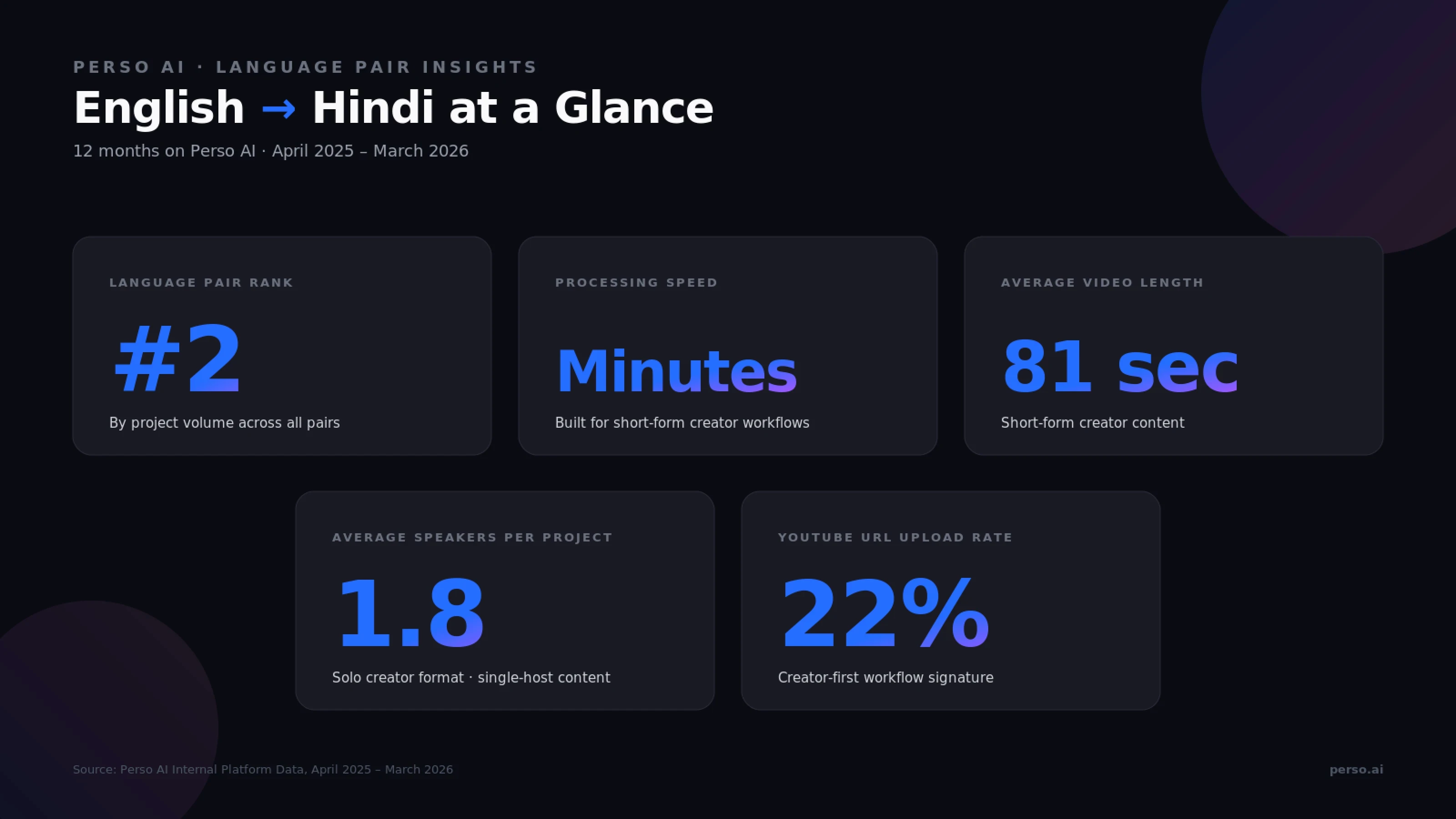
Source: Perso AI Internal Platform Data, April 2025 – March 2026
How do I translate an English video to Hindi with AI?
Perso AI translates English videos into Hindi in three steps:
Upload your English video (MP4, MOV, AVI, MKV up to 5 GB) or paste a YouTube URL — ~30 seconds
Select Hindi as the target language and choose optional features (voice cloning, lip-sync, multi-speaker) — ~15 seconds
Review & Export the dubbed video in MP4, WebM, or MOV (plus SRT/VTT subtitles) — 3–5 minutes
The entire process completes in minutes and preserves the original speaker's voice.
Step 1 — Upload notes
For English → Hindi, YouTube URL imports account for 22% of all uploads. This reflects the creator economy's workflow: creators who already publish English videos on YouTube simply paste the URL to generate a Hindi version. MP4 and MOV uploads cover the remaining 78%. Max file size is 5 GB, with audio-only formats (MP3, WAV, M4A) also supported for podcast-to-video use cases.
Step 2 — Optional features at language selection
Voice cloning — preserves the original speaker's tone in Hindi, critical for solo creators maintaining channel identity
Multi-speaker detection — automatic (though English → Hindi projects average just 1.8 speakers, typical of single-host content)
Lip-sync — used in 0.8% of projects; recommended for long-form content over 5 minutes
Step 3 — Review & export notes
Edit the Hindi script line-by-line in the built-in editor — particularly useful for adjusting formality level (informal tum vs formal aap), which varies by audience. No re-rendering required for script tweaks.
Before / After: Traditional English-to-Hindi studio dubbing takes 3–5 days and requires voice casting, studio booking, and post-production sync work. AI dubbing delivers the same output in minutes — enabling creators to ship Hindi versions same-day.
🎬 Ready to try it? Upload your first English video and get the Hindi dub in minutes.
The English-to-Hindi dubbing wave among Indian creators
English → Hindi dubbing has become a defining growth strategy for global creators targeting India in 2025. According to AIR Media-Tech, MrBeast added over 47 million Indian subscribers in one year by consistently dubbing his videos in seven Indian languages — including Hindi — a substantial regional subscriber gain that has become a reference case for multi-language YouTube strategy.
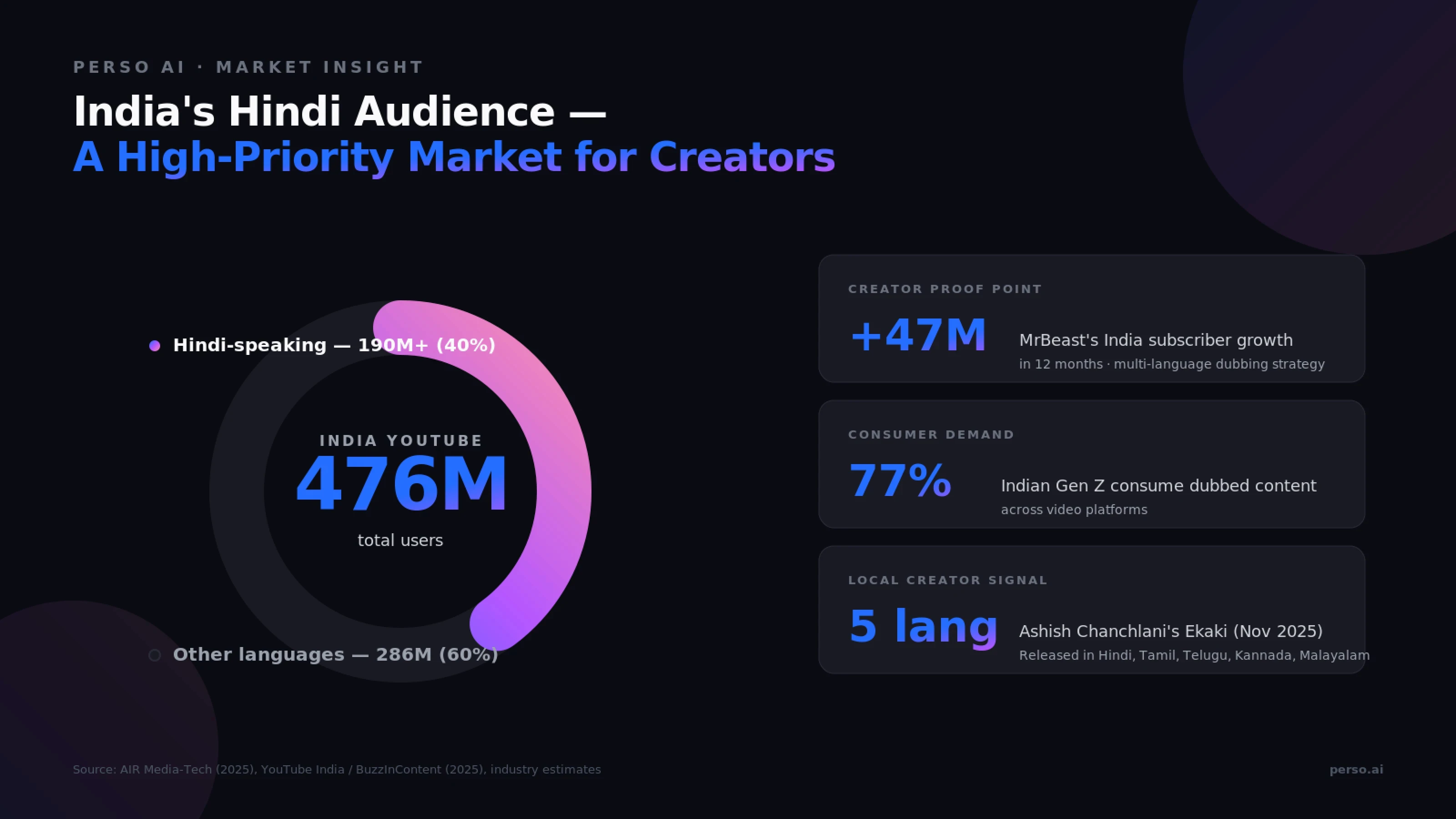
Source: AIR Media-Tech (2025), YouTube India / BuzzInContent (2025), Omdia/industry estimates
Why India's Hindi audience is one of the most important creator markets
The numbers behind this shift are significant:
Metric | Value | Source |
|---|---|---|
YouTube users in India | 476 million+ | YouTube India / industry estimates, 2025 |
Hindi-speaking YouTube audience | 190 million+ | YouTube India language data, 2025 |
Indian Gen Z consuming dubbed content | 77% | YouTube India / BuzzInContent, 2025 |
MrBeast India subscriber growth | +47M in 12 months | AIR Media-Tech, 2025 |
Ashish Chanchlani, an Indian creator known for English-Hindi content, returned to YouTube in late 2025 with Ekaki, a horror-comedy series released in five Indian languages (Hindi, Tamil, Telugu, Kannada, Malayalam). Several Hindi-dubbed kids channels report monthly view counts in the tens of millions on their Hindi audio tracks, illustrating the scale of demand for English-origin content localized into Hindi.
The 2025 window is closing
Industry analysis from AIR Media-Tech notes that "2025 is the year when translation and dubbing still give you a competitive edge on YouTube. By 2026, the wave of creators rushing into dubbing will turn this into a crowded race." For English-language creators, Hindi dubbing is no longer a nice-to-have — it's a growth requirement.
Perso AI's data matches the creator-first pattern
English → Hindi projects on Perso AI show the signature of creator-driven content:
1.8 average speakers per project — typical of single-host creator videos (vlogs, tutorials, explainers)
22% YouTube URL uploads — creators localizing existing YouTube content directly
81 seconds average video length — short-form, snackable content optimized for mobile viewing
What makes English-to-Hindi translation technically unique?
English → Hindi dubbing presents different technical challenges from Asian language pairs. Unlike Chinese → Hindi (tonal to non-tonal conversion), English and Hindi share a non-tonal structure but differ in syntax, gender, and formality systems.
English vs Hindi — Linguistic Comparison
Feature | English | Hindi |
|---|---|---|
Word order | SVO (Subject-Verb-Object) — "She watches videos" | SOV (Subject-Object-Verb) — "She videos watches" (वह वीडियो देखती है) |
Script | Latin alphabet | Devanagari (consonant-vowel syllabic) |
Gender | No grammatical gender (for most nouns) | Every noun has masculine/feminine gender affecting verbs and adjectives |
Formality levels | Generally 1 register | 3 registers: informal (tu), familiar (tum), formal (aap) — each requires different verb conjugations |
Script length | Baseline | Often 10–20% longer in Devanagari script and spoken audio |
Sources: Indo-Aryan linguistics research; Hindi grammar references (Wikipedia).
The four-step conversion problem
Converting English audio into Hindi requires AI to perform four distinct operations:
Transcribe English accurately — including idioms, contractions, and informal speech
Restructure syntax from SVO to SOV — every sentence needs grammatical reordering
Apply gender agreement — every Hindi verb and adjective must match the subject's gender
Choose appropriate formality level — creator content typically uses tum (familiar), while educational content trends toward aap (formal)
Why formality matters for creator content
The formality choice directly shapes audience connection. A YouTuber using aap (formal "you") in casual vlog content feels distant; an educator using tu (intimate "you") in a professional course feels unprofessional. Perso AI's default output targets tum (familiar) for creator content and offers editor-level adjustment for brand-specific tone.
Script length mismatch
Hindi in Devanagari often runs 10–20% longer than the same meaning in English, both in written form and spoken duration. Timing adjustments are handled automatically during the dubbing pass to keep Hindi output aligned with the original English video duration.
Content categories shaping English-to-Hindi dubbing
Perso AI's 12-month data reveals distinct content patterns for English → Hindi projects that mirror the global creator economy targeting India.
Content category breakdown
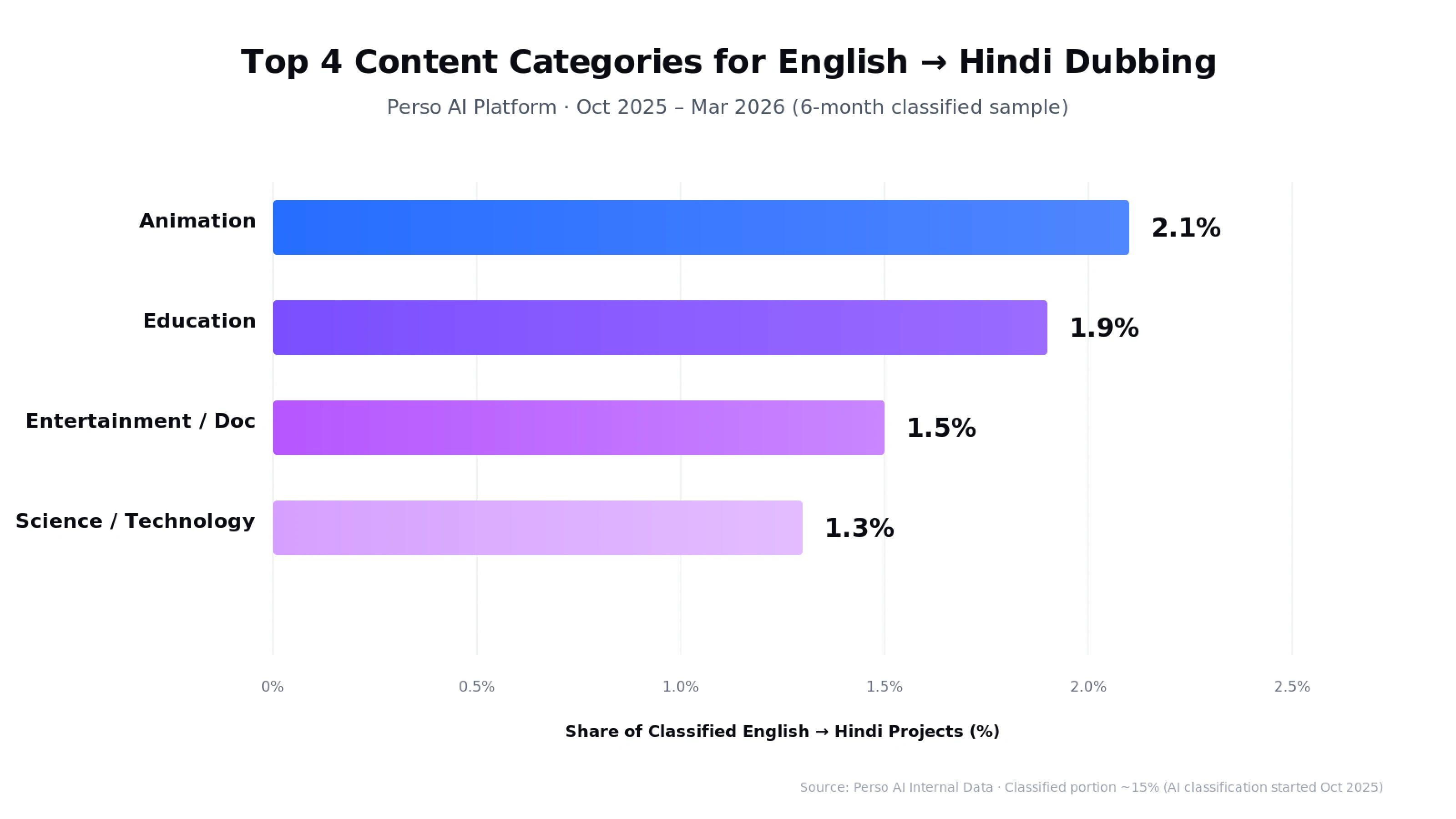
Source: Perso AI Internal Data · Oct 2025 – Mar 2026 (6-month classified sample)
Animation (2.1%) — English cartoons dubbed for Hindi-speaking kids (a growing YouTube category)
Education (1.9%) — Online courses, MOOCs, and tutorials adapted for Hindi learners
Entertainment / Documentary (1.5%) — Vlogs, reality content, and documentary clips
Science / Technology (1.3%) — Explainers and tech tutorials by global tech YouTubers
Note: Category data reflects approximately 15% of English-to-Hindi projects that received AI category classification (feature active from October 2025).
Format characteristics
English → Hindi projects share a distinct creator-driven signature:
Average video length: 81 seconds — aligned with YouTube Shorts and mobile-first content
Average speakers per project: 1.8 — solo host format dominant
Lip-sync activation: 0.8% — low, consistent with voice-over style rather than on-screen dialogue dubbing
YouTube URL upload: 22% — direct import from existing English YouTube videos
What this means for creators
If you're an English-language creator or educator targeting India, your workflow will likely involve:
Importing existing YouTube videos via URL (not re-uploading MP4)
Solo host or voiceover content (not dialogue-heavy)
60–120 second clips for social media + longer cuts for YouTube
Formality tuning (informal for vlogs, formal for courses)
Perso AI's English → Hindi pipeline is tuned for exactly this creator-first workflow.
How does Perso AI handle English-to-Hindi dubbing?
Perso AI is an AI-powered video dubbing and translation platform supporting 32+ languages. Its English → Hindi pipeline is tuned for the creator economy — solo hosts, YouTubers, and educators producing short-form and long-form content for India's Hindi-speaking audience.
Direct English-to-Hindi translation with syntax restructuring
Generic translators often produce literal word-by-word output that preserves English SVO order, producing awkward Hindi. Perso AI's direct English → Hindi model automatically restructures sentences into natural Hindi SOV order while preserving meaning, idioms, and cultural references.
Voice cloning preserves creator identity
For solo YouTubers and educators, voice continuity across episodes is critical for channel identity. The platform clones the original speaker's vocal characteristics — pitch, timbre, speaking pace — and applies them to the Hindi output, preserving the creator's identity across episodes and channel content.
YouTube URL import — built for creators
The 22% YouTube URL import rate on Perso AI's English → Hindi projects reflects this language pair's creator-driven workflow. Creators simply paste an existing YouTube video URL, and the platform handles download, transcription, translation, and dubbing without manual file upload.
Formality-aware output
Unlike generic translators, Perso AI's Hindi output accounts for register choice — defaulting to tum (familiar) for creator content, with manual editor adjustment for aap (formal) scenarios like corporate training or formal education.
Export flexibility for YouTube + mobile
Output formats include MP4, WebM, MOV for video, plus SRT, VTT, or ASS for subtitle files. This supports direct re-upload to YouTube (with Hindi audio track) or export as separate deliverables for social media distribution.
Frequently Asked Questions
Q. How accurate is AI English-to-Hindi video translation?
Perso AI achieves high translation accuracy for English-to-Hindi dubbing, validated across creator content, educational courses, and business videos. Accuracy is higher for scripted content than unscripted material with heavy slang. English → Hindi is one of the top language pairs on the platform (#2 by project volume), giving the model extensive training signal.
Q. How long does it take to dub an English video into Hindi?
AI dubbing delivers Hindi versions in minutes rather than the days required by manual studio dubbing. The average English-to-Hindi project on Perso AI is only 81 seconds long (short-form creator content), and the entire pipeline — transcription, translation, and Hindi voice synthesis — runs end-to-end on the platform without manual handoffs.
Q. Can I translate my existing YouTube video to Hindi directly?
Yes. Paste any YouTube URL and Perso AI handles download, transcription, and Hindi dubbing automatically. 22% of English-to-Hindi projects on the platform use this YouTube URL import method — a meaningful share that reflects how YouTubers work when localizing existing English content for Hindi audiences.
Q. Does Perso AI handle Hindi formality levels (tu/tum/aap) correctly?
Yes. The default Hindi output uses tum (familiar register) for creator content, which matches most YouTube vlog and tutorial contexts. For formal contexts (corporate training, academic courses), editors can adjust to aap (formal register) line-by-line in the built-in script editor.
Q. Does Perso AI preserve my voice when dubbing English to Hindi?
Yes. Voice cloning preserves the original speaker's tone, pitch, and emotional range when converting English audio to Hindi. This is critical for solo creators maintaining channel identity across episodes — both single-speaker vlogs and multi-speaker podcasts are supported (average 1.8 speakers per project).
Q. What content types work best for English-to-Hindi dubbing?
Tutorial videos, educational content, product explainers, vlogs, and animated kids content perform strongly. Scripted content generally translates more accurately than heavily improvised or slang-heavy material. According to industry data from AIR Media-Tech, MrBeast added 47M+ Indian subscribers through multi-language dubbing including Hindi — a reference case for how creator content in English can scale when localized for Indian audiences.
Ready to translate your English video to Hindi?
Start your first English → Hindi dubbing project in minutes. Free trial — no credit card required.
Start dubbing your English video now →
Data source: Perso AI Internal Platform Data, April 2025 – March 2026. Market figures sourced from AIR Media-Tech (linked), YouTube India / BuzzInContent, and industry estimates as cited inline. This post is part of Perso AI's Language Pair Guide series. For broader AI dubbing trends, see our Q1 2026 AI Dubbing Language Trends Report.
💡 Translate any English video to Hindi in minutes with Perso AI. Free trial — no credit card required.
Answer-First Opening
India's 190 million+ Hindi-speaking YouTube users represent one of the largest untapped audiences for English-language creators today. Perso AI translates English videos to Hindi with AI dubbing in three steps, preserving the original speaker's voice while adapting English SVO syntax into Hindi's SOV structure and three-tier formality system.
English → Hindi is one of the top language pairs on the platform (#2 by project volume), driven by global YouTubers, educators, and marketers reaching India's massive creator economy. AI dubbing delivers Hindi versions in minutes rather than days — enabling creators to ship localized content same-day.
The platform is optimized for solo-creator content — projects average just 1.8 speakers per video and 81 seconds per clip. 22% of English-to-Hindi uploads come through YouTube URL imports, reflecting the creator-first workflow of this corridor.
Source: Perso AI Internal Platform Data, April 2025 – March 2026
How do I translate an English video to Hindi with AI?
Perso AI translates English videos into Hindi in three steps:
Upload your English video (MP4, MOV, AVI, MKV up to 5 GB) or paste a YouTube URL — ~30 seconds
Select Hindi as the target language and choose optional features (voice cloning, lip-sync, multi-speaker) — ~15 seconds
Review & Export the dubbed video in MP4, WebM, or MOV (plus SRT/VTT subtitles) — 3–5 minutes
The entire process completes in minutes and preserves the original speaker's voice.
Step 1 — Upload notes
For English → Hindi, YouTube URL imports account for 22% of all uploads. This reflects the creator economy's workflow: creators who already publish English videos on YouTube simply paste the URL to generate a Hindi version. MP4 and MOV uploads cover the remaining 78%. Max file size is 5 GB, with audio-only formats (MP3, WAV, M4A) also supported for podcast-to-video use cases.
Step 2 — Optional features at language selection
Voice cloning — preserves the original speaker's tone in Hindi, critical for solo creators maintaining channel identity
Multi-speaker detection — automatic (though English → Hindi projects average just 1.8 speakers, typical of single-host content)
Lip-sync — used in 0.8% of projects; recommended for long-form content over 5 minutes
Step 3 — Review & export notes
Edit the Hindi script line-by-line in the built-in editor — particularly useful for adjusting formality level (informal tum vs formal aap), which varies by audience. No re-rendering required for script tweaks.
Before / After: Traditional English-to-Hindi studio dubbing takes 3–5 days and requires voice casting, studio booking, and post-production sync work. AI dubbing delivers the same output in minutes — enabling creators to ship Hindi versions same-day.
🎬 Ready to try it? Upload your first English video and get the Hindi dub in minutes.
The English-to-Hindi dubbing wave among Indian creators
English → Hindi dubbing has become a defining growth strategy for global creators targeting India in 2025. According to AIR Media-Tech, MrBeast added over 47 million Indian subscribers in one year by consistently dubbing his videos in seven Indian languages — including Hindi — a substantial regional subscriber gain that has become a reference case for multi-language YouTube strategy.
Source: AIR Media-Tech (2025), YouTube India / BuzzInContent (2025), Omdia/industry estimates
Why India's Hindi audience is one of the most important creator markets
The numbers behind this shift are significant:
Metric | Value | Source |
|---|---|---|
YouTube users in India | 476 million+ | YouTube India / industry estimates, 2025 |
Hindi-speaking YouTube audience | 190 million+ | YouTube India language data, 2025 |
Indian Gen Z consuming dubbed content | 77% | YouTube India / BuzzInContent, 2025 |
MrBeast India subscriber growth | +47M in 12 months | AIR Media-Tech, 2025 |
Ashish Chanchlani, an Indian creator known for English-Hindi content, returned to YouTube in late 2025 with Ekaki, a horror-comedy series released in five Indian languages (Hindi, Tamil, Telugu, Kannada, Malayalam). Several Hindi-dubbed kids channels report monthly view counts in the tens of millions on their Hindi audio tracks, illustrating the scale of demand for English-origin content localized into Hindi.
The 2025 window is closing
Industry analysis from AIR Media-Tech notes that "2025 is the year when translation and dubbing still give you a competitive edge on YouTube. By 2026, the wave of creators rushing into dubbing will turn this into a crowded race." For English-language creators, Hindi dubbing is no longer a nice-to-have — it's a growth requirement.
Perso AI's data matches the creator-first pattern
English → Hindi projects on Perso AI show the signature of creator-driven content:
1.8 average speakers per project — typical of single-host creator videos (vlogs, tutorials, explainers)
22% YouTube URL uploads — creators localizing existing YouTube content directly
81 seconds average video length — short-form, snackable content optimized for mobile viewing
What makes English-to-Hindi translation technically unique?
English → Hindi dubbing presents different technical challenges from Asian language pairs. Unlike Chinese → Hindi (tonal to non-tonal conversion), English and Hindi share a non-tonal structure but differ in syntax, gender, and formality systems.
English vs Hindi — Linguistic Comparison
Feature | English | Hindi |
|---|---|---|
Word order | SVO (Subject-Verb-Object) — "She watches videos" | SOV (Subject-Object-Verb) — "She videos watches" (वह वीडियो देखती है) |
Script | Latin alphabet | Devanagari (consonant-vowel syllabic) |
Gender | No grammatical gender (for most nouns) | Every noun has masculine/feminine gender affecting verbs and adjectives |
Formality levels | Generally 1 register | 3 registers: informal (tu), familiar (tum), formal (aap) — each requires different verb conjugations |
Script length | Baseline | Often 10–20% longer in Devanagari script and spoken audio |
Sources: Indo-Aryan linguistics research; Hindi grammar references (Wikipedia).
The four-step conversion problem
Converting English audio into Hindi requires AI to perform four distinct operations:
Transcribe English accurately — including idioms, contractions, and informal speech
Restructure syntax from SVO to SOV — every sentence needs grammatical reordering
Apply gender agreement — every Hindi verb and adjective must match the subject's gender
Choose appropriate formality level — creator content typically uses tum (familiar), while educational content trends toward aap (formal)
Why formality matters for creator content
The formality choice directly shapes audience connection. A YouTuber using aap (formal "you") in casual vlog content feels distant; an educator using tu (intimate "you") in a professional course feels unprofessional. Perso AI's default output targets tum (familiar) for creator content and offers editor-level adjustment for brand-specific tone.
Script length mismatch
Hindi in Devanagari often runs 10–20% longer than the same meaning in English, both in written form and spoken duration. Timing adjustments are handled automatically during the dubbing pass to keep Hindi output aligned with the original English video duration.
Content categories shaping English-to-Hindi dubbing
Perso AI's 12-month data reveals distinct content patterns for English → Hindi projects that mirror the global creator economy targeting India.
Content category breakdown
Source: Perso AI Internal Data · Oct 2025 – Mar 2026 (6-month classified sample)
Animation (2.1%) — English cartoons dubbed for Hindi-speaking kids (a growing YouTube category)
Education (1.9%) — Online courses, MOOCs, and tutorials adapted for Hindi learners
Entertainment / Documentary (1.5%) — Vlogs, reality content, and documentary clips
Science / Technology (1.3%) — Explainers and tech tutorials by global tech YouTubers
Note: Category data reflects approximately 15% of English-to-Hindi projects that received AI category classification (feature active from October 2025).
Format characteristics
English → Hindi projects share a distinct creator-driven signature:
Average video length: 81 seconds — aligned with YouTube Shorts and mobile-first content
Average speakers per project: 1.8 — solo host format dominant
Lip-sync activation: 0.8% — low, consistent with voice-over style rather than on-screen dialogue dubbing
YouTube URL upload: 22% — direct import from existing English YouTube videos
What this means for creators
If you're an English-language creator or educator targeting India, your workflow will likely involve:
Importing existing YouTube videos via URL (not re-uploading MP4)
Solo host or voiceover content (not dialogue-heavy)
60–120 second clips for social media + longer cuts for YouTube
Formality tuning (informal for vlogs, formal for courses)
Perso AI's English → Hindi pipeline is tuned for exactly this creator-first workflow.
How does Perso AI handle English-to-Hindi dubbing?
Perso AI is an AI-powered video dubbing and translation platform supporting 32+ languages. Its English → Hindi pipeline is tuned for the creator economy — solo hosts, YouTubers, and educators producing short-form and long-form content for India's Hindi-speaking audience.
Direct English-to-Hindi translation with syntax restructuring
Generic translators often produce literal word-by-word output that preserves English SVO order, producing awkward Hindi. Perso AI's direct English → Hindi model automatically restructures sentences into natural Hindi SOV order while preserving meaning, idioms, and cultural references.
Voice cloning preserves creator identity
For solo YouTubers and educators, voice continuity across episodes is critical for channel identity. The platform clones the original speaker's vocal characteristics — pitch, timbre, speaking pace — and applies them to the Hindi output, preserving the creator's identity across episodes and channel content.
YouTube URL import — built for creators
The 22% YouTube URL import rate on Perso AI's English → Hindi projects reflects this language pair's creator-driven workflow. Creators simply paste an existing YouTube video URL, and the platform handles download, transcription, translation, and dubbing without manual file upload.
Formality-aware output
Unlike generic translators, Perso AI's Hindi output accounts for register choice — defaulting to tum (familiar) for creator content, with manual editor adjustment for aap (formal) scenarios like corporate training or formal education.
Export flexibility for YouTube + mobile
Output formats include MP4, WebM, MOV for video, plus SRT, VTT, or ASS for subtitle files. This supports direct re-upload to YouTube (with Hindi audio track) or export as separate deliverables for social media distribution.
Frequently Asked Questions
Q. How accurate is AI English-to-Hindi video translation?
Perso AI achieves high translation accuracy for English-to-Hindi dubbing, validated across creator content, educational courses, and business videos. Accuracy is higher for scripted content than unscripted material with heavy slang. English → Hindi is one of the top language pairs on the platform (#2 by project volume), giving the model extensive training signal.
Q. How long does it take to dub an English video into Hindi?
AI dubbing delivers Hindi versions in minutes rather than the days required by manual studio dubbing. The average English-to-Hindi project on Perso AI is only 81 seconds long (short-form creator content), and the entire pipeline — transcription, translation, and Hindi voice synthesis — runs end-to-end on the platform without manual handoffs.
Q. Can I translate my existing YouTube video to Hindi directly?
Yes. Paste any YouTube URL and Perso AI handles download, transcription, and Hindi dubbing automatically. 22% of English-to-Hindi projects on the platform use this YouTube URL import method — a meaningful share that reflects how YouTubers work when localizing existing English content for Hindi audiences.
Q. Does Perso AI handle Hindi formality levels (tu/tum/aap) correctly?
Yes. The default Hindi output uses tum (familiar register) for creator content, which matches most YouTube vlog and tutorial contexts. For formal contexts (corporate training, academic courses), editors can adjust to aap (formal register) line-by-line in the built-in script editor.
Q. Does Perso AI preserve my voice when dubbing English to Hindi?
Yes. Voice cloning preserves the original speaker's tone, pitch, and emotional range when converting English audio to Hindi. This is critical for solo creators maintaining channel identity across episodes — both single-speaker vlogs and multi-speaker podcasts are supported (average 1.8 speakers per project).
Q. What content types work best for English-to-Hindi dubbing?
Tutorial videos, educational content, product explainers, vlogs, and animated kids content perform strongly. Scripted content generally translates more accurately than heavily improvised or slang-heavy material. According to industry data from AIR Media-Tech, MrBeast added 47M+ Indian subscribers through multi-language dubbing including Hindi — a reference case for how creator content in English can scale when localized for Indian audiences.
Ready to translate your English video to Hindi?
Start your first English → Hindi dubbing project in minutes. Free trial — no credit card required.
Start dubbing your English video now →
Data source: Perso AI Internal Platform Data, April 2025 – March 2026. Market figures sourced from AIR Media-Tech (linked), YouTube India / BuzzInContent, and industry estimates as cited inline. This post is part of Perso AI's Language Pair Guide series. For broader AI dubbing trends, see our Q1 2026 AI Dubbing Language Trends Report.
Continue Reading
Browse All