AI Dubbing for TikTok, Reels & Shorts: 2026 Features
Last Updated




Jump to section
Jump to section

Share
Share
Share
AI Video Translator, Localization, and Dubbing Tool
Try it out for Free
You post a Short that performs well in the U.S. The hook lands. The pacing is tight. The captions match every beat.
Then you try a Spanish version. The meaning is fine, but the timing slips. A punchy line becomes longer. The voice feels rushed. On a face-to-camera clip, the mouth movement looks slightly off. The result does not feel native anymore, and in short form, viewers notice fast.
This is where AI Dubbing needs a creator-first checklist. Shorts, Reels, and TikTok are punishing formats. You need crisp timing, rapid repairs, and a methodology that enables Dubbing, Automatic Dubbing, and a solid video Translator setup without turning every movie into a rewriting job.
This guide is for creators, social teams, and agencies localizing short form content for multiple markets.
Why Short Form Dubbing Fails More Often Than Long Form?
Short videos compress everything. You have less time to explain, less time to recover from awkward phrasing, and fewer seconds before someone scrolls.
Three things make short form harder:
Hook sensitivity: the first line must fit the exact beat of the visuals
Speech density: creators speak faster and cut tighter than long form content
Visual scrutiny: face-to-camera clips and reaction content make sync issues obvious
That is why the best workflows treat transcription, editing, and timing as part of AI Dubbing quality, not extra steps.
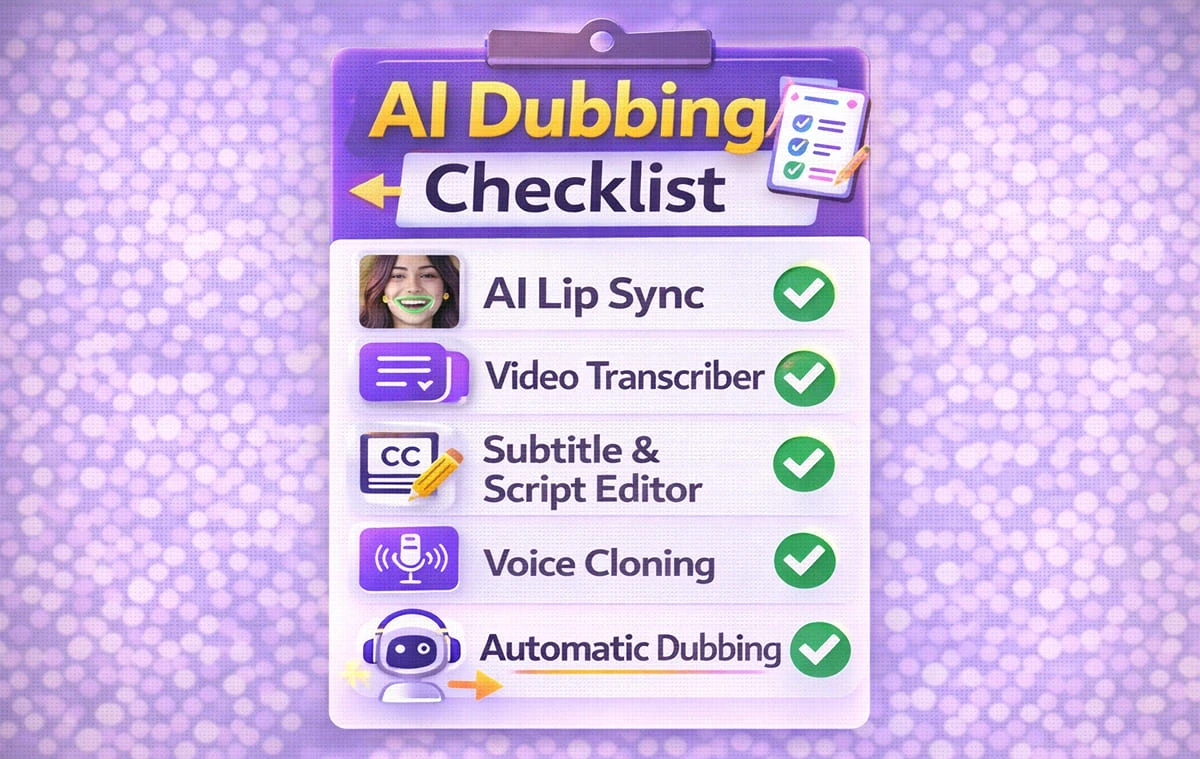
AI Dubbing Checklist for Shorts Reels and TikTok
Use this checklist when evaluating tools or when your output feels “almost right” but still not watchable.
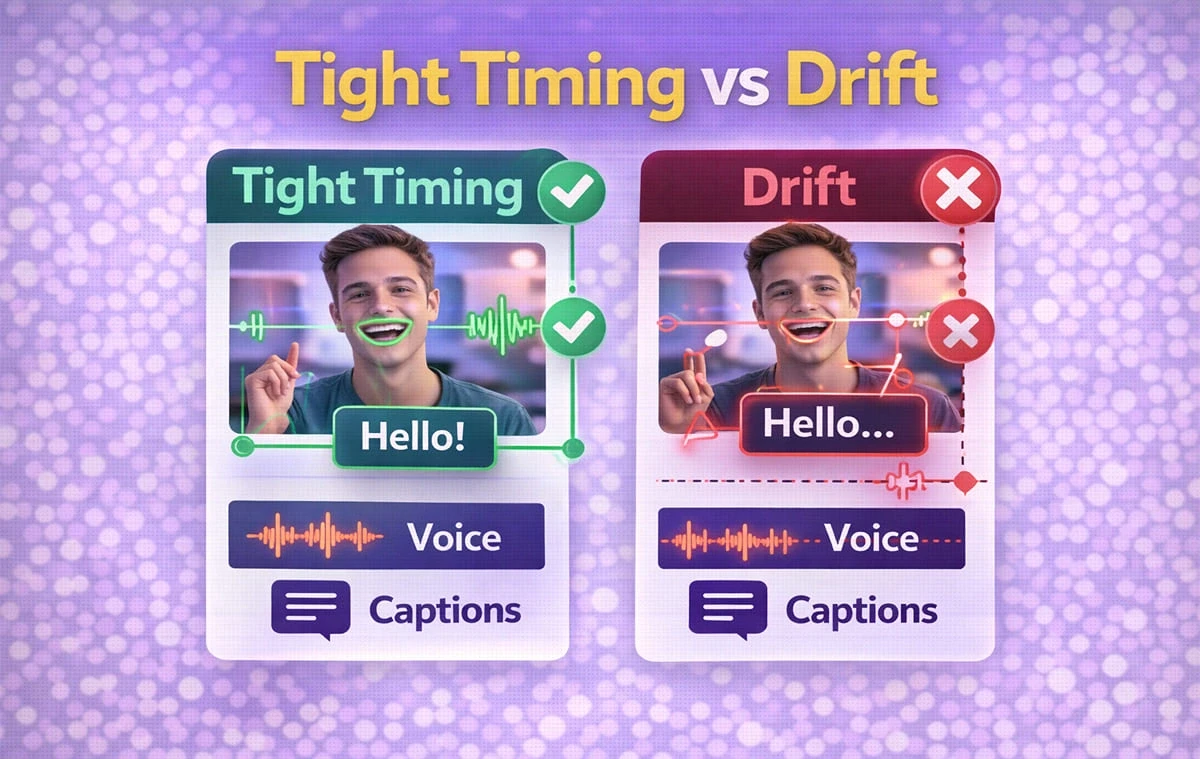
Timing Control That Keeps the Hook Intact
Short form needs timing that feels intentional. Look for the ability to keep sentences aligned with scene cuts and on-screen text.
If timing drifts, the viewer hears a line that belongs to the previous shot. Even one second can ruin the punch.
Script Edits That Do Not Break the Whole Project
Short form creators iterate constantly. You need fast text changes without restarting everything.
A Subtitle & Script Editor matters when you want to shorten a line, remove filler words, or adjust phrasing so it sounds natural in the target language.
Clean Segmentation for Captions and Voice Pacing
Short form often relies on captions as part of the style. Segmentation needs to match the way creators speak.
If captions appear in long blocks, readability drops. If they appear in tiny fragments, the voice pacing can feel choppy.
Multi-Speaker Handling for Interviews and Collabs
Collabs, duets, podcast clips, and street interviews are common in Shorts and TikTok. The workflow must keep speaker turns clear.
This is where Video Transcriber quality shows up immediately. Bad speaker splits create wrong voice assignment, awkward overlaps, or confusing timing.
Voice Realism That Fits the Content Style
Short form is personal. The voice needs to match the vibe. A corporate sounding voice can feel out of place on creator content.
This is why Voice Cloning is valuable for some creators, especially when the creator’s delivery is part of the brand.
Video Translator Workflow Built for Rapid Short Form Production
Short form localization is not only translation. It is a repeatable production loop.
A creator-friendly Video Translator workflow usually looks like this:
Generate transcript and timing
Translate with creator style phrasing
Edit the script where it feels unnatural
Generate dubbed audio
Check sync on face-to-camera segments
Export for vertical platforms
For many teams, having the steps in one place reduces friction. That is why some creators start from Perso Dubbing for video translation and dubbing when they want one workflow across Shorts, Reels, and TikTok.
Automatic Dubbing When Speed Matters
Automatic Dubbing can be a strong fit for short form, but only when the content type allows it.
Automatic Dubbing tends to work well for:
Screen recordings with quick narration
Short tutorials where visuals carry meaning
Clips without face-to-camera speaking
Recaps where exact lip sync is not critical
You usually need more control for:
Talking head hooks
Comedy and punchline timing
Emotional storytelling
Interview clips where turn-taking matters
A practical rule is simple. If the viewer is watching a face and expecting natural delivery, do not treat it as a one-click job. Build a review step for timing and phrasing.
AI Lip Sync Checks That Matter for Vertical Video
Short form often uses close framing. The mouth is visible, and the scroll speed is fast.
When evaluating AI Lip Sync, focus on:
Close-up stability: no jitter around the mouth during fast speech
Occlusion handling: captions, hands, microphones, and filters should not break the mouth area
Cut resilience: quick cuts should not cause visible drift
For teams that want lip sync to feel consistent in vertical clips, Perso Dubbing dubbing workflow is a useful reference point for how dubbing, editing, and sync sit in the same flow.
Feature Checklist Table for Short Form AI Dubbing
Short form requirement | Feature to look for | What “good” looks like in practice |
Hook timing stays tight | Timing control and segmentation | First line lands with the first cut and on-screen text |
Captions match pacing | Video Transcriber quality | Lines break naturally, not in long blocks or tiny fragments |
Fast edits for awkward lines | Subtitle & Script Editor | You can shorten phrasing without redoing the whole project |
Creator identity stays consistent | Voice Cloning option | Voice style matches the original tone across languages |
Face-to-camera feels believable | AI Lip Sync | Close-ups look natural, even with quick speech |
This table is also a useful internal checklist for your team. If one row fails, that is usually where the video starts to feel “dubbed” instead of localized.
Where Video Transcriber Quality Changes the Outcome
Short form teams often underestimate transcription because the video is short. In practice, short videos ads create higher expectations for timing and segmentation.
A strong Video Transcriber helps by:
keeping timestamps stable
splitting lines at natural pauses
handling speaker turns cleanly
producing captions that are readable on mobile
If your output feels rushed, the problem is often transcript segmentation. Fixing that early makes Dubbing and Video Translation smoother.
For a deeper read focused on how lip sync and translation workflows connect, AI lip sync in video translation workflows fits naturally alongside creator localization decisions.
Practical Workflow for Shorts Reels and TikTok Teams
Here is a simple process that scales across content types:
Start with your best performing clips: Pick videos that already work in English. Localization amplifies what is already proven.
Localize the hook first: Short form lives or dies in the first seconds. Translate and refine the hook before you polish the rest.
Use script edits to protect pacing: If a line becomes too long, shorten it. Preserve the beat, not the literal wording.
Check face-to-camera segments separately: Do a fast review of clips where a face is centered. That is where lip sync issues show up first.
Create a repeatable export routine: Keep consistent subtitle styling and caption timing across languages. Consistency makes the library feel professional.
Frequently Asked Questions
Do I need AI Dubbing for every Short?
Not always. Some creators use subtitles only for certain markets. AI Dubbing becomes more valuable when you want a native listening experience.
When is Automatic Dubbing enough for short form?
It is usually enough when the video is screen-led or when the face is not the focus. Talking head hooks often need script refinement and sync checks.
Does Voice Cloning matter for Shorts and TikTok?
It matters when the creator’s voice is part of the identity. If the voice is not central, a well-matched voice can still work.
What is the fastest fix for awkward translated lines?
Shorten the line, adjust segmentation, and re-check timing. Most problems come from phrasing that is correct but not speakable at speed.
Conclusion
Short form localization is a timing game. AI Dubbing works best when transcription, script edits, and sync checks support the pace that Shorts, Reels, and TikTok demand. Use the checklist to identify where quality breaks, and build a repeatable workflow so every new language feels like content made for that audience.
You post a Short that performs well in the U.S. The hook lands. The pacing is tight. The captions match every beat.
Then you try a Spanish version. The meaning is fine, but the timing slips. A punchy line becomes longer. The voice feels rushed. On a face-to-camera clip, the mouth movement looks slightly off. The result does not feel native anymore, and in short form, viewers notice fast.
This is where AI Dubbing needs a creator-first checklist. Shorts, Reels, and TikTok are punishing formats. You need crisp timing, rapid repairs, and a methodology that enables Dubbing, Automatic Dubbing, and a solid video Translator setup without turning every movie into a rewriting job.
This guide is for creators, social teams, and agencies localizing short form content for multiple markets.
Why Short Form Dubbing Fails More Often Than Long Form?
Short videos compress everything. You have less time to explain, less time to recover from awkward phrasing, and fewer seconds before someone scrolls.
Three things make short form harder:
Hook sensitivity: the first line must fit the exact beat of the visuals
Speech density: creators speak faster and cut tighter than long form content
Visual scrutiny: face-to-camera clips and reaction content make sync issues obvious
That is why the best workflows treat transcription, editing, and timing as part of AI Dubbing quality, not extra steps.
AI Dubbing Checklist for Shorts Reels and TikTok
Use this checklist when evaluating tools or when your output feels “almost right” but still not watchable.
Timing Control That Keeps the Hook Intact
Short form needs timing that feels intentional. Look for the ability to keep sentences aligned with scene cuts and on-screen text.
If timing drifts, the viewer hears a line that belongs to the previous shot. Even one second can ruin the punch.
Script Edits That Do Not Break the Whole Project
Short form creators iterate constantly. You need fast text changes without restarting everything.
A Subtitle & Script Editor matters when you want to shorten a line, remove filler words, or adjust phrasing so it sounds natural in the target language.
Clean Segmentation for Captions and Voice Pacing
Short form often relies on captions as part of the style. Segmentation needs to match the way creators speak.
If captions appear in long blocks, readability drops. If they appear in tiny fragments, the voice pacing can feel choppy.
Multi-Speaker Handling for Interviews and Collabs
Collabs, duets, podcast clips, and street interviews are common in Shorts and TikTok. The workflow must keep speaker turns clear.
This is where Video Transcriber quality shows up immediately. Bad speaker splits create wrong voice assignment, awkward overlaps, or confusing timing.
Voice Realism That Fits the Content Style
Short form is personal. The voice needs to match the vibe. A corporate sounding voice can feel out of place on creator content.
This is why Voice Cloning is valuable for some creators, especially when the creator’s delivery is part of the brand.
Video Translator Workflow Built for Rapid Short Form Production
Short form localization is not only translation. It is a repeatable production loop.
A creator-friendly Video Translator workflow usually looks like this:
Generate transcript and timing
Translate with creator style phrasing
Edit the script where it feels unnatural
Generate dubbed audio
Check sync on face-to-camera segments
Export for vertical platforms
For many teams, having the steps in one place reduces friction. That is why some creators start from Perso Dubbing for video translation and dubbing when they want one workflow across Shorts, Reels, and TikTok.
Automatic Dubbing When Speed Matters
Automatic Dubbing can be a strong fit for short form, but only when the content type allows it.
Automatic Dubbing tends to work well for:
Screen recordings with quick narration
Short tutorials where visuals carry meaning
Clips without face-to-camera speaking
Recaps where exact lip sync is not critical
You usually need more control for:
Talking head hooks
Comedy and punchline timing
Emotional storytelling
Interview clips where turn-taking matters
A practical rule is simple. If the viewer is watching a face and expecting natural delivery, do not treat it as a one-click job. Build a review step for timing and phrasing.
AI Lip Sync Checks That Matter for Vertical Video
Short form often uses close framing. The mouth is visible, and the scroll speed is fast.
When evaluating AI Lip Sync, focus on:
Close-up stability: no jitter around the mouth during fast speech
Occlusion handling: captions, hands, microphones, and filters should not break the mouth area
Cut resilience: quick cuts should not cause visible drift
For teams that want lip sync to feel consistent in vertical clips, Perso Dubbing dubbing workflow is a useful reference point for how dubbing, editing, and sync sit in the same flow.
Feature Checklist Table for Short Form AI Dubbing
Short form requirement | Feature to look for | What “good” looks like in practice |
Hook timing stays tight | Timing control and segmentation | First line lands with the first cut and on-screen text |
Captions match pacing | Video Transcriber quality | Lines break naturally, not in long blocks or tiny fragments |
Fast edits for awkward lines | Subtitle & Script Editor | You can shorten phrasing without redoing the whole project |
Creator identity stays consistent | Voice Cloning option | Voice style matches the original tone across languages |
Face-to-camera feels believable | AI Lip Sync | Close-ups look natural, even with quick speech |
This table is also a useful internal checklist for your team. If one row fails, that is usually where the video starts to feel “dubbed” instead of localized.
Where Video Transcriber Quality Changes the Outcome
Short form teams often underestimate transcription because the video is short. In practice, short videos ads create higher expectations for timing and segmentation.
A strong Video Transcriber helps by:
keeping timestamps stable
splitting lines at natural pauses
handling speaker turns cleanly
producing captions that are readable on mobile
If your output feels rushed, the problem is often transcript segmentation. Fixing that early makes Dubbing and Video Translation smoother.
For a deeper read focused on how lip sync and translation workflows connect, AI lip sync in video translation workflows fits naturally alongside creator localization decisions.
Practical Workflow for Shorts Reels and TikTok Teams
Here is a simple process that scales across content types:
Start with your best performing clips: Pick videos that already work in English. Localization amplifies what is already proven.
Localize the hook first: Short form lives or dies in the first seconds. Translate and refine the hook before you polish the rest.
Use script edits to protect pacing: If a line becomes too long, shorten it. Preserve the beat, not the literal wording.
Check face-to-camera segments separately: Do a fast review of clips where a face is centered. That is where lip sync issues show up first.
Create a repeatable export routine: Keep consistent subtitle styling and caption timing across languages. Consistency makes the library feel professional.
Frequently Asked Questions
Do I need AI Dubbing for every Short?
Not always. Some creators use subtitles only for certain markets. AI Dubbing becomes more valuable when you want a native listening experience.
When is Automatic Dubbing enough for short form?
It is usually enough when the video is screen-led or when the face is not the focus. Talking head hooks often need script refinement and sync checks.
Does Voice Cloning matter for Shorts and TikTok?
It matters when the creator’s voice is part of the identity. If the voice is not central, a well-matched voice can still work.
What is the fastest fix for awkward translated lines?
Shorten the line, adjust segmentation, and re-check timing. Most problems come from phrasing that is correct but not speakable at speed.
Conclusion
Short form localization is a timing game. AI Dubbing works best when transcription, script edits, and sync checks support the pace that Shorts, Reels, and TikTok demand. Use the checklist to identify where quality breaks, and build a repeatable workflow so every new language feels like content made for that audience.
You post a Short that performs well in the U.S. The hook lands. The pacing is tight. The captions match every beat.
Then you try a Spanish version. The meaning is fine, but the timing slips. A punchy line becomes longer. The voice feels rushed. On a face-to-camera clip, the mouth movement looks slightly off. The result does not feel native anymore, and in short form, viewers notice fast.
This is where AI Dubbing needs a creator-first checklist. Shorts, Reels, and TikTok are punishing formats. You need crisp timing, rapid repairs, and a methodology that enables Dubbing, Automatic Dubbing, and a solid video Translator setup without turning every movie into a rewriting job.
This guide is for creators, social teams, and agencies localizing short form content for multiple markets.
Why Short Form Dubbing Fails More Often Than Long Form?
Short videos compress everything. You have less time to explain, less time to recover from awkward phrasing, and fewer seconds before someone scrolls.
Three things make short form harder:
Hook sensitivity: the first line must fit the exact beat of the visuals
Speech density: creators speak faster and cut tighter than long form content
Visual scrutiny: face-to-camera clips and reaction content make sync issues obvious
That is why the best workflows treat transcription, editing, and timing as part of AI Dubbing quality, not extra steps.
AI Dubbing Checklist for Shorts Reels and TikTok
Use this checklist when evaluating tools or when your output feels “almost right” but still not watchable.
Timing Control That Keeps the Hook Intact
Short form needs timing that feels intentional. Look for the ability to keep sentences aligned with scene cuts and on-screen text.
If timing drifts, the viewer hears a line that belongs to the previous shot. Even one second can ruin the punch.
Script Edits That Do Not Break the Whole Project
Short form creators iterate constantly. You need fast text changes without restarting everything.
A Subtitle & Script Editor matters when you want to shorten a line, remove filler words, or adjust phrasing so it sounds natural in the target language.
Clean Segmentation for Captions and Voice Pacing
Short form often relies on captions as part of the style. Segmentation needs to match the way creators speak.
If captions appear in long blocks, readability drops. If they appear in tiny fragments, the voice pacing can feel choppy.
Multi-Speaker Handling for Interviews and Collabs
Collabs, duets, podcast clips, and street interviews are common in Shorts and TikTok. The workflow must keep speaker turns clear.
This is where Video Transcriber quality shows up immediately. Bad speaker splits create wrong voice assignment, awkward overlaps, or confusing timing.
Voice Realism That Fits the Content Style
Short form is personal. The voice needs to match the vibe. A corporate sounding voice can feel out of place on creator content.
This is why Voice Cloning is valuable for some creators, especially when the creator’s delivery is part of the brand.
Video Translator Workflow Built for Rapid Short Form Production
Short form localization is not only translation. It is a repeatable production loop.
A creator-friendly Video Translator workflow usually looks like this:
Generate transcript and timing
Translate with creator style phrasing
Edit the script where it feels unnatural
Generate dubbed audio
Check sync on face-to-camera segments
Export for vertical platforms
For many teams, having the steps in one place reduces friction. That is why some creators start from Perso Dubbing for video translation and dubbing when they want one workflow across Shorts, Reels, and TikTok.
Automatic Dubbing When Speed Matters
Automatic Dubbing can be a strong fit for short form, but only when the content type allows it.
Automatic Dubbing tends to work well for:
Screen recordings with quick narration
Short tutorials where visuals carry meaning
Clips without face-to-camera speaking
Recaps where exact lip sync is not critical
You usually need more control for:
Talking head hooks
Comedy and punchline timing
Emotional storytelling
Interview clips where turn-taking matters
A practical rule is simple. If the viewer is watching a face and expecting natural delivery, do not treat it as a one-click job. Build a review step for timing and phrasing.
AI Lip Sync Checks That Matter for Vertical Video
Short form often uses close framing. The mouth is visible, and the scroll speed is fast.
When evaluating AI Lip Sync, focus on:
Close-up stability: no jitter around the mouth during fast speech
Occlusion handling: captions, hands, microphones, and filters should not break the mouth area
Cut resilience: quick cuts should not cause visible drift
For teams that want lip sync to feel consistent in vertical clips, Perso Dubbing dubbing workflow is a useful reference point for how dubbing, editing, and sync sit in the same flow.
Feature Checklist Table for Short Form AI Dubbing
Short form requirement | Feature to look for | What “good” looks like in practice |
Hook timing stays tight | Timing control and segmentation | First line lands with the first cut and on-screen text |
Captions match pacing | Video Transcriber quality | Lines break naturally, not in long blocks or tiny fragments |
Fast edits for awkward lines | Subtitle & Script Editor | You can shorten phrasing without redoing the whole project |
Creator identity stays consistent | Voice Cloning option | Voice style matches the original tone across languages |
Face-to-camera feels believable | AI Lip Sync | Close-ups look natural, even with quick speech |
This table is also a useful internal checklist for your team. If one row fails, that is usually where the video starts to feel “dubbed” instead of localized.
Where Video Transcriber Quality Changes the Outcome
Short form teams often underestimate transcription because the video is short. In practice, short videos ads create higher expectations for timing and segmentation.
A strong Video Transcriber helps by:
keeping timestamps stable
splitting lines at natural pauses
handling speaker turns cleanly
producing captions that are readable on mobile
If your output feels rushed, the problem is often transcript segmentation. Fixing that early makes Dubbing and Video Translation smoother.
For a deeper read focused on how lip sync and translation workflows connect, AI lip sync in video translation workflows fits naturally alongside creator localization decisions.
Practical Workflow for Shorts Reels and TikTok Teams
Here is a simple process that scales across content types:
Start with your best performing clips: Pick videos that already work in English. Localization amplifies what is already proven.
Localize the hook first: Short form lives or dies in the first seconds. Translate and refine the hook before you polish the rest.
Use script edits to protect pacing: If a line becomes too long, shorten it. Preserve the beat, not the literal wording.
Check face-to-camera segments separately: Do a fast review of clips where a face is centered. That is where lip sync issues show up first.
Create a repeatable export routine: Keep consistent subtitle styling and caption timing across languages. Consistency makes the library feel professional.
Frequently Asked Questions
Do I need AI Dubbing for every Short?
Not always. Some creators use subtitles only for certain markets. AI Dubbing becomes more valuable when you want a native listening experience.
When is Automatic Dubbing enough for short form?
It is usually enough when the video is screen-led or when the face is not the focus. Talking head hooks often need script refinement and sync checks.
Does Voice Cloning matter for Shorts and TikTok?
It matters when the creator’s voice is part of the identity. If the voice is not central, a well-matched voice can still work.
What is the fastest fix for awkward translated lines?
Shorten the line, adjust segmentation, and re-check timing. Most problems come from phrasing that is correct but not speakable at speed.
Conclusion
Short form localization is a timing game. AI Dubbing works best when transcription, script edits, and sync checks support the pace that Shorts, Reels, and TikTok demand. Use the checklist to identify where quality breaks, and build a repeatable workflow so every new language feels like content made for that audience.
Continue Reading
Browse All