AI Dubbing Language Trends 2026: Data from 10K+ Projects




Jump to section
Jump to section

Share
Share
Share
AI Video Translator, Localization, and Dubbing Tool
Try it out for Free
Last updated: 2026-09-29
Public data supplement (v2.0): Zenodo (DOI) · GitHub · Hugging Face
How many platform projects were recorded?
The cumulative platform dataset includes cancelled and deleted projects, internal and demo workspaces, and accounts flagged for multi-account abuse. Each target language creates a separate project. This is one platform’s activity, not a global market estimate.
How many target languages and combinations were observed?
Regional variants are grouped under base languages. Source labels retain AutoDetect and OtherLanguages, so not every combination identifies both languages explicitly.
How many paying creators used multiple languages?
The paid cohort excludes free-plan and unknown-plan projects, flagged abuse accounts, internal and demo workspaces, and cancelled projects. It uses project-level plan assignment; creator accounts are not companies, unique people, or necessarily subscribers at the end of the window.
Which target language and industry led paid dubbed minutes?
Q1 2026 project-count sample. Historical sample, not the v2 cumulative platform dataset or the paid cohort.
Key Findings
According to the Stanford AI Index Report 2025, multimodal AI adoption in enterprise content workflows grew 2.4× year-over-year, with voice- and video-generation tools leading the acquisition curve. Perso Dubbing’s Q1 2026 platform data sits inside this broader shift, and offers the first end-to-end look at which languages are actually being dubbed once adoption turns into production use.
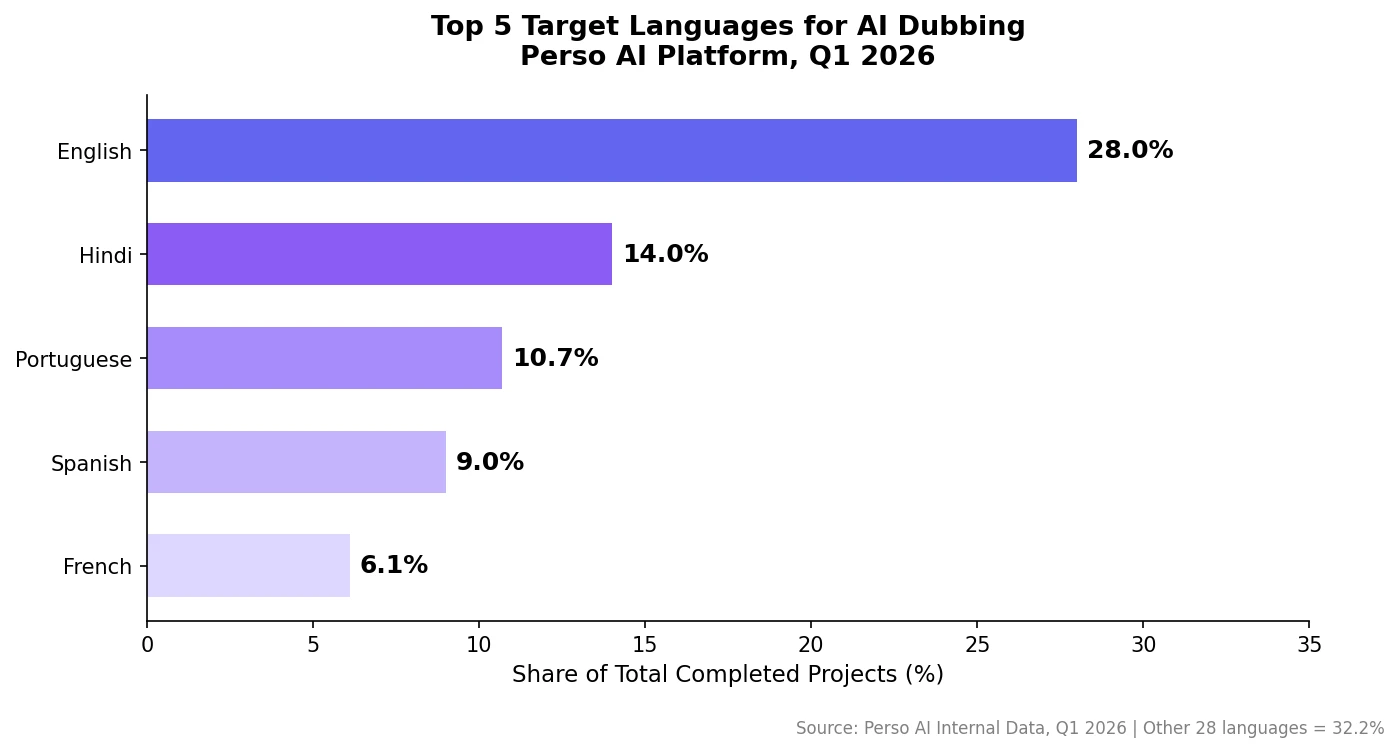
Q1 2026 project-count sample. Perso Dubbing‘s Q1 2026 platform data , one of the largest AI dubbing statistics datasets made publicly available , English is the most selected target language for AI dubbing at 28.0% of all completed projects, followed by Hindi (14.0%) and Portuguese (10.7%). Together, these three languages represent 52.7% of all dubbed content. Across 15 major source languages analyzed, 11 choose English as their primary dubbing target , confirming that non-English-speaking creators worldwide are using AI dubbing to reach global English-speaking audiences.
Q1 2026 project-count sample. Key finding: English is the #1 target language for AI dubbing at 28.0% of all projects. Of 15 major source languages, 11 choose English as their primary dubbing target , Perso Dubbing, Q1 2026.
Q1 2026 project-count sample. This report analyzes tens of thousands of completed AI projects on the Perso Dubbing platform from January through March 2026, spanning 33 source languages, 33 target languages, and 531 unique language pair combinations. The data reveals that English functions as the central hub of global AI dubbing, Indonesian is the fastest-growing target language at +25.2%, and education content leads all content categories at 10.3% of total volume. Notably, the top 10 language pairs account for only 42.9% of total volume , meaning the majority of AI dubbing activity occurs across hundreds of niche language corridors. These findings represent the first platform-level language pair distribution dataset publicly available for AI dubbing , a data gap that existing market research reports on dubbing industry size have not addressed.
Methodology
This report is based on anonymized, aggregated data from the Perso Dubbing platform covering Q1 2026 (January 1 , March 31, 2026). The dataset includes tens of thousands of completed projects across 33 source languages, 33 target languages, and 531 unique language pair combinations. Only projects with a “completed” status were included; incomplete, canceled, or failed projects were excluded from all calculations.
All figures are expressed as percentages of total completed project volume. Growth rates compare January 2026 to March 2026 values. This data represents usage patterns on Perso Dubbing’s platform and may not reflect the entire AI dubbing market. However, as no comparable platform-level language distribution data has been published publicly, these findings offer a unique window into real-world AI dubbing behavior.
For broader market context: the global AI dubbing market was valued at $1.16 billion in 2024 and is projected to grow at a CAGR of 18.3% through 2033 (Business Research Insights, 2024). Meanwhile, English remains the dominant language of online video consumption, with over 700 million English-speaking YouTube users worldwide (Statista, 2025). The language distribution patterns observed in Perso Dubbing’s data align with these macro trends , English as the primary hub, with rapid growth in emerging-market languages.
Q1 2026 project-count sample. Historical sample, not the v2 cumulative platform dataset or the paid cohort.
Why Is English Both the #1 Source and #1 Target for AI Dubbing?
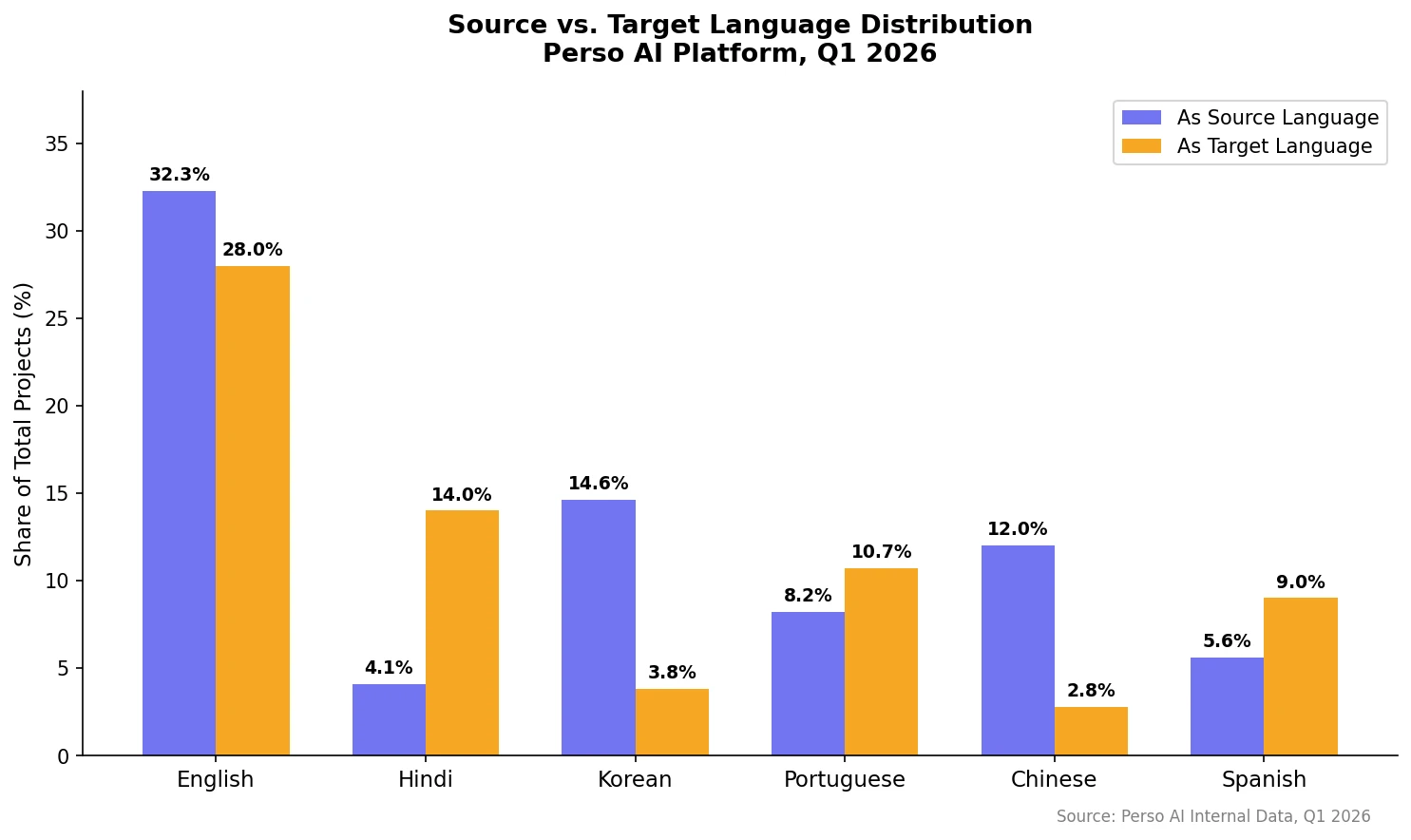
Q1 2026 project-count sample. English plays a dual role in AI dubbing. According to Perso Dubbing’s Q1 2026 data, English is both the #1 source language at 32.3% of all projects and the #1 target language at 28.0%. A total of 26.9% of all projects on the platform flow in the “→ English” direction , making English the single largest destination for AI-dubbed content in this Perso Dubbing Q1 2026 sample.
This pattern aligns with Ethnologue 2025 data on global content creation: while English is the native language of ~380M speakers, it functions as the world’s dominant content language, with an estimated 1.5B people consuming English-language media regularly. Inbound-to-English dubbing reflects the “global → English” creator economy; outbound-from-English reflects brand and media companies reaching non-English markets.
Q1 2026 project-count sample. Key finding: 26.9% of all AI projects on Perso Dubbing flow from non-English sources to English , making English the single largest destination for cross-language dubbing in this Perso Dubbing Q1 2026 sample. , Perso Dubbing, Q1 2026.
Q1 2026 project-count sample. This dual role means English serves as the lingua franca of AI dubbing. Non-English-speaking creators dub their content into English to access global audiences , and the sources are geographically diverse. Of all projects flowing toward English, no single source language dominates: Korean accounts for 27.4% of the → English flow, followed by Portuguese (9.6%), Chinese (9.6%), Russian (9.4%), and Spanish (9.2%).
Q1 2026 project-count sample. Simultaneously, English-language creators dub outward into multiple regional markets. Among all English-source projects, Portuguese is the top outbound target at 18.1%, followed by French (14.5%), Hindi (13.3%), and Spanish (12.9%). These four languages alone absorb 58.8% of all English-outbound dubbing , pointing to Latin America, Francophone Africa and Europe, and South Asia as the primary expansion corridors for English-language content.
Source Language Distribution , Top 5 (Perso Dubbing, Q1 2026)
Q1 2026 project-count sample. Historical sample, not the v2 cumulative platform dataset or the paid cohort.
Rank | Source Language | Share of Projects |
|---|---|---|
1 | English | 32.3% |
2 | Korean | 14.6% |
3 | Chinese | 12.0% |
4 | Portuguese | 8.2% |
5 | Spanish | 5.6% |
Target Language Distribution , Top 5 (Perso Dubbing, Q1 2026)
Q1 2026 project-count sample. Historical sample, not the v2 cumulative platform dataset or the paid cohort.
Rank | Target Language | Share of Projects |
|---|---|---|
1 | English | 28.0% |
2 | Hindi | 14.0% |
3 | Portuguese | 10.7% |
4 | Spanish | 9.0% |
5 | French | 6.1% |
Q1 2026 project-count sample. While English leads as a source language, its share (32.3%) is only 1.2× the combined share of the next two source languages , Korean (14.6%) and Chinese (12.0%) at 26.6% together. The AI dubbing landscape is multilingual by nature, with no single language holding an overwhelming majority.
Q1 2026 project-count sample. “26.9% of all dubbing flows toward English , this confirms AI dubbing is becoming the infrastructure for global content distribution, not just a translation tool,” says Taeksoon Kwon, CTO of Perso Dubbing.
Where Does AI-Dubbed Content Flow? Language Pair Patterns
Q1 2026 project-count sample. Perso Dubbing’s Q1 2026 data reveals a clear directional pattern: 26.9% of all projects flow from non-English sources toward English. Among the top 10 most-used language pairs, 5 target English , Korean → English, Portuguese → English, Chinese → English, Russian → English, and Spanish → English. This pattern confirms that AI dubbing is primarily used by non-English-speaking creators seeking to reach English-speaking audiences.
Top 10 Language Pairs (Perso Dubbing, Q1 2026)
Q1 2026 project-count sample. Historical sample, not the v2 cumulative platform dataset or the paid cohort.
Rank | Language Pair | Share of Projects |
|---|---|---|
1 | Korean → English | 7.4% |
2 | Chinese → Hindi | 6.3% |
3 | English → Portuguese | 5.8% |
4 | English → French | 4.7% |
5 | English → Hindi | 4.3% |
6 | English → Spanish | 4.2% |
7 | Portuguese → English | 2.6% |
8 | Chinese → English | 2.6% |
9 | Russian → English | 2.5% |
10 | Spanish → English | 2.5% |
Q1 2026 project-count sample. Beyond the English-directed flow, a secondary pattern emerges: English-language content is being dubbed outward into Portuguese, French, Hindi, and Spanish , with English → Spanish (4.2%) now ranking #6 overall. The combination of inbound (→ English) and outbound (English →) flows reinforces English’s role as the bidirectional hub of AI dubbing.
Q1 2026 project-count sample. The second-largest language pair, Chinese → Hindi (6.3%), stands out as the only top-10 pair that does not involve English at all. This non-English corridor , connecting Chinese-speaking content creators with Hindi-speaking audiences , represents a significant cross-regional dubbing flow independent of the English hub.
Q1 2026 project-count sample. With 531 unique language pair combinations recorded in a single quarter, AI dubbing demand spans far beyond the top 10. The top 10 pairs account for 42.9% of total volume, while the remaining 521 pairs collectively represent 57.1% , confirming that niche localization needs drive the majority of AI dubbing activity across the global creator economy.
Which AI Dubbing Languages Are Growing Fastest?
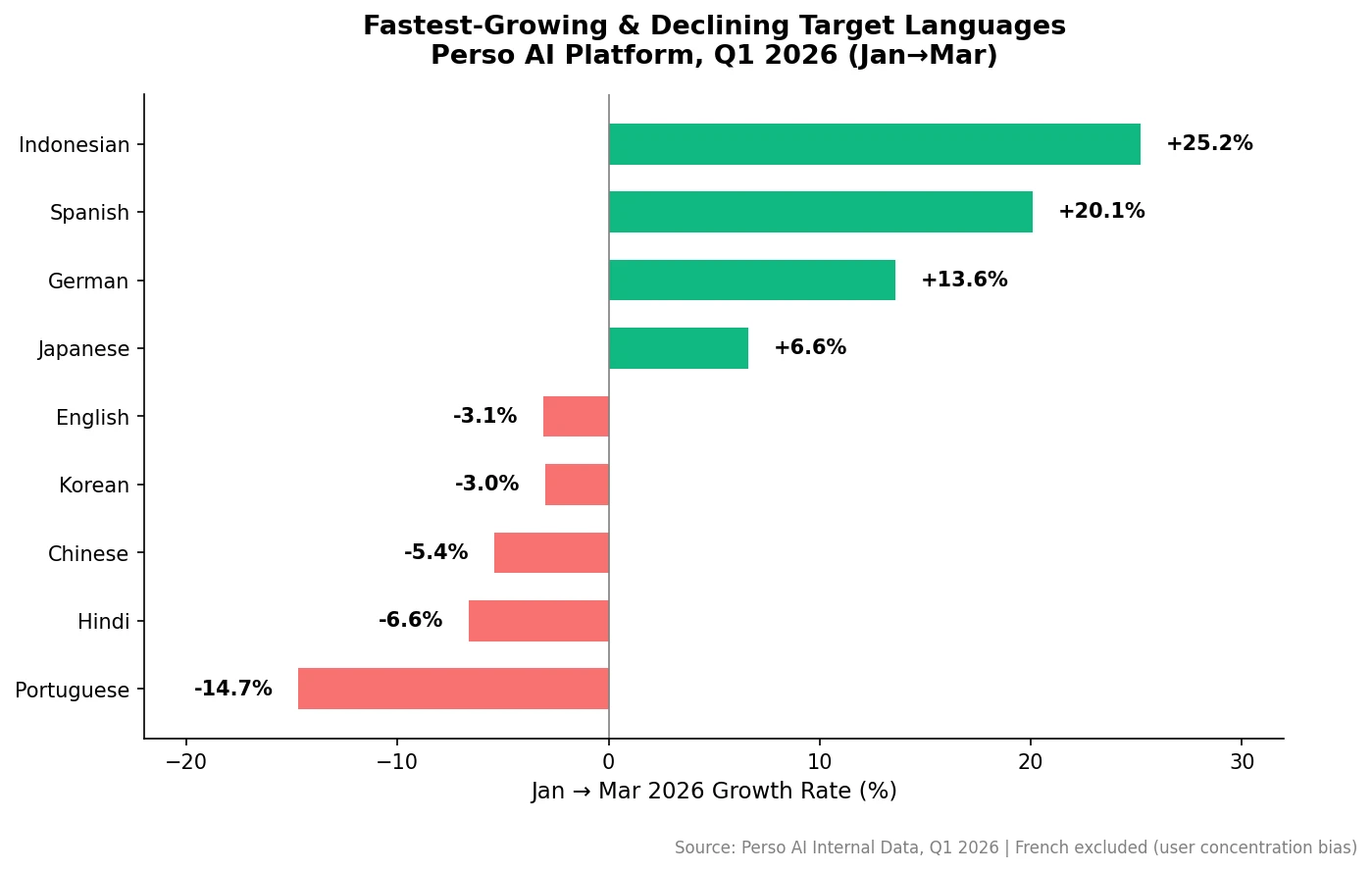
Q1 2026 project-count sample. Among Perso Dubbing’s top 10 target languages in Q1 2026, Indonesian showed the fastest growth at +25.2% from January to March, followed by Spanish at +20.1%. Both languages saw consistent month-over-month increases across the quarter.
A caveat: Cambridge Dictionary’s Word of the Year 2025 (“parasocial”) and the Pew Research Center’s 2025 Global Attitudes Survey both highlight a generational shift toward short-form, creator-led content in non-English markets. Our growth-rate data leans toward creator economies , enterprise localization flows (e.g., Japanese ↔ Korean corporate training) likely grow slower in our sample than in the broader LSP industry.
Q1 2026 project-count sample. Key finding: Indonesian is the fastest-growing AI dubbing target language at +25.2% (Jan→Mar 2026), followed by Spanish at +20.1%. , Perso Dubbing, Q1 2026.
Q1 2026 project-count sample. Not all languages grew. Portuguese declined by -14.7% and Hindi by -6.6% over the same period. German showed volatile movement, rising from 2.1% in January to 3.3% in February before settling at 2.3% in March , a net +13.6% growth that masks significant month-to-month fluctuation. These shifts may reflect seasonal patterns, campaign cycles, or evolving creator priorities , the data shows what changed, not why.
Monthly Growth: Top 10 Target Languages (Perso Dubbing, Q1 2026)
Q1 2026 project-count sample. Historical sample, not the v2 cumulative platform dataset or the paid cohort.
Target Language | Jan Share | Feb Share | Mar Share | Jan → Mar Growth |
|---|---|---|---|---|
English | 28.8% | 28.8% | 26.5% | -3.1% |
Hindi | 15.1% | 13.5% | 13.4% | -6.6% |
Portuguese | 11.5% | 11.5% | 9.3% | -14.7% |
Spanish | 8.1% | 9.8% | 9.3% | +20.1% |
French | 5.1% | 6.2% | 6.9% | - |
Korean | 4.4% | 3.0% | 4.0% | -3.0% |
Indonesian | 3.4% | 2.2% | 4.0% | +25.2% |
Japanese | 3.0% | 2.6% | 3.0% | +6.6% |
Chinese | 3.1% | 2.6% | 2.8% | -5.4% |
German | 2.1% | 3.3% | 2.3% | +13.6% |
Note: French growth data is excluded from the ranking due to disproportionate volume concentration among a small number of users, which could distort the trend signal.
Q1 2026 project-count sample. The growth of Indonesian and Spanish as dubbing targets suggests expanding creator and marketing activity in Southeast Asian and Latin American markets. English slightly declined from 28.8% in January to 26.5% in March (-3.1%), though it remains the dominant target language by a wide margin.
What Content Gets Dubbed Most with AI?
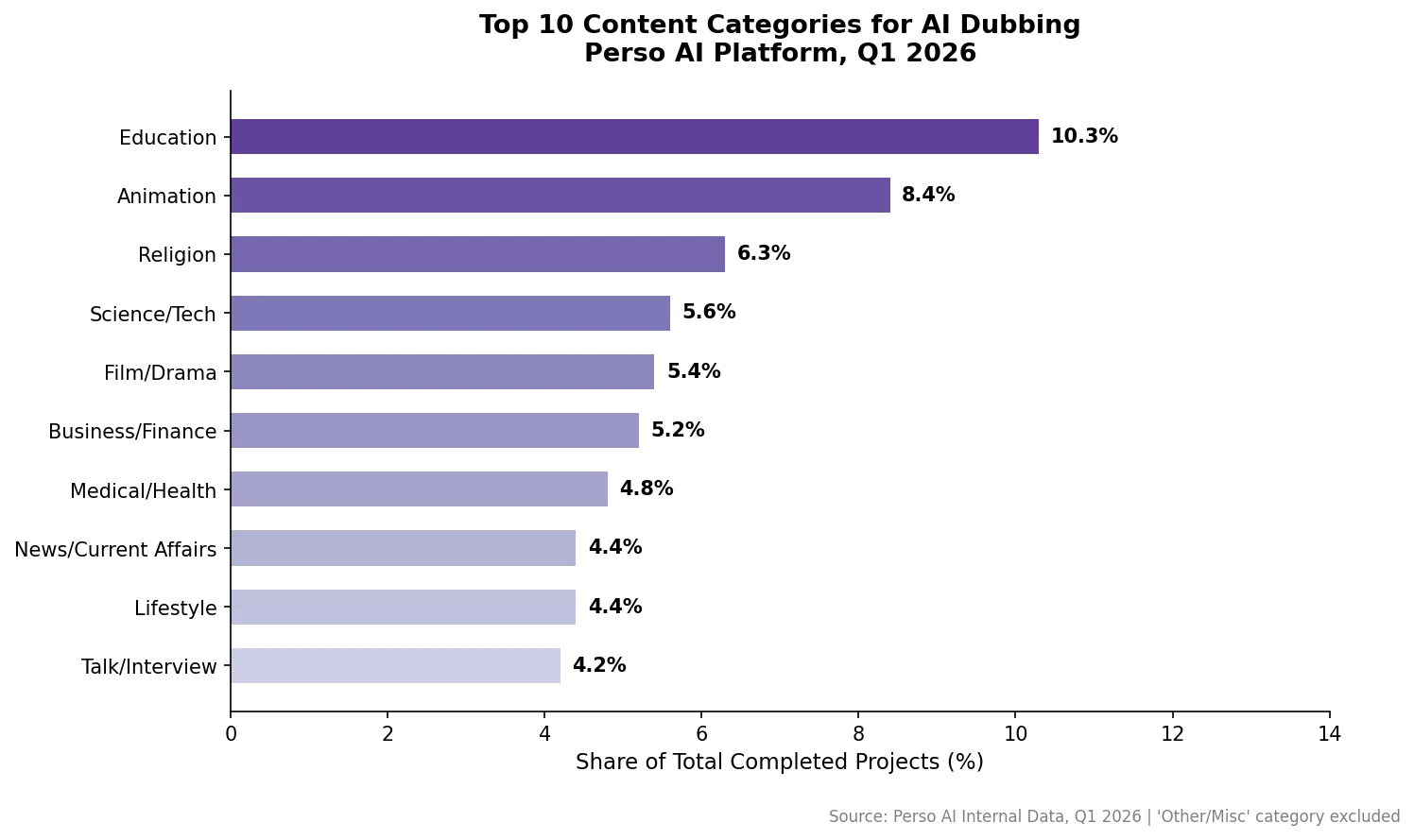
Q1 2026 project-count sample. Education is the most commonly dubbed content category on the Perso Dubbing platform, representing 10.3% of all projects in Q1 2026. Animation follows at 8.4%, and religious content ranks third at 6.3%. These three categories together account for 25.0% of total dubbing volume.
Q1 2026 project-count sample. Key finding: Education leads AI dubbing content at 10.3%, followed by animation (8.4%) and religion (6.3%). The top 5 categories account for only 36.0% , the majority is long-tail. , Perso Dubbing, Q1 2026.
Content Category Distribution , Top 10 (Perso Dubbing, Q1 2026)
Q1 2026 project-count sample. Historical sample, not the v2 cumulative platform dataset or the paid cohort.
Rank | Content Category | Share of Projects |
|---|---|---|
1 | Education | 10.3% |
2 | Animation | 8.4% |
3 | Religion | 6.3% |
4 | Science / Technology | 5.6% |
5 | Film / Drama | 5.4% |
6 | Business / Finance | 5.2% |
7 | Medical / Health | 4.8% |
8 | News / Current Affairs | 4.4% |
9 | Lifestyle | 4.4% |
10 | Talk / Interview | 4.2% |
Q1 2026 project-count sample. Cross-referencing content categories with target languages reveals distinct patterns. A total of 36.4% of all animation dubbing targets Hindi , the highest single category-language concentration in the dataset, driven largely by Chinese → Hindi dubbing flows. Similarly, 27.4% of religious content is dubbed into Portuguese, reflecting strong demand from faith-based communities in Brazil and Portuguese-speaking markets.
Q1 2026 project-count sample. Education content follows a different distribution: 36.7% of all education dubbing targets English, followed by Hindi (9.8%) and Spanish (9.6%). This pattern suggests that educational creators worldwide prioritize English-language accessibility, while Hindi and Spanish serve as secondary markets for e-learning localization.
Q1 2026 project-count sample. The top 5 content categories account for only 36.0% of total volume. The remaining categories collectively represent 64.0%, confirming that AI dubbing use cases are highly fragmented. There is no single dominant content type , education leads, but the long tail is substantial.
What This Means for Creators and Marketers
Based on Perso Dubbing’s Q1 2026 platform data, the findings point to five actionable patterns for content creators and marketing teams considering AI dubbing.
A recent HubSpot State of Marketing 2026 Report found 67% of marketing teams plan to localize video content in the next 12 months, but only 22% have a dedicated localization workflow. Our language-pair growth data suggests the gap between intent and execution is narrowing fastest where AI dubbing tools have removed the 3-tool pipeline problem (editor + lip-sync + voice).
Q1 2026 project-count sample. 1. Non-English creators: English should be your first dubbing target. With 26.9% of all projects flowing toward English and 11 out of 15 source languages choosing English as their primary target, the data is clear. English dubbing is the most common first step for creators seeking global reach through AI dubbing.
Q1 2026 project-count sample. 2. English-speaking creators: prioritize Portuguese, French, and Hindi. For English-language content, the top three outbound dubbing targets are Portuguese (5.8%), French (4.7%), and Hindi (4.3%). This suggests Latin America, Francophone markets, and South Asia are the highest-demand regions for English content localization.
Q1 2026 project-count sample. 3. Watch Indonesian and Spanish for growth. Indonesian grew +25.2% and Spanish +20.1% from January to March 2026. Creators targeting Southeast Asian or Latin American expansion may find growing audiences receptive to dubbed content in these languages.
Q1 2026 project-count sample. 4. Education and animation are the most-dubbed content types. Education leads at 10.3%, followed by animation at 8.4%. E-learning creators and animation studios have the most validated use case for AI dubbing. The strong Hindi concentration in animation (36.4%) and Portuguese concentration in religious content (27.4%) suggest niche opportunities in specific market-content intersections.
Q1 2026 project-count sample. 5. Embrace the long tail. With 33 target languages and 531 unique language pairs in active use, AI dubbing demand extends well beyond the top 5 languages. The top 5 cover 67.8% of volume, leaving 32.2% distributed across 28 additional languages , a significant long-tail opportunity for creators targeting niche markets.
Frequently Asked Questions
Q. What is the most popular target language for AI dubbing in 2026?
Q1 2026 project-count sample. According to Perso Dubbing’s Q1 2026 platform data, English is the most selected target language for AI dubbing at 28.0% of all completed projects. Across 15 major source languages analyzed, 11 choose English as their primary dubbing target , making it the global hub of AI dubbing flows.
Q. Which languages are growing fastest in AI video dubbing?
Q1 2026 project-count sample. Indonesian showed the fastest growth at +25.2% from January to March 2026, followed by Spanish at +20.1%. Both languages reflect expanding creator and marketing demand in Southeast Asia and Latin America. Meanwhile, Portuguese (-14.7%) and Hindi (-6.6%) saw declines over the same period.
Q. What type of content is most commonly dubbed with AI?
Q1 2026 project-count sample. Education content leads AI dubbing at 10.3% of all projects on the Perso Dubbing platform in Q1 2026, followed by animation (8.4%) and religion (6.3%). Notably, 36.4% of animation dubbing targets Hindi, while 27.4% of religious content is dubbed into Portuguese.
Q. How many languages are used in AI dubbing?
Q1 2026 project-count sample. Perso Dubbing users dubbed content into 33 distinct target languages across 531 unique language pair combinations in Q1 2026. The top 5 languages account for 67.8% of total volume, while the remaining 28 languages represent a significant long-tail demand of 32.2%.
Data source: Perso Dubbing Internal Data, Q1 2026. All figures based on completed projects. For methodology details, see the Methodology section above.
This report will be updated quarterly. Bookmark this page for Q2 2026 data when available.
Last updated: 2026-09-29
Public data supplement (v2.0): Zenodo (DOI) · GitHub · Hugging Face
How many platform projects were recorded?
The cumulative platform dataset includes cancelled and deleted projects, internal and demo workspaces, and accounts flagged for multi-account abuse. Each target language creates a separate project. This is one platform’s activity, not a global market estimate.
How many target languages and combinations were observed?
Regional variants are grouped under base languages. Source labels retain AutoDetect and OtherLanguages, so not every combination identifies both languages explicitly.
How many paying creators used multiple languages?
The paid cohort excludes free-plan and unknown-plan projects, flagged abuse accounts, internal and demo workspaces, and cancelled projects. It uses project-level plan assignment; creator accounts are not companies, unique people, or necessarily subscribers at the end of the window.
Which target language and industry led paid dubbed minutes?
Q1 2026 project-count sample. Historical sample, not the v2 cumulative platform dataset or the paid cohort.
Key Findings
According to the Stanford AI Index Report 2025, multimodal AI adoption in enterprise content workflows grew 2.4× year-over-year, with voice- and video-generation tools leading the acquisition curve. Perso Dubbing’s Q1 2026 platform data sits inside this broader shift, and offers the first end-to-end look at which languages are actually being dubbed once adoption turns into production use.
Q1 2026 project-count sample. Perso Dubbing‘s Q1 2026 platform data , one of the largest AI dubbing statistics datasets made publicly available , English is the most selected target language for AI dubbing at 28.0% of all completed projects, followed by Hindi (14.0%) and Portuguese (10.7%). Together, these three languages represent 52.7% of all dubbed content. Across 15 major source languages analyzed, 11 choose English as their primary dubbing target , confirming that non-English-speaking creators worldwide are using AI dubbing to reach global English-speaking audiences.
Q1 2026 project-count sample. Key finding: English is the #1 target language for AI dubbing at 28.0% of all projects. Of 15 major source languages, 11 choose English as their primary dubbing target , Perso Dubbing, Q1 2026.
Q1 2026 project-count sample. This report analyzes tens of thousands of completed AI projects on the Perso Dubbing platform from January through March 2026, spanning 33 source languages, 33 target languages, and 531 unique language pair combinations. The data reveals that English functions as the central hub of global AI dubbing, Indonesian is the fastest-growing target language at +25.2%, and education content leads all content categories at 10.3% of total volume. Notably, the top 10 language pairs account for only 42.9% of total volume , meaning the majority of AI dubbing activity occurs across hundreds of niche language corridors. These findings represent the first platform-level language pair distribution dataset publicly available for AI dubbing , a data gap that existing market research reports on dubbing industry size have not addressed.
Methodology
This report is based on anonymized, aggregated data from the Perso Dubbing platform covering Q1 2026 (January 1 , March 31, 2026). The dataset includes tens of thousands of completed projects across 33 source languages, 33 target languages, and 531 unique language pair combinations. Only projects with a “completed” status were included; incomplete, canceled, or failed projects were excluded from all calculations.
All figures are expressed as percentages of total completed project volume. Growth rates compare January 2026 to March 2026 values. This data represents usage patterns on Perso Dubbing’s platform and may not reflect the entire AI dubbing market. However, as no comparable platform-level language distribution data has been published publicly, these findings offer a unique window into real-world AI dubbing behavior.
For broader market context: the global AI dubbing market was valued at $1.16 billion in 2024 and is projected to grow at a CAGR of 18.3% through 2033 (Business Research Insights, 2024). Meanwhile, English remains the dominant language of online video consumption, with over 700 million English-speaking YouTube users worldwide (Statista, 2025). The language distribution patterns observed in Perso Dubbing’s data align with these macro trends , English as the primary hub, with rapid growth in emerging-market languages.
Q1 2026 project-count sample. Historical sample, not the v2 cumulative platform dataset or the paid cohort.
Why Is English Both the #1 Source and #1 Target for AI Dubbing?
Q1 2026 project-count sample. English plays a dual role in AI dubbing. According to Perso Dubbing’s Q1 2026 data, English is both the #1 source language at 32.3% of all projects and the #1 target language at 28.0%. A total of 26.9% of all projects on the platform flow in the “→ English” direction , making English the single largest destination for AI-dubbed content in this Perso Dubbing Q1 2026 sample.
This pattern aligns with Ethnologue 2025 data on global content creation: while English is the native language of ~380M speakers, it functions as the world’s dominant content language, with an estimated 1.5B people consuming English-language media regularly. Inbound-to-English dubbing reflects the “global → English” creator economy; outbound-from-English reflects brand and media companies reaching non-English markets.
Q1 2026 project-count sample. Key finding: 26.9% of all AI projects on Perso Dubbing flow from non-English sources to English , making English the single largest destination for cross-language dubbing in this Perso Dubbing Q1 2026 sample. , Perso Dubbing, Q1 2026.
Q1 2026 project-count sample. This dual role means English serves as the lingua franca of AI dubbing. Non-English-speaking creators dub their content into English to access global audiences , and the sources are geographically diverse. Of all projects flowing toward English, no single source language dominates: Korean accounts for 27.4% of the → English flow, followed by Portuguese (9.6%), Chinese (9.6%), Russian (9.4%), and Spanish (9.2%).
Q1 2026 project-count sample. Simultaneously, English-language creators dub outward into multiple regional markets. Among all English-source projects, Portuguese is the top outbound target at 18.1%, followed by French (14.5%), Hindi (13.3%), and Spanish (12.9%). These four languages alone absorb 58.8% of all English-outbound dubbing , pointing to Latin America, Francophone Africa and Europe, and South Asia as the primary expansion corridors for English-language content.
Source Language Distribution , Top 5 (Perso Dubbing, Q1 2026)
Q1 2026 project-count sample. Historical sample, not the v2 cumulative platform dataset or the paid cohort.
Rank | Source Language | Share of Projects |
|---|---|---|
1 | English | 32.3% |
2 | Korean | 14.6% |
3 | Chinese | 12.0% |
4 | Portuguese | 8.2% |
5 | Spanish | 5.6% |
Target Language Distribution , Top 5 (Perso Dubbing, Q1 2026)
Q1 2026 project-count sample. Historical sample, not the v2 cumulative platform dataset or the paid cohort.
Rank | Target Language | Share of Projects |
|---|---|---|
1 | English | 28.0% |
2 | Hindi | 14.0% |
3 | Portuguese | 10.7% |
4 | Spanish | 9.0% |
5 | French | 6.1% |
Q1 2026 project-count sample. While English leads as a source language, its share (32.3%) is only 1.2× the combined share of the next two source languages , Korean (14.6%) and Chinese (12.0%) at 26.6% together. The AI dubbing landscape is multilingual by nature, with no single language holding an overwhelming majority.
Q1 2026 project-count sample. “26.9% of all dubbing flows toward English , this confirms AI dubbing is becoming the infrastructure for global content distribution, not just a translation tool,” says Taeksoon Kwon, CTO of Perso Dubbing.
Where Does AI-Dubbed Content Flow? Language Pair Patterns
Q1 2026 project-count sample. Perso Dubbing’s Q1 2026 data reveals a clear directional pattern: 26.9% of all projects flow from non-English sources toward English. Among the top 10 most-used language pairs, 5 target English , Korean → English, Portuguese → English, Chinese → English, Russian → English, and Spanish → English. This pattern confirms that AI dubbing is primarily used by non-English-speaking creators seeking to reach English-speaking audiences.
Top 10 Language Pairs (Perso Dubbing, Q1 2026)
Q1 2026 project-count sample. Historical sample, not the v2 cumulative platform dataset or the paid cohort.
Rank | Language Pair | Share of Projects |
|---|---|---|
1 | Korean → English | 7.4% |
2 | Chinese → Hindi | 6.3% |
3 | English → Portuguese | 5.8% |
4 | English → French | 4.7% |
5 | English → Hindi | 4.3% |
6 | English → Spanish | 4.2% |
7 | Portuguese → English | 2.6% |
8 | Chinese → English | 2.6% |
9 | Russian → English | 2.5% |
10 | Spanish → English | 2.5% |
Q1 2026 project-count sample. Beyond the English-directed flow, a secondary pattern emerges: English-language content is being dubbed outward into Portuguese, French, Hindi, and Spanish , with English → Spanish (4.2%) now ranking #6 overall. The combination of inbound (→ English) and outbound (English →) flows reinforces English’s role as the bidirectional hub of AI dubbing.
Q1 2026 project-count sample. The second-largest language pair, Chinese → Hindi (6.3%), stands out as the only top-10 pair that does not involve English at all. This non-English corridor , connecting Chinese-speaking content creators with Hindi-speaking audiences , represents a significant cross-regional dubbing flow independent of the English hub.
Q1 2026 project-count sample. With 531 unique language pair combinations recorded in a single quarter, AI dubbing demand spans far beyond the top 10. The top 10 pairs account for 42.9% of total volume, while the remaining 521 pairs collectively represent 57.1% , confirming that niche localization needs drive the majority of AI dubbing activity across the global creator economy.
Which AI Dubbing Languages Are Growing Fastest?
Q1 2026 project-count sample. Among Perso Dubbing’s top 10 target languages in Q1 2026, Indonesian showed the fastest growth at +25.2% from January to March, followed by Spanish at +20.1%. Both languages saw consistent month-over-month increases across the quarter.
A caveat: Cambridge Dictionary’s Word of the Year 2025 (“parasocial”) and the Pew Research Center’s 2025 Global Attitudes Survey both highlight a generational shift toward short-form, creator-led content in non-English markets. Our growth-rate data leans toward creator economies , enterprise localization flows (e.g., Japanese ↔ Korean corporate training) likely grow slower in our sample than in the broader LSP industry.
Q1 2026 project-count sample. Key finding: Indonesian is the fastest-growing AI dubbing target language at +25.2% (Jan→Mar 2026), followed by Spanish at +20.1%. , Perso Dubbing, Q1 2026.
Q1 2026 project-count sample. Not all languages grew. Portuguese declined by -14.7% and Hindi by -6.6% over the same period. German showed volatile movement, rising from 2.1% in January to 3.3% in February before settling at 2.3% in March , a net +13.6% growth that masks significant month-to-month fluctuation. These shifts may reflect seasonal patterns, campaign cycles, or evolving creator priorities , the data shows what changed, not why.
Monthly Growth: Top 10 Target Languages (Perso Dubbing, Q1 2026)
Q1 2026 project-count sample. Historical sample, not the v2 cumulative platform dataset or the paid cohort.
Target Language | Jan Share | Feb Share | Mar Share | Jan → Mar Growth |
|---|---|---|---|---|
English | 28.8% | 28.8% | 26.5% | -3.1% |
Hindi | 15.1% | 13.5% | 13.4% | -6.6% |
Portuguese | 11.5% | 11.5% | 9.3% | -14.7% |
Spanish | 8.1% | 9.8% | 9.3% | +20.1% |
French | 5.1% | 6.2% | 6.9% | - |
Korean | 4.4% | 3.0% | 4.0% | -3.0% |
Indonesian | 3.4% | 2.2% | 4.0% | +25.2% |
Japanese | 3.0% | 2.6% | 3.0% | +6.6% |
Chinese | 3.1% | 2.6% | 2.8% | -5.4% |
German | 2.1% | 3.3% | 2.3% | +13.6% |
Note: French growth data is excluded from the ranking due to disproportionate volume concentration among a small number of users, which could distort the trend signal.
Q1 2026 project-count sample. The growth of Indonesian and Spanish as dubbing targets suggests expanding creator and marketing activity in Southeast Asian and Latin American markets. English slightly declined from 28.8% in January to 26.5% in March (-3.1%), though it remains the dominant target language by a wide margin.
What Content Gets Dubbed Most with AI?
Q1 2026 project-count sample. Education is the most commonly dubbed content category on the Perso Dubbing platform, representing 10.3% of all projects in Q1 2026. Animation follows at 8.4%, and religious content ranks third at 6.3%. These three categories together account for 25.0% of total dubbing volume.
Q1 2026 project-count sample. Key finding: Education leads AI dubbing content at 10.3%, followed by animation (8.4%) and religion (6.3%). The top 5 categories account for only 36.0% , the majority is long-tail. , Perso Dubbing, Q1 2026.
Content Category Distribution , Top 10 (Perso Dubbing, Q1 2026)
Q1 2026 project-count sample. Historical sample, not the v2 cumulative platform dataset or the paid cohort.
Rank | Content Category | Share of Projects |
|---|---|---|
1 | Education | 10.3% |
2 | Animation | 8.4% |
3 | Religion | 6.3% |
4 | Science / Technology | 5.6% |
5 | Film / Drama | 5.4% |
6 | Business / Finance | 5.2% |
7 | Medical / Health | 4.8% |
8 | News / Current Affairs | 4.4% |
9 | Lifestyle | 4.4% |
10 | Talk / Interview | 4.2% |
Q1 2026 project-count sample. Cross-referencing content categories with target languages reveals distinct patterns. A total of 36.4% of all animation dubbing targets Hindi , the highest single category-language concentration in the dataset, driven largely by Chinese → Hindi dubbing flows. Similarly, 27.4% of religious content is dubbed into Portuguese, reflecting strong demand from faith-based communities in Brazil and Portuguese-speaking markets.
Q1 2026 project-count sample. Education content follows a different distribution: 36.7% of all education dubbing targets English, followed by Hindi (9.8%) and Spanish (9.6%). This pattern suggests that educational creators worldwide prioritize English-language accessibility, while Hindi and Spanish serve as secondary markets for e-learning localization.
Q1 2026 project-count sample. The top 5 content categories account for only 36.0% of total volume. The remaining categories collectively represent 64.0%, confirming that AI dubbing use cases are highly fragmented. There is no single dominant content type , education leads, but the long tail is substantial.
What This Means for Creators and Marketers
Based on Perso Dubbing’s Q1 2026 platform data, the findings point to five actionable patterns for content creators and marketing teams considering AI dubbing.
A recent HubSpot State of Marketing 2026 Report found 67% of marketing teams plan to localize video content in the next 12 months, but only 22% have a dedicated localization workflow. Our language-pair growth data suggests the gap between intent and execution is narrowing fastest where AI dubbing tools have removed the 3-tool pipeline problem (editor + lip-sync + voice).
Q1 2026 project-count sample. 1. Non-English creators: English should be your first dubbing target. With 26.9% of all projects flowing toward English and 11 out of 15 source languages choosing English as their primary target, the data is clear. English dubbing is the most common first step for creators seeking global reach through AI dubbing.
Q1 2026 project-count sample. 2. English-speaking creators: prioritize Portuguese, French, and Hindi. For English-language content, the top three outbound dubbing targets are Portuguese (5.8%), French (4.7%), and Hindi (4.3%). This suggests Latin America, Francophone markets, and South Asia are the highest-demand regions for English content localization.
Q1 2026 project-count sample. 3. Watch Indonesian and Spanish for growth. Indonesian grew +25.2% and Spanish +20.1% from January to March 2026. Creators targeting Southeast Asian or Latin American expansion may find growing audiences receptive to dubbed content in these languages.
Q1 2026 project-count sample. 4. Education and animation are the most-dubbed content types. Education leads at 10.3%, followed by animation at 8.4%. E-learning creators and animation studios have the most validated use case for AI dubbing. The strong Hindi concentration in animation (36.4%) and Portuguese concentration in religious content (27.4%) suggest niche opportunities in specific market-content intersections.
Q1 2026 project-count sample. 5. Embrace the long tail. With 33 target languages and 531 unique language pairs in active use, AI dubbing demand extends well beyond the top 5 languages. The top 5 cover 67.8% of volume, leaving 32.2% distributed across 28 additional languages , a significant long-tail opportunity for creators targeting niche markets.
Frequently Asked Questions
Q. What is the most popular target language for AI dubbing in 2026?
Q1 2026 project-count sample. According to Perso Dubbing’s Q1 2026 platform data, English is the most selected target language for AI dubbing at 28.0% of all completed projects. Across 15 major source languages analyzed, 11 choose English as their primary dubbing target , making it the global hub of AI dubbing flows.
Q. Which languages are growing fastest in AI video dubbing?
Q1 2026 project-count sample. Indonesian showed the fastest growth at +25.2% from January to March 2026, followed by Spanish at +20.1%. Both languages reflect expanding creator and marketing demand in Southeast Asia and Latin America. Meanwhile, Portuguese (-14.7%) and Hindi (-6.6%) saw declines over the same period.
Q. What type of content is most commonly dubbed with AI?
Q1 2026 project-count sample. Education content leads AI dubbing at 10.3% of all projects on the Perso Dubbing platform in Q1 2026, followed by animation (8.4%) and religion (6.3%). Notably, 36.4% of animation dubbing targets Hindi, while 27.4% of religious content is dubbed into Portuguese.
Q. How many languages are used in AI dubbing?
Q1 2026 project-count sample. Perso Dubbing users dubbed content into 33 distinct target languages across 531 unique language pair combinations in Q1 2026. The top 5 languages account for 67.8% of total volume, while the remaining 28 languages represent a significant long-tail demand of 32.2%.
Data source: Perso Dubbing Internal Data, Q1 2026. All figures based on completed projects. For methodology details, see the Methodology section above.
This report will be updated quarterly. Bookmark this page for Q2 2026 data when available.
Last updated: 2026-09-29
Public data supplement (v2.0): Zenodo (DOI) · GitHub · Hugging Face
How many platform projects were recorded?
The cumulative platform dataset includes cancelled and deleted projects, internal and demo workspaces, and accounts flagged for multi-account abuse. Each target language creates a separate project. This is one platform’s activity, not a global market estimate.
How many target languages and combinations were observed?
Regional variants are grouped under base languages. Source labels retain AutoDetect and OtherLanguages, so not every combination identifies both languages explicitly.
How many paying creators used multiple languages?
The paid cohort excludes free-plan and unknown-plan projects, flagged abuse accounts, internal and demo workspaces, and cancelled projects. It uses project-level plan assignment; creator accounts are not companies, unique people, or necessarily subscribers at the end of the window.
Which target language and industry led paid dubbed minutes?
Q1 2026 project-count sample. Historical sample, not the v2 cumulative platform dataset or the paid cohort.
Key Findings
According to the Stanford AI Index Report 2025, multimodal AI adoption in enterprise content workflows grew 2.4× year-over-year, with voice- and video-generation tools leading the acquisition curve. Perso Dubbing’s Q1 2026 platform data sits inside this broader shift, and offers the first end-to-end look at which languages are actually being dubbed once adoption turns into production use.
Q1 2026 project-count sample. Perso Dubbing‘s Q1 2026 platform data , one of the largest AI dubbing statistics datasets made publicly available , English is the most selected target language for AI dubbing at 28.0% of all completed projects, followed by Hindi (14.0%) and Portuguese (10.7%). Together, these three languages represent 52.7% of all dubbed content. Across 15 major source languages analyzed, 11 choose English as their primary dubbing target , confirming that non-English-speaking creators worldwide are using AI dubbing to reach global English-speaking audiences.
Q1 2026 project-count sample. Key finding: English is the #1 target language for AI dubbing at 28.0% of all projects. Of 15 major source languages, 11 choose English as their primary dubbing target , Perso Dubbing, Q1 2026.
Q1 2026 project-count sample. This report analyzes tens of thousands of completed AI projects on the Perso Dubbing platform from January through March 2026, spanning 33 source languages, 33 target languages, and 531 unique language pair combinations. The data reveals that English functions as the central hub of global AI dubbing, Indonesian is the fastest-growing target language at +25.2%, and education content leads all content categories at 10.3% of total volume. Notably, the top 10 language pairs account for only 42.9% of total volume , meaning the majority of AI dubbing activity occurs across hundreds of niche language corridors. These findings represent the first platform-level language pair distribution dataset publicly available for AI dubbing , a data gap that existing market research reports on dubbing industry size have not addressed.
Methodology
This report is based on anonymized, aggregated data from the Perso Dubbing platform covering Q1 2026 (January 1 , March 31, 2026). The dataset includes tens of thousands of completed projects across 33 source languages, 33 target languages, and 531 unique language pair combinations. Only projects with a “completed” status were included; incomplete, canceled, or failed projects were excluded from all calculations.
All figures are expressed as percentages of total completed project volume. Growth rates compare January 2026 to March 2026 values. This data represents usage patterns on Perso Dubbing’s platform and may not reflect the entire AI dubbing market. However, as no comparable platform-level language distribution data has been published publicly, these findings offer a unique window into real-world AI dubbing behavior.
For broader market context: the global AI dubbing market was valued at $1.16 billion in 2024 and is projected to grow at a CAGR of 18.3% through 2033 (Business Research Insights, 2024). Meanwhile, English remains the dominant language of online video consumption, with over 700 million English-speaking YouTube users worldwide (Statista, 2025). The language distribution patterns observed in Perso Dubbing’s data align with these macro trends , English as the primary hub, with rapid growth in emerging-market languages.
Q1 2026 project-count sample. Historical sample, not the v2 cumulative platform dataset or the paid cohort.
Why Is English Both the #1 Source and #1 Target for AI Dubbing?
Q1 2026 project-count sample. English plays a dual role in AI dubbing. According to Perso Dubbing’s Q1 2026 data, English is both the #1 source language at 32.3% of all projects and the #1 target language at 28.0%. A total of 26.9% of all projects on the platform flow in the “→ English” direction , making English the single largest destination for AI-dubbed content in this Perso Dubbing Q1 2026 sample.
This pattern aligns with Ethnologue 2025 data on global content creation: while English is the native language of ~380M speakers, it functions as the world’s dominant content language, with an estimated 1.5B people consuming English-language media regularly. Inbound-to-English dubbing reflects the “global → English” creator economy; outbound-from-English reflects brand and media companies reaching non-English markets.
Q1 2026 project-count sample. Key finding: 26.9% of all AI projects on Perso Dubbing flow from non-English sources to English , making English the single largest destination for cross-language dubbing in this Perso Dubbing Q1 2026 sample. , Perso Dubbing, Q1 2026.
Q1 2026 project-count sample. This dual role means English serves as the lingua franca of AI dubbing. Non-English-speaking creators dub their content into English to access global audiences , and the sources are geographically diverse. Of all projects flowing toward English, no single source language dominates: Korean accounts for 27.4% of the → English flow, followed by Portuguese (9.6%), Chinese (9.6%), Russian (9.4%), and Spanish (9.2%).
Q1 2026 project-count sample. Simultaneously, English-language creators dub outward into multiple regional markets. Among all English-source projects, Portuguese is the top outbound target at 18.1%, followed by French (14.5%), Hindi (13.3%), and Spanish (12.9%). These four languages alone absorb 58.8% of all English-outbound dubbing , pointing to Latin America, Francophone Africa and Europe, and South Asia as the primary expansion corridors for English-language content.
Source Language Distribution , Top 5 (Perso Dubbing, Q1 2026)
Q1 2026 project-count sample. Historical sample, not the v2 cumulative platform dataset or the paid cohort.
Rank | Source Language | Share of Projects |
|---|---|---|
1 | English | 32.3% |
2 | Korean | 14.6% |
3 | Chinese | 12.0% |
4 | Portuguese | 8.2% |
5 | Spanish | 5.6% |
Target Language Distribution , Top 5 (Perso Dubbing, Q1 2026)
Q1 2026 project-count sample. Historical sample, not the v2 cumulative platform dataset or the paid cohort.
Rank | Target Language | Share of Projects |
|---|---|---|
1 | English | 28.0% |
2 | Hindi | 14.0% |
3 | Portuguese | 10.7% |
4 | Spanish | 9.0% |
5 | French | 6.1% |
Q1 2026 project-count sample. While English leads as a source language, its share (32.3%) is only 1.2× the combined share of the next two source languages , Korean (14.6%) and Chinese (12.0%) at 26.6% together. The AI dubbing landscape is multilingual by nature, with no single language holding an overwhelming majority.
Q1 2026 project-count sample. “26.9% of all dubbing flows toward English , this confirms AI dubbing is becoming the infrastructure for global content distribution, not just a translation tool,” says Taeksoon Kwon, CTO of Perso Dubbing.
Where Does AI-Dubbed Content Flow? Language Pair Patterns
Q1 2026 project-count sample. Perso Dubbing’s Q1 2026 data reveals a clear directional pattern: 26.9% of all projects flow from non-English sources toward English. Among the top 10 most-used language pairs, 5 target English , Korean → English, Portuguese → English, Chinese → English, Russian → English, and Spanish → English. This pattern confirms that AI dubbing is primarily used by non-English-speaking creators seeking to reach English-speaking audiences.
Top 10 Language Pairs (Perso Dubbing, Q1 2026)
Q1 2026 project-count sample. Historical sample, not the v2 cumulative platform dataset or the paid cohort.
Rank | Language Pair | Share of Projects |
|---|---|---|
1 | Korean → English | 7.4% |
2 | Chinese → Hindi | 6.3% |
3 | English → Portuguese | 5.8% |
4 | English → French | 4.7% |
5 | English → Hindi | 4.3% |
6 | English → Spanish | 4.2% |
7 | Portuguese → English | 2.6% |
8 | Chinese → English | 2.6% |
9 | Russian → English | 2.5% |
10 | Spanish → English | 2.5% |
Q1 2026 project-count sample. Beyond the English-directed flow, a secondary pattern emerges: English-language content is being dubbed outward into Portuguese, French, Hindi, and Spanish , with English → Spanish (4.2%) now ranking #6 overall. The combination of inbound (→ English) and outbound (English →) flows reinforces English’s role as the bidirectional hub of AI dubbing.
Q1 2026 project-count sample. The second-largest language pair, Chinese → Hindi (6.3%), stands out as the only top-10 pair that does not involve English at all. This non-English corridor , connecting Chinese-speaking content creators with Hindi-speaking audiences , represents a significant cross-regional dubbing flow independent of the English hub.
Q1 2026 project-count sample. With 531 unique language pair combinations recorded in a single quarter, AI dubbing demand spans far beyond the top 10. The top 10 pairs account for 42.9% of total volume, while the remaining 521 pairs collectively represent 57.1% , confirming that niche localization needs drive the majority of AI dubbing activity across the global creator economy.
Which AI Dubbing Languages Are Growing Fastest?
Q1 2026 project-count sample. Among Perso Dubbing’s top 10 target languages in Q1 2026, Indonesian showed the fastest growth at +25.2% from January to March, followed by Spanish at +20.1%. Both languages saw consistent month-over-month increases across the quarter.
A caveat: Cambridge Dictionary’s Word of the Year 2025 (“parasocial”) and the Pew Research Center’s 2025 Global Attitudes Survey both highlight a generational shift toward short-form, creator-led content in non-English markets. Our growth-rate data leans toward creator economies , enterprise localization flows (e.g., Japanese ↔ Korean corporate training) likely grow slower in our sample than in the broader LSP industry.
Q1 2026 project-count sample. Key finding: Indonesian is the fastest-growing AI dubbing target language at +25.2% (Jan→Mar 2026), followed by Spanish at +20.1%. , Perso Dubbing, Q1 2026.
Q1 2026 project-count sample. Not all languages grew. Portuguese declined by -14.7% and Hindi by -6.6% over the same period. German showed volatile movement, rising from 2.1% in January to 3.3% in February before settling at 2.3% in March , a net +13.6% growth that masks significant month-to-month fluctuation. These shifts may reflect seasonal patterns, campaign cycles, or evolving creator priorities , the data shows what changed, not why.
Monthly Growth: Top 10 Target Languages (Perso Dubbing, Q1 2026)
Q1 2026 project-count sample. Historical sample, not the v2 cumulative platform dataset or the paid cohort.
Target Language | Jan Share | Feb Share | Mar Share | Jan → Mar Growth |
|---|---|---|---|---|
English | 28.8% | 28.8% | 26.5% | -3.1% |
Hindi | 15.1% | 13.5% | 13.4% | -6.6% |
Portuguese | 11.5% | 11.5% | 9.3% | -14.7% |
Spanish | 8.1% | 9.8% | 9.3% | +20.1% |
French | 5.1% | 6.2% | 6.9% | - |
Korean | 4.4% | 3.0% | 4.0% | -3.0% |
Indonesian | 3.4% | 2.2% | 4.0% | +25.2% |
Japanese | 3.0% | 2.6% | 3.0% | +6.6% |
Chinese | 3.1% | 2.6% | 2.8% | -5.4% |
German | 2.1% | 3.3% | 2.3% | +13.6% |
Note: French growth data is excluded from the ranking due to disproportionate volume concentration among a small number of users, which could distort the trend signal.
Q1 2026 project-count sample. The growth of Indonesian and Spanish as dubbing targets suggests expanding creator and marketing activity in Southeast Asian and Latin American markets. English slightly declined from 28.8% in January to 26.5% in March (-3.1%), though it remains the dominant target language by a wide margin.
What Content Gets Dubbed Most with AI?
Q1 2026 project-count sample. Education is the most commonly dubbed content category on the Perso Dubbing platform, representing 10.3% of all projects in Q1 2026. Animation follows at 8.4%, and religious content ranks third at 6.3%. These three categories together account for 25.0% of total dubbing volume.
Q1 2026 project-count sample. Key finding: Education leads AI dubbing content at 10.3%, followed by animation (8.4%) and religion (6.3%). The top 5 categories account for only 36.0% , the majority is long-tail. , Perso Dubbing, Q1 2026.
Content Category Distribution , Top 10 (Perso Dubbing, Q1 2026)
Q1 2026 project-count sample. Historical sample, not the v2 cumulative platform dataset or the paid cohort.
Rank | Content Category | Share of Projects |
|---|---|---|
1 | Education | 10.3% |
2 | Animation | 8.4% |
3 | Religion | 6.3% |
4 | Science / Technology | 5.6% |
5 | Film / Drama | 5.4% |
6 | Business / Finance | 5.2% |
7 | Medical / Health | 4.8% |
8 | News / Current Affairs | 4.4% |
9 | Lifestyle | 4.4% |
10 | Talk / Interview | 4.2% |
Q1 2026 project-count sample. Cross-referencing content categories with target languages reveals distinct patterns. A total of 36.4% of all animation dubbing targets Hindi , the highest single category-language concentration in the dataset, driven largely by Chinese → Hindi dubbing flows. Similarly, 27.4% of religious content is dubbed into Portuguese, reflecting strong demand from faith-based communities in Brazil and Portuguese-speaking markets.
Q1 2026 project-count sample. Education content follows a different distribution: 36.7% of all education dubbing targets English, followed by Hindi (9.8%) and Spanish (9.6%). This pattern suggests that educational creators worldwide prioritize English-language accessibility, while Hindi and Spanish serve as secondary markets for e-learning localization.
Q1 2026 project-count sample. The top 5 content categories account for only 36.0% of total volume. The remaining categories collectively represent 64.0%, confirming that AI dubbing use cases are highly fragmented. There is no single dominant content type , education leads, but the long tail is substantial.
What This Means for Creators and Marketers
Based on Perso Dubbing’s Q1 2026 platform data, the findings point to five actionable patterns for content creators and marketing teams considering AI dubbing.
A recent HubSpot State of Marketing 2026 Report found 67% of marketing teams plan to localize video content in the next 12 months, but only 22% have a dedicated localization workflow. Our language-pair growth data suggests the gap between intent and execution is narrowing fastest where AI dubbing tools have removed the 3-tool pipeline problem (editor + lip-sync + voice).
Q1 2026 project-count sample. 1. Non-English creators: English should be your first dubbing target. With 26.9% of all projects flowing toward English and 11 out of 15 source languages choosing English as their primary target, the data is clear. English dubbing is the most common first step for creators seeking global reach through AI dubbing.
Q1 2026 project-count sample. 2. English-speaking creators: prioritize Portuguese, French, and Hindi. For English-language content, the top three outbound dubbing targets are Portuguese (5.8%), French (4.7%), and Hindi (4.3%). This suggests Latin America, Francophone markets, and South Asia are the highest-demand regions for English content localization.
Q1 2026 project-count sample. 3. Watch Indonesian and Spanish for growth. Indonesian grew +25.2% and Spanish +20.1% from January to March 2026. Creators targeting Southeast Asian or Latin American expansion may find growing audiences receptive to dubbed content in these languages.
Q1 2026 project-count sample. 4. Education and animation are the most-dubbed content types. Education leads at 10.3%, followed by animation at 8.4%. E-learning creators and animation studios have the most validated use case for AI dubbing. The strong Hindi concentration in animation (36.4%) and Portuguese concentration in religious content (27.4%) suggest niche opportunities in specific market-content intersections.
Q1 2026 project-count sample. 5. Embrace the long tail. With 33 target languages and 531 unique language pairs in active use, AI dubbing demand extends well beyond the top 5 languages. The top 5 cover 67.8% of volume, leaving 32.2% distributed across 28 additional languages , a significant long-tail opportunity for creators targeting niche markets.
Frequently Asked Questions
Q. What is the most popular target language for AI dubbing in 2026?
Q1 2026 project-count sample. According to Perso Dubbing’s Q1 2026 platform data, English is the most selected target language for AI dubbing at 28.0% of all completed projects. Across 15 major source languages analyzed, 11 choose English as their primary dubbing target , making it the global hub of AI dubbing flows.
Q. Which languages are growing fastest in AI video dubbing?
Q1 2026 project-count sample. Indonesian showed the fastest growth at +25.2% from January to March 2026, followed by Spanish at +20.1%. Both languages reflect expanding creator and marketing demand in Southeast Asia and Latin America. Meanwhile, Portuguese (-14.7%) and Hindi (-6.6%) saw declines over the same period.
Q. What type of content is most commonly dubbed with AI?
Q1 2026 project-count sample. Education content leads AI dubbing at 10.3% of all projects on the Perso Dubbing platform in Q1 2026, followed by animation (8.4%) and religion (6.3%). Notably, 36.4% of animation dubbing targets Hindi, while 27.4% of religious content is dubbed into Portuguese.
Q. How many languages are used in AI dubbing?
Q1 2026 project-count sample. Perso Dubbing users dubbed content into 33 distinct target languages across 531 unique language pair combinations in Q1 2026. The top 5 languages account for 67.8% of total volume, while the remaining 28 languages represent a significant long-tail demand of 32.2%.
Data source: Perso Dubbing Internal Data, Q1 2026. All figures based on completed projects. For methodology details, see the Methodology section above.
This report will be updated quarterly. Bookmark this page for Q2 2026 data when available.
Continue Reading
Browse All