Still English-Only? Money-Making Dubbing Languages Vary by Industry
Last Updated




Jump to section
Jump to section

Share
Share
Share
AI Video Translator, Localization, and Dubbing Tool
Try it out for Free
Once you finish your first English dub, the next question comes naturally
"Which language should I add next?"
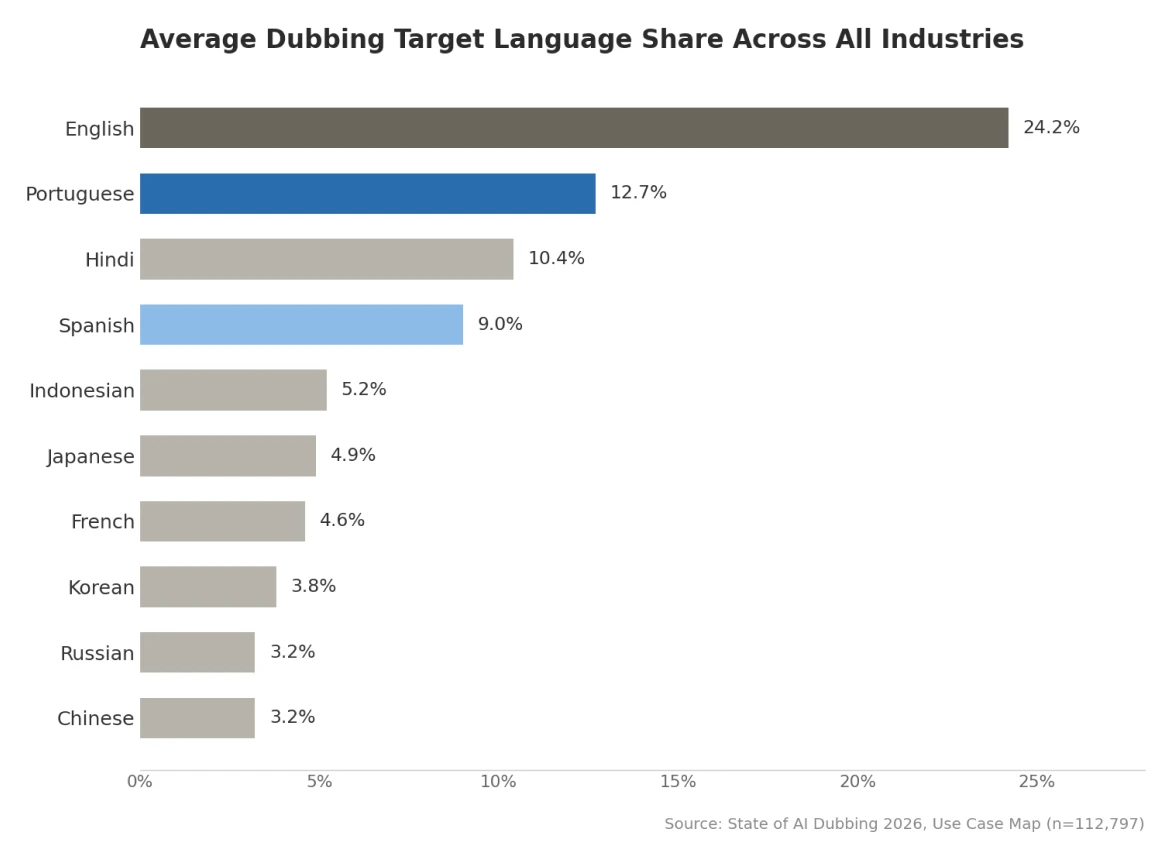
Most people reach for Spanish, the world's second most spoken language. But State of AI Dubbing 2026, which analyzed about 110,000 dubbing projects from 4,023 creators across 80 countries, shows our instinct misses the mark. The short version: pick your dubbing language by the type of content (your industry), not by raw speaker count. Across all industries, Portuguese (12.7%) has already passed Spanish (9.0%), and the most attractive language after English is completely different from one field to the next.
In part one, "AI dubbing isn't about voice quality, it's language reach," we argued that the global race comes down to how many languages you expand into. This piece takes the next step and answers the follow-up: so which language should your business start with? Find your industry's signature language below.
Pick languages by population and you'll miss your viewers
The most common mistake when adding a language is using market size as the yardstick: ranking countries by population or GDP. It looks reasonable, but the data shows real dubbing demand moves on a different logic.
When State of AI Dubbing 2026 cross-analyzed target language by industry, the same language varied by more than 3x in demand depending on the field. Russian sits at 2–3% in most fields but jumps to 10.5% in gaming. Korean averages around 3% overall but reaches 12.5% in science and technology. Hold to a population ranking and you lose the very viewers who would watch your content.
What drives dubbing demand isn't how many people speak a language. It's what the speakers of that language actually watch. So the starting point for language choice isn't broad world population stats, it's the real demand in the industry your content belongs to.
Your industry's cheat code: the signature-language map
The table below lists the top three target languages for 10 industries, plus the signature language, the one whose demand concentrates here far more than in other fields. The signature language is your first candidate after English.
Note: signature languages were chosen by weighing target-language share within the industry, excess demand versus the cross-industry average, and links to broader global trends.
Industry | Top 3 target languages | Signature language |
|---|---|---|
Education | English · Spanish · Portuguese | None (evenly spread) |
Science & technology | English · Korean · Spanish | Korean |
Business & finance | English · Spanish · Portuguese | Indonesian |
Healthcare & wellness | English · Portuguese · Spanish | Japanese |
Gaming | English · Russian · Portuguese | Russian |
Religion | English · Portuguese · Spanish | Portuguese |
Talk & interview | English · Portuguese · Japanese | Japanese |
Entertainment & documentary | English · French · Hindi | French |
Animation | Hindi · Portuguese · English | Hindi |
Film & drama | Hindi · English · Indonesian | Hindi |
Using it is simple. Find the field your content sits in, and place that industry's signature language right after English. For gaming, that's Russian; for science and tech, Korean; for documentary, French, right behind English. These are languages a population ranking would have buried far down the list.
The report notes that Hindi's strength in animation and film may reflect Perso Dubbing's India and South Asia user mix. Treat these two fields as a market signal, but cross-check against your own viewing data.
The dubbing blue ocean others missed: Portuguese
Average across every industry and something more interesting shows up. The most widely used language after English isn't Spanish, it's Portuguese. Portuguese took 12.7% of the total share, Spanish 9.0%, even though Spanish has roughly four times as many speakers.
Behind the reversal sits Brazil, a market of 200 million people. Portuguese trails only English across nearly every field: religion (25.2%), talk (19.5%), animation (16.3%), business (13.5%), healthcare (12.0%). It isn't a one-genre spike. It's a general-purpose runner-up that works regardless of field.
The takeaway is clear. If your industry's signature language is ambiguous, or you can only add one language beyond English, the answer is usually Portuguese. Pause the reflex to pick Spanish and target Brazilian viewers first.
BTS created demand for science YouTube?
The other strong signal is Korean. It looks ordinary at around 3% on average, but in science and tech content it hits 12.5%, beating Spanish (8.9%) for second place.
That's the reach of K-content that swept global markets. Viewers who entered Korean culture through BTS, Squid Game, and Parasite now consume knowledge and tech content in Korean too. About 30% of Korean target dubbing concentrates in knowledge verticals like science, technology, and education. Demand that came in through entertainment is evolving toward learning and tech.
So if your team makes education, science, tech, or lecture-style content, Korean belongs in your top tier of candidates, not on a "maybe later" list. Keep defaulting to English–Spanish–Chinese and you hand this valuable second-place market straight to competitors.
Industry priority guide at a glance
A quick guide for deciding which language to add right after English.
1st | 2nd | 3rd | |
|---|---|---|---|
Gaming | Russian | Portuguese | German |
Science & tech | Korean | Spanish | Japanese |
Documentary & entertainment | French | Hindi | Portuguese |
Religion | Portuguese | Spanish | Hindi |
Healthcare & wellness | Portuguese | Spanish | Japanese |
Business & finance | Spanish | Portuguese | Indonesian |
Talk & interview | Portuguese | Spanish | Japanese |
Education | Spanish | Portuguese | |
Not sure which industry? | Start with Portuguese (general-purpose runner-up) |
So where should your content start?
With industry demand mapped, the playbook is three steps.
Identify your content's industry. Find your field in the table above: gaming, education, documentary, and so on.
Dub the signature language first. In the slot after English where you'd habitually drop Spanish, put the data-backed signature language instead.
Expand to five languages, step by step. Starting from the signature language, add the second and third picks in order. Per the report, only the top 12% of creators reach five or more languages. Cross that line and the traffic you can capture globally changes entirely.
Perso Dubbing supports dubbing in 99+ languages and, drawing on real usage across 909 language pairs, suggests the next language that fits your business. The era of guessing your way through language choice is over. Build your content's next leap on the data where global creators are already winning.
→ Plan your next language with Perso Dubbing
Frequently asked questions
Should I do Spanish or Portuguese first?
By the cross-industry average, Portuguese (12.7%) is ahead of Spanish (9.0%). As Brazil's market grows, Portuguese stays strong across fields. That said, some areas like education and business are traditionally stronger in Spanish, so the most accurate move is to check your own industry's pattern first.
How exactly is a "signature language" decided?
It's the language whose share in a given industry rises most above the cross-industry average. Russian averages about 3% across all industries but climbs to 10.5% in gaming, roughly 3.3x, which makes it the signature language for gaming.
How many languages does Perso Dubbing support?
Perso Dubbing supports dubbing in 99+ languages, including English, Spanish, Chinese, Japanese, Korean, Portuguese, French, German, Hindi, Arabic, Turkish, Vietnamese, and Indonesian, with voice recognition in 100+ languages. The list keeps growing so creators can reach global viewers more easily.
All figures are from State of AI Dubbing 2026 (Perso Dubbing Data Team, 2026).
Once you finish your first English dub, the next question comes naturally
"Which language should I add next?"
Most people reach for Spanish, the world's second most spoken language. But State of AI Dubbing 2026, which analyzed about 110,000 dubbing projects from 4,023 creators across 80 countries, shows our instinct misses the mark. The short version: pick your dubbing language by the type of content (your industry), not by raw speaker count. Across all industries, Portuguese (12.7%) has already passed Spanish (9.0%), and the most attractive language after English is completely different from one field to the next.
In part one, "AI dubbing isn't about voice quality, it's language reach," we argued that the global race comes down to how many languages you expand into. This piece takes the next step and answers the follow-up: so which language should your business start with? Find your industry's signature language below.
Pick languages by population and you'll miss your viewers
The most common mistake when adding a language is using market size as the yardstick: ranking countries by population or GDP. It looks reasonable, but the data shows real dubbing demand moves on a different logic.
When State of AI Dubbing 2026 cross-analyzed target language by industry, the same language varied by more than 3x in demand depending on the field. Russian sits at 2–3% in most fields but jumps to 10.5% in gaming. Korean averages around 3% overall but reaches 12.5% in science and technology. Hold to a population ranking and you lose the very viewers who would watch your content.
What drives dubbing demand isn't how many people speak a language. It's what the speakers of that language actually watch. So the starting point for language choice isn't broad world population stats, it's the real demand in the industry your content belongs to.
Your industry's cheat code: the signature-language map
The table below lists the top three target languages for 10 industries, plus the signature language, the one whose demand concentrates here far more than in other fields. The signature language is your first candidate after English.
Note: signature languages were chosen by weighing target-language share within the industry, excess demand versus the cross-industry average, and links to broader global trends.
Industry | Top 3 target languages | Signature language |
|---|---|---|
Education | English · Spanish · Portuguese | None (evenly spread) |
Science & technology | English · Korean · Spanish | Korean |
Business & finance | English · Spanish · Portuguese | Indonesian |
Healthcare & wellness | English · Portuguese · Spanish | Japanese |
Gaming | English · Russian · Portuguese | Russian |
Religion | English · Portuguese · Spanish | Portuguese |
Talk & interview | English · Portuguese · Japanese | Japanese |
Entertainment & documentary | English · French · Hindi | French |
Animation | Hindi · Portuguese · English | Hindi |
Film & drama | Hindi · English · Indonesian | Hindi |
Using it is simple. Find the field your content sits in, and place that industry's signature language right after English. For gaming, that's Russian; for science and tech, Korean; for documentary, French, right behind English. These are languages a population ranking would have buried far down the list.
The report notes that Hindi's strength in animation and film may reflect Perso Dubbing's India and South Asia user mix. Treat these two fields as a market signal, but cross-check against your own viewing data.
The dubbing blue ocean others missed: Portuguese
Average across every industry and something more interesting shows up. The most widely used language after English isn't Spanish, it's Portuguese. Portuguese took 12.7% of the total share, Spanish 9.0%, even though Spanish has roughly four times as many speakers.
Behind the reversal sits Brazil, a market of 200 million people. Portuguese trails only English across nearly every field: religion (25.2%), talk (19.5%), animation (16.3%), business (13.5%), healthcare (12.0%). It isn't a one-genre spike. It's a general-purpose runner-up that works regardless of field.
The takeaway is clear. If your industry's signature language is ambiguous, or you can only add one language beyond English, the answer is usually Portuguese. Pause the reflex to pick Spanish and target Brazilian viewers first.
BTS created demand for science YouTube?
The other strong signal is Korean. It looks ordinary at around 3% on average, but in science and tech content it hits 12.5%, beating Spanish (8.9%) for second place.
That's the reach of K-content that swept global markets. Viewers who entered Korean culture through BTS, Squid Game, and Parasite now consume knowledge and tech content in Korean too. About 30% of Korean target dubbing concentrates in knowledge verticals like science, technology, and education. Demand that came in through entertainment is evolving toward learning and tech.
So if your team makes education, science, tech, or lecture-style content, Korean belongs in your top tier of candidates, not on a "maybe later" list. Keep defaulting to English–Spanish–Chinese and you hand this valuable second-place market straight to competitors.
Industry priority guide at a glance
A quick guide for deciding which language to add right after English.
1st | 2nd | 3rd | |
|---|---|---|---|
Gaming | Russian | Portuguese | German |
Science & tech | Korean | Spanish | Japanese |
Documentary & entertainment | French | Hindi | Portuguese |
Religion | Portuguese | Spanish | Hindi |
Healthcare & wellness | Portuguese | Spanish | Japanese |
Business & finance | Spanish | Portuguese | Indonesian |
Talk & interview | Portuguese | Spanish | Japanese |
Education | Spanish | Portuguese | |
Not sure which industry? | Start with Portuguese (general-purpose runner-up) |
So where should your content start?
With industry demand mapped, the playbook is three steps.
Identify your content's industry. Find your field in the table above: gaming, education, documentary, and so on.
Dub the signature language first. In the slot after English where you'd habitually drop Spanish, put the data-backed signature language instead.
Expand to five languages, step by step. Starting from the signature language, add the second and third picks in order. Per the report, only the top 12% of creators reach five or more languages. Cross that line and the traffic you can capture globally changes entirely.
Perso Dubbing supports dubbing in 99+ languages and, drawing on real usage across 909 language pairs, suggests the next language that fits your business. The era of guessing your way through language choice is over. Build your content's next leap on the data where global creators are already winning.
→ Plan your next language with Perso Dubbing
Frequently asked questions
Should I do Spanish or Portuguese first?
By the cross-industry average, Portuguese (12.7%) is ahead of Spanish (9.0%). As Brazil's market grows, Portuguese stays strong across fields. That said, some areas like education and business are traditionally stronger in Spanish, so the most accurate move is to check your own industry's pattern first.
How exactly is a "signature language" decided?
It's the language whose share in a given industry rises most above the cross-industry average. Russian averages about 3% across all industries but climbs to 10.5% in gaming, roughly 3.3x, which makes it the signature language for gaming.
How many languages does Perso Dubbing support?
Perso Dubbing supports dubbing in 99+ languages, including English, Spanish, Chinese, Japanese, Korean, Portuguese, French, German, Hindi, Arabic, Turkish, Vietnamese, and Indonesian, with voice recognition in 100+ languages. The list keeps growing so creators can reach global viewers more easily.
All figures are from State of AI Dubbing 2026 (Perso Dubbing Data Team, 2026).
Once you finish your first English dub, the next question comes naturally
"Which language should I add next?"
Most people reach for Spanish, the world's second most spoken language. But State of AI Dubbing 2026, which analyzed about 110,000 dubbing projects from 4,023 creators across 80 countries, shows our instinct misses the mark. The short version: pick your dubbing language by the type of content (your industry), not by raw speaker count. Across all industries, Portuguese (12.7%) has already passed Spanish (9.0%), and the most attractive language after English is completely different from one field to the next.
In part one, "AI dubbing isn't about voice quality, it's language reach," we argued that the global race comes down to how many languages you expand into. This piece takes the next step and answers the follow-up: so which language should your business start with? Find your industry's signature language below.
Pick languages by population and you'll miss your viewers
The most common mistake when adding a language is using market size as the yardstick: ranking countries by population or GDP. It looks reasonable, but the data shows real dubbing demand moves on a different logic.
When State of AI Dubbing 2026 cross-analyzed target language by industry, the same language varied by more than 3x in demand depending on the field. Russian sits at 2–3% in most fields but jumps to 10.5% in gaming. Korean averages around 3% overall but reaches 12.5% in science and technology. Hold to a population ranking and you lose the very viewers who would watch your content.
What drives dubbing demand isn't how many people speak a language. It's what the speakers of that language actually watch. So the starting point for language choice isn't broad world population stats, it's the real demand in the industry your content belongs to.
Your industry's cheat code: the signature-language map
The table below lists the top three target languages for 10 industries, plus the signature language, the one whose demand concentrates here far more than in other fields. The signature language is your first candidate after English.
Note: signature languages were chosen by weighing target-language share within the industry, excess demand versus the cross-industry average, and links to broader global trends.
Industry | Top 3 target languages | Signature language |
|---|---|---|
Education | English · Spanish · Portuguese | None (evenly spread) |
Science & technology | English · Korean · Spanish | Korean |
Business & finance | English · Spanish · Portuguese | Indonesian |
Healthcare & wellness | English · Portuguese · Spanish | Japanese |
Gaming | English · Russian · Portuguese | Russian |
Religion | English · Portuguese · Spanish | Portuguese |
Talk & interview | English · Portuguese · Japanese | Japanese |
Entertainment & documentary | English · French · Hindi | French |
Animation | Hindi · Portuguese · English | Hindi |
Film & drama | Hindi · English · Indonesian | Hindi |
Using it is simple. Find the field your content sits in, and place that industry's signature language right after English. For gaming, that's Russian; for science and tech, Korean; for documentary, French, right behind English. These are languages a population ranking would have buried far down the list.
The report notes that Hindi's strength in animation and film may reflect Perso Dubbing's India and South Asia user mix. Treat these two fields as a market signal, but cross-check against your own viewing data.
The dubbing blue ocean others missed: Portuguese
Average across every industry and something more interesting shows up. The most widely used language after English isn't Spanish, it's Portuguese. Portuguese took 12.7% of the total share, Spanish 9.0%, even though Spanish has roughly four times as many speakers.
Behind the reversal sits Brazil, a market of 200 million people. Portuguese trails only English across nearly every field: religion (25.2%), talk (19.5%), animation (16.3%), business (13.5%), healthcare (12.0%). It isn't a one-genre spike. It's a general-purpose runner-up that works regardless of field.
The takeaway is clear. If your industry's signature language is ambiguous, or you can only add one language beyond English, the answer is usually Portuguese. Pause the reflex to pick Spanish and target Brazilian viewers first.
BTS created demand for science YouTube?
The other strong signal is Korean. It looks ordinary at around 3% on average, but in science and tech content it hits 12.5%, beating Spanish (8.9%) for second place.
That's the reach of K-content that swept global markets. Viewers who entered Korean culture through BTS, Squid Game, and Parasite now consume knowledge and tech content in Korean too. About 30% of Korean target dubbing concentrates in knowledge verticals like science, technology, and education. Demand that came in through entertainment is evolving toward learning and tech.
So if your team makes education, science, tech, or lecture-style content, Korean belongs in your top tier of candidates, not on a "maybe later" list. Keep defaulting to English–Spanish–Chinese and you hand this valuable second-place market straight to competitors.
Industry priority guide at a glance
A quick guide for deciding which language to add right after English.
1st | 2nd | 3rd | |
|---|---|---|---|
Gaming | Russian | Portuguese | German |
Science & tech | Korean | Spanish | Japanese |
Documentary & entertainment | French | Hindi | Portuguese |
Religion | Portuguese | Spanish | Hindi |
Healthcare & wellness | Portuguese | Spanish | Japanese |
Business & finance | Spanish | Portuguese | Indonesian |
Talk & interview | Portuguese | Spanish | Japanese |
Education | Spanish | Portuguese | |
Not sure which industry? | Start with Portuguese (general-purpose runner-up) |
So where should your content start?
With industry demand mapped, the playbook is three steps.
Identify your content's industry. Find your field in the table above: gaming, education, documentary, and so on.
Dub the signature language first. In the slot after English where you'd habitually drop Spanish, put the data-backed signature language instead.
Expand to five languages, step by step. Starting from the signature language, add the second and third picks in order. Per the report, only the top 12% of creators reach five or more languages. Cross that line and the traffic you can capture globally changes entirely.
Perso Dubbing supports dubbing in 99+ languages and, drawing on real usage across 909 language pairs, suggests the next language that fits your business. The era of guessing your way through language choice is over. Build your content's next leap on the data where global creators are already winning.
→ Plan your next language with Perso Dubbing
Frequently asked questions
Should I do Spanish or Portuguese first?
By the cross-industry average, Portuguese (12.7%) is ahead of Spanish (9.0%). As Brazil's market grows, Portuguese stays strong across fields. That said, some areas like education and business are traditionally stronger in Spanish, so the most accurate move is to check your own industry's pattern first.
How exactly is a "signature language" decided?
It's the language whose share in a given industry rises most above the cross-industry average. Russian averages about 3% across all industries but climbs to 10.5% in gaming, roughly 3.3x, which makes it the signature language for gaming.
How many languages does Perso Dubbing support?
Perso Dubbing supports dubbing in 99+ languages, including English, Spanish, Chinese, Japanese, Korean, Portuguese, French, German, Hindi, Arabic, Turkish, Vietnamese, and Indonesian, with voice recognition in 100+ languages. The list keeps growing so creators can reach global viewers more easily.
All figures are from State of AI Dubbing 2026 (Perso Dubbing Data Team, 2026).
Continue Reading
Browse All