The Rise of Non-Western Audiences: Where Contents Should Expand Next
Last Updated




Jump to section
Jump to section

Share
Share
Share

AI Video Translator, Localization, and Dubbing Tool
Try it out for Free
For years, the global content industry relied on a simple growth strategy: "Create content in English, and the world will watch." Content was typically produced in English first, while other languages were treated as optional add-ons through translation.
However, the findings from 『State of AI Dubbing 2026』 suggest that this approach is no longer enough. The report makes one thing clear: an English-only strategy is no longer sufficient for global growth.
Following the first two articles in this series on reach and language selection, this article explores why non-Western markets are emerging as the next major battleground for AI dubbing—and which content categories are most likely to succeed in each market.
The End of the English Monopoly: Who Comes Next?
Historically, the global content ecosystem revolved around English. Other languages were often added later through basic translation, creating an "English-first" structure.
According to 『State of AI Dubbing 2026』, that landscape has changed dramatically. The AI dubbing market now operates across 36 source languages and 34 target languages, creating 909 active language pairs in a highly interconnected ecosystem.
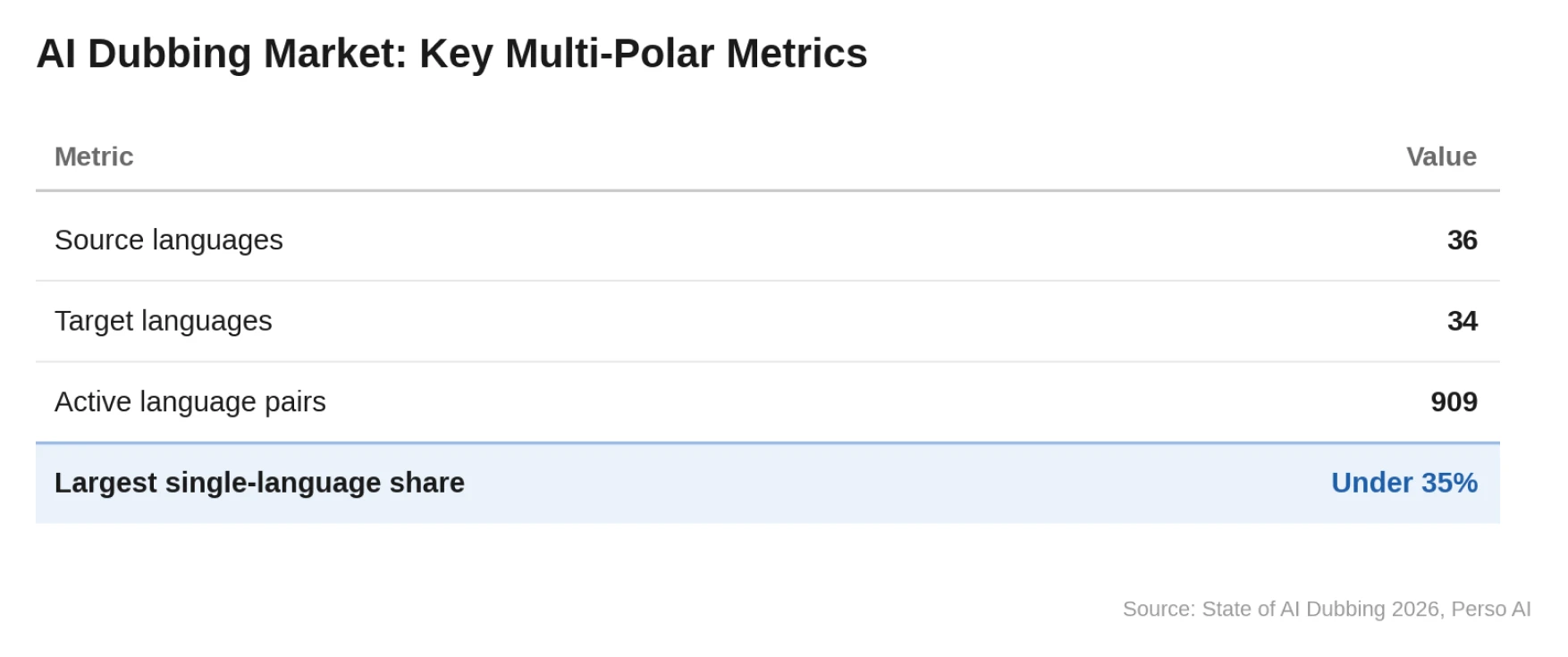
No single language now accounts for more than 35% of professional dubbing demand. In other words, the market is no longer organized around one dominant hub. Instead, it is becoming increasingly multipolar, with demand spreading across multiple language communities.
So where are the most promising opportunities today? The answer is not the traditional Western markets of North America or Europe. Instead, the data points to markets that have historically received less attention from global content creators: Brazil and South Korea.
Brazil: A Dual Hub Rivaling English
The first major pillar of non-Western growth is Portuguese—more specifically, Brazil.
Across the industry, Portuguese accounts for 12.7% of dubbing demand, already surpassing Spanish at 9.0%. This is particularly notable because Spanish has roughly four times as many native speakers worldwide. The explanation lies in the sheer scale of Brazil, a country with more than 200 million people and a highly engaged digital audience.
Religious content category stands out above all others. Driven by strong faith-based communities throughout Latin America, Portuguese has become nearly equal to English in the religious dubbing market. Portuguese accounts for 25.2% of demand, while English holds 25.6%.
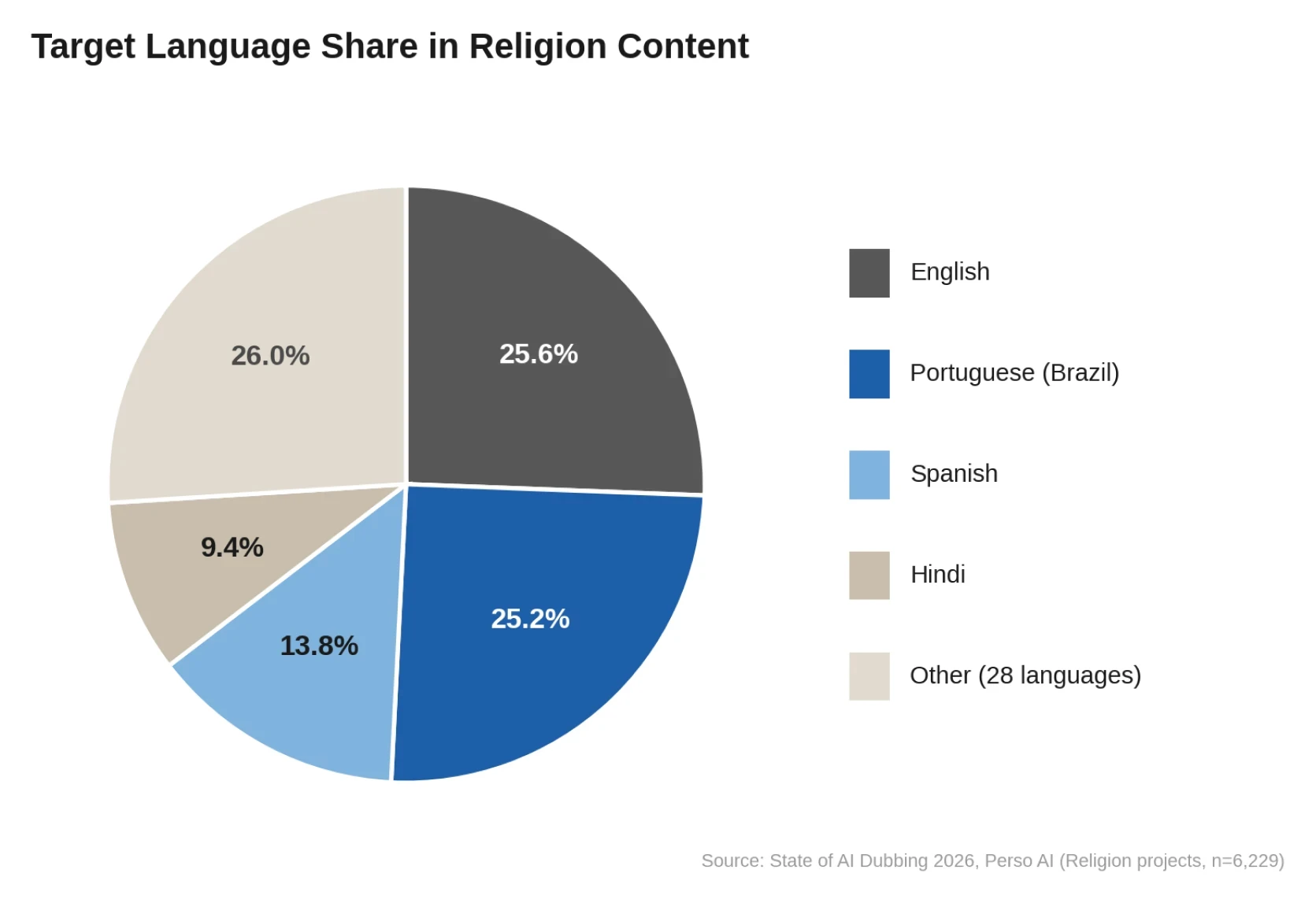
The report describes this phenomenon as a "Dual Hub" structure, where Portuguese and English function as co-leading languages within the religious content ecosystem.
Brazil's strength extends beyond a single category. Looking at Portuguese-targeted dubbing by industry, demand is remarkably balanced across multiple verticals:
Animation: 12.9%
Religion: 12.0%
Education: 9.9%
No single category exceeds 13%, demonstrating that Brazil is a highly diversified multi-vertical market. Whether your content focuses on education, entertainment, religion, or general knowledge, the Brazilian audience presents a broad and stable opportunity.
South Korea: A Global Hub for Knowledge Content
The second major growth pillar is Korean. At first glance, Korean appears relatively modest, representing only around 3% of overall dubbing demand. However, the picture changes dramatically within science and technology content.
Among science and technology projects, Korean accounts for 12.5% of dubbing demand, ranking second structurally and surpassing Spanish (8.9%) by 3.6 percentage points.
The roots of this trend can be traced back to the global rise of K-content. International audiences who first discovered Korean culture through BTS, Squid Game, Parasite, and BLACKPINK are increasingly seeking not only entertainment but also educational and knowledge-based content in Korean.
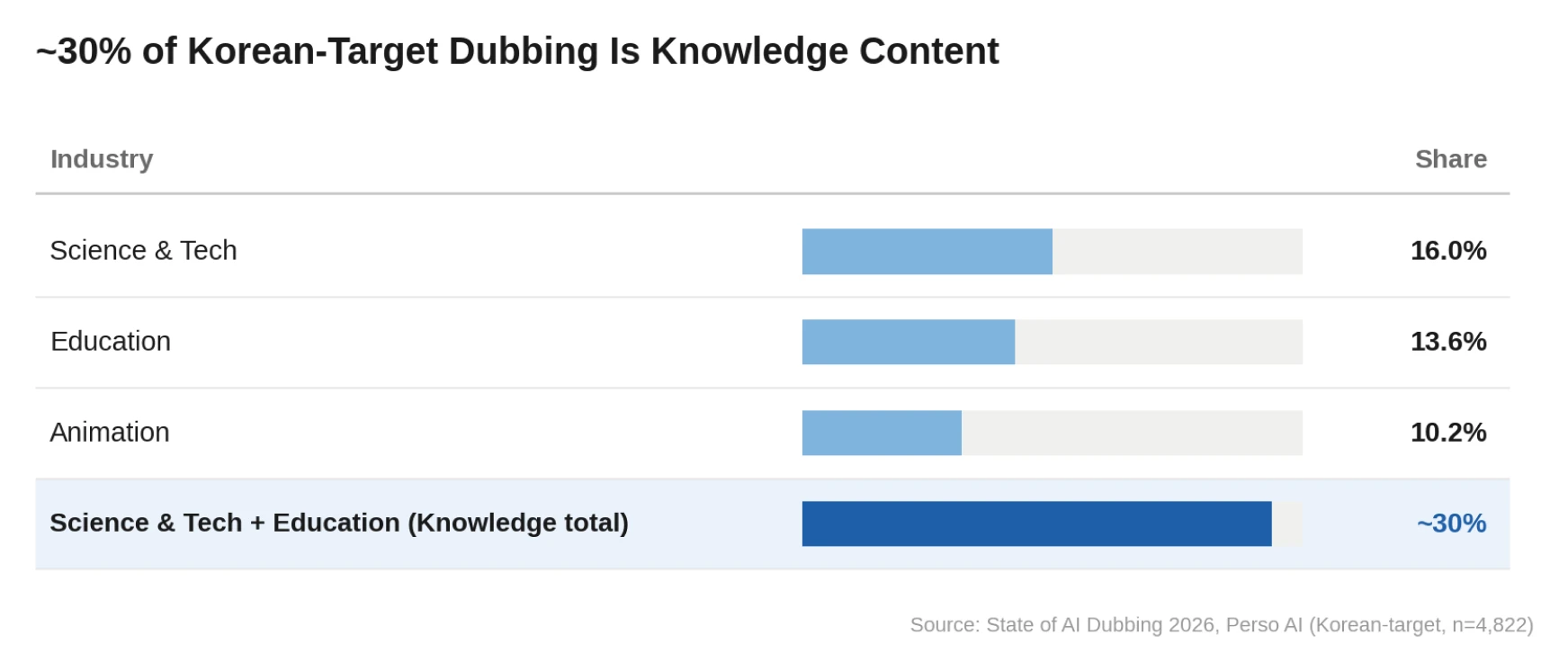
When analyzing the entire Korean-targeted dubbing dataset (n=4,822), science and technology (16.0%) and education (13.6%) together account for nearly 30% of all demand. This suggests that cultural interest initially driven by entertainment is expanding into learning, professional development, and technology-focused content.
Content Opportunities Across Non-Western Markets
The shift toward non-Western markets extends beyond Brazil and South Korea. Demand is increasingly distributed across multiple language communities, each with its own content preferences.
The table below highlights the strongest-performing content categories for several major non-Western language markets.
Market (Language) | Top Category | Second Category | Third Category |
|---|---|---|---|
Brazil (Portuguese) | Animation (12.9%) | Religion (12.0%) | Education (9.9%) |
South Korea (Korean) | Science & Technology (16.0%) | Education (13.6%) | Animation (10.2%) |
Japan (Japanese) | Healthcare (16.0%) | Education (14.8%) | Gaming (11.0%) |
Spanish-speaking Markets | Education (13.3%) | Religion (8.0%) | Business (7.2%) |
For content creators, these profiles reveal hidden opportunities. By aligning content with the strengths of each market, it is possible to reach significantly larger audiences without proportionally increasing production effort.
The Opportunity Is Available Today
Treating non-Western markets as a secondary priority means missing some of the fastest-growing sources of global demand.
Take a look at your content category and compare it with the table above. Identify the non-Western market that best aligns with your content after English. Whether that market is Brazil, South Korea, Japan, or another emerging language community, the potential audience may be much larger than you expect.
Perso Dubbing supports dubbing in 99+ languages and provides market recommendations based on real-world data from 909 active language pairs. With AI-powered voice cloning, lip-sync technology, and localized adaptation, creators can expand beyond Western audiences and reach high-potential global markets faster than ever.
Frequently Asked Questions
Why are non-Western markets becoming important in AI dubbing?
According to State of AI Dubbing 2026, dubbing demand is no longer concentrated around English. Instead, the market has evolved into a multipolar ecosystem where languages such as Portuguese and Korean are experiencing rapid growth. Examples include Portuguese surpassing Spanish in overall demand and Korean outperforming Spanish within science and technology content.
Why is the Brazilian (Portuguese) market attracting so much attention?
Brazil represents one of the most balanced and diversified dubbing markets. In religious content, Portuguese (25.2%) nearly matches English (25.6%), while animation, education, and other categories also demonstrate strong demand. For creators adding just one language beyond English, Portuguese is often the safest expansion choice.
Can AI dubbing adapt to cultural and linguistic nuances in different markets?
Yes. Perso Dubbing goes beyond direct translation by adapting tone, intent, and cultural context for each target market. Combined with voice cloning and lip-sync technology, dubbed videos can sound and feel as if they were originally created for local audiences.
All statistics cited in this article are based on State of AI Dubbing 2026 (Perso Dubbing Data Team, 2026).
For years, the global content industry relied on a simple growth strategy: "Create content in English, and the world will watch." Content was typically produced in English first, while other languages were treated as optional add-ons through translation.
However, the findings from 『State of AI Dubbing 2026』 suggest that this approach is no longer enough. The report makes one thing clear: an English-only strategy is no longer sufficient for global growth.
Following the first two articles in this series on reach and language selection, this article explores why non-Western markets are emerging as the next major battleground for AI dubbing—and which content categories are most likely to succeed in each market.
The End of the English Monopoly: Who Comes Next?
Historically, the global content ecosystem revolved around English. Other languages were often added later through basic translation, creating an "English-first" structure.
According to 『State of AI Dubbing 2026』, that landscape has changed dramatically. The AI dubbing market now operates across 36 source languages and 34 target languages, creating 909 active language pairs in a highly interconnected ecosystem.
No single language now accounts for more than 35% of professional dubbing demand. In other words, the market is no longer organized around one dominant hub. Instead, it is becoming increasingly multipolar, with demand spreading across multiple language communities.
So where are the most promising opportunities today? The answer is not the traditional Western markets of North America or Europe. Instead, the data points to markets that have historically received less attention from global content creators: Brazil and South Korea.
Brazil: A Dual Hub Rivaling English
The first major pillar of non-Western growth is Portuguese—more specifically, Brazil.
Across the industry, Portuguese accounts for 12.7% of dubbing demand, already surpassing Spanish at 9.0%. This is particularly notable because Spanish has roughly four times as many native speakers worldwide. The explanation lies in the sheer scale of Brazil, a country with more than 200 million people and a highly engaged digital audience.
Religious content category stands out above all others. Driven by strong faith-based communities throughout Latin America, Portuguese has become nearly equal to English in the religious dubbing market. Portuguese accounts for 25.2% of demand, while English holds 25.6%.
The report describes this phenomenon as a "Dual Hub" structure, where Portuguese and English function as co-leading languages within the religious content ecosystem.
Brazil's strength extends beyond a single category. Looking at Portuguese-targeted dubbing by industry, demand is remarkably balanced across multiple verticals:
Animation: 12.9%
Religion: 12.0%
Education: 9.9%
No single category exceeds 13%, demonstrating that Brazil is a highly diversified multi-vertical market. Whether your content focuses on education, entertainment, religion, or general knowledge, the Brazilian audience presents a broad and stable opportunity.
South Korea: A Global Hub for Knowledge Content
The second major growth pillar is Korean. At first glance, Korean appears relatively modest, representing only around 3% of overall dubbing demand. However, the picture changes dramatically within science and technology content.
Among science and technology projects, Korean accounts for 12.5% of dubbing demand, ranking second structurally and surpassing Spanish (8.9%) by 3.6 percentage points.
The roots of this trend can be traced back to the global rise of K-content. International audiences who first discovered Korean culture through BTS, Squid Game, Parasite, and BLACKPINK are increasingly seeking not only entertainment but also educational and knowledge-based content in Korean.
When analyzing the entire Korean-targeted dubbing dataset (n=4,822), science and technology (16.0%) and education (13.6%) together account for nearly 30% of all demand. This suggests that cultural interest initially driven by entertainment is expanding into learning, professional development, and technology-focused content.
Content Opportunities Across Non-Western Markets
The shift toward non-Western markets extends beyond Brazil and South Korea. Demand is increasingly distributed across multiple language communities, each with its own content preferences.
The table below highlights the strongest-performing content categories for several major non-Western language markets.
Market (Language) | Top Category | Second Category | Third Category |
|---|---|---|---|
Brazil (Portuguese) | Animation (12.9%) | Religion (12.0%) | Education (9.9%) |
South Korea (Korean) | Science & Technology (16.0%) | Education (13.6%) | Animation (10.2%) |
Japan (Japanese) | Healthcare (16.0%) | Education (14.8%) | Gaming (11.0%) |
Spanish-speaking Markets | Education (13.3%) | Religion (8.0%) | Business (7.2%) |
For content creators, these profiles reveal hidden opportunities. By aligning content with the strengths of each market, it is possible to reach significantly larger audiences without proportionally increasing production effort.
The Opportunity Is Available Today
Treating non-Western markets as a secondary priority means missing some of the fastest-growing sources of global demand.
Take a look at your content category and compare it with the table above. Identify the non-Western market that best aligns with your content after English. Whether that market is Brazil, South Korea, Japan, or another emerging language community, the potential audience may be much larger than you expect.
Perso Dubbing supports dubbing in 99+ languages and provides market recommendations based on real-world data from 909 active language pairs. With AI-powered voice cloning, lip-sync technology, and localized adaptation, creators can expand beyond Western audiences and reach high-potential global markets faster than ever.
Frequently Asked Questions
Why are non-Western markets becoming important in AI dubbing?
According to State of AI Dubbing 2026, dubbing demand is no longer concentrated around English. Instead, the market has evolved into a multipolar ecosystem where languages such as Portuguese and Korean are experiencing rapid growth. Examples include Portuguese surpassing Spanish in overall demand and Korean outperforming Spanish within science and technology content.
Why is the Brazilian (Portuguese) market attracting so much attention?
Brazil represents one of the most balanced and diversified dubbing markets. In religious content, Portuguese (25.2%) nearly matches English (25.6%), while animation, education, and other categories also demonstrate strong demand. For creators adding just one language beyond English, Portuguese is often the safest expansion choice.
Can AI dubbing adapt to cultural and linguistic nuances in different markets?
Yes. Perso Dubbing goes beyond direct translation by adapting tone, intent, and cultural context for each target market. Combined with voice cloning and lip-sync technology, dubbed videos can sound and feel as if they were originally created for local audiences.
All statistics cited in this article are based on State of AI Dubbing 2026 (Perso Dubbing Data Team, 2026).
For years, the global content industry relied on a simple growth strategy: "Create content in English, and the world will watch." Content was typically produced in English first, while other languages were treated as optional add-ons through translation.
However, the findings from 『State of AI Dubbing 2026』 suggest that this approach is no longer enough. The report makes one thing clear: an English-only strategy is no longer sufficient for global growth.
Following the first two articles in this series on reach and language selection, this article explores why non-Western markets are emerging as the next major battleground for AI dubbing—and which content categories are most likely to succeed in each market.
The End of the English Monopoly: Who Comes Next?
Historically, the global content ecosystem revolved around English. Other languages were often added later through basic translation, creating an "English-first" structure.
According to 『State of AI Dubbing 2026』, that landscape has changed dramatically. The AI dubbing market now operates across 36 source languages and 34 target languages, creating 909 active language pairs in a highly interconnected ecosystem.
No single language now accounts for more than 35% of professional dubbing demand. In other words, the market is no longer organized around one dominant hub. Instead, it is becoming increasingly multipolar, with demand spreading across multiple language communities.
So where are the most promising opportunities today? The answer is not the traditional Western markets of North America or Europe. Instead, the data points to markets that have historically received less attention from global content creators: Brazil and South Korea.
Brazil: A Dual Hub Rivaling English
The first major pillar of non-Western growth is Portuguese—more specifically, Brazil.
Across the industry, Portuguese accounts for 12.7% of dubbing demand, already surpassing Spanish at 9.0%. This is particularly notable because Spanish has roughly four times as many native speakers worldwide. The explanation lies in the sheer scale of Brazil, a country with more than 200 million people and a highly engaged digital audience.
Religious content category stands out above all others. Driven by strong faith-based communities throughout Latin America, Portuguese has become nearly equal to English in the religious dubbing market. Portuguese accounts for 25.2% of demand, while English holds 25.6%.
The report describes this phenomenon as a "Dual Hub" structure, where Portuguese and English function as co-leading languages within the religious content ecosystem.
Brazil's strength extends beyond a single category. Looking at Portuguese-targeted dubbing by industry, demand is remarkably balanced across multiple verticals:
Animation: 12.9%
Religion: 12.0%
Education: 9.9%
No single category exceeds 13%, demonstrating that Brazil is a highly diversified multi-vertical market. Whether your content focuses on education, entertainment, religion, or general knowledge, the Brazilian audience presents a broad and stable opportunity.
South Korea: A Global Hub for Knowledge Content
The second major growth pillar is Korean. At first glance, Korean appears relatively modest, representing only around 3% of overall dubbing demand. However, the picture changes dramatically within science and technology content.
Among science and technology projects, Korean accounts for 12.5% of dubbing demand, ranking second structurally and surpassing Spanish (8.9%) by 3.6 percentage points.
The roots of this trend can be traced back to the global rise of K-content. International audiences who first discovered Korean culture through BTS, Squid Game, Parasite, and BLACKPINK are increasingly seeking not only entertainment but also educational and knowledge-based content in Korean.
When analyzing the entire Korean-targeted dubbing dataset (n=4,822), science and technology (16.0%) and education (13.6%) together account for nearly 30% of all demand. This suggests that cultural interest initially driven by entertainment is expanding into learning, professional development, and technology-focused content.
Content Opportunities Across Non-Western Markets
The shift toward non-Western markets extends beyond Brazil and South Korea. Demand is increasingly distributed across multiple language communities, each with its own content preferences.
The table below highlights the strongest-performing content categories for several major non-Western language markets.
Market (Language) | Top Category | Second Category | Third Category |
|---|---|---|---|
Brazil (Portuguese) | Animation (12.9%) | Religion (12.0%) | Education (9.9%) |
South Korea (Korean) | Science & Technology (16.0%) | Education (13.6%) | Animation (10.2%) |
Japan (Japanese) | Healthcare (16.0%) | Education (14.8%) | Gaming (11.0%) |
Spanish-speaking Markets | Education (13.3%) | Religion (8.0%) | Business (7.2%) |
For content creators, these profiles reveal hidden opportunities. By aligning content with the strengths of each market, it is possible to reach significantly larger audiences without proportionally increasing production effort.
The Opportunity Is Available Today
Treating non-Western markets as a secondary priority means missing some of the fastest-growing sources of global demand.
Take a look at your content category and compare it with the table above. Identify the non-Western market that best aligns with your content after English. Whether that market is Brazil, South Korea, Japan, or another emerging language community, the potential audience may be much larger than you expect.
Perso Dubbing supports dubbing in 99+ languages and provides market recommendations based on real-world data from 909 active language pairs. With AI-powered voice cloning, lip-sync technology, and localized adaptation, creators can expand beyond Western audiences and reach high-potential global markets faster than ever.
Frequently Asked Questions
Why are non-Western markets becoming important in AI dubbing?
According to State of AI Dubbing 2026, dubbing demand is no longer concentrated around English. Instead, the market has evolved into a multipolar ecosystem where languages such as Portuguese and Korean are experiencing rapid growth. Examples include Portuguese surpassing Spanish in overall demand and Korean outperforming Spanish within science and technology content.
Why is the Brazilian (Portuguese) market attracting so much attention?
Brazil represents one of the most balanced and diversified dubbing markets. In religious content, Portuguese (25.2%) nearly matches English (25.6%), while animation, education, and other categories also demonstrate strong demand. For creators adding just one language beyond English, Portuguese is often the safest expansion choice.
Can AI dubbing adapt to cultural and linguistic nuances in different markets?
Yes. Perso Dubbing goes beyond direct translation by adapting tone, intent, and cultural context for each target market. Combined with voice cloning and lip-sync technology, dubbed videos can sound and feel as if they were originally created for local audiences.
All statistics cited in this article are based on State of AI Dubbing 2026 (Perso Dubbing Data Team, 2026).
Continue Reading
Browse All