Video Translator Workflows for Marketing Campaign Localization
Last Updated




Jump to section
Jump to section

Share
Share
Share

AI Video Translator, Localization, and Dubbing Tool
Try it out for Free
Are you a marketing manager struggling to launch your video campaigns in multiple countries at the same time?
Managing different languages can feel like a slow and expensive puzzle, especially when you need to keep your brand's voice consistent across every region.
This article explains how a professional video translator workflow helps you move past simple subtitles to create high-quality, localized content that actually connects with your global audience. You will learn how to set up a smart system to scale your marketing efforts without losing your mind or your budget.
Marketing challenges with multilingual video
Marketing teams face real problems when they try to share video campaigns across different countries. Your original message may work perfectly in English, but when you translate it word-for-word into Spanish or German, the impact disappears. Literal translations make your brand sound stiff and corporate instead of exciting and human. Cultural references that connect instantly with American viewers often confuse audiences in Asia or Europe.
Timing becomes another serious issue. If your Spanish subtitle is longer than the English version, it takes up more screen space and viewers might miss important parts before the scene changes. This gets worse when you're managing 5, 10, or 15 different language versions at the same time.
Budget pressure hits hard too. Traditional professional dubbing used to cost too much and take too long, so many marketing teams just added subtitles because they had no other choice. But subtitles don't deliver the same emotional connection, especially for brand storytelling, product demos, and social media ads where feeling matters more than reading.
CSA Research surveyed 8,709 consumers across 29 countries and found that 76% of online shoppers prefer to buy products when information is available in their native language. When your video stays in English only, you're losing more than three-quarters of your potential customers before they even watch.
So what's the solution? Let's compare your options.

Video translator vs subtitle-only approaches
Subtitles work, and they're cheap. You can add them to your video in a few hours and get your message into five different languages by the end of the week. But they also create a hidden problem that hurts your campaign results.
When people watch a subtitled video, their brain splits attention between reading text and watching your product demo. They miss important visual details, emotional moments, and call-to-action buttons because they're busy reading the bottom of the screen. This attention split reduces how much viewers actually understand and remember from your video.
Feature | Subtitles Only | Video Translator with Dubbing |
Viewer attention | Split between reading and watching | Fully focused on visuals |
Engagement rate | Baseline | 3-5x higher |
Watch time | Standard | 40-70% longer |
Mobile experience | Difficult to read small text | Easy, natural listening |
Brand voice consistency | Text translation only | Voice tone and emotion preserved |
Production speed | Fast (hours) | Fast with AI tools (1-2 days) |
The performance data shows this clearly. Dubbed videos often achieve significantly higher engagement than subtitled versions of the same content. Viewers tend to watch much longer when they hear the message in their native language instead of reading subtitles. Comment rates from international audiences can increase substantially with dubbed content.
A video translator that includes dubbing capabilities solves this problem. Instead of making viewers read, you let them hear your message in Spanish, German, or Japanese using natural-sounding voices. Modern AI dubbing tools can even clone your spokesperson's voice across 32+ languages, so your brand sounds consistent everywhere.
This matters most for mobile viewing, where subtitle text gets even smaller and harder to read. Since most social media users watch videos on their phones, subtitle-only approaches cut your international engagement before viewers even finish the first 10 seconds.
Understanding the difference is one thing. But how do you actually scale this across your entire campaign?
Campaign localization at scale
Localizing one video for two languages feels manageable. Localizing 15 videos for 8 different regions becomes chaos fast. Marketing teams who try to scale without a clear system end up with missed deadlines, inconsistent brand voice across markets, and translation costs that spiral out of control.
The traditional workflow breaks down at scale because it relies on too many manual handoffs. You send files to translators, wait for them to come back, review them, send revision requests, wait again, then finally publish—weeks after your campaign should have launched. When you multiply this process across multiple languages and videos, the delays stack up. Your global launch loses its impact.
A video translator built for marketing teams removes these bottlenecks. Modern tools let you upload your master video once, select your target languages, and generate dubbed versions in hours instead of weeks. The system uses glossaries to maintain your brand terminology across all versions. Your product names and key phrases stay consistent whether someone watches in Tokyo or Toronto.
The efficiency gains become massive when you're running ongoing campaigns. Instead of treating each language version as a separate project, you work from a single source file. When you need to update your call-to-action or fix a product detail, you change it once and push updates to all language versions automatically. This may cut revision time even up to 70-80% compared to managing separate files for each market.
Smart teams start small and scale gradually:
Pick one high-value video and test it in three priority languages first
Measure actual engagement metrics—watch time, click-through rates, conversion—for 1-2 weeks
Once you confirm the approach works, expand to more languages and more video types
This testing phase prevents expensive mistakes and builds confidence before you commit your full budget
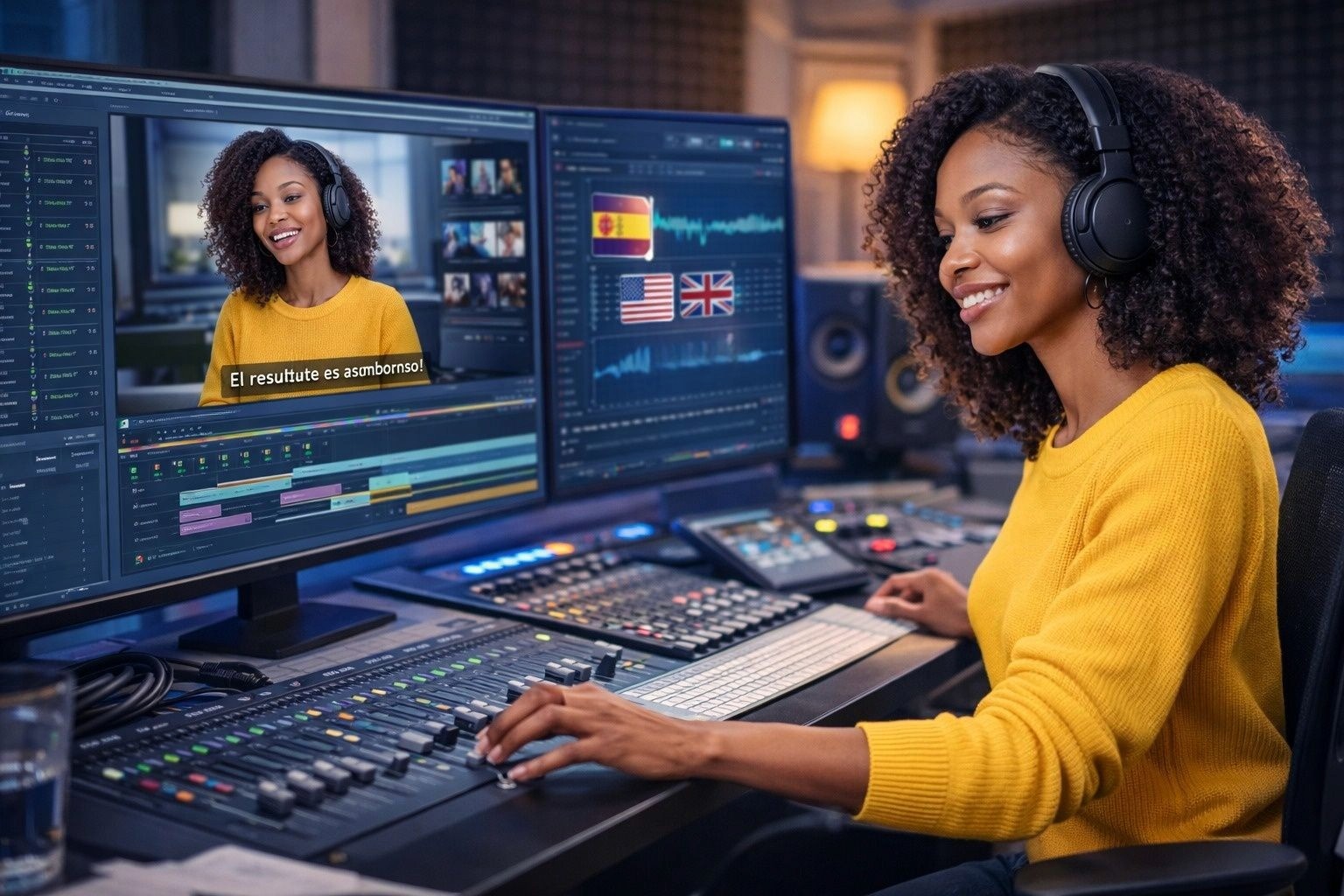
Example: product launch across regions
Imagine you're launching a new project management software tool across North America, Europe, and Asia. Your marketing team created a 2-minute product demo video in English that explains the key features, shows the interface, and includes customer testimonials. Now you need to reach audiences in Germany, France, Spain, Japan, and South Korea—all within the same launch week.
Here's what the workflow looks like with a video translator system:
Week 1: Preparation
Upload your master English video to the platform
Create a brand glossary with product names, key feature terms like "task automation" and "real-time collaboration," and your company tagline
The system will use these exact terms across all language versions to keep your brand voice consistent
Week 2: Translation and dubbing
Select your five target languages and generate translated scripts
Review each script with native speakers on your team or through quick freelancer reviews
Catch cultural issues (like changing "hit a home run" to a more universal metaphor for Japan)
AI dubbing tool creates voice tracks in each language, matching the tone and energy of your original narrator
Week 3: Regional customization
Swap out customer testimonial clips with regional clients where appropriate
Adjust on-screen text graphics to make room for longer translations in Japanese and Korean
Regional tweaks happen in parallel, not sequentially, saving days of production time
Week 4: Launch and measure
All five language versions go live simultaneously across YouTube, LinkedIn, and your product website
Track engagement metrics and compare performance across markets
Use data to optimize future campaigns
Teams using this workflow often see substantially higher engagement in European and Asian markets. This approach can lead to significantly more product inquiries. Companies that localize launch videos for new language markets frequently report stronger lead generation.
The key difference? They treated localization as part of the launch strategy from day one, not as an afterthought.
Operational workflow tips
Start by building your brand glossary before you translate anything. Include:
Product names and key feature terminology
Company tagline and brand messaging phrases
Industry-specific terms that must stay consistent
Phrases that should never be literally translated
Set up a centralized asset library from day one. Store your master video files, approved scripts, brand guidelines, and all language versions in one Digital Asset Management system. When someone needs the latest German version or wants to check the approved Japanese script, they find it in 30 seconds instead of sending Slack messages to five different people.
Break your project into specific tasks with clear owners. Don't just assign "Spanish localization" to Maria. Instead, create separate tasks like "review Spanish script translation," "approve voice selection," and "test Spanish version on mobile". This level of detail prevents the situation where everyone thinks someone else is handling quality checks.
Plan realistic timelines with buffer periods built in. Your project timeline says two weeks. But then your Japanese reviewer gets sick. Your French translator goes on vacation. Your German market manager is swamped with another launch. Suddenly, two weeks becomes four. Add buffer time from the start—three extra days minimum for review cycles, approvals, and platform testing.
Use translation memory systems even for video projects. When you update your product demo video next quarter, the system remembers how you translated "seamless integration" in all eight languages last time. You reuse 60-70% of previous translations automatically, cutting both time and cost for every update.
Test your localized videos with small focus groups before the full launch. Show the French version to three native French speakers on your team or hire quick freelancer reviewers. They'll catch awkward phrasing, cultural mismatches, or technical issues that you'd never spot yourself. This 2-hour investment prevents embarrassing mistakes in front of 50,000 viewers.
Track performance metrics separately for each language version. Don't just look at total views across all markets. Compare watch-through rates, click-through rates, and conversion rates for your German video versus your Spanish video. When you discover that Japanese viewers watch 85% of the video but German viewers drop off at 40%, you know exactly where to improve next time.
Here's what this looks like in practice: A SaaS company launched their demo video in six languages. They noticed German viewers dropped off at 40% while Japanese viewers watched 85%. After reviewing the German version, they discovered a cultural issue—the informal tone didn't match German business expectations. They re-recorded with a more professional voice and watch-through rates jumped to 72%.
Ready to localize your marketing campaigns?
Managing multilingual video campaigns doesn't have to slow down your launch schedule or drain your budget. When you use a video translator system built for marketing teams, you move from weeks of manual coordination to days of streamlined production. Your brand voice stays consistent across every market, your team spends less time on administrative handoffs, and your international audiences finally get the same quality experience as your English-speaking customers.
The difference between companies that succeed globally and those that struggle often comes down to how efficiently they handle localization. Teams that treat video translation as a technical workflow problem—not just a language problem—consistently deliver better results faster.
Perso Dubbing helps marketing teams localize video campaigns across 32+ languages with AI dubbing that maintains your brand voice. Explore how automated video translation workflows can help you reach global audiences without the traditional production bottlenecks.
Are you a marketing manager struggling to launch your video campaigns in multiple countries at the same time?
Managing different languages can feel like a slow and expensive puzzle, especially when you need to keep your brand's voice consistent across every region.
This article explains how a professional video translator workflow helps you move past simple subtitles to create high-quality, localized content that actually connects with your global audience. You will learn how to set up a smart system to scale your marketing efforts without losing your mind or your budget.
Marketing challenges with multilingual video
Marketing teams face real problems when they try to share video campaigns across different countries. Your original message may work perfectly in English, but when you translate it word-for-word into Spanish or German, the impact disappears. Literal translations make your brand sound stiff and corporate instead of exciting and human. Cultural references that connect instantly with American viewers often confuse audiences in Asia or Europe.
Timing becomes another serious issue. If your Spanish subtitle is longer than the English version, it takes up more screen space and viewers might miss important parts before the scene changes. This gets worse when you're managing 5, 10, or 15 different language versions at the same time.
Budget pressure hits hard too. Traditional professional dubbing used to cost too much and take too long, so many marketing teams just added subtitles because they had no other choice. But subtitles don't deliver the same emotional connection, especially for brand storytelling, product demos, and social media ads where feeling matters more than reading.
CSA Research surveyed 8,709 consumers across 29 countries and found that 76% of online shoppers prefer to buy products when information is available in their native language. When your video stays in English only, you're losing more than three-quarters of your potential customers before they even watch.
So what's the solution? Let's compare your options.
Video translator vs subtitle-only approaches
Subtitles work, and they're cheap. You can add them to your video in a few hours and get your message into five different languages by the end of the week. But they also create a hidden problem that hurts your campaign results.
When people watch a subtitled video, their brain splits attention between reading text and watching your product demo. They miss important visual details, emotional moments, and call-to-action buttons because they're busy reading the bottom of the screen. This attention split reduces how much viewers actually understand and remember from your video.
Feature | Subtitles Only | Video Translator with Dubbing |
Viewer attention | Split between reading and watching | Fully focused on visuals |
Engagement rate | Baseline | 3-5x higher |
Watch time | Standard | 40-70% longer |
Mobile experience | Difficult to read small text | Easy, natural listening |
Brand voice consistency | Text translation only | Voice tone and emotion preserved |
Production speed | Fast (hours) | Fast with AI tools (1-2 days) |
The performance data shows this clearly. Dubbed videos often achieve significantly higher engagement than subtitled versions of the same content. Viewers tend to watch much longer when they hear the message in their native language instead of reading subtitles. Comment rates from international audiences can increase substantially with dubbed content.
A video translator that includes dubbing capabilities solves this problem. Instead of making viewers read, you let them hear your message in Spanish, German, or Japanese using natural-sounding voices. Modern AI dubbing tools can even clone your spokesperson's voice across 32+ languages, so your brand sounds consistent everywhere.
This matters most for mobile viewing, where subtitle text gets even smaller and harder to read. Since most social media users watch videos on their phones, subtitle-only approaches cut your international engagement before viewers even finish the first 10 seconds.
Understanding the difference is one thing. But how do you actually scale this across your entire campaign?
Campaign localization at scale
Localizing one video for two languages feels manageable. Localizing 15 videos for 8 different regions becomes chaos fast. Marketing teams who try to scale without a clear system end up with missed deadlines, inconsistent brand voice across markets, and translation costs that spiral out of control.
The traditional workflow breaks down at scale because it relies on too many manual handoffs. You send files to translators, wait for them to come back, review them, send revision requests, wait again, then finally publish—weeks after your campaign should have launched. When you multiply this process across multiple languages and videos, the delays stack up. Your global launch loses its impact.
A video translator built for marketing teams removes these bottlenecks. Modern tools let you upload your master video once, select your target languages, and generate dubbed versions in hours instead of weeks. The system uses glossaries to maintain your brand terminology across all versions. Your product names and key phrases stay consistent whether someone watches in Tokyo or Toronto.
The efficiency gains become massive when you're running ongoing campaigns. Instead of treating each language version as a separate project, you work from a single source file. When you need to update your call-to-action or fix a product detail, you change it once and push updates to all language versions automatically. This may cut revision time even up to 70-80% compared to managing separate files for each market.
Smart teams start small and scale gradually:
Pick one high-value video and test it in three priority languages first
Measure actual engagement metrics—watch time, click-through rates, conversion—for 1-2 weeks
Once you confirm the approach works, expand to more languages and more video types
This testing phase prevents expensive mistakes and builds confidence before you commit your full budget
Example: product launch across regions
Imagine you're launching a new project management software tool across North America, Europe, and Asia. Your marketing team created a 2-minute product demo video in English that explains the key features, shows the interface, and includes customer testimonials. Now you need to reach audiences in Germany, France, Spain, Japan, and South Korea—all within the same launch week.
Here's what the workflow looks like with a video translator system:
Week 1: Preparation
Upload your master English video to the platform
Create a brand glossary with product names, key feature terms like "task automation" and "real-time collaboration," and your company tagline
The system will use these exact terms across all language versions to keep your brand voice consistent
Week 2: Translation and dubbing
Select your five target languages and generate translated scripts
Review each script with native speakers on your team or through quick freelancer reviews
Catch cultural issues (like changing "hit a home run" to a more universal metaphor for Japan)
AI dubbing tool creates voice tracks in each language, matching the tone and energy of your original narrator
Week 3: Regional customization
Swap out customer testimonial clips with regional clients where appropriate
Adjust on-screen text graphics to make room for longer translations in Japanese and Korean
Regional tweaks happen in parallel, not sequentially, saving days of production time
Week 4: Launch and measure
All five language versions go live simultaneously across YouTube, LinkedIn, and your product website
Track engagement metrics and compare performance across markets
Use data to optimize future campaigns
Teams using this workflow often see substantially higher engagement in European and Asian markets. This approach can lead to significantly more product inquiries. Companies that localize launch videos for new language markets frequently report stronger lead generation.
The key difference? They treated localization as part of the launch strategy from day one, not as an afterthought.
Operational workflow tips
Start by building your brand glossary before you translate anything. Include:
Product names and key feature terminology
Company tagline and brand messaging phrases
Industry-specific terms that must stay consistent
Phrases that should never be literally translated
Set up a centralized asset library from day one. Store your master video files, approved scripts, brand guidelines, and all language versions in one Digital Asset Management system. When someone needs the latest German version or wants to check the approved Japanese script, they find it in 30 seconds instead of sending Slack messages to five different people.
Break your project into specific tasks with clear owners. Don't just assign "Spanish localization" to Maria. Instead, create separate tasks like "review Spanish script translation," "approve voice selection," and "test Spanish version on mobile". This level of detail prevents the situation where everyone thinks someone else is handling quality checks.
Plan realistic timelines with buffer periods built in. Your project timeline says two weeks. But then your Japanese reviewer gets sick. Your French translator goes on vacation. Your German market manager is swamped with another launch. Suddenly, two weeks becomes four. Add buffer time from the start—three extra days minimum for review cycles, approvals, and platform testing.
Use translation memory systems even for video projects. When you update your product demo video next quarter, the system remembers how you translated "seamless integration" in all eight languages last time. You reuse 60-70% of previous translations automatically, cutting both time and cost for every update.
Test your localized videos with small focus groups before the full launch. Show the French version to three native French speakers on your team or hire quick freelancer reviewers. They'll catch awkward phrasing, cultural mismatches, or technical issues that you'd never spot yourself. This 2-hour investment prevents embarrassing mistakes in front of 50,000 viewers.
Track performance metrics separately for each language version. Don't just look at total views across all markets. Compare watch-through rates, click-through rates, and conversion rates for your German video versus your Spanish video. When you discover that Japanese viewers watch 85% of the video but German viewers drop off at 40%, you know exactly where to improve next time.
Here's what this looks like in practice: A SaaS company launched their demo video in six languages. They noticed German viewers dropped off at 40% while Japanese viewers watched 85%. After reviewing the German version, they discovered a cultural issue—the informal tone didn't match German business expectations. They re-recorded with a more professional voice and watch-through rates jumped to 72%.
Ready to localize your marketing campaigns?
Managing multilingual video campaigns doesn't have to slow down your launch schedule or drain your budget. When you use a video translator system built for marketing teams, you move from weeks of manual coordination to days of streamlined production. Your brand voice stays consistent across every market, your team spends less time on administrative handoffs, and your international audiences finally get the same quality experience as your English-speaking customers.
The difference between companies that succeed globally and those that struggle often comes down to how efficiently they handle localization. Teams that treat video translation as a technical workflow problem—not just a language problem—consistently deliver better results faster.
Perso Dubbing helps marketing teams localize video campaigns across 32+ languages with AI dubbing that maintains your brand voice. Explore how automated video translation workflows can help you reach global audiences without the traditional production bottlenecks.
Are you a marketing manager struggling to launch your video campaigns in multiple countries at the same time?
Managing different languages can feel like a slow and expensive puzzle, especially when you need to keep your brand's voice consistent across every region.
This article explains how a professional video translator workflow helps you move past simple subtitles to create high-quality, localized content that actually connects with your global audience. You will learn how to set up a smart system to scale your marketing efforts without losing your mind or your budget.
Marketing challenges with multilingual video
Marketing teams face real problems when they try to share video campaigns across different countries. Your original message may work perfectly in English, but when you translate it word-for-word into Spanish or German, the impact disappears. Literal translations make your brand sound stiff and corporate instead of exciting and human. Cultural references that connect instantly with American viewers often confuse audiences in Asia or Europe.
Timing becomes another serious issue. If your Spanish subtitle is longer than the English version, it takes up more screen space and viewers might miss important parts before the scene changes. This gets worse when you're managing 5, 10, or 15 different language versions at the same time.
Budget pressure hits hard too. Traditional professional dubbing used to cost too much and take too long, so many marketing teams just added subtitles because they had no other choice. But subtitles don't deliver the same emotional connection, especially for brand storytelling, product demos, and social media ads where feeling matters more than reading.
CSA Research surveyed 8,709 consumers across 29 countries and found that 76% of online shoppers prefer to buy products when information is available in their native language. When your video stays in English only, you're losing more than three-quarters of your potential customers before they even watch.
So what's the solution? Let's compare your options.
Video translator vs subtitle-only approaches
Subtitles work, and they're cheap. You can add them to your video in a few hours and get your message into five different languages by the end of the week. But they also create a hidden problem that hurts your campaign results.
When people watch a subtitled video, their brain splits attention between reading text and watching your product demo. They miss important visual details, emotional moments, and call-to-action buttons because they're busy reading the bottom of the screen. This attention split reduces how much viewers actually understand and remember from your video.
Feature | Subtitles Only | Video Translator with Dubbing |
Viewer attention | Split between reading and watching | Fully focused on visuals |
Engagement rate | Baseline | 3-5x higher |
Watch time | Standard | 40-70% longer |
Mobile experience | Difficult to read small text | Easy, natural listening |
Brand voice consistency | Text translation only | Voice tone and emotion preserved |
Production speed | Fast (hours) | Fast with AI tools (1-2 days) |
The performance data shows this clearly. Dubbed videos often achieve significantly higher engagement than subtitled versions of the same content. Viewers tend to watch much longer when they hear the message in their native language instead of reading subtitles. Comment rates from international audiences can increase substantially with dubbed content.
A video translator that includes dubbing capabilities solves this problem. Instead of making viewers read, you let them hear your message in Spanish, German, or Japanese using natural-sounding voices. Modern AI dubbing tools can even clone your spokesperson's voice across 32+ languages, so your brand sounds consistent everywhere.
This matters most for mobile viewing, where subtitle text gets even smaller and harder to read. Since most social media users watch videos on their phones, subtitle-only approaches cut your international engagement before viewers even finish the first 10 seconds.
Understanding the difference is one thing. But how do you actually scale this across your entire campaign?
Campaign localization at scale
Localizing one video for two languages feels manageable. Localizing 15 videos for 8 different regions becomes chaos fast. Marketing teams who try to scale without a clear system end up with missed deadlines, inconsistent brand voice across markets, and translation costs that spiral out of control.
The traditional workflow breaks down at scale because it relies on too many manual handoffs. You send files to translators, wait for them to come back, review them, send revision requests, wait again, then finally publish—weeks after your campaign should have launched. When you multiply this process across multiple languages and videos, the delays stack up. Your global launch loses its impact.
A video translator built for marketing teams removes these bottlenecks. Modern tools let you upload your master video once, select your target languages, and generate dubbed versions in hours instead of weeks. The system uses glossaries to maintain your brand terminology across all versions. Your product names and key phrases stay consistent whether someone watches in Tokyo or Toronto.
The efficiency gains become massive when you're running ongoing campaigns. Instead of treating each language version as a separate project, you work from a single source file. When you need to update your call-to-action or fix a product detail, you change it once and push updates to all language versions automatically. This may cut revision time even up to 70-80% compared to managing separate files for each market.
Smart teams start small and scale gradually:
Pick one high-value video and test it in three priority languages first
Measure actual engagement metrics—watch time, click-through rates, conversion—for 1-2 weeks
Once you confirm the approach works, expand to more languages and more video types
This testing phase prevents expensive mistakes and builds confidence before you commit your full budget
Example: product launch across regions
Imagine you're launching a new project management software tool across North America, Europe, and Asia. Your marketing team created a 2-minute product demo video in English that explains the key features, shows the interface, and includes customer testimonials. Now you need to reach audiences in Germany, France, Spain, Japan, and South Korea—all within the same launch week.
Here's what the workflow looks like with a video translator system:
Week 1: Preparation
Upload your master English video to the platform
Create a brand glossary with product names, key feature terms like "task automation" and "real-time collaboration," and your company tagline
The system will use these exact terms across all language versions to keep your brand voice consistent
Week 2: Translation and dubbing
Select your five target languages and generate translated scripts
Review each script with native speakers on your team or through quick freelancer reviews
Catch cultural issues (like changing "hit a home run" to a more universal metaphor for Japan)
AI dubbing tool creates voice tracks in each language, matching the tone and energy of your original narrator
Week 3: Regional customization
Swap out customer testimonial clips with regional clients where appropriate
Adjust on-screen text graphics to make room for longer translations in Japanese and Korean
Regional tweaks happen in parallel, not sequentially, saving days of production time
Week 4: Launch and measure
All five language versions go live simultaneously across YouTube, LinkedIn, and your product website
Track engagement metrics and compare performance across markets
Use data to optimize future campaigns
Teams using this workflow often see substantially higher engagement in European and Asian markets. This approach can lead to significantly more product inquiries. Companies that localize launch videos for new language markets frequently report stronger lead generation.
The key difference? They treated localization as part of the launch strategy from day one, not as an afterthought.
Operational workflow tips
Start by building your brand glossary before you translate anything. Include:
Product names and key feature terminology
Company tagline and brand messaging phrases
Industry-specific terms that must stay consistent
Phrases that should never be literally translated
Set up a centralized asset library from day one. Store your master video files, approved scripts, brand guidelines, and all language versions in one Digital Asset Management system. When someone needs the latest German version or wants to check the approved Japanese script, they find it in 30 seconds instead of sending Slack messages to five different people.
Break your project into specific tasks with clear owners. Don't just assign "Spanish localization" to Maria. Instead, create separate tasks like "review Spanish script translation," "approve voice selection," and "test Spanish version on mobile". This level of detail prevents the situation where everyone thinks someone else is handling quality checks.
Plan realistic timelines with buffer periods built in. Your project timeline says two weeks. But then your Japanese reviewer gets sick. Your French translator goes on vacation. Your German market manager is swamped with another launch. Suddenly, two weeks becomes four. Add buffer time from the start—three extra days minimum for review cycles, approvals, and platform testing.
Use translation memory systems even for video projects. When you update your product demo video next quarter, the system remembers how you translated "seamless integration" in all eight languages last time. You reuse 60-70% of previous translations automatically, cutting both time and cost for every update.
Test your localized videos with small focus groups before the full launch. Show the French version to three native French speakers on your team or hire quick freelancer reviewers. They'll catch awkward phrasing, cultural mismatches, or technical issues that you'd never spot yourself. This 2-hour investment prevents embarrassing mistakes in front of 50,000 viewers.
Track performance metrics separately for each language version. Don't just look at total views across all markets. Compare watch-through rates, click-through rates, and conversion rates for your German video versus your Spanish video. When you discover that Japanese viewers watch 85% of the video but German viewers drop off at 40%, you know exactly where to improve next time.
Here's what this looks like in practice: A SaaS company launched their demo video in six languages. They noticed German viewers dropped off at 40% while Japanese viewers watched 85%. After reviewing the German version, they discovered a cultural issue—the informal tone didn't match German business expectations. They re-recorded with a more professional voice and watch-through rates jumped to 72%.
Ready to localize your marketing campaigns?
Managing multilingual video campaigns doesn't have to slow down your launch schedule or drain your budget. When you use a video translator system built for marketing teams, you move from weeks of manual coordination to days of streamlined production. Your brand voice stays consistent across every market, your team spends less time on administrative handoffs, and your international audiences finally get the same quality experience as your English-speaking customers.
The difference between companies that succeed globally and those that struggle often comes down to how efficiently they handle localization. Teams that treat video translation as a technical workflow problem—not just a language problem—consistently deliver better results faster.
Perso Dubbing helps marketing teams localize video campaigns across 32+ languages with AI dubbing that maintains your brand voice. Explore how automated video translation workflows can help you reach global audiences without the traditional production bottlenecks.
Continue Reading
Browse All