AI Video Translation Tools: Features & Business Limits
Last Updated




Jump to section
Jump to section

Share
Share
Share
AI Video Translator, Localization, and Dubbing Tool
Try it out for Free
AI video translation has become a practical requirement for businesses operating across multiple markets. Training teams, marketers, product organisations, and course creators are expected to deliver multilingual video content quickly, without duplicating production work for every language.
It is important to note that tools like Gemini or Claude are not AI video translation tools themselves, but general-purpose AI systems that support text-based tasks within the broader video translation workflow. Translating text is only one part of the process. Audio handling, voice consistency, timing, and lip sync introduce challenges that general AI tools are not designed to manage.
This article is for business teams evaluating AI video translation tools for real-world use. It explains what these tools can do, where their limitations appear, and why companies often combine general AI tools with specialised video translation and AI dubbing solutions to deliver production-ready multilingual videos at scale.
The sections below break down where general AI tools fit in video translation workflows, where their limitations begin, and when specialised AI video translation platforms are necessary.
What AI Video Translation Tools Can Do
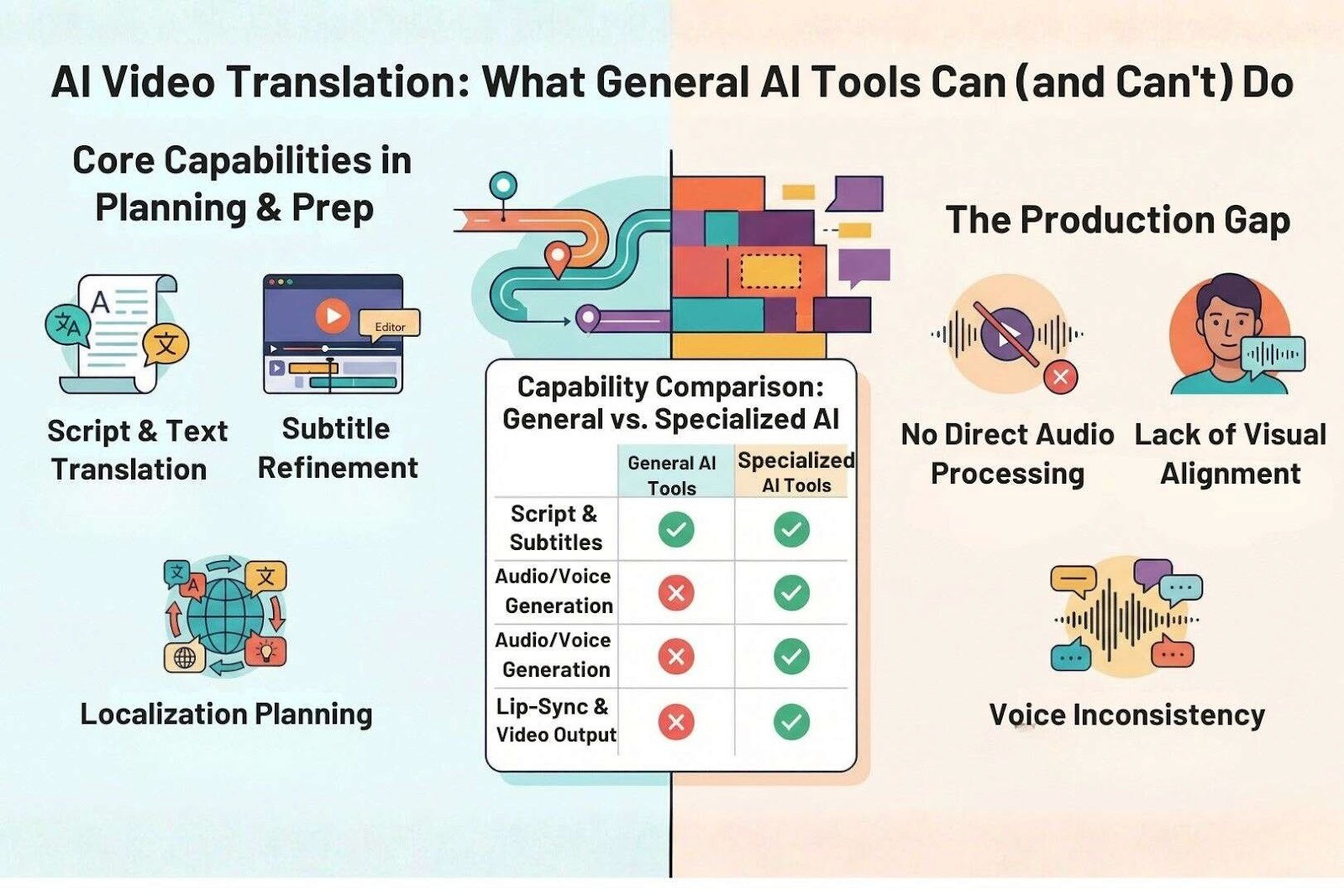
In practical business workflows, general AI tools such as Gemini or Claude are typically used to prepare and organise content that will later be translated, dubbed, or localised using specialised video tools.
At this stage, general AI tools are commonly used for:
Translating video scripts before recording or dubbing
Preparing subtitle drafts for multilingual review
Adapting written content for different languages and regions
One of the most common use cases is script translation. AI tools can translate scripts into multiple languages quickly, allowing marketing, product, and training teams to review how messaging changes across regions before committing to full video production.
General AI tools are also frequently used to prepare subtitle drafts. By translating dialogue into target languages, they help teams generate initial subtitle files that can later be reviewed, edited, and synchronised using video-specific tools.
Another important use case is localisation planning. Businesses often use AI to adjust tone, terminology, or phrasing for different markets before producing multilingual videos. This may include simplifying technical language, adapting calls to action, or aligning messaging with regional expectations.
Beyond translation, general AI tools also support content organisation, such as managing translated text, tracking language versions, and preparing localisation assets that will later be combined with audio and video elements.
While these capabilities make general AI tools useful for early-stage AI video translation tasks, they remain focused on text-based processes. Understanding these strengths helps clarify where general AI tools fit and where specialised video translation and AI dubbing solutions become necessary.
Limitations of AI Video Translation Tools
While tools such as Gemini and Claude are effective for text-based tasks, they do not process video or audio files directly.
For business teams creating multilingual video content, this becomes a clear limit when the goal is production-ready video translation rather than script preparation.
For business video translation use cases, general AI tools face specific technical limitations, including:
No direct support for audio or video file processing
No ability to generate translated voiceovers or AI dubbing
No control over lip sync or timing between speech and visuals
As a result, companies often need other tools or manual steps to handle audio.
Another challenge is the lack of voice consistency and control. Business videos often require a consistent tone, pacing, and style across multiple languages. General AI tools do not provide voice management features, such as selecting or maintaining the same voice across different videos or languages, which can lead to fragmented results.
AI tools also struggle with lip-sync and visual alignment. Translating text alone does not account for how spoken language matches on-screen visuals. Without specialised support, translated dialogue may feel disconnected from the original video, especially in customer-facing or branded content.
Finally, scaling becomes difficult as content volume grows. Managing subtitles, scripts, and language versions across many videos often introduces manual steps and quality checks. For business teams working with multilingual video content at scale, these gaps can slow production and increase the risk of inconsistencies.
These limitations do not reduce the value of general AI tools. Instead, they explain why many businesses move beyond text-based solutions when transitioning from planning to production-ready video translation.
When Specialised AI Video Translation Tools Are Needed
Teams managing multilingual video content usually move to specialised AI video translation tools when they need:
Production-ready video outputs
Consistent quality across multiple languages
Faster turnaround times for multilingual video projects
Specialised AI video translation tools are designed to work directly with audio and video elements, support full video translation workflows, enable AI dubbing and automatic dubbing, and manage lip sync for multilingual video content.
Instead of focusing only on scripts or subtitles, they support translated voiceovers, automatic dubbing, timing alignment, and language-specific versions of the same video.
This makes them more suitable for use cases such as product launches, customer education, internal training, or global marketing campaigns.
Another reason businesses adopt specialised tools is workflow efficiency. Managing text translation separately from audio and video editing often introduces manual steps and handovers between tools. Purpose-built video translation platforms reduce this complexity by keeping translation, voice generation, and localisation tasks in one workflow.
Specialised tools also offer better control over voice and language consistency. For companies producing multiple videos across different markets, maintaining a recognisable voice and tone is important. Dedicated video translation solutions are built to support this requirement at scale, rather than treating it as an add-on.
In practice, many companies combine general AI tools with specialised video translation platforms. General AI tools help with early-stage translation and content adaptation, while specialised solutions handle the technical and production aspects needed to deliver polished multilingual videos.
How to Evaluate AI Video Translation Tools for Business Use
Once teams move beyond planning, success depends on choosing the right workflow and avoiding common scaling traps. The checklist below helps business teams evaluate AI video translation tools realistically.
Practical evaluation checklist for business teams
Use this to assess whether a tool is suitable for production use:
Input handling: Can the tool work directly with video and audio files, not just scripts?
Voice consistency: Can you reuse the same voice across multiple videos and languages?
Timing and lip sync: Does translated speech align naturally with on-screen visuals?
Update efficiency: Can you update existing multilingual videos without redoing everything?
Workflow integration: Does the tool reduce handovers between scripting, dubbing, and video editing?
Scalability: Can it handle multiple languages, teams, and frequent updates without manual overhead?
Common Mistakes When Scaling Multilingual Video Content
Many teams struggle with AI video translation not because of the tools, but because of how workflows are set up.
Common mistakes include relying only on subtitles for customer-facing videos, managing scripts and audio in separate tools, and recreating videos from scratch for each language. These approaches slow production, increase costs, and often result in inconsistent messaging across markets.
Avoiding these mistakes early helps teams scale multilingual video content faster and with fewer revisions.

Real Business Use Cases for AI Video Translation
Use Case 1: Marketing Videos for Global Campaigns
Business team challenge
Marketing teams often need to launch the same campaign video across multiple regions at once. Subtitles alone rarely deliver the same engagement as native-language audio, while manual dubbing is slow, expensive, and difficult to scale without breaking brand consistency.
Why specialised tools matter
Specialised AI video translation tools allow marketing teams to:
Generate AI dubbing with consistent brand voice across languages
Automatically align translated speech with visuals and timing
Launch multilingual campaigns quickly without re-recording or re-editing videos.
This enables faster global rollouts while preserving message clarity and brand identity.
Use Case 2: Internal Training and Employee Enablement
Business team challenge
Companies rely heavily on video for onboarding, compliance, and internal training. These videos are reused across regions and updated frequently, making manual re-recording impractical and hard to maintain consistently.
Why specialised tools matter
Specialised AI video translation tools help training teams:
Deliver spoken training in employees’ local languages
Maintain a consistent instructor voice across regions
Update multilingual training videos without reshooting content
This improves understanding, speeds up onboarding, and supports scalable internal training programs.
Use Case 3: Onboarding, Support, and Knowledge Base Videos
Business team challenge
Onboarding and support videos are designed to reduce confusion and support requests. When explanations do not match visuals or rely only on subtitles, users struggle to follow instructions and churn increases.
Why specialised tools matter
With specialised AI video translation tools, teams can:
Create natural-sounding multilingual voiceovers
Match spoken explanations precisely to on-screen actions
Update support content efficiently as products evolve
This leads to clearer onboarding, fewer support tickets, and better customer retention.
General AI Tools vs Specialised Video Translation Tools
General AI tools and specialised video translation platforms serve different purposes within the ai video translation process. Understanding how they compare helps businesses choose the right combination of tools for their video workflows.
The table below highlights how general AI tools and specialised video translation platforms differ across key capabilities.
Capability | General AI Tools | Specialised Video Translation Tools |
Text translation |
Yes |
Yes |
Subtitle drafts |
Yes |
Yes |
Script localisation |
Yes |
Yes |
Audio translation |
No |
Yes |
Voice generation |
No |
Yes |
Lip-sync alignment |
No |
Yes |
Video-ready outputs |
No |
Yes |
Multilingual scaling |
Limited |
Designed for it |
General AI tools are well suited for text-based tasks such as translating scripts, preparing subtitles, or adapting messaging for different languages. These capabilities make them useful during the early stages of video localisation, especially when business teams are planning or testing content for new markets.
Specialised video translation tools, on the other hand, are built to handle audio and video elements directly. They focus on turning translated content into usable video outputs, which is essential for businesses that need consistent quality, voice control, and efficient localisation across multiple videos and languages.
Rather than replacing each other, these tools are often used together. General AI tools support ideation and preparation, while specialised platforms handle the technical steps required to deliver complete multilingual video content.
Common Questions About AI Video Translation
Can AI tools translate videos automatically?
AI tools can support parts of the video translation process, such as translating scripts or generating subtitle drafts. However, most general AI tools do not translate video or audio files directly. Full video translation usually requires specialised tools that handle audio, timing, and video outputs.
Are general AI tools enough for business video translation?
General AI tools are useful for early-stage tasks like content planning, text translation, and localisation preparation. For business use cases that require production-ready videos, consistent voices, or multilingual scaling, additional tools are typically needed.
Do AI video translation tools replace human review?
AI video translation tools can speed up localisation workflows, but human review is still important. Business teams often review translations to ensure accuracy, brand tone, and cultural relevance, especially for customer-facing or instructional content.
How do businesses combine different AI tools for video translation?
Many businesses use general AI tools for scripting and text translation, then rely on specialised video translation platforms to handle audio, voice, and final video outputs. This combined approach allows business teams to balance flexibility with production quality.
Conclusion: Choosing the Right AI Video Translation Approach
AI video translation helps businesses adapt video content for global audiences more easily. General AI tools play an important role in translation, planning, and localisation preparation, especially in the early phases of video projects.
To move from planning to production-ready multilingual video content, businesses need tools that handle audio, voice, and timing as part of one workflow.
Specialised AI video translation platforms make it possible to launch, update, and scale multilingual videos without rebuilding content for every market.
If you are currently translating scripts or subtitles but struggling with production, voice consistency, or turnaround time, exploring a purpose-built AI video translation solution is the next practical step.
You can learn how Perso Dubbing supports AI dubbing, automatic dubbing, and scalable multilingual video workflows for business teams.
AI video translation has become a practical requirement for businesses operating across multiple markets. Training teams, marketers, product organisations, and course creators are expected to deliver multilingual video content quickly, without duplicating production work for every language.
It is important to note that tools like Gemini or Claude are not AI video translation tools themselves, but general-purpose AI systems that support text-based tasks within the broader video translation workflow. Translating text is only one part of the process. Audio handling, voice consistency, timing, and lip sync introduce challenges that general AI tools are not designed to manage.
This article is for business teams evaluating AI video translation tools for real-world use. It explains what these tools can do, where their limitations appear, and why companies often combine general AI tools with specialised video translation and AI dubbing solutions to deliver production-ready multilingual videos at scale.
The sections below break down where general AI tools fit in video translation workflows, where their limitations begin, and when specialised AI video translation platforms are necessary.
What AI Video Translation Tools Can Do
In practical business workflows, general AI tools such as Gemini or Claude are typically used to prepare and organise content that will later be translated, dubbed, or localised using specialised video tools.
At this stage, general AI tools are commonly used for:
Translating video scripts before recording or dubbing
Preparing subtitle drafts for multilingual review
Adapting written content for different languages and regions
One of the most common use cases is script translation. AI tools can translate scripts into multiple languages quickly, allowing marketing, product, and training teams to review how messaging changes across regions before committing to full video production.
General AI tools are also frequently used to prepare subtitle drafts. By translating dialogue into target languages, they help teams generate initial subtitle files that can later be reviewed, edited, and synchronised using video-specific tools.
Another important use case is localisation planning. Businesses often use AI to adjust tone, terminology, or phrasing for different markets before producing multilingual videos. This may include simplifying technical language, adapting calls to action, or aligning messaging with regional expectations.
Beyond translation, general AI tools also support content organisation, such as managing translated text, tracking language versions, and preparing localisation assets that will later be combined with audio and video elements.
While these capabilities make general AI tools useful for early-stage AI video translation tasks, they remain focused on text-based processes. Understanding these strengths helps clarify where general AI tools fit and where specialised video translation and AI dubbing solutions become necessary.
Limitations of AI Video Translation Tools
While tools such as Gemini and Claude are effective for text-based tasks, they do not process video or audio files directly.
For business teams creating multilingual video content, this becomes a clear limit when the goal is production-ready video translation rather than script preparation.
For business video translation use cases, general AI tools face specific technical limitations, including:
No direct support for audio or video file processing
No ability to generate translated voiceovers or AI dubbing
No control over lip sync or timing between speech and visuals
As a result, companies often need other tools or manual steps to handle audio.
Another challenge is the lack of voice consistency and control. Business videos often require a consistent tone, pacing, and style across multiple languages. General AI tools do not provide voice management features, such as selecting or maintaining the same voice across different videos or languages, which can lead to fragmented results.
AI tools also struggle with lip-sync and visual alignment. Translating text alone does not account for how spoken language matches on-screen visuals. Without specialised support, translated dialogue may feel disconnected from the original video, especially in customer-facing or branded content.
Finally, scaling becomes difficult as content volume grows. Managing subtitles, scripts, and language versions across many videos often introduces manual steps and quality checks. For business teams working with multilingual video content at scale, these gaps can slow production and increase the risk of inconsistencies.
These limitations do not reduce the value of general AI tools. Instead, they explain why many businesses move beyond text-based solutions when transitioning from planning to production-ready video translation.
When Specialised AI Video Translation Tools Are Needed
Teams managing multilingual video content usually move to specialised AI video translation tools when they need:
Production-ready video outputs
Consistent quality across multiple languages
Faster turnaround times for multilingual video projects
Specialised AI video translation tools are designed to work directly with audio and video elements, support full video translation workflows, enable AI dubbing and automatic dubbing, and manage lip sync for multilingual video content.
Instead of focusing only on scripts or subtitles, they support translated voiceovers, automatic dubbing, timing alignment, and language-specific versions of the same video.
This makes them more suitable for use cases such as product launches, customer education, internal training, or global marketing campaigns.
Another reason businesses adopt specialised tools is workflow efficiency. Managing text translation separately from audio and video editing often introduces manual steps and handovers between tools. Purpose-built video translation platforms reduce this complexity by keeping translation, voice generation, and localisation tasks in one workflow.
Specialised tools also offer better control over voice and language consistency. For companies producing multiple videos across different markets, maintaining a recognisable voice and tone is important. Dedicated video translation solutions are built to support this requirement at scale, rather than treating it as an add-on.
In practice, many companies combine general AI tools with specialised video translation platforms. General AI tools help with early-stage translation and content adaptation, while specialised solutions handle the technical and production aspects needed to deliver polished multilingual videos.
How to Evaluate AI Video Translation Tools for Business Use
Once teams move beyond planning, success depends on choosing the right workflow and avoiding common scaling traps. The checklist below helps business teams evaluate AI video translation tools realistically.
Practical evaluation checklist for business teams
Use this to assess whether a tool is suitable for production use:
Input handling: Can the tool work directly with video and audio files, not just scripts?
Voice consistency: Can you reuse the same voice across multiple videos and languages?
Timing and lip sync: Does translated speech align naturally with on-screen visuals?
Update efficiency: Can you update existing multilingual videos without redoing everything?
Workflow integration: Does the tool reduce handovers between scripting, dubbing, and video editing?
Scalability: Can it handle multiple languages, teams, and frequent updates without manual overhead?
Common Mistakes When Scaling Multilingual Video Content
Many teams struggle with AI video translation not because of the tools, but because of how workflows are set up.
Common mistakes include relying only on subtitles for customer-facing videos, managing scripts and audio in separate tools, and recreating videos from scratch for each language. These approaches slow production, increase costs, and often result in inconsistent messaging across markets.
Avoiding these mistakes early helps teams scale multilingual video content faster and with fewer revisions.
Real Business Use Cases for AI Video Translation
Use Case 1: Marketing Videos for Global Campaigns
Business team challenge
Marketing teams often need to launch the same campaign video across multiple regions at once. Subtitles alone rarely deliver the same engagement as native-language audio, while manual dubbing is slow, expensive, and difficult to scale without breaking brand consistency.
Why specialised tools matter
Specialised AI video translation tools allow marketing teams to:
Generate AI dubbing with consistent brand voice across languages
Automatically align translated speech with visuals and timing
Launch multilingual campaigns quickly without re-recording or re-editing videos.
This enables faster global rollouts while preserving message clarity and brand identity.
Use Case 2: Internal Training and Employee Enablement
Business team challenge
Companies rely heavily on video for onboarding, compliance, and internal training. These videos are reused across regions and updated frequently, making manual re-recording impractical and hard to maintain consistently.
Why specialised tools matter
Specialised AI video translation tools help training teams:
Deliver spoken training in employees’ local languages
Maintain a consistent instructor voice across regions
Update multilingual training videos without reshooting content
This improves understanding, speeds up onboarding, and supports scalable internal training programs.
Use Case 3: Onboarding, Support, and Knowledge Base Videos
Business team challenge
Onboarding and support videos are designed to reduce confusion and support requests. When explanations do not match visuals or rely only on subtitles, users struggle to follow instructions and churn increases.
Why specialised tools matter
With specialised AI video translation tools, teams can:
Create natural-sounding multilingual voiceovers
Match spoken explanations precisely to on-screen actions
Update support content efficiently as products evolve
This leads to clearer onboarding, fewer support tickets, and better customer retention.
General AI Tools vs Specialised Video Translation Tools
General AI tools and specialised video translation platforms serve different purposes within the ai video translation process. Understanding how they compare helps businesses choose the right combination of tools for their video workflows.
The table below highlights how general AI tools and specialised video translation platforms differ across key capabilities.
Capability | General AI Tools | Specialised Video Translation Tools |
Text translation |
Yes |
Yes |
Subtitle drafts |
Yes |
Yes |
Script localisation |
Yes |
Yes |
Audio translation |
No |
Yes |
Voice generation |
No |
Yes |
Lip-sync alignment |
No |
Yes |
Video-ready outputs |
No |
Yes |
Multilingual scaling |
Limited |
Designed for it |
General AI tools are well suited for text-based tasks such as translating scripts, preparing subtitles, or adapting messaging for different languages. These capabilities make them useful during the early stages of video localisation, especially when business teams are planning or testing content for new markets.
Specialised video translation tools, on the other hand, are built to handle audio and video elements directly. They focus on turning translated content into usable video outputs, which is essential for businesses that need consistent quality, voice control, and efficient localisation across multiple videos and languages.
Rather than replacing each other, these tools are often used together. General AI tools support ideation and preparation, while specialised platforms handle the technical steps required to deliver complete multilingual video content.
Common Questions About AI Video Translation
Can AI tools translate videos automatically?
AI tools can support parts of the video translation process, such as translating scripts or generating subtitle drafts. However, most general AI tools do not translate video or audio files directly. Full video translation usually requires specialised tools that handle audio, timing, and video outputs.
Are general AI tools enough for business video translation?
General AI tools are useful for early-stage tasks like content planning, text translation, and localisation preparation. For business use cases that require production-ready videos, consistent voices, or multilingual scaling, additional tools are typically needed.
Do AI video translation tools replace human review?
AI video translation tools can speed up localisation workflows, but human review is still important. Business teams often review translations to ensure accuracy, brand tone, and cultural relevance, especially for customer-facing or instructional content.
How do businesses combine different AI tools for video translation?
Many businesses use general AI tools for scripting and text translation, then rely on specialised video translation platforms to handle audio, voice, and final video outputs. This combined approach allows business teams to balance flexibility with production quality.
Conclusion: Choosing the Right AI Video Translation Approach
AI video translation helps businesses adapt video content for global audiences more easily. General AI tools play an important role in translation, planning, and localisation preparation, especially in the early phases of video projects.
To move from planning to production-ready multilingual video content, businesses need tools that handle audio, voice, and timing as part of one workflow.
Specialised AI video translation platforms make it possible to launch, update, and scale multilingual videos without rebuilding content for every market.
If you are currently translating scripts or subtitles but struggling with production, voice consistency, or turnaround time, exploring a purpose-built AI video translation solution is the next practical step.
You can learn how Perso Dubbing supports AI dubbing, automatic dubbing, and scalable multilingual video workflows for business teams.
AI video translation has become a practical requirement for businesses operating across multiple markets. Training teams, marketers, product organisations, and course creators are expected to deliver multilingual video content quickly, without duplicating production work for every language.
It is important to note that tools like Gemini or Claude are not AI video translation tools themselves, but general-purpose AI systems that support text-based tasks within the broader video translation workflow. Translating text is only one part of the process. Audio handling, voice consistency, timing, and lip sync introduce challenges that general AI tools are not designed to manage.
This article is for business teams evaluating AI video translation tools for real-world use. It explains what these tools can do, where their limitations appear, and why companies often combine general AI tools with specialised video translation and AI dubbing solutions to deliver production-ready multilingual videos at scale.
The sections below break down where general AI tools fit in video translation workflows, where their limitations begin, and when specialised AI video translation platforms are necessary.
What AI Video Translation Tools Can Do
In practical business workflows, general AI tools such as Gemini or Claude are typically used to prepare and organise content that will later be translated, dubbed, or localised using specialised video tools.
At this stage, general AI tools are commonly used for:
Translating video scripts before recording or dubbing
Preparing subtitle drafts for multilingual review
Adapting written content for different languages and regions
One of the most common use cases is script translation. AI tools can translate scripts into multiple languages quickly, allowing marketing, product, and training teams to review how messaging changes across regions before committing to full video production.
General AI tools are also frequently used to prepare subtitle drafts. By translating dialogue into target languages, they help teams generate initial subtitle files that can later be reviewed, edited, and synchronised using video-specific tools.
Another important use case is localisation planning. Businesses often use AI to adjust tone, terminology, or phrasing for different markets before producing multilingual videos. This may include simplifying technical language, adapting calls to action, or aligning messaging with regional expectations.
Beyond translation, general AI tools also support content organisation, such as managing translated text, tracking language versions, and preparing localisation assets that will later be combined with audio and video elements.
While these capabilities make general AI tools useful for early-stage AI video translation tasks, they remain focused on text-based processes. Understanding these strengths helps clarify where general AI tools fit and where specialised video translation and AI dubbing solutions become necessary.
Limitations of AI Video Translation Tools
While tools such as Gemini and Claude are effective for text-based tasks, they do not process video or audio files directly.
For business teams creating multilingual video content, this becomes a clear limit when the goal is production-ready video translation rather than script preparation.
For business video translation use cases, general AI tools face specific technical limitations, including:
No direct support for audio or video file processing
No ability to generate translated voiceovers or AI dubbing
No control over lip sync or timing between speech and visuals
As a result, companies often need other tools or manual steps to handle audio.
Another challenge is the lack of voice consistency and control. Business videos often require a consistent tone, pacing, and style across multiple languages. General AI tools do not provide voice management features, such as selecting or maintaining the same voice across different videos or languages, which can lead to fragmented results.
AI tools also struggle with lip-sync and visual alignment. Translating text alone does not account for how spoken language matches on-screen visuals. Without specialised support, translated dialogue may feel disconnected from the original video, especially in customer-facing or branded content.
Finally, scaling becomes difficult as content volume grows. Managing subtitles, scripts, and language versions across many videos often introduces manual steps and quality checks. For business teams working with multilingual video content at scale, these gaps can slow production and increase the risk of inconsistencies.
These limitations do not reduce the value of general AI tools. Instead, they explain why many businesses move beyond text-based solutions when transitioning from planning to production-ready video translation.
When Specialised AI Video Translation Tools Are Needed
Teams managing multilingual video content usually move to specialised AI video translation tools when they need:
Production-ready video outputs
Consistent quality across multiple languages
Faster turnaround times for multilingual video projects
Specialised AI video translation tools are designed to work directly with audio and video elements, support full video translation workflows, enable AI dubbing and automatic dubbing, and manage lip sync for multilingual video content.
Instead of focusing only on scripts or subtitles, they support translated voiceovers, automatic dubbing, timing alignment, and language-specific versions of the same video.
This makes them more suitable for use cases such as product launches, customer education, internal training, or global marketing campaigns.
Another reason businesses adopt specialised tools is workflow efficiency. Managing text translation separately from audio and video editing often introduces manual steps and handovers between tools. Purpose-built video translation platforms reduce this complexity by keeping translation, voice generation, and localisation tasks in one workflow.
Specialised tools also offer better control over voice and language consistency. For companies producing multiple videos across different markets, maintaining a recognisable voice and tone is important. Dedicated video translation solutions are built to support this requirement at scale, rather than treating it as an add-on.
In practice, many companies combine general AI tools with specialised video translation platforms. General AI tools help with early-stage translation and content adaptation, while specialised solutions handle the technical and production aspects needed to deliver polished multilingual videos.
How to Evaluate AI Video Translation Tools for Business Use
Once teams move beyond planning, success depends on choosing the right workflow and avoiding common scaling traps. The checklist below helps business teams evaluate AI video translation tools realistically.
Practical evaluation checklist for business teams
Use this to assess whether a tool is suitable for production use:
Input handling: Can the tool work directly with video and audio files, not just scripts?
Voice consistency: Can you reuse the same voice across multiple videos and languages?
Timing and lip sync: Does translated speech align naturally with on-screen visuals?
Update efficiency: Can you update existing multilingual videos without redoing everything?
Workflow integration: Does the tool reduce handovers between scripting, dubbing, and video editing?
Scalability: Can it handle multiple languages, teams, and frequent updates without manual overhead?
Common Mistakes When Scaling Multilingual Video Content
Many teams struggle with AI video translation not because of the tools, but because of how workflows are set up.
Common mistakes include relying only on subtitles for customer-facing videos, managing scripts and audio in separate tools, and recreating videos from scratch for each language. These approaches slow production, increase costs, and often result in inconsistent messaging across markets.
Avoiding these mistakes early helps teams scale multilingual video content faster and with fewer revisions.
Real Business Use Cases for AI Video Translation
Use Case 1: Marketing Videos for Global Campaigns
Business team challenge
Marketing teams often need to launch the same campaign video across multiple regions at once. Subtitles alone rarely deliver the same engagement as native-language audio, while manual dubbing is slow, expensive, and difficult to scale without breaking brand consistency.
Why specialised tools matter
Specialised AI video translation tools allow marketing teams to:
Generate AI dubbing with consistent brand voice across languages
Automatically align translated speech with visuals and timing
Launch multilingual campaigns quickly without re-recording or re-editing videos.
This enables faster global rollouts while preserving message clarity and brand identity.
Use Case 2: Internal Training and Employee Enablement
Business team challenge
Companies rely heavily on video for onboarding, compliance, and internal training. These videos are reused across regions and updated frequently, making manual re-recording impractical and hard to maintain consistently.
Why specialised tools matter
Specialised AI video translation tools help training teams:
Deliver spoken training in employees’ local languages
Maintain a consistent instructor voice across regions
Update multilingual training videos without reshooting content
This improves understanding, speeds up onboarding, and supports scalable internal training programs.
Use Case 3: Onboarding, Support, and Knowledge Base Videos
Business team challenge
Onboarding and support videos are designed to reduce confusion and support requests. When explanations do not match visuals or rely only on subtitles, users struggle to follow instructions and churn increases.
Why specialised tools matter
With specialised AI video translation tools, teams can:
Create natural-sounding multilingual voiceovers
Match spoken explanations precisely to on-screen actions
Update support content efficiently as products evolve
This leads to clearer onboarding, fewer support tickets, and better customer retention.
General AI Tools vs Specialised Video Translation Tools
General AI tools and specialised video translation platforms serve different purposes within the ai video translation process. Understanding how they compare helps businesses choose the right combination of tools for their video workflows.
The table below highlights how general AI tools and specialised video translation platforms differ across key capabilities.
Capability | General AI Tools | Specialised Video Translation Tools |
Text translation |
Yes |
Yes |
Subtitle drafts |
Yes |
Yes |
Script localisation |
Yes |
Yes |
Audio translation |
No |
Yes |
Voice generation |
No |
Yes |
Lip-sync alignment |
No |
Yes |
Video-ready outputs |
No |
Yes |
Multilingual scaling |
Limited |
Designed for it |
General AI tools are well suited for text-based tasks such as translating scripts, preparing subtitles, or adapting messaging for different languages. These capabilities make them useful during the early stages of video localisation, especially when business teams are planning or testing content for new markets.
Specialised video translation tools, on the other hand, are built to handle audio and video elements directly. They focus on turning translated content into usable video outputs, which is essential for businesses that need consistent quality, voice control, and efficient localisation across multiple videos and languages.
Rather than replacing each other, these tools are often used together. General AI tools support ideation and preparation, while specialised platforms handle the technical steps required to deliver complete multilingual video content.
Common Questions About AI Video Translation
Can AI tools translate videos automatically?
AI tools can support parts of the video translation process, such as translating scripts or generating subtitle drafts. However, most general AI tools do not translate video or audio files directly. Full video translation usually requires specialised tools that handle audio, timing, and video outputs.
Are general AI tools enough for business video translation?
General AI tools are useful for early-stage tasks like content planning, text translation, and localisation preparation. For business use cases that require production-ready videos, consistent voices, or multilingual scaling, additional tools are typically needed.
Do AI video translation tools replace human review?
AI video translation tools can speed up localisation workflows, but human review is still important. Business teams often review translations to ensure accuracy, brand tone, and cultural relevance, especially for customer-facing or instructional content.
How do businesses combine different AI tools for video translation?
Many businesses use general AI tools for scripting and text translation, then rely on specialised video translation platforms to handle audio, voice, and final video outputs. This combined approach allows business teams to balance flexibility with production quality.
Conclusion: Choosing the Right AI Video Translation Approach
AI video translation helps businesses adapt video content for global audiences more easily. General AI tools play an important role in translation, planning, and localisation preparation, especially in the early phases of video projects.
To move from planning to production-ready multilingual video content, businesses need tools that handle audio, voice, and timing as part of one workflow.
Specialised AI video translation platforms make it possible to launch, update, and scale multilingual videos without rebuilding content for every market.
If you are currently translating scripts or subtitles but struggling with production, voice consistency, or turnaround time, exploring a purpose-built AI video translation solution is the next practical step.
You can learn how Perso Dubbing supports AI dubbing, automatic dubbing, and scalable multilingual video workflows for business teams.
Continue Reading
Browse All