Can AI Translate a Video? What Actually Works in 2026
Last Updated




Jump to section
Jump to section

Share
Share
Share
AI Video Translator, Localization, and Dubbing Tool
Try it out for Free
By Untae Bae, Head of Growth & Product Owner at Perso AI
Yes, AI can translate videos — and in 2026, the technology has moved well beyond basic subtitles. Modern AI video translation tools handle speech recognition, translation, voice synthesis, and lip synchronization in a single automated pipeline. The result is a dubbed video that sounds natural in the target language, often completed in under five minutes.
But not every approach delivers the same quality. This guide breaks down how AI video translation actually works today, what it can and cannot do, and how to choose the right method for your content.
How AI Video Translation Works in 2026
AI video translation is not a single technology. It is a pipeline of four distinct AI systems working in sequence:
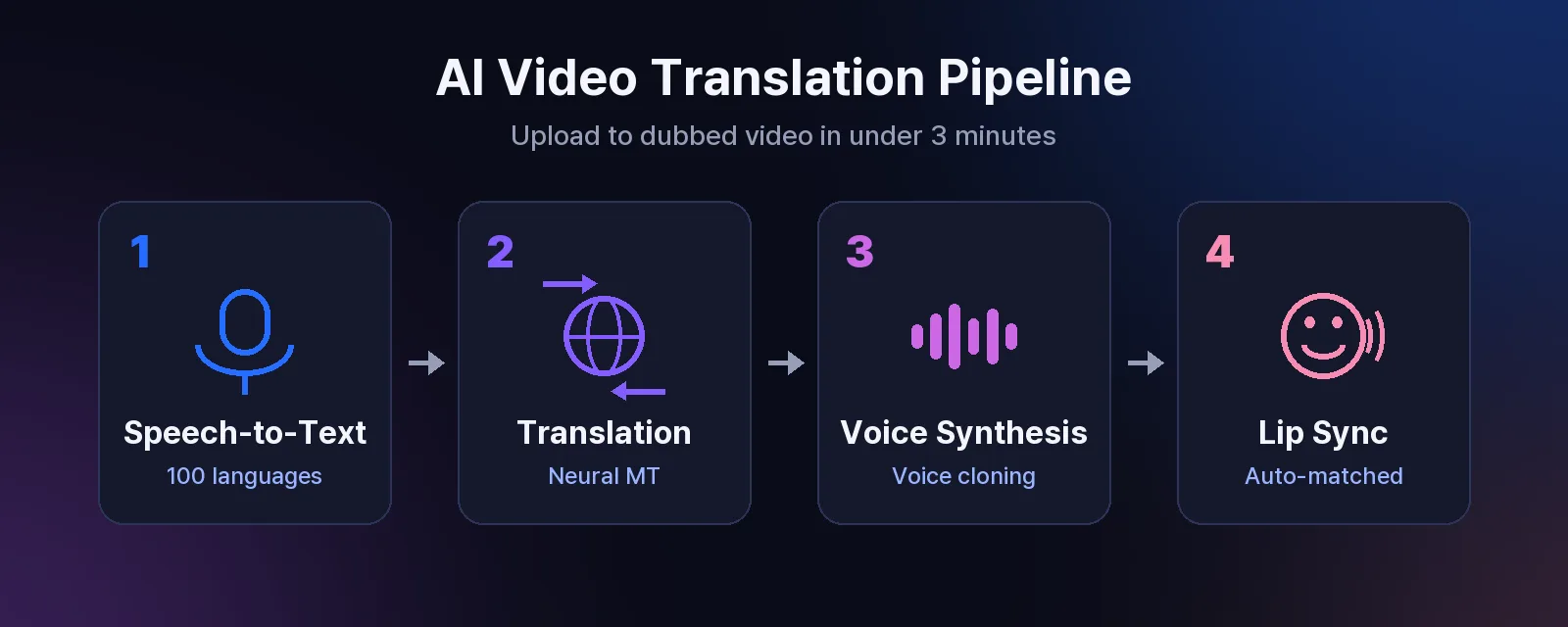
Speech-to-text (STT): AI transcribes the original audio into text. Leading tools now support 100 or more source languages with high accuracy, even for accented speech and overlapping speakers.
Machine translation: The transcribed text is translated into the target language. Neural machine translation engines handle context, idioms, and sentence structure far better than phrase-based systems from a few years ago.
Text-to-speech / voice synthesis (TTS): AI generates spoken audio in the target language. The most advanced systems clone the original speaker’s voice — preserving tone, pacing, and personality — rather than using a generic robotic voice.
Lip synchronization: AI adjusts the video’s mouth movements to match the new audio. This step is what separates a professional-looking dubbed video from one that feels obviously artificial.
When all four stages run together, you get AI dubbing: a fully translated video where the speaker appears to be speaking the target language naturally.
Perso Dubbing, for example, runs this entire pipeline in three steps — upload, select language, download — with an average processing time of under 3 minutes. It supports dubbing into 99+ languages and speech-to-text in 100 languages, combining its own dubbing models with global AI foundation models for natural-sounding output.
Can AI Auto-Translate Videos Accurately?
Accuracy depends on what you are translating and what “accurate” means for your use case.
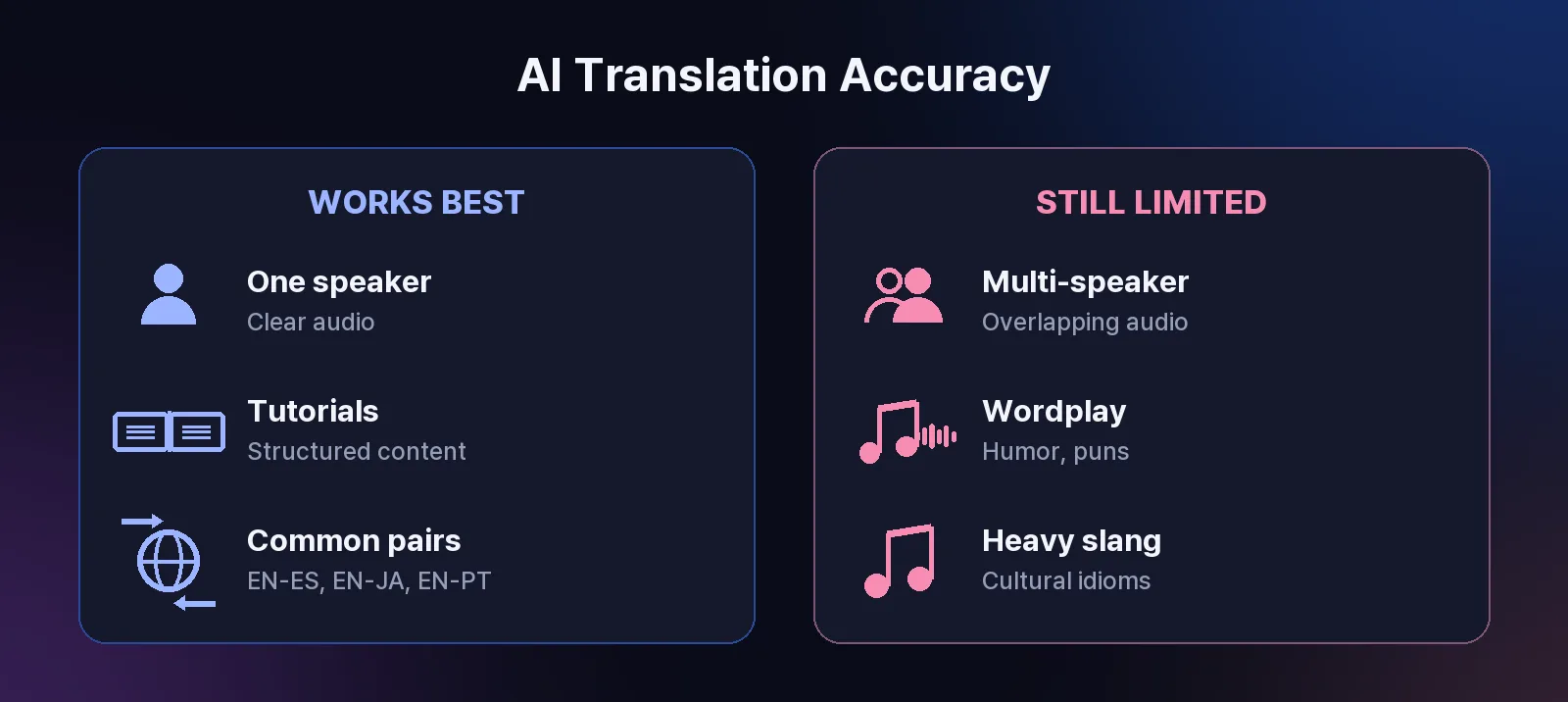
Where AI translation excels:
Clearly spoken content with one speaker (tutorials, presentations, product demos)
Common language pairs with large training data (English ↔ Spanish, English ↔ Japanese, English ↔ Portuguese)
Structured content where context is predictable (educational courses, corporate training)
Where AI translation struggles:
Heavy slang, humor, or cultural references that do not translate directly
Multiple overlapping speakers or significant background noise
Highly specialized terminology without sufficient training data (rare medical or legal jargon)
Poetry, song lyrics, or wordplay where meaning depends on sound
For most business and educational content, AI video translation in 2026 delivers accuracy that is comparable to a professional human translator — at a fraction of the cost and turnaround time.
The key is matching your content type to the right tool. Straightforward instructional content translates well out of the box. Creative content with nuanced language may need a human review pass after the AI translation. If you are wondering whether specific tools like Google Translate or ChatGPT can translate a video, the short answer is: not end-to-end — they handle text translation but lack the audio and video pipeline that dedicated AI dubbing tools provide.
AI Dubbing vs. AI Subtitles: Which Approach Should You Use?
When people ask “can AI translate a video,” they usually mean one of two things: adding translated subtitles or fully dubbing the audio. Both are valid, but they serve different purposes.
Factor | AI Subtitles | AI Dubbing |
|---|---|---|
Viewer experience | Requires reading; splits attention from visuals | Viewers watch and listen naturally |
Engagement | Lower average watch time (viewers skip subtitle-heavy content) | Higher retention — feels like native content |
Production effort | Minimal — text overlay only | Slightly more processing — includes voice synthesis and lip sync |
Cost | Lower per video | Higher per video, but far lower than human dubbing |
Best for | Text-heavy content, accessibility compliance, SEO (search engines index subtitle text) | Entertainment, tutorials, social media, any content where audio drives engagement |
The trend in 2026 is clear: audiences prefer dubbed content. Across YouTube, dubbed videos consistently outperform subtitled versions in watch time and subscriber growth in non-English markets — viewers engage more when they can listen rather than read.
For creators and businesses expanding globally, AI dubbing is the higher-impact choice. The cost difference between AI subtitles and AI dubbing has narrowed significantly — tools like Perso Dubbing offer dubbing starting at $6.99/month, making it accessible to individual creators, not just enterprise teams.
If you are unsure which approach fits, consider starting with AI dubbing for your highest-performing content and using subtitles as a supplement for longer, text-dense material.
What to Look for in an AI Video Translation Tool
Not all AI video translation tools deliver the same results. Here are the criteria that matter most when evaluating options in 2026:
Language coverage. Some tools support 20–30 languages. Others, like Perso Dubbing, support translating videos into 99+ languages with speech recognition in 100 languages. Broader coverage means you can reach more markets without switching tools.
Voice quality. Generic TTS voices sound robotic and reduce viewer trust. Look for tools that use advanced voice synthesis that preserves the original speaker’s tone and personality.
Lip synchronization. Automatic lip-synced dubbing is what makes dubbed content look professional. Without it, viewers immediately notice the mismatch between audio and mouth movements, which undermines credibility.
Processing speed. Manual dubbing takes days or weeks. AI tools vary from minutes to hours. Perso Dubbing processes most videos in under 3 minutes — fast enough to fit into a daily content workflow.
Pricing transparency. AI dubbing pricing varies widely. Some tools bundle dubbing credits with unrelated features (avatars, video editing), making the true cost per minute hard to calculate. Look for tools with clear per-minute pricing so you can forecast costs accurately.
Workflow simplicity. The best tools minimize steps between “I have a video” and “I have a translated video.” A three-step workflow — upload, select language, download — removes the learning curve that slows adoption.
The Bottom Line
AI can absolutely translate videos in 2026. The technology has matured from experimental to production-ready, handling everything from speech recognition to voice cloning to lip synchronization in a single automated pipeline.
The real question is no longer “can AI do this?” but “which approach and tool fit my content?” For most creators and businesses, AI dubbing delivers the best combination of quality, speed, and cost — especially when the goal is global audience growth.
If you want to see how AI video translation performs on your own content, the fastest way to evaluate is to test it directly. Perso Dubbing offers a free trial with no credit card required — upload a video, pick a language, and judge the result for yourself.
Frequently Asked Questions
Q. Can AI translate a video while keeping the original speaker’s voice? A. Yes. Modern AI dubbing tools use voice cloning to preserve the original speaker’s tone, pacing, and personality in the translated audio. Perso Dubbing achieves this by combining its own dubbing models with global AI foundation models, supporting dubbing into 99+ languages while maintaining natural voice characteristics.
Q. How long does AI video translation take? A. Processing time depends on video length and the tool you use. Perso Dubbing translates most videos in under 3 minutes — upload, select your target language, and download the dubbed version.
Q. Is AI dubbing accurate enough for professional use? A. For structured content like tutorials, presentations, and educational videos, AI dubbing accuracy in 2026 is comparable to professional human translation. Creative content with heavy slang or cultural wordplay may benefit from a human review pass after the AI translation step.
By Untae Bae, Head of Growth & Product Owner at Perso AI
Yes, AI can translate videos — and in 2026, the technology has moved well beyond basic subtitles. Modern AI video translation tools handle speech recognition, translation, voice synthesis, and lip synchronization in a single automated pipeline. The result is a dubbed video that sounds natural in the target language, often completed in under five minutes.
But not every approach delivers the same quality. This guide breaks down how AI video translation actually works today, what it can and cannot do, and how to choose the right method for your content.
How AI Video Translation Works in 2026
AI video translation is not a single technology. It is a pipeline of four distinct AI systems working in sequence:
Speech-to-text (STT): AI transcribes the original audio into text. Leading tools now support 100 or more source languages with high accuracy, even for accented speech and overlapping speakers.
Machine translation: The transcribed text is translated into the target language. Neural machine translation engines handle context, idioms, and sentence structure far better than phrase-based systems from a few years ago.
Text-to-speech / voice synthesis (TTS): AI generates spoken audio in the target language. The most advanced systems clone the original speaker’s voice — preserving tone, pacing, and personality — rather than using a generic robotic voice.
Lip synchronization: AI adjusts the video’s mouth movements to match the new audio. This step is what separates a professional-looking dubbed video from one that feels obviously artificial.
When all four stages run together, you get AI dubbing: a fully translated video where the speaker appears to be speaking the target language naturally.
Perso Dubbing, for example, runs this entire pipeline in three steps — upload, select language, download — with an average processing time of under 3 minutes. It supports dubbing into 99+ languages and speech-to-text in 100 languages, combining its own dubbing models with global AI foundation models for natural-sounding output.
Can AI Auto-Translate Videos Accurately?
Accuracy depends on what you are translating and what “accurate” means for your use case.
Where AI translation excels:
Clearly spoken content with one speaker (tutorials, presentations, product demos)
Common language pairs with large training data (English ↔ Spanish, English ↔ Japanese, English ↔ Portuguese)
Structured content where context is predictable (educational courses, corporate training)
Where AI translation struggles:
Heavy slang, humor, or cultural references that do not translate directly
Multiple overlapping speakers or significant background noise
Highly specialized terminology without sufficient training data (rare medical or legal jargon)
Poetry, song lyrics, or wordplay where meaning depends on sound
For most business and educational content, AI video translation in 2026 delivers accuracy that is comparable to a professional human translator — at a fraction of the cost and turnaround time.
The key is matching your content type to the right tool. Straightforward instructional content translates well out of the box. Creative content with nuanced language may need a human review pass after the AI translation. If you are wondering whether specific tools like Google Translate or ChatGPT can translate a video, the short answer is: not end-to-end — they handle text translation but lack the audio and video pipeline that dedicated AI dubbing tools provide.
AI Dubbing vs. AI Subtitles: Which Approach Should You Use?
When people ask “can AI translate a video,” they usually mean one of two things: adding translated subtitles or fully dubbing the audio. Both are valid, but they serve different purposes.
Factor | AI Subtitles | AI Dubbing |
|---|---|---|
Viewer experience | Requires reading; splits attention from visuals | Viewers watch and listen naturally |
Engagement | Lower average watch time (viewers skip subtitle-heavy content) | Higher retention — feels like native content |
Production effort | Minimal — text overlay only | Slightly more processing — includes voice synthesis and lip sync |
Cost | Lower per video | Higher per video, but far lower than human dubbing |
Best for | Text-heavy content, accessibility compliance, SEO (search engines index subtitle text) | Entertainment, tutorials, social media, any content where audio drives engagement |
The trend in 2026 is clear: audiences prefer dubbed content. Across YouTube, dubbed videos consistently outperform subtitled versions in watch time and subscriber growth in non-English markets — viewers engage more when they can listen rather than read.
For creators and businesses expanding globally, AI dubbing is the higher-impact choice. The cost difference between AI subtitles and AI dubbing has narrowed significantly — tools like Perso Dubbing offer dubbing starting at $6.99/month, making it accessible to individual creators, not just enterprise teams.
If you are unsure which approach fits, consider starting with AI dubbing for your highest-performing content and using subtitles as a supplement for longer, text-dense material.
What to Look for in an AI Video Translation Tool
Not all AI video translation tools deliver the same results. Here are the criteria that matter most when evaluating options in 2026:
Language coverage. Some tools support 20–30 languages. Others, like Perso Dubbing, support translating videos into 99+ languages with speech recognition in 100 languages. Broader coverage means you can reach more markets without switching tools.
Voice quality. Generic TTS voices sound robotic and reduce viewer trust. Look for tools that use advanced voice synthesis that preserves the original speaker’s tone and personality.
Lip synchronization. Automatic lip-synced dubbing is what makes dubbed content look professional. Without it, viewers immediately notice the mismatch between audio and mouth movements, which undermines credibility.
Processing speed. Manual dubbing takes days or weeks. AI tools vary from minutes to hours. Perso Dubbing processes most videos in under 3 minutes — fast enough to fit into a daily content workflow.
Pricing transparency. AI dubbing pricing varies widely. Some tools bundle dubbing credits with unrelated features (avatars, video editing), making the true cost per minute hard to calculate. Look for tools with clear per-minute pricing so you can forecast costs accurately.
Workflow simplicity. The best tools minimize steps between “I have a video” and “I have a translated video.” A three-step workflow — upload, select language, download — removes the learning curve that slows adoption.
The Bottom Line
AI can absolutely translate videos in 2026. The technology has matured from experimental to production-ready, handling everything from speech recognition to voice cloning to lip synchronization in a single automated pipeline.
The real question is no longer “can AI do this?” but “which approach and tool fit my content?” For most creators and businesses, AI dubbing delivers the best combination of quality, speed, and cost — especially when the goal is global audience growth.
If you want to see how AI video translation performs on your own content, the fastest way to evaluate is to test it directly. Perso Dubbing offers a free trial with no credit card required — upload a video, pick a language, and judge the result for yourself.
Frequently Asked Questions
Q. Can AI translate a video while keeping the original speaker’s voice? A. Yes. Modern AI dubbing tools use voice cloning to preserve the original speaker’s tone, pacing, and personality in the translated audio. Perso Dubbing achieves this by combining its own dubbing models with global AI foundation models, supporting dubbing into 99+ languages while maintaining natural voice characteristics.
Q. How long does AI video translation take? A. Processing time depends on video length and the tool you use. Perso Dubbing translates most videos in under 3 minutes — upload, select your target language, and download the dubbed version.
Q. Is AI dubbing accurate enough for professional use? A. For structured content like tutorials, presentations, and educational videos, AI dubbing accuracy in 2026 is comparable to professional human translation. Creative content with heavy slang or cultural wordplay may benefit from a human review pass after the AI translation step.
By Untae Bae, Head of Growth & Product Owner at Perso AI
Yes, AI can translate videos — and in 2026, the technology has moved well beyond basic subtitles. Modern AI video translation tools handle speech recognition, translation, voice synthesis, and lip synchronization in a single automated pipeline. The result is a dubbed video that sounds natural in the target language, often completed in under five minutes.
But not every approach delivers the same quality. This guide breaks down how AI video translation actually works today, what it can and cannot do, and how to choose the right method for your content.
How AI Video Translation Works in 2026
AI video translation is not a single technology. It is a pipeline of four distinct AI systems working in sequence:
Speech-to-text (STT): AI transcribes the original audio into text. Leading tools now support 100 or more source languages with high accuracy, even for accented speech and overlapping speakers.
Machine translation: The transcribed text is translated into the target language. Neural machine translation engines handle context, idioms, and sentence structure far better than phrase-based systems from a few years ago.
Text-to-speech / voice synthesis (TTS): AI generates spoken audio in the target language. The most advanced systems clone the original speaker’s voice — preserving tone, pacing, and personality — rather than using a generic robotic voice.
Lip synchronization: AI adjusts the video’s mouth movements to match the new audio. This step is what separates a professional-looking dubbed video from one that feels obviously artificial.
When all four stages run together, you get AI dubbing: a fully translated video where the speaker appears to be speaking the target language naturally.
Perso Dubbing, for example, runs this entire pipeline in three steps — upload, select language, download — with an average processing time of under 3 minutes. It supports dubbing into 99+ languages and speech-to-text in 100 languages, combining its own dubbing models with global AI foundation models for natural-sounding output.
Can AI Auto-Translate Videos Accurately?
Accuracy depends on what you are translating and what “accurate” means for your use case.
Where AI translation excels:
Clearly spoken content with one speaker (tutorials, presentations, product demos)
Common language pairs with large training data (English ↔ Spanish, English ↔ Japanese, English ↔ Portuguese)
Structured content where context is predictable (educational courses, corporate training)
Where AI translation struggles:
Heavy slang, humor, or cultural references that do not translate directly
Multiple overlapping speakers or significant background noise
Highly specialized terminology without sufficient training data (rare medical or legal jargon)
Poetry, song lyrics, or wordplay where meaning depends on sound
For most business and educational content, AI video translation in 2026 delivers accuracy that is comparable to a professional human translator — at a fraction of the cost and turnaround time.
The key is matching your content type to the right tool. Straightforward instructional content translates well out of the box. Creative content with nuanced language may need a human review pass after the AI translation. If you are wondering whether specific tools like Google Translate or ChatGPT can translate a video, the short answer is: not end-to-end — they handle text translation but lack the audio and video pipeline that dedicated AI dubbing tools provide.
AI Dubbing vs. AI Subtitles: Which Approach Should You Use?
When people ask “can AI translate a video,” they usually mean one of two things: adding translated subtitles or fully dubbing the audio. Both are valid, but they serve different purposes.
Factor | AI Subtitles | AI Dubbing |
|---|---|---|
Viewer experience | Requires reading; splits attention from visuals | Viewers watch and listen naturally |
Engagement | Lower average watch time (viewers skip subtitle-heavy content) | Higher retention — feels like native content |
Production effort | Minimal — text overlay only | Slightly more processing — includes voice synthesis and lip sync |
Cost | Lower per video | Higher per video, but far lower than human dubbing |
Best for | Text-heavy content, accessibility compliance, SEO (search engines index subtitle text) | Entertainment, tutorials, social media, any content where audio drives engagement |
The trend in 2026 is clear: audiences prefer dubbed content. Across YouTube, dubbed videos consistently outperform subtitled versions in watch time and subscriber growth in non-English markets — viewers engage more when they can listen rather than read.
For creators and businesses expanding globally, AI dubbing is the higher-impact choice. The cost difference between AI subtitles and AI dubbing has narrowed significantly — tools like Perso Dubbing offer dubbing starting at $6.99/month, making it accessible to individual creators, not just enterprise teams.
If you are unsure which approach fits, consider starting with AI dubbing for your highest-performing content and using subtitles as a supplement for longer, text-dense material.
What to Look for in an AI Video Translation Tool
Not all AI video translation tools deliver the same results. Here are the criteria that matter most when evaluating options in 2026:
Language coverage. Some tools support 20–30 languages. Others, like Perso Dubbing, support translating videos into 99+ languages with speech recognition in 100 languages. Broader coverage means you can reach more markets without switching tools.
Voice quality. Generic TTS voices sound robotic and reduce viewer trust. Look for tools that use advanced voice synthesis that preserves the original speaker’s tone and personality.
Lip synchronization. Automatic lip-synced dubbing is what makes dubbed content look professional. Without it, viewers immediately notice the mismatch between audio and mouth movements, which undermines credibility.
Processing speed. Manual dubbing takes days or weeks. AI tools vary from minutes to hours. Perso Dubbing processes most videos in under 3 minutes — fast enough to fit into a daily content workflow.
Pricing transparency. AI dubbing pricing varies widely. Some tools bundle dubbing credits with unrelated features (avatars, video editing), making the true cost per minute hard to calculate. Look for tools with clear per-minute pricing so you can forecast costs accurately.
Workflow simplicity. The best tools minimize steps between “I have a video” and “I have a translated video.” A three-step workflow — upload, select language, download — removes the learning curve that slows adoption.
The Bottom Line
AI can absolutely translate videos in 2026. The technology has matured from experimental to production-ready, handling everything from speech recognition to voice cloning to lip synchronization in a single automated pipeline.
The real question is no longer “can AI do this?” but “which approach and tool fit my content?” For most creators and businesses, AI dubbing delivers the best combination of quality, speed, and cost — especially when the goal is global audience growth.
If you want to see how AI video translation performs on your own content, the fastest way to evaluate is to test it directly. Perso Dubbing offers a free trial with no credit card required — upload a video, pick a language, and judge the result for yourself.
Frequently Asked Questions
Q. Can AI translate a video while keeping the original speaker’s voice? A. Yes. Modern AI dubbing tools use voice cloning to preserve the original speaker’s tone, pacing, and personality in the translated audio. Perso Dubbing achieves this by combining its own dubbing models with global AI foundation models, supporting dubbing into 99+ languages while maintaining natural voice characteristics.
Q. How long does AI video translation take? A. Processing time depends on video length and the tool you use. Perso Dubbing translates most videos in under 3 minutes — upload, select your target language, and download the dubbed version.
Q. Is AI dubbing accurate enough for professional use? A. For structured content like tutorials, presentations, and educational videos, AI dubbing accuracy in 2026 is comparable to professional human translation. Creative content with heavy slang or cultural wordplay may benefit from a human review pass after the AI translation step.
Continue Reading
Browse All