Video Translation Features That Prove Marketing ROI
Last Updated




Jump to section
Jump to section

Share
Share
Share

AI Video Translator, Localization, and Dubbing Tool
Try it out for Free
Your campaign is ready. Creative is approved. The landing page is live. Your best-performing video ad is converting in English.
Then the expansion request hits. You need localized versions for Spanish and French audiences, plus one more language for a new region your paid team wants to test. The problem is not translating words. The problem is maintaining the same clarity, pacing, and brand tone so the new versions perform like the original.
That is why Video Translation matters for marketing teams. When done well, it helps you launch faster across markets, keep creative consistent, and measure performance without rebuilding assets every time. In this guide, we’ll break down the features that make video localization reliable for marketing, especially the controls that reduce rework when you’re shipping multiple language versions at campaign speed. We’ll also show where Perso Dubbing fits when teams want repeatable script edits, fast iteration, and export-ready files for ads.
This article is for performance marketers, lifecycle teams, and brand marketers running multi-market campaigns.
Video Translation Goals That Matter for Marketing Teams
Marketing teams usually want three outcomes from Video Translation.
First, the localized video should feel native enough that viewers focus on the message, not the translation.
Second, the workflow should be repeatable. If every language version needs heavy manual fixes, scaling becomes difficult.
Third, the team needs clean measurement. Marketing does not need promises of ROI. Marketing needs predictable output and clear signals that help evaluate performance.
These outcomes depend less on “translation quality” alone and more on the feature set behind the workflow.
How Marketing Teams Measure ROI from Localized Video?
Marketing ROI shows up in performance signals, not opinions. Teams typically compare localized vs. original creative using a small set of metrics:
View-through / completion rate (does the message land without drop-off?)
Hold time / average watch time (does the localized version keep attention?)
CTR and landing-page conversion rate (does intent carry through?)
CPA / CAC by region (does cost efficiency improve or worsen?)
A simple approach is to run a regional split test: keep targeting and budget similar, swap only the language version, and track lift over 7–14 days. If watch time improves but CPA worsens, the issue is usually the offer or targeting. If completion drops sharply, the issue is usually script tone, timing, or clarity.
Dubbing Features That Protect Message Clarity
When marketing teams say a localized video “does not work,” the issue is often clarity. The voice sounds fine, but the message lands differently.
Script Control That Keeps Lines Speakable
Translated lines can become too long or too formal. Marketing videos often rely on short, punchy phrasing. Good workflows allow you to refine the script so it sounds like marketing language, not a literal transcript.
This is where a script editing layer helps, because it lets you adjust phrasing without redoing the entire project. In Perso Dubbing, teams typically use the Subtitle & Script Editor to tighten punchy ad lines, shorten long translations, and re-preview only the sections they changed.
Terminology Consistency for Product and Brand Language
Marketing teams repeat product names, taglines, and feature phrases across assets. A good workflow helps keep these terms consistent, so your messaging does not drift from one market to another.
Review Flow That Supports Fast Approvals
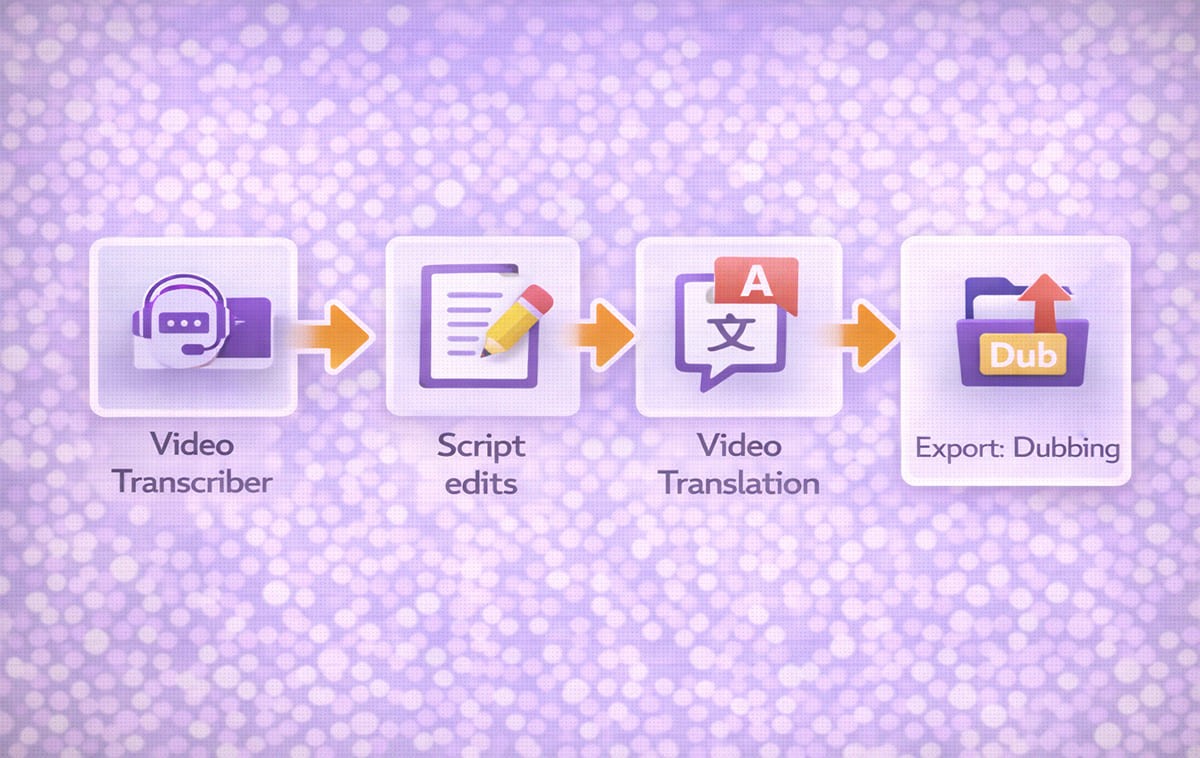
Marketing needs approvals that don’t stall launches. A strong setup lets you flag only the highest-impact lines (hook, offer, CTA), revise them, and re-preview without touching the rest. In Perso Dubbing, that usually looks like: quick script pass → short preview → approve → export.
Video Translator Workflow That Supports Campaign Velocity
A marketing friendly Video Translator workflow should fit how campaigns are built and shipped.
It usually needs:
A fast first draft of the translation
A clear way to review the script before final output
A stable export process so files are ready for channels
The ability to iterate on small sections without restarting everything
If your workflow forces full regeneration for small line changes, you lose speed. If it lets you edit and preview efficiently, you keep launch velocity across markets.
A useful way to understand how Perso Dubbing positions this overall approach is through its multilingual video platform that connects transcription, translation, and dubbing in one place.
AI Lip Sync Signals That Affect Performance Creatives
For some marketing videos, lip sync is optional. For others, it can influence perceived trust.
AI lip sync matters most when:
The speaker is on camera for long stretches
The video is testimonial or founder led
The creative relies on authenticity, such as UGC style ads
Close up face shots are common
Even when the translation is accurate, mismatched mouth movement can distract viewers. For performance creative, that distraction can reduce message retention.
If you want a deeper explanation of how lip sync fits into translation workflows, the AI video translator and lip sync overview breaks down the relationship between script timing and perceived realism.
Video Transcriber Features That Prevent Timing Drift
Marketing teams often overlook transcription quality, but timing begins there.
A strong Video Transcriber stage helps by:
Creating clean segments that match how people speak
Avoiding overly long subtitle blocks that force rushed delivery
Handling multi-speaker content in interviews or brand films
When transcription timing is stable, your dubbed audio has a clearer window to match pacing. That stability reduces awkward line delivery and makes review faster.
Automatic Dubbing Versus Controlled Localization for Marketing
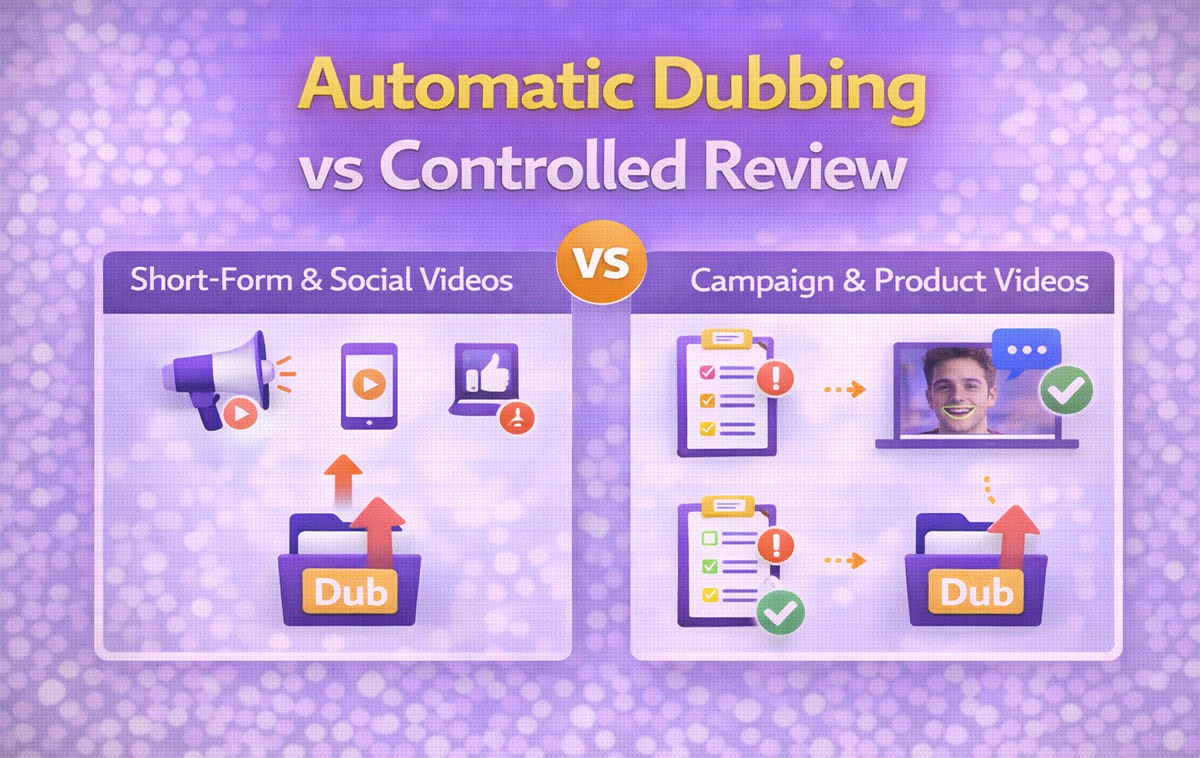
Marketing teams usually need two modes.
Automatic Dubbing for Scale
Automatic Dubbing works well for:
Screen heavy product walkthroughs
Short feature clips
Content where visuals carry the message
It is often a good choice when speed matters and the format is forgiving.
Controlled Dubbing for High Stakes Content
More control is typically needed for:
Founder-led campaigns
Testimonials
Brand films
High spend ad sets that require consistency
In these cases, script refinement and timing review matter more than raw throughput.
For performance teams, the video ads localization workflow is a useful model: move fast on iterations, but keep a consistent review checklist before anything ships
Feature Table for Marketing Focused Video Translation
Marketing goal | Feature to look for | Why it matters |
Launch quickly in new regions | Reliable workflow steps | Reduces friction between draft and publish |
Keep messaging consistent | Script editing and terminology control | Prevents tone drift across markets |
Improve on-camera trust | AI Lip Sync support | Helps talking-head ads feel natural |
Reduce rework | Video Transcriber timing stability | Minimizes rushed or clipped lines |
Scale output safely | Automatic Dubbing plus review control | Supports volume without losing clarity |
This table helps teams evaluate tools based on outcomes marketing cares about, not just technical labels.
Common Mistakes Marketing Teams Make with Video Translation
Most issues happen when teams treat Video Translation like a one-step export.
Translating Without Rewriting for Marketing Tone
Marketing copy is not the same as literal speech. If the translated script reads like documentation, it will not perform like an ad.
Skipping Timing Review
A few mis-timed segments can make the entire video feel rushed. Timing review is a small step that prevents major quality drops.
Using The Same Approach for Every Video
Some videos need Automatic Dubbing for speed. Others need controlled refinement. Segment your workflow by content type.
Forgetting Target Audience Clarity Per Market
Even within the same language, audiences can differ. A strong process includes short checks for phrasing and local norms before publishing.
Frequently Asked Questions
What does Video Translation mean for marketing teams?
Video Translation is the process of adapting video content into other languages while keeping the message, pacing, and tone consistent enough for marketing use.
Is Dubbing always better than subtitles for campaigns?
Not always. Subtitles work well for silent viewing and fast distribution. Dubbing can improve comprehension for audiences who prefer listening, depending on channel and creative format.
When should we use Automatic Dubbing?
Automatic Dubbing is often useful for scalable content such as product clips or screen-led videos, especially when you still have a light review step before publishing.
Does AI Lip Sync matter for ads?
It matters most when the video is face-led, testimonial-based, or close-up. It is less critical for screen recordings and motion graphics.
What is the fastest way to reduce awkwardly translated lines?
Start with a clean script, refine key phrases for tone, and review timing on the most important scenes before exporting.
Conclusion
Video Translation works best for marketing teams when it supports speed, clarity, and consistency across markets. Focus on script control, timing stability, and the right level of review, especially when using Dubbing, a Video Translator workflow, and Automatic Dubbing to scale campaign assets across regions.
Your campaign is ready. Creative is approved. The landing page is live. Your best-performing video ad is converting in English.
Then the expansion request hits. You need localized versions for Spanish and French audiences, plus one more language for a new region your paid team wants to test. The problem is not translating words. The problem is maintaining the same clarity, pacing, and brand tone so the new versions perform like the original.
That is why Video Translation matters for marketing teams. When done well, it helps you launch faster across markets, keep creative consistent, and measure performance without rebuilding assets every time. In this guide, we’ll break down the features that make video localization reliable for marketing, especially the controls that reduce rework when you’re shipping multiple language versions at campaign speed. We’ll also show where Perso Dubbing fits when teams want repeatable script edits, fast iteration, and export-ready files for ads.
This article is for performance marketers, lifecycle teams, and brand marketers running multi-market campaigns.
Video Translation Goals That Matter for Marketing Teams
Marketing teams usually want three outcomes from Video Translation.
First, the localized video should feel native enough that viewers focus on the message, not the translation.
Second, the workflow should be repeatable. If every language version needs heavy manual fixes, scaling becomes difficult.
Third, the team needs clean measurement. Marketing does not need promises of ROI. Marketing needs predictable output and clear signals that help evaluate performance.
These outcomes depend less on “translation quality” alone and more on the feature set behind the workflow.
How Marketing Teams Measure ROI from Localized Video?
Marketing ROI shows up in performance signals, not opinions. Teams typically compare localized vs. original creative using a small set of metrics:
View-through / completion rate (does the message land without drop-off?)
Hold time / average watch time (does the localized version keep attention?)
CTR and landing-page conversion rate (does intent carry through?)
CPA / CAC by region (does cost efficiency improve or worsen?)
A simple approach is to run a regional split test: keep targeting and budget similar, swap only the language version, and track lift over 7–14 days. If watch time improves but CPA worsens, the issue is usually the offer or targeting. If completion drops sharply, the issue is usually script tone, timing, or clarity.
Dubbing Features That Protect Message Clarity
When marketing teams say a localized video “does not work,” the issue is often clarity. The voice sounds fine, but the message lands differently.
Script Control That Keeps Lines Speakable
Translated lines can become too long or too formal. Marketing videos often rely on short, punchy phrasing. Good workflows allow you to refine the script so it sounds like marketing language, not a literal transcript.
This is where a script editing layer helps, because it lets you adjust phrasing without redoing the entire project. In Perso Dubbing, teams typically use the Subtitle & Script Editor to tighten punchy ad lines, shorten long translations, and re-preview only the sections they changed.
Terminology Consistency for Product and Brand Language
Marketing teams repeat product names, taglines, and feature phrases across assets. A good workflow helps keep these terms consistent, so your messaging does not drift from one market to another.
Review Flow That Supports Fast Approvals
Marketing needs approvals that don’t stall launches. A strong setup lets you flag only the highest-impact lines (hook, offer, CTA), revise them, and re-preview without touching the rest. In Perso Dubbing, that usually looks like: quick script pass → short preview → approve → export.
Video Translator Workflow That Supports Campaign Velocity
A marketing friendly Video Translator workflow should fit how campaigns are built and shipped.
It usually needs:
A fast first draft of the translation
A clear way to review the script before final output
A stable export process so files are ready for channels
The ability to iterate on small sections without restarting everything
If your workflow forces full regeneration for small line changes, you lose speed. If it lets you edit and preview efficiently, you keep launch velocity across markets.
A useful way to understand how Perso Dubbing positions this overall approach is through its multilingual video platform that connects transcription, translation, and dubbing in one place.
AI Lip Sync Signals That Affect Performance Creatives
For some marketing videos, lip sync is optional. For others, it can influence perceived trust.
AI lip sync matters most when:
The speaker is on camera for long stretches
The video is testimonial or founder led
The creative relies on authenticity, such as UGC style ads
Close up face shots are common
Even when the translation is accurate, mismatched mouth movement can distract viewers. For performance creative, that distraction can reduce message retention.
If you want a deeper explanation of how lip sync fits into translation workflows, the AI video translator and lip sync overview breaks down the relationship between script timing and perceived realism.
Video Transcriber Features That Prevent Timing Drift
Marketing teams often overlook transcription quality, but timing begins there.
A strong Video Transcriber stage helps by:
Creating clean segments that match how people speak
Avoiding overly long subtitle blocks that force rushed delivery
Handling multi-speaker content in interviews or brand films
When transcription timing is stable, your dubbed audio has a clearer window to match pacing. That stability reduces awkward line delivery and makes review faster.
Automatic Dubbing Versus Controlled Localization for Marketing
Marketing teams usually need two modes.
Automatic Dubbing for Scale
Automatic Dubbing works well for:
Screen heavy product walkthroughs
Short feature clips
Content where visuals carry the message
It is often a good choice when speed matters and the format is forgiving.
Controlled Dubbing for High Stakes Content
More control is typically needed for:
Founder-led campaigns
Testimonials
Brand films
High spend ad sets that require consistency
In these cases, script refinement and timing review matter more than raw throughput.
For performance teams, the video ads localization workflow is a useful model: move fast on iterations, but keep a consistent review checklist before anything ships
Feature Table for Marketing Focused Video Translation
Marketing goal | Feature to look for | Why it matters |
Launch quickly in new regions | Reliable workflow steps | Reduces friction between draft and publish |
Keep messaging consistent | Script editing and terminology control | Prevents tone drift across markets |
Improve on-camera trust | AI Lip Sync support | Helps talking-head ads feel natural |
Reduce rework | Video Transcriber timing stability | Minimizes rushed or clipped lines |
Scale output safely | Automatic Dubbing plus review control | Supports volume without losing clarity |
This table helps teams evaluate tools based on outcomes marketing cares about, not just technical labels.
Common Mistakes Marketing Teams Make with Video Translation
Most issues happen when teams treat Video Translation like a one-step export.
Translating Without Rewriting for Marketing Tone
Marketing copy is not the same as literal speech. If the translated script reads like documentation, it will not perform like an ad.
Skipping Timing Review
A few mis-timed segments can make the entire video feel rushed. Timing review is a small step that prevents major quality drops.
Using The Same Approach for Every Video
Some videos need Automatic Dubbing for speed. Others need controlled refinement. Segment your workflow by content type.
Forgetting Target Audience Clarity Per Market
Even within the same language, audiences can differ. A strong process includes short checks for phrasing and local norms before publishing.
Frequently Asked Questions
What does Video Translation mean for marketing teams?
Video Translation is the process of adapting video content into other languages while keeping the message, pacing, and tone consistent enough for marketing use.
Is Dubbing always better than subtitles for campaigns?
Not always. Subtitles work well for silent viewing and fast distribution. Dubbing can improve comprehension for audiences who prefer listening, depending on channel and creative format.
When should we use Automatic Dubbing?
Automatic Dubbing is often useful for scalable content such as product clips or screen-led videos, especially when you still have a light review step before publishing.
Does AI Lip Sync matter for ads?
It matters most when the video is face-led, testimonial-based, or close-up. It is less critical for screen recordings and motion graphics.
What is the fastest way to reduce awkwardly translated lines?
Start with a clean script, refine key phrases for tone, and review timing on the most important scenes before exporting.
Conclusion
Video Translation works best for marketing teams when it supports speed, clarity, and consistency across markets. Focus on script control, timing stability, and the right level of review, especially when using Dubbing, a Video Translator workflow, and Automatic Dubbing to scale campaign assets across regions.
Your campaign is ready. Creative is approved. The landing page is live. Your best-performing video ad is converting in English.
Then the expansion request hits. You need localized versions for Spanish and French audiences, plus one more language for a new region your paid team wants to test. The problem is not translating words. The problem is maintaining the same clarity, pacing, and brand tone so the new versions perform like the original.
That is why Video Translation matters for marketing teams. When done well, it helps you launch faster across markets, keep creative consistent, and measure performance without rebuilding assets every time. In this guide, we’ll break down the features that make video localization reliable for marketing, especially the controls that reduce rework when you’re shipping multiple language versions at campaign speed. We’ll also show where Perso Dubbing fits when teams want repeatable script edits, fast iteration, and export-ready files for ads.
This article is for performance marketers, lifecycle teams, and brand marketers running multi-market campaigns.
Video Translation Goals That Matter for Marketing Teams
Marketing teams usually want three outcomes from Video Translation.
First, the localized video should feel native enough that viewers focus on the message, not the translation.
Second, the workflow should be repeatable. If every language version needs heavy manual fixes, scaling becomes difficult.
Third, the team needs clean measurement. Marketing does not need promises of ROI. Marketing needs predictable output and clear signals that help evaluate performance.
These outcomes depend less on “translation quality” alone and more on the feature set behind the workflow.
How Marketing Teams Measure ROI from Localized Video?
Marketing ROI shows up in performance signals, not opinions. Teams typically compare localized vs. original creative using a small set of metrics:
View-through / completion rate (does the message land without drop-off?)
Hold time / average watch time (does the localized version keep attention?)
CTR and landing-page conversion rate (does intent carry through?)
CPA / CAC by region (does cost efficiency improve or worsen?)
A simple approach is to run a regional split test: keep targeting and budget similar, swap only the language version, and track lift over 7–14 days. If watch time improves but CPA worsens, the issue is usually the offer or targeting. If completion drops sharply, the issue is usually script tone, timing, or clarity.
Dubbing Features That Protect Message Clarity
When marketing teams say a localized video “does not work,” the issue is often clarity. The voice sounds fine, but the message lands differently.
Script Control That Keeps Lines Speakable
Translated lines can become too long or too formal. Marketing videos often rely on short, punchy phrasing. Good workflows allow you to refine the script so it sounds like marketing language, not a literal transcript.
This is where a script editing layer helps, because it lets you adjust phrasing without redoing the entire project. In Perso Dubbing, teams typically use the Subtitle & Script Editor to tighten punchy ad lines, shorten long translations, and re-preview only the sections they changed.
Terminology Consistency for Product and Brand Language
Marketing teams repeat product names, taglines, and feature phrases across assets. A good workflow helps keep these terms consistent, so your messaging does not drift from one market to another.
Review Flow That Supports Fast Approvals
Marketing needs approvals that don’t stall launches. A strong setup lets you flag only the highest-impact lines (hook, offer, CTA), revise them, and re-preview without touching the rest. In Perso Dubbing, that usually looks like: quick script pass → short preview → approve → export.
Video Translator Workflow That Supports Campaign Velocity
A marketing friendly Video Translator workflow should fit how campaigns are built and shipped.
It usually needs:
A fast first draft of the translation
A clear way to review the script before final output
A stable export process so files are ready for channels
The ability to iterate on small sections without restarting everything
If your workflow forces full regeneration for small line changes, you lose speed. If it lets you edit and preview efficiently, you keep launch velocity across markets.
A useful way to understand how Perso Dubbing positions this overall approach is through its multilingual video platform that connects transcription, translation, and dubbing in one place.
AI Lip Sync Signals That Affect Performance Creatives
For some marketing videos, lip sync is optional. For others, it can influence perceived trust.
AI lip sync matters most when:
The speaker is on camera for long stretches
The video is testimonial or founder led
The creative relies on authenticity, such as UGC style ads
Close up face shots are common
Even when the translation is accurate, mismatched mouth movement can distract viewers. For performance creative, that distraction can reduce message retention.
If you want a deeper explanation of how lip sync fits into translation workflows, the AI video translator and lip sync overview breaks down the relationship between script timing and perceived realism.
Video Transcriber Features That Prevent Timing Drift
Marketing teams often overlook transcription quality, but timing begins there.
A strong Video Transcriber stage helps by:
Creating clean segments that match how people speak
Avoiding overly long subtitle blocks that force rushed delivery
Handling multi-speaker content in interviews or brand films
When transcription timing is stable, your dubbed audio has a clearer window to match pacing. That stability reduces awkward line delivery and makes review faster.
Automatic Dubbing Versus Controlled Localization for Marketing
Marketing teams usually need two modes.
Automatic Dubbing for Scale
Automatic Dubbing works well for:
Screen heavy product walkthroughs
Short feature clips
Content where visuals carry the message
It is often a good choice when speed matters and the format is forgiving.
Controlled Dubbing for High Stakes Content
More control is typically needed for:
Founder-led campaigns
Testimonials
Brand films
High spend ad sets that require consistency
In these cases, script refinement and timing review matter more than raw throughput.
For performance teams, the video ads localization workflow is a useful model: move fast on iterations, but keep a consistent review checklist before anything ships
Feature Table for Marketing Focused Video Translation
Marketing goal | Feature to look for | Why it matters |
Launch quickly in new regions | Reliable workflow steps | Reduces friction between draft and publish |
Keep messaging consistent | Script editing and terminology control | Prevents tone drift across markets |
Improve on-camera trust | AI Lip Sync support | Helps talking-head ads feel natural |
Reduce rework | Video Transcriber timing stability | Minimizes rushed or clipped lines |
Scale output safely | Automatic Dubbing plus review control | Supports volume without losing clarity |
This table helps teams evaluate tools based on outcomes marketing cares about, not just technical labels.
Common Mistakes Marketing Teams Make with Video Translation
Most issues happen when teams treat Video Translation like a one-step export.
Translating Without Rewriting for Marketing Tone
Marketing copy is not the same as literal speech. If the translated script reads like documentation, it will not perform like an ad.
Skipping Timing Review
A few mis-timed segments can make the entire video feel rushed. Timing review is a small step that prevents major quality drops.
Using The Same Approach for Every Video
Some videos need Automatic Dubbing for speed. Others need controlled refinement. Segment your workflow by content type.
Forgetting Target Audience Clarity Per Market
Even within the same language, audiences can differ. A strong process includes short checks for phrasing and local norms before publishing.
Frequently Asked Questions
What does Video Translation mean for marketing teams?
Video Translation is the process of adapting video content into other languages while keeping the message, pacing, and tone consistent enough for marketing use.
Is Dubbing always better than subtitles for campaigns?
Not always. Subtitles work well for silent viewing and fast distribution. Dubbing can improve comprehension for audiences who prefer listening, depending on channel and creative format.
When should we use Automatic Dubbing?
Automatic Dubbing is often useful for scalable content such as product clips or screen-led videos, especially when you still have a light review step before publishing.
Does AI Lip Sync matter for ads?
It matters most when the video is face-led, testimonial-based, or close-up. It is less critical for screen recordings and motion graphics.
What is the fastest way to reduce awkwardly translated lines?
Start with a clean script, refine key phrases for tone, and review timing on the most important scenes before exporting.
Conclusion
Video Translation works best for marketing teams when it supports speed, clarity, and consistency across markets. Focus on script control, timing stability, and the right level of review, especially when using Dubbing, a Video Translator workflow, and Automatic Dubbing to scale campaign assets across regions.
Continue Reading
Browse All