AI Dubbing for Product Demos: Perfect Timing Guide
Last Updated




Jump to section
Jump to section

Share
Share
Share
AI Video Translator, Localization, and Dubbing Tool
Try it out for Free
Your product demo converts well in English. Prospects understand the value. The pacing feels clear. The feature walkthrough flows naturally.
Now you want to release Spanish, German, and Japanese versions for global markets. You translate the script and generate a dubbed version. The words are correct, but some sections feel rushed. A feature explanation runs too long. The timing no longer matches the on-screen actions.
This is where AI Dubbing becomes more than translation. It becomes a timing and consistency tool.
In this guide, we will explain how AI Dubbing improves product demo performance, which features protect clarity across languages, and how to structure Automatic Dubbing workflows that support clean Video Translation results for sales teams.
This guide is for SaaS marketers, product teams, and growth leaders who rely on demos to convert international audiences.
Why Consistent Timing Matters in Product Demo Dubbing?
Product demos are structured. They usually follow this pattern:
Introduce the problem
Show the feature
Explain the benefit
Demonstrate the result
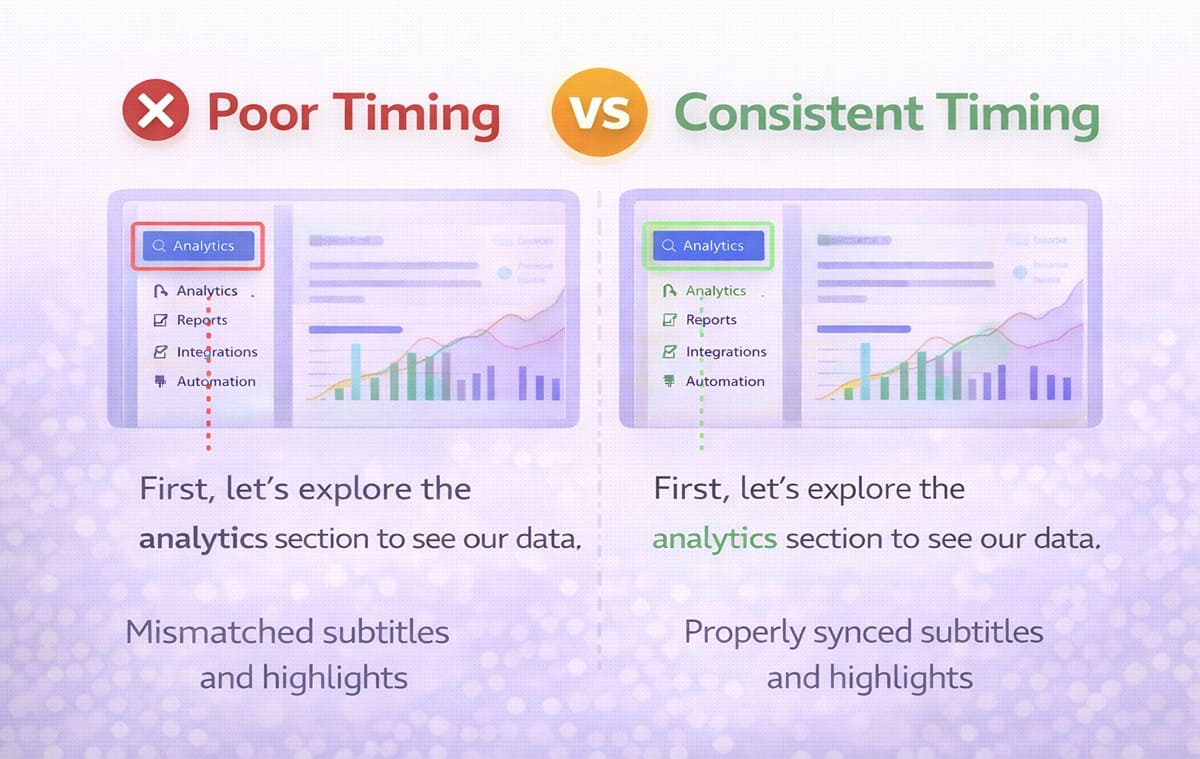
When timing shifts during Dubbing, the visual and verbal explanation drift apart. Viewers may see a feature highlighted before or after it is described.
That small disconnect reduces clarity and can weaken sales impact.
Strong AI Dubbing workflows protect timing so that:
Voice aligns with screen interactions
Feature explanations stay synchronized
Call to action moments land naturally
For teams structuring multilingual demo workflows, you can review AI dubbing tools for multilingual product videos to understand how timing and script control are handled in one system.
AI Dubbing and Automatic Dubbing for Demo Localization
Not every demo requires the same level of control.
When Automatic Dubbing Works Well
Automatic Dubbing can work for:
Screen focused demos with minimal face time
Feature tours where visuals carry the message
Short update announcements
In these cases, consistent transcript timing and clear translation may be enough.
When You Need Controlled AI Dubbing
You need more control when:
The demo includes talking head segments
The presenter’s tone influences trust
The pacing of feature reveals is tightly structured
Controlled AI Dubbing allows refinement before export. That means better alignment between spoken explanation and interface interaction.
Subtitle & Script Editor Improves Video Translation Stability
Even accurate translations can sound awkward in demos. Some sentences expand in other languages. Others become too short.
A Subtitle & Script Editor allows you to:
Shorten overly long phrases
Adjust segmentation for better flow
Align terminology consistently
Maintain stable timestamps
This editing layer reduces friction inside your Video Translation workflow.
If you want a deeper technical breakdown of how script consistency supports multilingual branding, explore maintaining brand voice consistency with AI dubbing.
Video To Text Script as The Foundation of Clean Dubbing
Every strong AI Dubbing workflow starts with a reliable Video to Text Script.
A clean script ensures:
Feature names remain consistent
Product terminology is stable
Segments align with visual transitions
Without a structured Video to Text Script, timing errors compound during voice generation.
For teams expanding demo content across regions, starting with Perso Dubbing video translation and dubbing for global product teams helps align transcription, translation, and output within one workflow.
Voice Cloning for Demo Consistency Across Markets
If your product demo includes a founder or product lead, voice matters. Prospects often associate authority with delivery style.
Voice Cloning helps maintain a consistent tone across languages while preserving rhythm and pacing. This is especially useful when scaling demo libraries.
When evaluating Voice Cloning inside AI Dubbing workflows, verify:
Tone remains professional
Technical terminology is pronounced clearly
Multi speaker segments stay distinct
How A Video Translator Workflow Supports Sales Enablement?
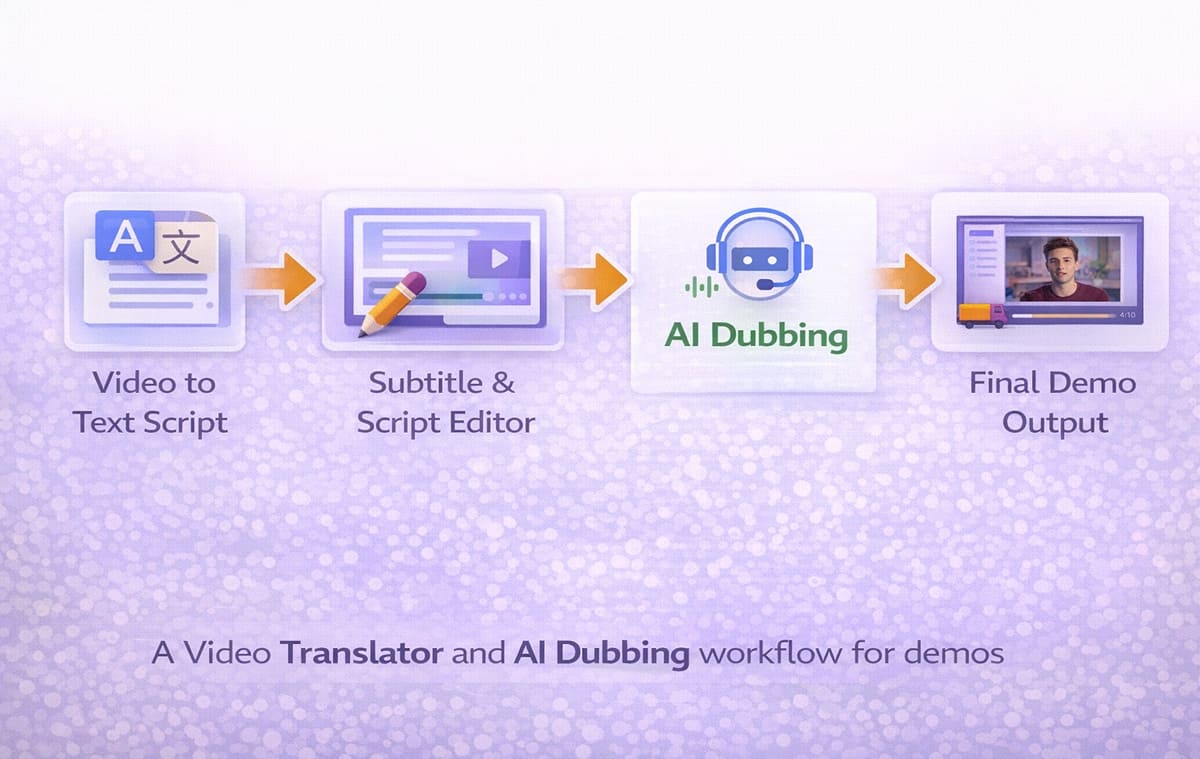
A Video Translator workflow for product demos should support repeatable production, not one off localization.
A structured process typically includes:
Generate Video to Text Script
Translate with terminology control
Refine in Subtitle & Script Editor
Generate AI Dubbing output
Review synchronization
When these steps are standardized, sales teams can deploy localized demos faster without sacrificing clarity.
For companies running paid campaigns or regional launches, see AI dubbing for video ads across global markets to understand how timing precision supports conversion performance.
Feature Comparison Table for Demo Focused AI Dubbing
Demo Requirement | Feature Needed | Why It Matters for Sales |
Precise feature walkthrough | Clean transcript timing | Keeps voice aligned with UI interactions |
Founder led explanation | Voice Cloning | Preserves tone and credibility |
Complex terminology | Script editing controls | Prevents awkward phrasing |
Multi market expansion | Video Translation workflow | Enables repeatable localization |
Rapid updates | Automatic Dubbing support | Speeds up minor revisions |
This table highlights why AI Dubbing for demos is not just about translation accuracy. It is about preserving the structure of the sales narrative.
Common Mistakes When Localizing Product Demos
Even strong product teams make avoidable errors when adapting demos for new markets. Most problems are not caused by translation itself, but by timing, script structure, and workflow shortcuts that affect Dubbing quality.
Over relying on translation alone: Accurate translation does not guarantee synchronized delivery. Timing and segmentation matter equally.
Ignoring script readability: Some translated lines are grammatically correct but too long for natural delivery.
Skipping sync checks on feature reveals: If the spoken explanation lags behind the visual action, clarity suffers.
Treating every demo the same: Short feature clips may tolerate Automatic Dubbing. Founder led demos often require deeper control.
Frequently Asked Questions
Does AI Dubbing improve product demo conversions?
Clear timing and synchronized explanations improve viewer understanding, which supports stronger engagement.
Is Automatic Dubbing enough for SaaS demos?
It can be effective for screen focused demos. Talking head or narrative heavy demos usually benefit from more control.
How does Subtitle & Script Editor improve results?
It allows quick refinements without regenerating the entire project, which stabilizes timing and phrasing.
Should we use Voice Cloning for all demos?
It depends on brand positioning. Founder led demos often benefit more than purely screen recorded tutorials.
Conclusion
AI Dubbing for product demos works best when timing, script clarity, and voice consistency align with the visual flow of the presentation. By combining structured Video Translation workflows, controlled editing, and consistent voice delivery, teams can scale multilingual demos without disrupting the sales narrative.
Your product demo converts well in English. Prospects understand the value. The pacing feels clear. The feature walkthrough flows naturally.
Now you want to release Spanish, German, and Japanese versions for global markets. You translate the script and generate a dubbed version. The words are correct, but some sections feel rushed. A feature explanation runs too long. The timing no longer matches the on-screen actions.
This is where AI Dubbing becomes more than translation. It becomes a timing and consistency tool.
In this guide, we will explain how AI Dubbing improves product demo performance, which features protect clarity across languages, and how to structure Automatic Dubbing workflows that support clean Video Translation results for sales teams.
This guide is for SaaS marketers, product teams, and growth leaders who rely on demos to convert international audiences.
Why Consistent Timing Matters in Product Demo Dubbing?
Product demos are structured. They usually follow this pattern:
Introduce the problem
Show the feature
Explain the benefit
Demonstrate the result
When timing shifts during Dubbing, the visual and verbal explanation drift apart. Viewers may see a feature highlighted before or after it is described.
That small disconnect reduces clarity and can weaken sales impact.
Strong AI Dubbing workflows protect timing so that:
Voice aligns with screen interactions
Feature explanations stay synchronized
Call to action moments land naturally
For teams structuring multilingual demo workflows, you can review AI dubbing tools for multilingual product videos to understand how timing and script control are handled in one system.
AI Dubbing and Automatic Dubbing for Demo Localization
Not every demo requires the same level of control.
When Automatic Dubbing Works Well
Automatic Dubbing can work for:
Screen focused demos with minimal face time
Feature tours where visuals carry the message
Short update announcements
In these cases, consistent transcript timing and clear translation may be enough.
When You Need Controlled AI Dubbing
You need more control when:
The demo includes talking head segments
The presenter’s tone influences trust
The pacing of feature reveals is tightly structured
Controlled AI Dubbing allows refinement before export. That means better alignment between spoken explanation and interface interaction.
Subtitle & Script Editor Improves Video Translation Stability
Even accurate translations can sound awkward in demos. Some sentences expand in other languages. Others become too short.
A Subtitle & Script Editor allows you to:
Shorten overly long phrases
Adjust segmentation for better flow
Align terminology consistently
Maintain stable timestamps
This editing layer reduces friction inside your Video Translation workflow.
If you want a deeper technical breakdown of how script consistency supports multilingual branding, explore maintaining brand voice consistency with AI dubbing.
Video To Text Script as The Foundation of Clean Dubbing
Every strong AI Dubbing workflow starts with a reliable Video to Text Script.
A clean script ensures:
Feature names remain consistent
Product terminology is stable
Segments align with visual transitions
Without a structured Video to Text Script, timing errors compound during voice generation.
For teams expanding demo content across regions, starting with Perso Dubbing video translation and dubbing for global product teams helps align transcription, translation, and output within one workflow.
Voice Cloning for Demo Consistency Across Markets
If your product demo includes a founder or product lead, voice matters. Prospects often associate authority with delivery style.
Voice Cloning helps maintain a consistent tone across languages while preserving rhythm and pacing. This is especially useful when scaling demo libraries.
When evaluating Voice Cloning inside AI Dubbing workflows, verify:
Tone remains professional
Technical terminology is pronounced clearly
Multi speaker segments stay distinct
How A Video Translator Workflow Supports Sales Enablement?
A Video Translator workflow for product demos should support repeatable production, not one off localization.
A structured process typically includes:
Generate Video to Text Script
Translate with terminology control
Refine in Subtitle & Script Editor
Generate AI Dubbing output
Review synchronization
When these steps are standardized, sales teams can deploy localized demos faster without sacrificing clarity.
For companies running paid campaigns or regional launches, see AI dubbing for video ads across global markets to understand how timing precision supports conversion performance.
Feature Comparison Table for Demo Focused AI Dubbing
Demo Requirement | Feature Needed | Why It Matters for Sales |
Precise feature walkthrough | Clean transcript timing | Keeps voice aligned with UI interactions |
Founder led explanation | Voice Cloning | Preserves tone and credibility |
Complex terminology | Script editing controls | Prevents awkward phrasing |
Multi market expansion | Video Translation workflow | Enables repeatable localization |
Rapid updates | Automatic Dubbing support | Speeds up minor revisions |
This table highlights why AI Dubbing for demos is not just about translation accuracy. It is about preserving the structure of the sales narrative.
Common Mistakes When Localizing Product Demos
Even strong product teams make avoidable errors when adapting demos for new markets. Most problems are not caused by translation itself, but by timing, script structure, and workflow shortcuts that affect Dubbing quality.
Over relying on translation alone: Accurate translation does not guarantee synchronized delivery. Timing and segmentation matter equally.
Ignoring script readability: Some translated lines are grammatically correct but too long for natural delivery.
Skipping sync checks on feature reveals: If the spoken explanation lags behind the visual action, clarity suffers.
Treating every demo the same: Short feature clips may tolerate Automatic Dubbing. Founder led demos often require deeper control.
Frequently Asked Questions
Does AI Dubbing improve product demo conversions?
Clear timing and synchronized explanations improve viewer understanding, which supports stronger engagement.
Is Automatic Dubbing enough for SaaS demos?
It can be effective for screen focused demos. Talking head or narrative heavy demos usually benefit from more control.
How does Subtitle & Script Editor improve results?
It allows quick refinements without regenerating the entire project, which stabilizes timing and phrasing.
Should we use Voice Cloning for all demos?
It depends on brand positioning. Founder led demos often benefit more than purely screen recorded tutorials.
Conclusion
AI Dubbing for product demos works best when timing, script clarity, and voice consistency align with the visual flow of the presentation. By combining structured Video Translation workflows, controlled editing, and consistent voice delivery, teams can scale multilingual demos without disrupting the sales narrative.
Your product demo converts well in English. Prospects understand the value. The pacing feels clear. The feature walkthrough flows naturally.
Now you want to release Spanish, German, and Japanese versions for global markets. You translate the script and generate a dubbed version. The words are correct, but some sections feel rushed. A feature explanation runs too long. The timing no longer matches the on-screen actions.
This is where AI Dubbing becomes more than translation. It becomes a timing and consistency tool.
In this guide, we will explain how AI Dubbing improves product demo performance, which features protect clarity across languages, and how to structure Automatic Dubbing workflows that support clean Video Translation results for sales teams.
This guide is for SaaS marketers, product teams, and growth leaders who rely on demos to convert international audiences.
Why Consistent Timing Matters in Product Demo Dubbing?
Product demos are structured. They usually follow this pattern:
Introduce the problem
Show the feature
Explain the benefit
Demonstrate the result
When timing shifts during Dubbing, the visual and verbal explanation drift apart. Viewers may see a feature highlighted before or after it is described.
That small disconnect reduces clarity and can weaken sales impact.
Strong AI Dubbing workflows protect timing so that:
Voice aligns with screen interactions
Feature explanations stay synchronized
Call to action moments land naturally
For teams structuring multilingual demo workflows, you can review AI dubbing tools for multilingual product videos to understand how timing and script control are handled in one system.
AI Dubbing and Automatic Dubbing for Demo Localization
Not every demo requires the same level of control.
When Automatic Dubbing Works Well
Automatic Dubbing can work for:
Screen focused demos with minimal face time
Feature tours where visuals carry the message
Short update announcements
In these cases, consistent transcript timing and clear translation may be enough.
When You Need Controlled AI Dubbing
You need more control when:
The demo includes talking head segments
The presenter’s tone influences trust
The pacing of feature reveals is tightly structured
Controlled AI Dubbing allows refinement before export. That means better alignment between spoken explanation and interface interaction.
Subtitle & Script Editor Improves Video Translation Stability
Even accurate translations can sound awkward in demos. Some sentences expand in other languages. Others become too short.
A Subtitle & Script Editor allows you to:
Shorten overly long phrases
Adjust segmentation for better flow
Align terminology consistently
Maintain stable timestamps
This editing layer reduces friction inside your Video Translation workflow.
If you want a deeper technical breakdown of how script consistency supports multilingual branding, explore maintaining brand voice consistency with AI dubbing.
Video To Text Script as The Foundation of Clean Dubbing
Every strong AI Dubbing workflow starts with a reliable Video to Text Script.
A clean script ensures:
Feature names remain consistent
Product terminology is stable
Segments align with visual transitions
Without a structured Video to Text Script, timing errors compound during voice generation.
For teams expanding demo content across regions, starting with Perso Dubbing video translation and dubbing for global product teams helps align transcription, translation, and output within one workflow.
Voice Cloning for Demo Consistency Across Markets
If your product demo includes a founder or product lead, voice matters. Prospects often associate authority with delivery style.
Voice Cloning helps maintain a consistent tone across languages while preserving rhythm and pacing. This is especially useful when scaling demo libraries.
When evaluating Voice Cloning inside AI Dubbing workflows, verify:
Tone remains professional
Technical terminology is pronounced clearly
Multi speaker segments stay distinct
How A Video Translator Workflow Supports Sales Enablement?
A Video Translator workflow for product demos should support repeatable production, not one off localization.
A structured process typically includes:
Generate Video to Text Script
Translate with terminology control
Refine in Subtitle & Script Editor
Generate AI Dubbing output
Review synchronization
When these steps are standardized, sales teams can deploy localized demos faster without sacrificing clarity.
For companies running paid campaigns or regional launches, see AI dubbing for video ads across global markets to understand how timing precision supports conversion performance.
Feature Comparison Table for Demo Focused AI Dubbing
Demo Requirement | Feature Needed | Why It Matters for Sales |
Precise feature walkthrough | Clean transcript timing | Keeps voice aligned with UI interactions |
Founder led explanation | Voice Cloning | Preserves tone and credibility |
Complex terminology | Script editing controls | Prevents awkward phrasing |
Multi market expansion | Video Translation workflow | Enables repeatable localization |
Rapid updates | Automatic Dubbing support | Speeds up minor revisions |
This table highlights why AI Dubbing for demos is not just about translation accuracy. It is about preserving the structure of the sales narrative.
Common Mistakes When Localizing Product Demos
Even strong product teams make avoidable errors when adapting demos for new markets. Most problems are not caused by translation itself, but by timing, script structure, and workflow shortcuts that affect Dubbing quality.
Over relying on translation alone: Accurate translation does not guarantee synchronized delivery. Timing and segmentation matter equally.
Ignoring script readability: Some translated lines are grammatically correct but too long for natural delivery.
Skipping sync checks on feature reveals: If the spoken explanation lags behind the visual action, clarity suffers.
Treating every demo the same: Short feature clips may tolerate Automatic Dubbing. Founder led demos often require deeper control.
Frequently Asked Questions
Does AI Dubbing improve product demo conversions?
Clear timing and synchronized explanations improve viewer understanding, which supports stronger engagement.
Is Automatic Dubbing enough for SaaS demos?
It can be effective for screen focused demos. Talking head or narrative heavy demos usually benefit from more control.
How does Subtitle & Script Editor improve results?
It allows quick refinements without regenerating the entire project, which stabilizes timing and phrasing.
Should we use Voice Cloning for all demos?
It depends on brand positioning. Founder led demos often benefit more than purely screen recorded tutorials.
Conclusion
AI Dubbing for product demos works best when timing, script clarity, and voice consistency align with the visual flow of the presentation. By combining structured Video Translation workflows, controlled editing, and consistent voice delivery, teams can scale multilingual demos without disrupting the sales narrative.
Continue Reading
Browse All