How to Localize Help Videos for Global Customer Success
Last Updated




Jump to section
Jump to section

Share
Share
Share

AI Video Translator, Localization, and Dubbing Tool
Try it out for Free
Your customer success team just spent weeks creating the perfect product tutorial. The video is clear, helpful, and answers every common question. But here’s the problem: many global customers may not fully understand it if it’s only in English.
Video translator tools help customer success teams turn single-language education content into multilingual resources that reach every customer, no matter where they are or what language they speak. When customers understand your product better, they need less support, stay longer, and use more features.
Customer education videos can reduce support tickets and improve product adoption. And when you translate these videos into multiple languages, the impact can grow. In many cases, multilingual education helps customers feel more confident, which can support adoption and renewals.
For customer success teams managing global accounts, video translation isn't just about language anymore. It's about giving every customer the same chance to succeed with your product. Traditional translation methods take 4-6 weeks and cost a lot. Modern video translator tools can finish the same work in just 3-5 days while keeping your original speaker's voice and style.

Why Customer Education Videos Matter
Video has become the number one choice for learning. When customers need help with your product, many prefer watching a short video instead of reading a long guide. This isn't surprising. Videos show exactly how things work, step by step.
Customer success teams know this truth: educated customers are happier customers. When people understand how to use your product properly, they:
Open fewer support tickets
Discover more features on their own
Stay subscribed for longer periods
Recommend your product to others
Here’s what teams often see: when customer education is strong, customer satisfaction usually improves. Training videos can improve product adoption rates significantly because customers can watch them anytime, pause when needed, and replay difficult parts.
But there's a challenge most customer success teams face. Your product might serve customers in Germany, Japan, Brazil, and France. If your tutorial videos only exist in English, you're leaving most of your global customers without proper support.
Traditional text guides can be translated easily. Videos? That's where things get complicated. You need voiceovers, subtitles, and someone who understands both the language and your product. This is exactly where a video translator becomes essential for customer success work.
Translating Help and Tutorial Videos
Imagine this scenario: Your customer success team creates a 10-minute tutorial showing new users how to set up their accounts. In English, it works perfectly. But your Spanish-speaking customers struggle, and your French customers send confused support emails.
Video translator technology solves this exact problem. Instead of recreating videos from scratch in each language, you translate the original video while keeping the same visuals, timing, and flow.
The example of how traditional translation process used to look like:
Send the video script to a translation agency (3-5 business days)
Hire voice actors for each language (another 5-7 days)
Re-record audio in a studio (2-3 days per language)
Edit and sync the new audio with your video (3-4 days)
Review and make corrections (2-3 more days)
Total time: easily 4-6 weeks per language.
Total cost: often high, especially across multiple languages.
Modern video translator tools change everything. The same process now takes 3-5 days, and you can translate into multiple languages at once. AI can help with translated audio and natural timing so videos feel right in each language.
For customer success teams, this means something important: you can update your tutorial library whenever your product changes, without waiting weeks for translations to catch up.
Consistency Across Markets
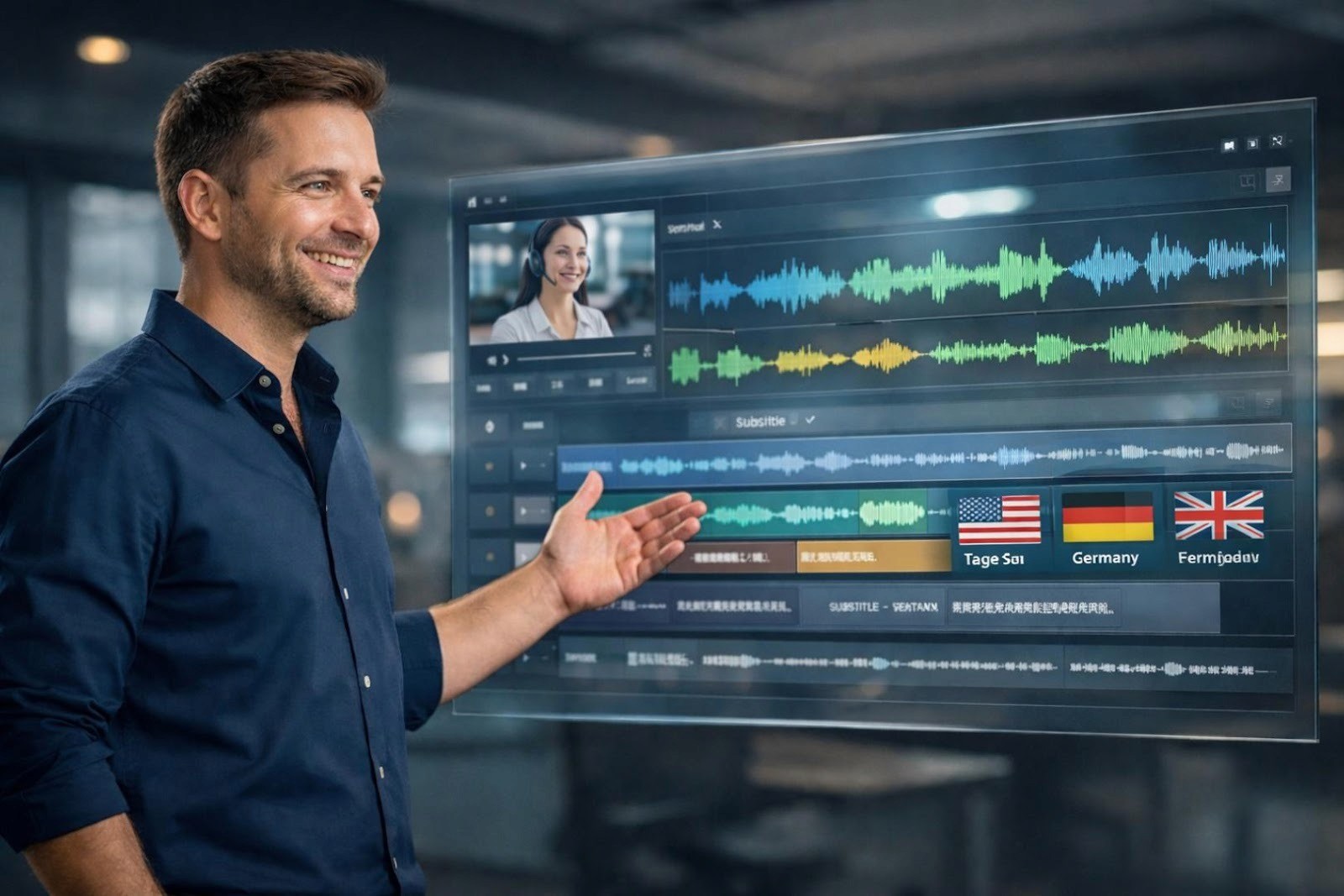
Here's a common problem: Your German customers learn one workflow from a translated video. Your Japanese customers see a slightly different version because it was created by a different translator. Your Brazilian customers get confused because their tutorial uses different terminology.
Inconsistent customer education creates support nightmares. When different markets receive different information, your support team spends hours fixing confusion that shouldn't exist in the first place.
Video translator tools help maintain consistency because they work from one source video. Every market gets the same:
Product demonstration steps
Feature explanations
Best practice recommendations
Troubleshooting guidance
The only thing that changes is the language. The visual content, timing, and message stay identical across all versions.
Traditional Method | Video Translator Method |
Different producers per market | One original video for all markets |
Message drift across versions | Identical message in every language |
Hard to update consistently | Update once, applies to all languages |
Takes 4-6 weeks per language | Completes in 3-5 days total |
This consistency matters for customer success teams managing global accounts. When a customer in Tokyo and a customer in Toronto watch your onboarding video, they should see exactly the same process, just in their preferred language.
When customers learn in their own language, they often feel more confident—and that can support conversions.
Example: Knowledge Base Video Localization
Let's look at a real-world situation. A SaaS company runs customer success for 15,000 users across Europe, Asia, and South America. Their knowledge base contains 50 tutorial videos covering everything from basic setup to advanced features.
The challenge: Support tickets kept coming in from non-English markets. The team realized customers weren't watching the English tutorials. They needed help, but they couldn't understand the help that existed.
The solution: The customer success team used a video translator to localize their entire knowledge base. They chose their top 5 customer languages: Spanish, French, German, Japanese, and Portuguese.
Here's what happened:
Week 1: They uploaded all 50 videos to the translation platform
Week 2: They reviewed and approved the translated versions
Week 3: They published the multilingual knowledge base
The results after 3 months:
Fewer basic support tickets from non-English markets
More customers finishing tutorial videos
Customer satisfaction scores improved across all markets
Less time spent answering repeat ‘how-to’ questions
The cost? Less than what they previously spent translating just three videos the traditional way. More importantly, customers could now learn independently in their preferred language, which improved both product adoption and customer confidence.
Measuring Effectiveness
You've translated your customer education videos. Now comes the important question: Is it actually working?
Customer success teams need clear metrics to prove that video translation efforts deliver real value. Here are the key numbers to track:
Core metrics for translated education content:
Video completion rate by language - Are customers watching translated videos all the way through? Higher completion rates mean better engagement
Support ticket volume by region - Track whether non-English markets send fewer basic questions after accessing translated tutorials
Feature adoption rates - Compare how quickly customers in different markets start using advanced features after watching localized training videos
Customer satisfaction scores (CSAT) - Measure satisfaction improvements in markets that receive translated content
Time to value - How quickly do customers achieve their first success with your product? Translated education can speed this up significantly
Most customer success platforms already track these metrics. The key is comparing performance before and after introducing translated videos.
Some teams find that customers who complete onboarding videos are more likely to renew. Others see faster time-to-value in markets where education is localized.
The numbers don't lie. When customers understand your product in their own language, everyone wins. Also check this AI video translator beginner guide to learn more about the technology behind video translation.
Conclusion
Customer education videos work best when every customer can understand them. A video translator removes language barriers that prevent your global users from learning your product properly.
The benefits are clear and measurable. Translated education content reduces support workload, improves satisfaction scores, and helps customers succeed faster in every market. What used to take weeks and cost thousands of dollars can now happen in days at a fraction of the price.
For customer success teams managing global accounts, video translation isn't a luxury anymore. It's how you scale quality education without scaling your team size. When customers in Tokyo, São Paulo, and Paris can all watch the same helpful tutorial in their own language, your product becomes easier to use everywhere.
The question isn't whether to translate your customer education videos. It's how quickly you can start.
Ready to Translate Your Customer Education Videos?
Video translator technology makes multilingual customer support simple and affordable. Transform your existing tutorial library into multiple languages while maintaining the same quality and message across all markets.
Learn how AI dubbing can help your customer success team reach every customer in their preferred language. Explore video translation solutions that work for global customer education.
Your customer success team just spent weeks creating the perfect product tutorial. The video is clear, helpful, and answers every common question. But here’s the problem: many global customers may not fully understand it if it’s only in English.
Video translator tools help customer success teams turn single-language education content into multilingual resources that reach every customer, no matter where they are or what language they speak. When customers understand your product better, they need less support, stay longer, and use more features.
Customer education videos can reduce support tickets and improve product adoption. And when you translate these videos into multiple languages, the impact can grow. In many cases, multilingual education helps customers feel more confident, which can support adoption and renewals.
For customer success teams managing global accounts, video translation isn't just about language anymore. It's about giving every customer the same chance to succeed with your product. Traditional translation methods take 4-6 weeks and cost a lot. Modern video translator tools can finish the same work in just 3-5 days while keeping your original speaker's voice and style.
Why Customer Education Videos Matter
Video has become the number one choice for learning. When customers need help with your product, many prefer watching a short video instead of reading a long guide. This isn't surprising. Videos show exactly how things work, step by step.
Customer success teams know this truth: educated customers are happier customers. When people understand how to use your product properly, they:
Open fewer support tickets
Discover more features on their own
Stay subscribed for longer periods
Recommend your product to others
Here’s what teams often see: when customer education is strong, customer satisfaction usually improves. Training videos can improve product adoption rates significantly because customers can watch them anytime, pause when needed, and replay difficult parts.
But there's a challenge most customer success teams face. Your product might serve customers in Germany, Japan, Brazil, and France. If your tutorial videos only exist in English, you're leaving most of your global customers without proper support.
Traditional text guides can be translated easily. Videos? That's where things get complicated. You need voiceovers, subtitles, and someone who understands both the language and your product. This is exactly where a video translator becomes essential for customer success work.
Translating Help and Tutorial Videos
Imagine this scenario: Your customer success team creates a 10-minute tutorial showing new users how to set up their accounts. In English, it works perfectly. But your Spanish-speaking customers struggle, and your French customers send confused support emails.
Video translator technology solves this exact problem. Instead of recreating videos from scratch in each language, you translate the original video while keeping the same visuals, timing, and flow.
The example of how traditional translation process used to look like:
Send the video script to a translation agency (3-5 business days)
Hire voice actors for each language (another 5-7 days)
Re-record audio in a studio (2-3 days per language)
Edit and sync the new audio with your video (3-4 days)
Review and make corrections (2-3 more days)
Total time: easily 4-6 weeks per language.
Total cost: often high, especially across multiple languages.
Modern video translator tools change everything. The same process now takes 3-5 days, and you can translate into multiple languages at once. AI can help with translated audio and natural timing so videos feel right in each language.
For customer success teams, this means something important: you can update your tutorial library whenever your product changes, without waiting weeks for translations to catch up.
Consistency Across Markets
Here's a common problem: Your German customers learn one workflow from a translated video. Your Japanese customers see a slightly different version because it was created by a different translator. Your Brazilian customers get confused because their tutorial uses different terminology.
Inconsistent customer education creates support nightmares. When different markets receive different information, your support team spends hours fixing confusion that shouldn't exist in the first place.
Video translator tools help maintain consistency because they work from one source video. Every market gets the same:
Product demonstration steps
Feature explanations
Best practice recommendations
Troubleshooting guidance
The only thing that changes is the language. The visual content, timing, and message stay identical across all versions.
Traditional Method | Video Translator Method |
Different producers per market | One original video for all markets |
Message drift across versions | Identical message in every language |
Hard to update consistently | Update once, applies to all languages |
Takes 4-6 weeks per language | Completes in 3-5 days total |
This consistency matters for customer success teams managing global accounts. When a customer in Tokyo and a customer in Toronto watch your onboarding video, they should see exactly the same process, just in their preferred language.
When customers learn in their own language, they often feel more confident—and that can support conversions.
Example: Knowledge Base Video Localization
Let's look at a real-world situation. A SaaS company runs customer success for 15,000 users across Europe, Asia, and South America. Their knowledge base contains 50 tutorial videos covering everything from basic setup to advanced features.
The challenge: Support tickets kept coming in from non-English markets. The team realized customers weren't watching the English tutorials. They needed help, but they couldn't understand the help that existed.
The solution: The customer success team used a video translator to localize their entire knowledge base. They chose their top 5 customer languages: Spanish, French, German, Japanese, and Portuguese.
Here's what happened:
Week 1: They uploaded all 50 videos to the translation platform
Week 2: They reviewed and approved the translated versions
Week 3: They published the multilingual knowledge base
The results after 3 months:
Fewer basic support tickets from non-English markets
More customers finishing tutorial videos
Customer satisfaction scores improved across all markets
Less time spent answering repeat ‘how-to’ questions
The cost? Less than what they previously spent translating just three videos the traditional way. More importantly, customers could now learn independently in their preferred language, which improved both product adoption and customer confidence.
Measuring Effectiveness
You've translated your customer education videos. Now comes the important question: Is it actually working?
Customer success teams need clear metrics to prove that video translation efforts deliver real value. Here are the key numbers to track:
Core metrics for translated education content:
Video completion rate by language - Are customers watching translated videos all the way through? Higher completion rates mean better engagement
Support ticket volume by region - Track whether non-English markets send fewer basic questions after accessing translated tutorials
Feature adoption rates - Compare how quickly customers in different markets start using advanced features after watching localized training videos
Customer satisfaction scores (CSAT) - Measure satisfaction improvements in markets that receive translated content
Time to value - How quickly do customers achieve their first success with your product? Translated education can speed this up significantly
Most customer success platforms already track these metrics. The key is comparing performance before and after introducing translated videos.
Some teams find that customers who complete onboarding videos are more likely to renew. Others see faster time-to-value in markets where education is localized.
The numbers don't lie. When customers understand your product in their own language, everyone wins. Also check this AI video translator beginner guide to learn more about the technology behind video translation.
Conclusion
Customer education videos work best when every customer can understand them. A video translator removes language barriers that prevent your global users from learning your product properly.
The benefits are clear and measurable. Translated education content reduces support workload, improves satisfaction scores, and helps customers succeed faster in every market. What used to take weeks and cost thousands of dollars can now happen in days at a fraction of the price.
For customer success teams managing global accounts, video translation isn't a luxury anymore. It's how you scale quality education without scaling your team size. When customers in Tokyo, São Paulo, and Paris can all watch the same helpful tutorial in their own language, your product becomes easier to use everywhere.
The question isn't whether to translate your customer education videos. It's how quickly you can start.
Ready to Translate Your Customer Education Videos?
Video translator technology makes multilingual customer support simple and affordable. Transform your existing tutorial library into multiple languages while maintaining the same quality and message across all markets.
Learn how AI dubbing can help your customer success team reach every customer in their preferred language. Explore video translation solutions that work for global customer education.
Your customer success team just spent weeks creating the perfect product tutorial. The video is clear, helpful, and answers every common question. But here’s the problem: many global customers may not fully understand it if it’s only in English.
Video translator tools help customer success teams turn single-language education content into multilingual resources that reach every customer, no matter where they are or what language they speak. When customers understand your product better, they need less support, stay longer, and use more features.
Customer education videos can reduce support tickets and improve product adoption. And when you translate these videos into multiple languages, the impact can grow. In many cases, multilingual education helps customers feel more confident, which can support adoption and renewals.
For customer success teams managing global accounts, video translation isn't just about language anymore. It's about giving every customer the same chance to succeed with your product. Traditional translation methods take 4-6 weeks and cost a lot. Modern video translator tools can finish the same work in just 3-5 days while keeping your original speaker's voice and style.
Why Customer Education Videos Matter
Video has become the number one choice for learning. When customers need help with your product, many prefer watching a short video instead of reading a long guide. This isn't surprising. Videos show exactly how things work, step by step.
Customer success teams know this truth: educated customers are happier customers. When people understand how to use your product properly, they:
Open fewer support tickets
Discover more features on their own
Stay subscribed for longer periods
Recommend your product to others
Here’s what teams often see: when customer education is strong, customer satisfaction usually improves. Training videos can improve product adoption rates significantly because customers can watch them anytime, pause when needed, and replay difficult parts.
But there's a challenge most customer success teams face. Your product might serve customers in Germany, Japan, Brazil, and France. If your tutorial videos only exist in English, you're leaving most of your global customers without proper support.
Traditional text guides can be translated easily. Videos? That's where things get complicated. You need voiceovers, subtitles, and someone who understands both the language and your product. This is exactly where a video translator becomes essential for customer success work.
Translating Help and Tutorial Videos
Imagine this scenario: Your customer success team creates a 10-minute tutorial showing new users how to set up their accounts. In English, it works perfectly. But your Spanish-speaking customers struggle, and your French customers send confused support emails.
Video translator technology solves this exact problem. Instead of recreating videos from scratch in each language, you translate the original video while keeping the same visuals, timing, and flow.
The example of how traditional translation process used to look like:
Send the video script to a translation agency (3-5 business days)
Hire voice actors for each language (another 5-7 days)
Re-record audio in a studio (2-3 days per language)
Edit and sync the new audio with your video (3-4 days)
Review and make corrections (2-3 more days)
Total time: easily 4-6 weeks per language.
Total cost: often high, especially across multiple languages.
Modern video translator tools change everything. The same process now takes 3-5 days, and you can translate into multiple languages at once. AI can help with translated audio and natural timing so videos feel right in each language.
For customer success teams, this means something important: you can update your tutorial library whenever your product changes, without waiting weeks for translations to catch up.
Consistency Across Markets
Here's a common problem: Your German customers learn one workflow from a translated video. Your Japanese customers see a slightly different version because it was created by a different translator. Your Brazilian customers get confused because their tutorial uses different terminology.
Inconsistent customer education creates support nightmares. When different markets receive different information, your support team spends hours fixing confusion that shouldn't exist in the first place.
Video translator tools help maintain consistency because they work from one source video. Every market gets the same:
Product demonstration steps
Feature explanations
Best practice recommendations
Troubleshooting guidance
The only thing that changes is the language. The visual content, timing, and message stay identical across all versions.
Traditional Method | Video Translator Method |
Different producers per market | One original video for all markets |
Message drift across versions | Identical message in every language |
Hard to update consistently | Update once, applies to all languages |
Takes 4-6 weeks per language | Completes in 3-5 days total |
This consistency matters for customer success teams managing global accounts. When a customer in Tokyo and a customer in Toronto watch your onboarding video, they should see exactly the same process, just in their preferred language.
When customers learn in their own language, they often feel more confident—and that can support conversions.
Example: Knowledge Base Video Localization
Let's look at a real-world situation. A SaaS company runs customer success for 15,000 users across Europe, Asia, and South America. Their knowledge base contains 50 tutorial videos covering everything from basic setup to advanced features.
The challenge: Support tickets kept coming in from non-English markets. The team realized customers weren't watching the English tutorials. They needed help, but they couldn't understand the help that existed.
The solution: The customer success team used a video translator to localize their entire knowledge base. They chose their top 5 customer languages: Spanish, French, German, Japanese, and Portuguese.
Here's what happened:
Week 1: They uploaded all 50 videos to the translation platform
Week 2: They reviewed and approved the translated versions
Week 3: They published the multilingual knowledge base
The results after 3 months:
Fewer basic support tickets from non-English markets
More customers finishing tutorial videos
Customer satisfaction scores improved across all markets
Less time spent answering repeat ‘how-to’ questions
The cost? Less than what they previously spent translating just three videos the traditional way. More importantly, customers could now learn independently in their preferred language, which improved both product adoption and customer confidence.
Measuring Effectiveness
You've translated your customer education videos. Now comes the important question: Is it actually working?
Customer success teams need clear metrics to prove that video translation efforts deliver real value. Here are the key numbers to track:
Core metrics for translated education content:
Video completion rate by language - Are customers watching translated videos all the way through? Higher completion rates mean better engagement
Support ticket volume by region - Track whether non-English markets send fewer basic questions after accessing translated tutorials
Feature adoption rates - Compare how quickly customers in different markets start using advanced features after watching localized training videos
Customer satisfaction scores (CSAT) - Measure satisfaction improvements in markets that receive translated content
Time to value - How quickly do customers achieve their first success with your product? Translated education can speed this up significantly
Most customer success platforms already track these metrics. The key is comparing performance before and after introducing translated videos.
Some teams find that customers who complete onboarding videos are more likely to renew. Others see faster time-to-value in markets where education is localized.
The numbers don't lie. When customers understand your product in their own language, everyone wins. Also check this AI video translator beginner guide to learn more about the technology behind video translation.
Conclusion
Customer education videos work best when every customer can understand them. A video translator removes language barriers that prevent your global users from learning your product properly.
The benefits are clear and measurable. Translated education content reduces support workload, improves satisfaction scores, and helps customers succeed faster in every market. What used to take weeks and cost thousands of dollars can now happen in days at a fraction of the price.
For customer success teams managing global accounts, video translation isn't a luxury anymore. It's how you scale quality education without scaling your team size. When customers in Tokyo, São Paulo, and Paris can all watch the same helpful tutorial in their own language, your product becomes easier to use everywhere.
The question isn't whether to translate your customer education videos. It's how quickly you can start.
Ready to Translate Your Customer Education Videos?
Video translator technology makes multilingual customer support simple and affordable. Transform your existing tutorial library into multiple languages while maintaining the same quality and message across all markets.
Learn how AI dubbing can help your customer success team reach every customer in their preferred language. Explore video translation solutions that work for global customer education.
Continue Reading
Browse All