Can AI Dub and Translate Your Videos? What's Actually Possible in 2026
Last Updated




Jump to section
Jump to section

Share
Share
Share

AI Video Translator, Localization, and Dubbing Tool
Try it out for Free
Yes — AI can dub and translate videos in 99+ languages, preserve the original speaker’s voice, and deliver results in minutes. Over the past 16 months, 140,143 creators used Perso Dubbing to complete 316,856 dubbing projects with a 95.1% success rate (Source: Perso AI platform data, Jan 2025–Apr 2026). But AI dubbing is not magic. It has clear strengths and known limitations. This guide breaks down what works, what doesn’t, and how to test it yourself before committing to a workflow.
What AI Video Dubbing Can Actually Do in 2026
AI dubbing has moved well beyond robotic text-to-speech. Modern systems detect speakers, transcribe speech, translate the script, and generate dubbed audio in a target language — all automatically. The best tools also synchronize lip movements to match the new audio track.
Perso Dubbing handles the full pipeline: speech recognition in 100 languages, translation, and voice synthesis in 99+ target languages, combining its own dubbing models with global AI foundation models for natural-sounding output. The workflow takes three steps: upload your video, choose a target language, and download the dubbed version. No manual transcription, editing, or audio engineering is required.
Voice preservation is the biggest leap forward. First-generation AI dubbing produced flat, robotic voices that lost the speaker’s personality entirely. Current systems retain the original speaker’s tone, pacing, and inflection — making output usable for professional content without re-recording. For creators and businesses, this means the dubbed version sounds like the same person speaking a different language.
How Accurate Is It? Data from 316,856 Real Projects
Platform-level data from Perso Dubbing reveals where AI dubbing delivers consistently and where results vary by content type and language pair.
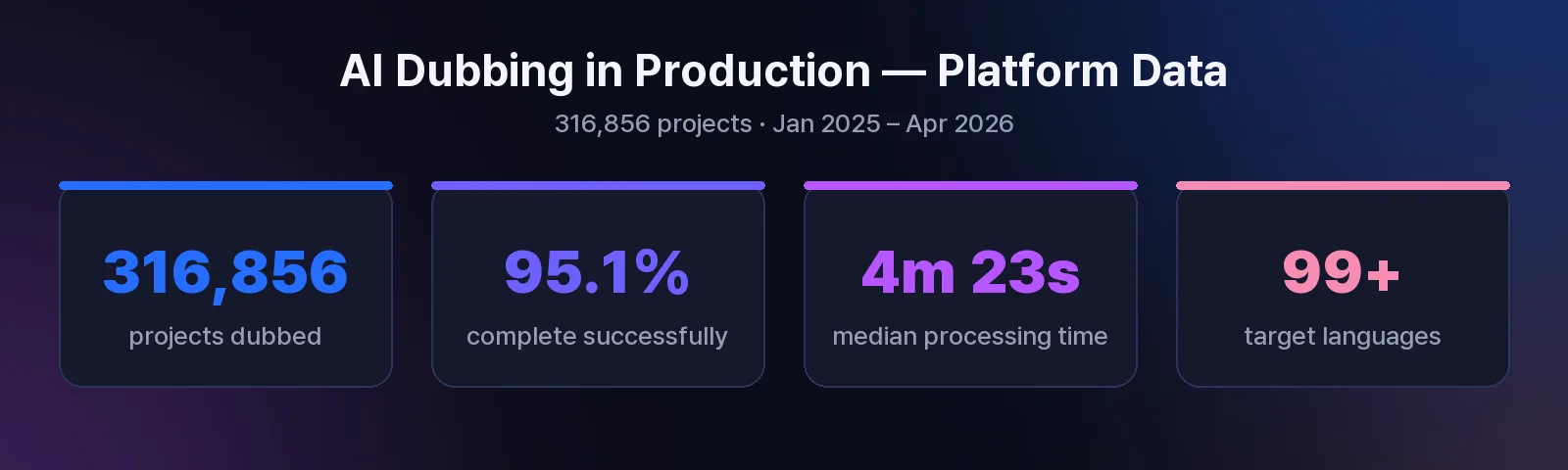
Completion and reliability. 95.1% of all dubbing projects on Perso Dubbing complete successfully. The 4.8% failure rate is typically caused by severely degraded source audio, overlapping music that obscures speech, or unsupported audio formats — not the AI translation engine itself.
Processing speed. For completed projects, the median completion time across all project lengths is 4 minutes 23 seconds, and 56.6% finish in under 5 minutes. Short-form videos under 1 minute — which make up 55.8% of all projects on the platform — typically complete in under 3 minutes (Source: Perso AI platform data, Jan 2025–Apr 2026).
Language pair performance. Not all language combinations produce equal quality. The platform’s most popular routes — English→Hindi (37,746 projects) and Chinese→Hindi (37,339 projects) — are heavily optimized through training data volume. Less common pairs may show more translation artifacts. English as either source or target language tends to produce the most consistent results.
Content type patterns. Education content leads AI dubbing adoption at 10.8% of categorized projects, followed by Animation (9.2%) and Film/Drama (7.3%). Educational videos with clear single-speaker audio and minimal background noise consistently produce the highest dubbing quality across all language pairs.
Where AI Dubbing Falls Short
No honest capability assessment should skip the limitations. AI dubbing in 2026 still struggles with several well-documented scenarios:
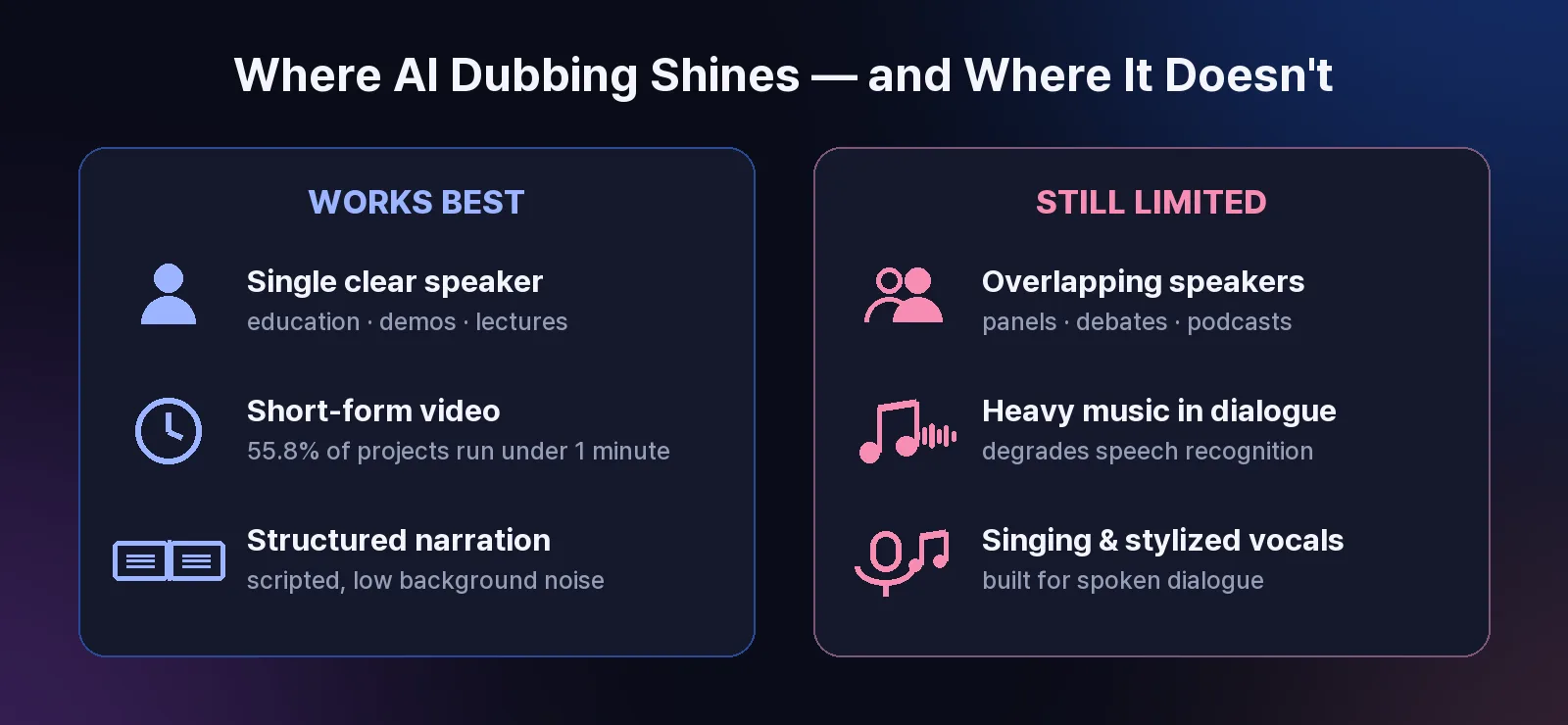
Overlapping speakers. When multiple people talk simultaneously — panel discussions, heated debates, or group conversations — AI has difficulty isolating individual voices. The output is often garbled or drops dialogue entirely.
Heavy background music or effects. Ambient sound mixed into dialogue tracks degrades speech recognition accuracy upstream, which cascades into translation errors. Videos where music and speech compete produce measurably lower-quality results.
Cultural nuance and humor. AI translates words accurately but may miss idioms, sarcasm, wordplay, or culturally specific references. A joke that works in English may translate literally into something confusing in Japanese or Portuguese. Human review remains essential for high-stakes content where tone matters as much as meaning.
Singing and stylized vocals. AI dubbing systems are built for spoken dialogue. Songs, chants, or highly performative vocal styles fall outside their current design scope.
Extreme emotional range. While voice preservation has improved significantly, intensely emotional scenes — crying, whispering, shouting — can sound slightly flattened compared to the original performance. This gap is narrowing with each model generation but is not yet eliminated.
For a deeper look at what AI dubbing is and how it works, see our complete guide. If your source video has audio issues, our guide on why AI dubbing sounds bad and how to fix it covers the five most common source-video problems.
Can AI Auto-Translate Video Audio?
Yes. AI can extract speech from a video, translate it, and generate new audio in the target language — without any manual transcription or separate translation steps.
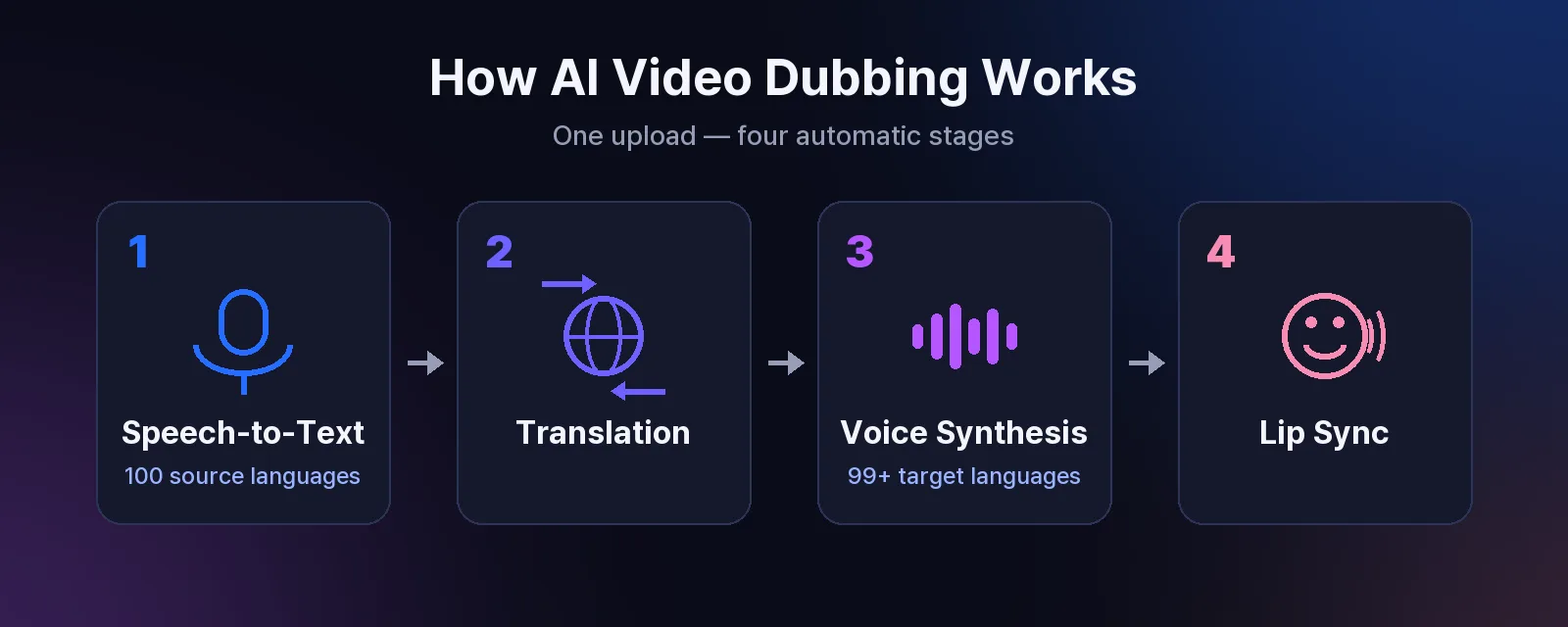
The pipeline runs four stages automatically: speech-to-text (transcription) → machine translation → text-to-speech (voice synthesis) → lip sync alignment. On Perso Dubbing, the speech recognition engine supports 100 source languages, meaning it can process videos originally recorded in nearly any language. You upload a video, select a target language, and the system handles all four stages end to end.
The key distinction from subtitle-only translation: AI dubbing replaces the audio track entirely. Viewers hear the content in their language rather than reading captions. This matters especially for mobile-first audiences — 15.0% of all dubbing projects on Perso Dubbing originate from YouTube URLs, where viewers often watch without reading subtitles (Source: Perso AI platform data).
If you need both dubbed audio and subtitles, you can translate videos into 99+ languages with both outputs in a single workflow.
Which Use Cases Get the Best Results
AI dubbing quality varies significantly by content type. Based on platform data from 316,856 projects, here is what performs best and where to set realistic expectations:
Content Type | Dubbing Quality | Why |
|---|---|---|
Educational lectures | Excellent | Clear single-speaker audio, structured delivery, minimal background noise |
Product demos / SaaS walkthroughs | Excellent | Controlled recording environment, scripted narration |
YouTube short-form (under 1 min) | Very Good | Brief content with less room for cumulative translation errors |
Interviews (1 speaker at a time) | Good | Works well when speakers take clear turns without overlap |
Film / drama dialogue | Variable | Depends heavily on audio mix — clean dialogue tracks work, heavy scoring does not |
Panel discussions / podcasts | Fair | Multi-speaker overlap remains the primary challenge |
Education is also the most language-diverse category on the platform, with creators dubbing into 34 unique target languages — more than any other content type (Source: State of AI Dubbing 2026, Perso AI). This suggests that structured, clearly spoken content translates well across a wide range of language pairs, not just the most popular ones.
How to Run Your Own Test
The fastest way to answer “can AI dub my videos?” is to test it with your own content. Here is a practical framework:
Pick a representative clip. Choose a 1–3 minute video that matches your typical content — same speaker count, audio conditions, and subject matter.
Select a well-optimized language pair. Start with English→Spanish, English→Portuguese, or English→Hindi for the most reliable first impression.
Run the dubbing. Upload to Perso Dubbing and select your target language. Short clips typically complete in under 3 minutes.
Evaluate three dimensions. (a) Translation accuracy — does it convey the right meaning? (b) Voice naturalness — does it sound like a real speaker? (c) Lip sync — do mouth movements match reasonably?
Test an edge case. Try a clip with background music, multiple speakers, or fast dialogue to map the boundaries for your specific content type.
Perso Dubbing offers a free trial without requiring a credit card. See plans and pricing to get started with your own videos.
Frequently Asked Questions
Q. Can AI accurately dub a video into another language? A. Yes. AI dubbing tools like Perso Dubbing translate and re-voice video content in 99+ languages. Accuracy depends on source audio quality and language pair — well-recorded single-speaker videos produce the best results. Across 316,856 projects on Perso Dubbing, the successful completion rate is 95.1%.
Q. Can AI auto-translate videos without manual work? A. Yes. Modern AI dubbing platforms handle the full pipeline automatically — speech recognition, translation, voice synthesis, and lip sync alignment. You upload a video, choose a target language, and download the result. Most projects finish in under 5 minutes with no manual transcription or editing required.
Q. What types of video content work best with AI dubbing? A. Educational lectures, product demos, and short-form YouTube content produce the best AI dubbing results. These formats share clear audio, single speakers, and structured delivery. Content with overlapping speakers, heavy background music, or singing remains challenging for current AI dubbing systems.
About the Author: Untae Bae is Head of Growth & Product Owner at Perso AI, where he leads product strategy and growth for Perso Dubbing, serving creators in 80+ countries.
Yes — AI can dub and translate videos in 99+ languages, preserve the original speaker’s voice, and deliver results in minutes. Over the past 16 months, 140,143 creators used Perso Dubbing to complete 316,856 dubbing projects with a 95.1% success rate (Source: Perso AI platform data, Jan 2025–Apr 2026). But AI dubbing is not magic. It has clear strengths and known limitations. This guide breaks down what works, what doesn’t, and how to test it yourself before committing to a workflow.
What AI Video Dubbing Can Actually Do in 2026
AI dubbing has moved well beyond robotic text-to-speech. Modern systems detect speakers, transcribe speech, translate the script, and generate dubbed audio in a target language — all automatically. The best tools also synchronize lip movements to match the new audio track.
Perso Dubbing handles the full pipeline: speech recognition in 100 languages, translation, and voice synthesis in 99+ target languages, combining its own dubbing models with global AI foundation models for natural-sounding output. The workflow takes three steps: upload your video, choose a target language, and download the dubbed version. No manual transcription, editing, or audio engineering is required.
Voice preservation is the biggest leap forward. First-generation AI dubbing produced flat, robotic voices that lost the speaker’s personality entirely. Current systems retain the original speaker’s tone, pacing, and inflection — making output usable for professional content without re-recording. For creators and businesses, this means the dubbed version sounds like the same person speaking a different language.
How Accurate Is It? Data from 316,856 Real Projects
Platform-level data from Perso Dubbing reveals where AI dubbing delivers consistently and where results vary by content type and language pair.
Completion and reliability. 95.1% of all dubbing projects on Perso Dubbing complete successfully. The 4.8% failure rate is typically caused by severely degraded source audio, overlapping music that obscures speech, or unsupported audio formats — not the AI translation engine itself.
Processing speed. For completed projects, the median completion time across all project lengths is 4 minutes 23 seconds, and 56.6% finish in under 5 minutes. Short-form videos under 1 minute — which make up 55.8% of all projects on the platform — typically complete in under 3 minutes (Source: Perso AI platform data, Jan 2025–Apr 2026).
Language pair performance. Not all language combinations produce equal quality. The platform’s most popular routes — English→Hindi (37,746 projects) and Chinese→Hindi (37,339 projects) — are heavily optimized through training data volume. Less common pairs may show more translation artifacts. English as either source or target language tends to produce the most consistent results.
Content type patterns. Education content leads AI dubbing adoption at 10.8% of categorized projects, followed by Animation (9.2%) and Film/Drama (7.3%). Educational videos with clear single-speaker audio and minimal background noise consistently produce the highest dubbing quality across all language pairs.
Where AI Dubbing Falls Short
No honest capability assessment should skip the limitations. AI dubbing in 2026 still struggles with several well-documented scenarios:
Overlapping speakers. When multiple people talk simultaneously — panel discussions, heated debates, or group conversations — AI has difficulty isolating individual voices. The output is often garbled or drops dialogue entirely.
Heavy background music or effects. Ambient sound mixed into dialogue tracks degrades speech recognition accuracy upstream, which cascades into translation errors. Videos where music and speech compete produce measurably lower-quality results.
Cultural nuance and humor. AI translates words accurately but may miss idioms, sarcasm, wordplay, or culturally specific references. A joke that works in English may translate literally into something confusing in Japanese or Portuguese. Human review remains essential for high-stakes content where tone matters as much as meaning.
Singing and stylized vocals. AI dubbing systems are built for spoken dialogue. Songs, chants, or highly performative vocal styles fall outside their current design scope.
Extreme emotional range. While voice preservation has improved significantly, intensely emotional scenes — crying, whispering, shouting — can sound slightly flattened compared to the original performance. This gap is narrowing with each model generation but is not yet eliminated.
For a deeper look at what AI dubbing is and how it works, see our complete guide. If your source video has audio issues, our guide on why AI dubbing sounds bad and how to fix it covers the five most common source-video problems.
Can AI Auto-Translate Video Audio?
Yes. AI can extract speech from a video, translate it, and generate new audio in the target language — without any manual transcription or separate translation steps.
The pipeline runs four stages automatically: speech-to-text (transcription) → machine translation → text-to-speech (voice synthesis) → lip sync alignment. On Perso Dubbing, the speech recognition engine supports 100 source languages, meaning it can process videos originally recorded in nearly any language. You upload a video, select a target language, and the system handles all four stages end to end.
The key distinction from subtitle-only translation: AI dubbing replaces the audio track entirely. Viewers hear the content in their language rather than reading captions. This matters especially for mobile-first audiences — 15.0% of all dubbing projects on Perso Dubbing originate from YouTube URLs, where viewers often watch without reading subtitles (Source: Perso AI platform data).
If you need both dubbed audio and subtitles, you can translate videos into 99+ languages with both outputs in a single workflow.
Which Use Cases Get the Best Results
AI dubbing quality varies significantly by content type. Based on platform data from 316,856 projects, here is what performs best and where to set realistic expectations:
Content Type | Dubbing Quality | Why |
|---|---|---|
Educational lectures | Excellent | Clear single-speaker audio, structured delivery, minimal background noise |
Product demos / SaaS walkthroughs | Excellent | Controlled recording environment, scripted narration |
YouTube short-form (under 1 min) | Very Good | Brief content with less room for cumulative translation errors |
Interviews (1 speaker at a time) | Good | Works well when speakers take clear turns without overlap |
Film / drama dialogue | Variable | Depends heavily on audio mix — clean dialogue tracks work, heavy scoring does not |
Panel discussions / podcasts | Fair | Multi-speaker overlap remains the primary challenge |
Education is also the most language-diverse category on the platform, with creators dubbing into 34 unique target languages — more than any other content type (Source: State of AI Dubbing 2026, Perso AI). This suggests that structured, clearly spoken content translates well across a wide range of language pairs, not just the most popular ones.
How to Run Your Own Test
The fastest way to answer “can AI dub my videos?” is to test it with your own content. Here is a practical framework:
Pick a representative clip. Choose a 1–3 minute video that matches your typical content — same speaker count, audio conditions, and subject matter.
Select a well-optimized language pair. Start with English→Spanish, English→Portuguese, or English→Hindi for the most reliable first impression.
Run the dubbing. Upload to Perso Dubbing and select your target language. Short clips typically complete in under 3 minutes.
Evaluate three dimensions. (a) Translation accuracy — does it convey the right meaning? (b) Voice naturalness — does it sound like a real speaker? (c) Lip sync — do mouth movements match reasonably?
Test an edge case. Try a clip with background music, multiple speakers, or fast dialogue to map the boundaries for your specific content type.
Perso Dubbing offers a free trial without requiring a credit card. See plans and pricing to get started with your own videos.
Frequently Asked Questions
Q. Can AI accurately dub a video into another language? A. Yes. AI dubbing tools like Perso Dubbing translate and re-voice video content in 99+ languages. Accuracy depends on source audio quality and language pair — well-recorded single-speaker videos produce the best results. Across 316,856 projects on Perso Dubbing, the successful completion rate is 95.1%.
Q. Can AI auto-translate videos without manual work? A. Yes. Modern AI dubbing platforms handle the full pipeline automatically — speech recognition, translation, voice synthesis, and lip sync alignment. You upload a video, choose a target language, and download the result. Most projects finish in under 5 minutes with no manual transcription or editing required.
Q. What types of video content work best with AI dubbing? A. Educational lectures, product demos, and short-form YouTube content produce the best AI dubbing results. These formats share clear audio, single speakers, and structured delivery. Content with overlapping speakers, heavy background music, or singing remains challenging for current AI dubbing systems.
About the Author: Untae Bae is Head of Growth & Product Owner at Perso AI, where he leads product strategy and growth for Perso Dubbing, serving creators in 80+ countries.
Yes — AI can dub and translate videos in 99+ languages, preserve the original speaker’s voice, and deliver results in minutes. Over the past 16 months, 140,143 creators used Perso Dubbing to complete 316,856 dubbing projects with a 95.1% success rate (Source: Perso AI platform data, Jan 2025–Apr 2026). But AI dubbing is not magic. It has clear strengths and known limitations. This guide breaks down what works, what doesn’t, and how to test it yourself before committing to a workflow.
What AI Video Dubbing Can Actually Do in 2026
AI dubbing has moved well beyond robotic text-to-speech. Modern systems detect speakers, transcribe speech, translate the script, and generate dubbed audio in a target language — all automatically. The best tools also synchronize lip movements to match the new audio track.
Perso Dubbing handles the full pipeline: speech recognition in 100 languages, translation, and voice synthesis in 99+ target languages, combining its own dubbing models with global AI foundation models for natural-sounding output. The workflow takes three steps: upload your video, choose a target language, and download the dubbed version. No manual transcription, editing, or audio engineering is required.
Voice preservation is the biggest leap forward. First-generation AI dubbing produced flat, robotic voices that lost the speaker’s personality entirely. Current systems retain the original speaker’s tone, pacing, and inflection — making output usable for professional content without re-recording. For creators and businesses, this means the dubbed version sounds like the same person speaking a different language.
How Accurate Is It? Data from 316,856 Real Projects
Platform-level data from Perso Dubbing reveals where AI dubbing delivers consistently and where results vary by content type and language pair.
Completion and reliability. 95.1% of all dubbing projects on Perso Dubbing complete successfully. The 4.8% failure rate is typically caused by severely degraded source audio, overlapping music that obscures speech, or unsupported audio formats — not the AI translation engine itself.
Processing speed. For completed projects, the median completion time across all project lengths is 4 minutes 23 seconds, and 56.6% finish in under 5 minutes. Short-form videos under 1 minute — which make up 55.8% of all projects on the platform — typically complete in under 3 minutes (Source: Perso AI platform data, Jan 2025–Apr 2026).
Language pair performance. Not all language combinations produce equal quality. The platform’s most popular routes — English→Hindi (37,746 projects) and Chinese→Hindi (37,339 projects) — are heavily optimized through training data volume. Less common pairs may show more translation artifacts. English as either source or target language tends to produce the most consistent results.
Content type patterns. Education content leads AI dubbing adoption at 10.8% of categorized projects, followed by Animation (9.2%) and Film/Drama (7.3%). Educational videos with clear single-speaker audio and minimal background noise consistently produce the highest dubbing quality across all language pairs.
Where AI Dubbing Falls Short
No honest capability assessment should skip the limitations. AI dubbing in 2026 still struggles with several well-documented scenarios:
Overlapping speakers. When multiple people talk simultaneously — panel discussions, heated debates, or group conversations — AI has difficulty isolating individual voices. The output is often garbled or drops dialogue entirely.
Heavy background music or effects. Ambient sound mixed into dialogue tracks degrades speech recognition accuracy upstream, which cascades into translation errors. Videos where music and speech compete produce measurably lower-quality results.
Cultural nuance and humor. AI translates words accurately but may miss idioms, sarcasm, wordplay, or culturally specific references. A joke that works in English may translate literally into something confusing in Japanese or Portuguese. Human review remains essential for high-stakes content where tone matters as much as meaning.
Singing and stylized vocals. AI dubbing systems are built for spoken dialogue. Songs, chants, or highly performative vocal styles fall outside their current design scope.
Extreme emotional range. While voice preservation has improved significantly, intensely emotional scenes — crying, whispering, shouting — can sound slightly flattened compared to the original performance. This gap is narrowing with each model generation but is not yet eliminated.
For a deeper look at what AI dubbing is and how it works, see our complete guide. If your source video has audio issues, our guide on why AI dubbing sounds bad and how to fix it covers the five most common source-video problems.
Can AI Auto-Translate Video Audio?
Yes. AI can extract speech from a video, translate it, and generate new audio in the target language — without any manual transcription or separate translation steps.
The pipeline runs four stages automatically: speech-to-text (transcription) → machine translation → text-to-speech (voice synthesis) → lip sync alignment. On Perso Dubbing, the speech recognition engine supports 100 source languages, meaning it can process videos originally recorded in nearly any language. You upload a video, select a target language, and the system handles all four stages end to end.
The key distinction from subtitle-only translation: AI dubbing replaces the audio track entirely. Viewers hear the content in their language rather than reading captions. This matters especially for mobile-first audiences — 15.0% of all dubbing projects on Perso Dubbing originate from YouTube URLs, where viewers often watch without reading subtitles (Source: Perso AI platform data).
If you need both dubbed audio and subtitles, you can translate videos into 99+ languages with both outputs in a single workflow.
Which Use Cases Get the Best Results
AI dubbing quality varies significantly by content type. Based on platform data from 316,856 projects, here is what performs best and where to set realistic expectations:
Content Type | Dubbing Quality | Why |
|---|---|---|
Educational lectures | Excellent | Clear single-speaker audio, structured delivery, minimal background noise |
Product demos / SaaS walkthroughs | Excellent | Controlled recording environment, scripted narration |
YouTube short-form (under 1 min) | Very Good | Brief content with less room for cumulative translation errors |
Interviews (1 speaker at a time) | Good | Works well when speakers take clear turns without overlap |
Film / drama dialogue | Variable | Depends heavily on audio mix — clean dialogue tracks work, heavy scoring does not |
Panel discussions / podcasts | Fair | Multi-speaker overlap remains the primary challenge |
Education is also the most language-diverse category on the platform, with creators dubbing into 34 unique target languages — more than any other content type (Source: State of AI Dubbing 2026, Perso AI). This suggests that structured, clearly spoken content translates well across a wide range of language pairs, not just the most popular ones.
How to Run Your Own Test
The fastest way to answer “can AI dub my videos?” is to test it with your own content. Here is a practical framework:
Pick a representative clip. Choose a 1–3 minute video that matches your typical content — same speaker count, audio conditions, and subject matter.
Select a well-optimized language pair. Start with English→Spanish, English→Portuguese, or English→Hindi for the most reliable first impression.
Run the dubbing. Upload to Perso Dubbing and select your target language. Short clips typically complete in under 3 minutes.
Evaluate three dimensions. (a) Translation accuracy — does it convey the right meaning? (b) Voice naturalness — does it sound like a real speaker? (c) Lip sync — do mouth movements match reasonably?
Test an edge case. Try a clip with background music, multiple speakers, or fast dialogue to map the boundaries for your specific content type.
Perso Dubbing offers a free trial without requiring a credit card. See plans and pricing to get started with your own videos.
Frequently Asked Questions
Q. Can AI accurately dub a video into another language? A. Yes. AI dubbing tools like Perso Dubbing translate and re-voice video content in 99+ languages. Accuracy depends on source audio quality and language pair — well-recorded single-speaker videos produce the best results. Across 316,856 projects on Perso Dubbing, the successful completion rate is 95.1%.
Q. Can AI auto-translate videos without manual work? A. Yes. Modern AI dubbing platforms handle the full pipeline automatically — speech recognition, translation, voice synthesis, and lip sync alignment. You upload a video, choose a target language, and download the result. Most projects finish in under 5 minutes with no manual transcription or editing required.
Q. What types of video content work best with AI dubbing? A. Educational lectures, product demos, and short-form YouTube content produce the best AI dubbing results. These formats share clear audio, single speakers, and structured delivery. Content with overlapping speakers, heavy background music, or singing remains challenging for current AI dubbing systems.
About the Author: Untae Bae is Head of Growth & Product Owner at Perso AI, where he leads product strategy and growth for Perso Dubbing, serving creators in 80+ countries.
Continue Reading
Browse All