What Is AI Dubbing? How It Works and When to Use It (2026)
Last Updated




Jump to section
Jump to section

Share
Share
Share
AI Video Translator, Localization, and Dubbing Tool
Try it out for Free
AI dubbing automatically replaces a video’s original audio with an AI-generated voice in another language while preserving the speaker’s tone, timing, and emotional delivery. Where traditional studio dubbing once required voice actors, recording sessions, and 1-2 weeks of post-production per language, AI dubbing compresses that workflow into minutes, and a single video can be released in dozens of languages simultaneously, each in the original speaker’s cloned voice.
Two numbers define the 2026 AI dubbing market:
99+ output dubbing languages: the typical coverage range of leading platforms (Perso Dubbing supports 99+ output languages and recognizes 100 input languages for transcription)
$0.24 to $7.20 per dubbed minute: the effective price range across the 10 major AI dubbing platforms that publish usable per-minute rates (Perso AI pricing survey of 11 vendors, August 2026), vs. $50-$500 per minute for traditional studio dubbing
AI dubbing transcribes the source speech, translates the transcript, and synthesizes speech in the target language. Voice characteristics depend on the selected service and settings.
AI dubbing is distinct from two adjacent techniques. Subtitles display translated text on screen while the original audio continues to play. Voiceover layers a new voice on top of the original audio without replacing it. AI dubbing alone fully substitutes the original audio with a synthesized voice that matches the original speaker’s pitch, cadence, and emotional tone in the new language, making the localized version feel as if the speaker had natively spoken that language.
This guide covers how AI dubbing works, when it is the right choice (and when it is not), what it costs, and the platforms creators and enterprises rely on in 2026.
📅 Last updated: September 2026. Includes an August 2026 pricing survey of 11 AI dubbing vendors and platform data from the State of AI Dubbing 2026 report.
The global AI dubbing tools market was valued at $783 million in 2023 and is projected to reach $1.88 billion by 2030 (Valuates Reports, 2024). This guide explains how AI dubbing works, how it compares to manual dubbing, and how you can start dubbing your videos today.
How AI Dubbing Works
The workflow below covers transcription, translation and voice synthesis, plus optional lip-sync. Reviewing each stage helps you understand how your voice and content are processed.
Speech Recognition (ASR): The AI transcribes the original audio, identifying each speaker and their dialogue timestamps. ASR (Automatic Speech Recognition) converts spoken words into text with speaker diarization, the process of separating individual speakers in multi-person audio.
Machine Translation: The transcript is translated into the target language using neural machine translation, maintaining context and meaning.
Voice Synthesis (TTS): A cloned version of the original speaker’s voice delivers the translated script, preserving pitch, emotion, and speaking style. TTS (Text-to-Speech) generates human-like audio from written text.
Lip-Sync Alignment (optional): The AI adjusts the dubbed audio timing and the speaker’s visual mouth movements to match the translated dialogue, creating a natural viewing experience.
Perso Dubbing, an AI video dubbing platform by ESTsoft, automates the dubbing workflow, with lip-sync available as an optional paid feature. Users upload a video, choose from 99+ supported languages, and receive a fully dubbed video, typically within minutes. The platform handles multi-speaker content without manual intervention. Across completed projects processed on Perso AI, the median completion time was 4 minutes 23 seconds, and 56.6% finished in under 5 minutes (Perso AI platform data, Jan 2025 to Apr 2026).
“The biggest barrier to global content distribution has always been language. AI dubbing removes that barrier by letting creators publish in 99+ languages from a single source video, without re-recording a single word.” (Untae Bae, Head of Growth & Product Owner at Perso Dubbing)
Try it now: Upload your first video to Perso Dubbing and get a free dubbed clip in minutes.
AI Dubbing vs. Traditional Dubbing
The differences between AI dubbing and manual dubbing are significant in cost, speed, and scalability. Here is a side-by-side comparison of both workflows.
Before: Traditional Dubbing Workflow
A typical manual dubbing project follows this process:
Transcribe the original audio (1-2 days)
Translate the script (2-5 days per language)
Hire voice actors for each language (1-2 weeks)
Record in a studio (1-3 days per language)
Edit and sync audio to video (2-5 days)
Quality review and revisions (1-2 days)
Total: 2-6 weeks per language. Cost: $50-$500+ per finished minute for standard content, and up to $700-$1,200 per minute for complex character-driven work, depending on language, voice talent, studio time, and revision rounds (Verbolabs, 2025; Vozo AI, 2025).
After: AI Dubbing Workflow
With Perso Dubbing, the same project takes three steps:
Upload your video
Select target languages (up to 99+ at once)
Download the dubbed video, with optional lip-sync
Total: Minutes per language. Cost: Starting at $6.99/month.
Comparison Table
Factor | Traditional Dubbing | Perso Dubbing |
|---|---|---|
Time per language | 2-6 weeks | Minutes |
Cost per minute | $50-$500 | Included in subscription |
Languages at once | 1 at a time | 99+ simultaneously |
Voice consistency | Varies by actor | Original voice preserved |
Lip-sync | Manual post-production | Automatic (paid plans) |
Scalability | Linear (each language = new project) | Parallel (all languages at once) |
Based on industry average timelines of 2-6 weeks for traditional dubbing per language, AI dubbing platforms like Perso Dubbing can complete in minutes what previously took weeks.
When Should You Use AI Dubbing?
AI dubbing is not the right tool for every video. The decision depends on how much your content relies on acting performance, how many languages you need, and how fast you need to publish.
AI dubbing is the right choice when:
The speaker is informing, not performing. Tutorials, lectures, product demos, news commentary, interviews, and corporate training carry meaning through words, not dramatic delivery. This is where AI dubbing quality is already strong. Education is the largest categorized use case on Perso AI at 11.0% of categorized projects (State of AI Dubbing 2026).
You need more than 2-3 languages. Traditional dubbing scales linearly: each new language means new actors, new studio time, and new costs. AI dubbing generates all target languages from one upload, so the per-language cost drops as you add markets.
Speed matters more than perfection. If your content is time-sensitive (product launches, trend commentary, weekly episodes), a dub that ships in minutes beats a studio dub that ships in six weeks.
Your budget is under roughly $50 per finished minute. Below the entry price of traditional studio work, AI dubbing is effectively the only option for voice localization.
Traditional dubbing still wins when:
Acting performance is the product. Character-driven films, prestige drama, and animation with distinct character voices still benefit from professional voice actors who can direct emotional nuance scene by scene. Studios often use a hybrid workflow: AI for the first pass, human actors for hero content.
The content carries legal or medical liability. Regulated content should go through certified human translation review. AI dubbing can produce the draft, but a human should sign off before publication.
Your audience expects subtitles. Some viewer communities, such as anime audiences and film festival viewers, prefer original audio with subtitles. Dubbing of any kind, AI or human, works against that expectation.
AI dubbing fits informational and instructional content at scale, while traditional dubbing keeps an edge for performance-driven entertainment. Nothing forces a single choice: teams can run AI dubbing for scale content and reserve studio work for hero titles.
Who Uses AI Dubbing?
AI dubbing serves a wide range of content creators and businesses. Below are four key segments where AI dubbing delivers the highest impact.
Content Creators & YouTubers
Perso Dubbing, an AI dubbing platform supporting 99+ languages, enables YouTube creators to reach global audiences without recording in multiple languages. A creator with an English channel can instantly publish in Spanish, Portuguese, Japanese, and 30 other languages, multiplying potential viewership without additional production effort.
Q1 2026 project-count sample. According to Perso Dubbing platform data (Q1 2026), the top 5 target languages users dub their videos into are English (37.2%), Portuguese (9.1%), Spanish (9.1%), Chinese (6.7%), and Japanese (6.3%), together accounting for over 68% of all dubbing output. The most active global dubbing route is English → Portuguese (14.8%), driven by Brazil’s content consumption market, followed by English → Spanish (7.6%) across 20+ Spanish-speaking countries. Emerging markets like Vietnamese (4.2%) and Hungarian (1.6%) also appear in the top 12 target languages, which points to localization demand beyond traditional Western European markets (Perso Dubbing Internal Data, Q1 2026). Historical sample, not the v2 cumulative platform dataset or the paid cohort.
Earlier platform statistics describe historical reporting periods. Compare language distributions only when the reporting period and project population match; they do not establish current market demand.
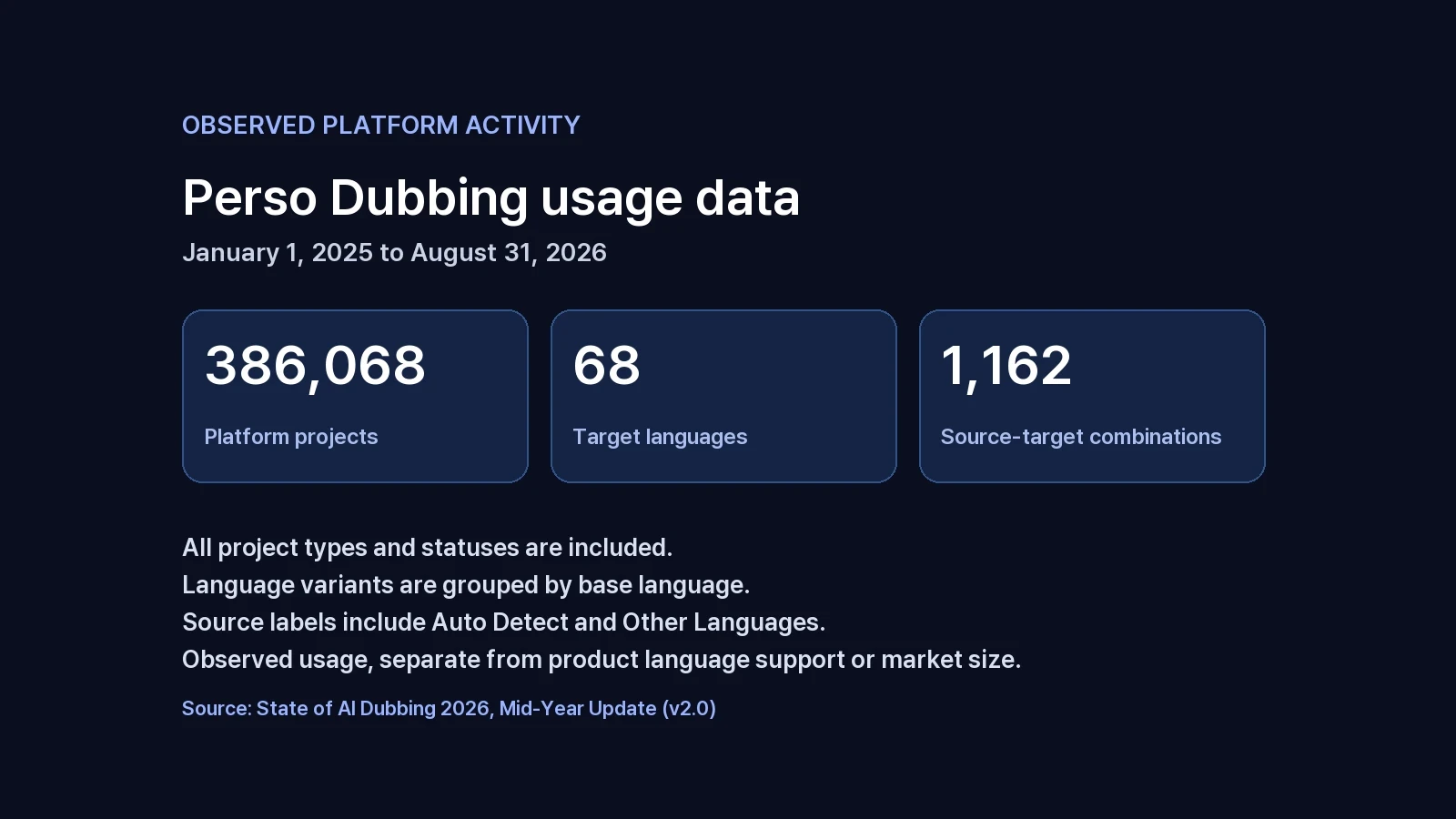
From January 1, 2025 to August 31, 2026, the platform dataset covers all project types and statuses. Counts use grouped base languages and retain AutoDetect and OtherLanguages categories. These platform records do not measure market demand or supported languages.
Q1 2026 project-count sample. Historical sample, not the v2 cumulative platform dataset or the paid cohort.
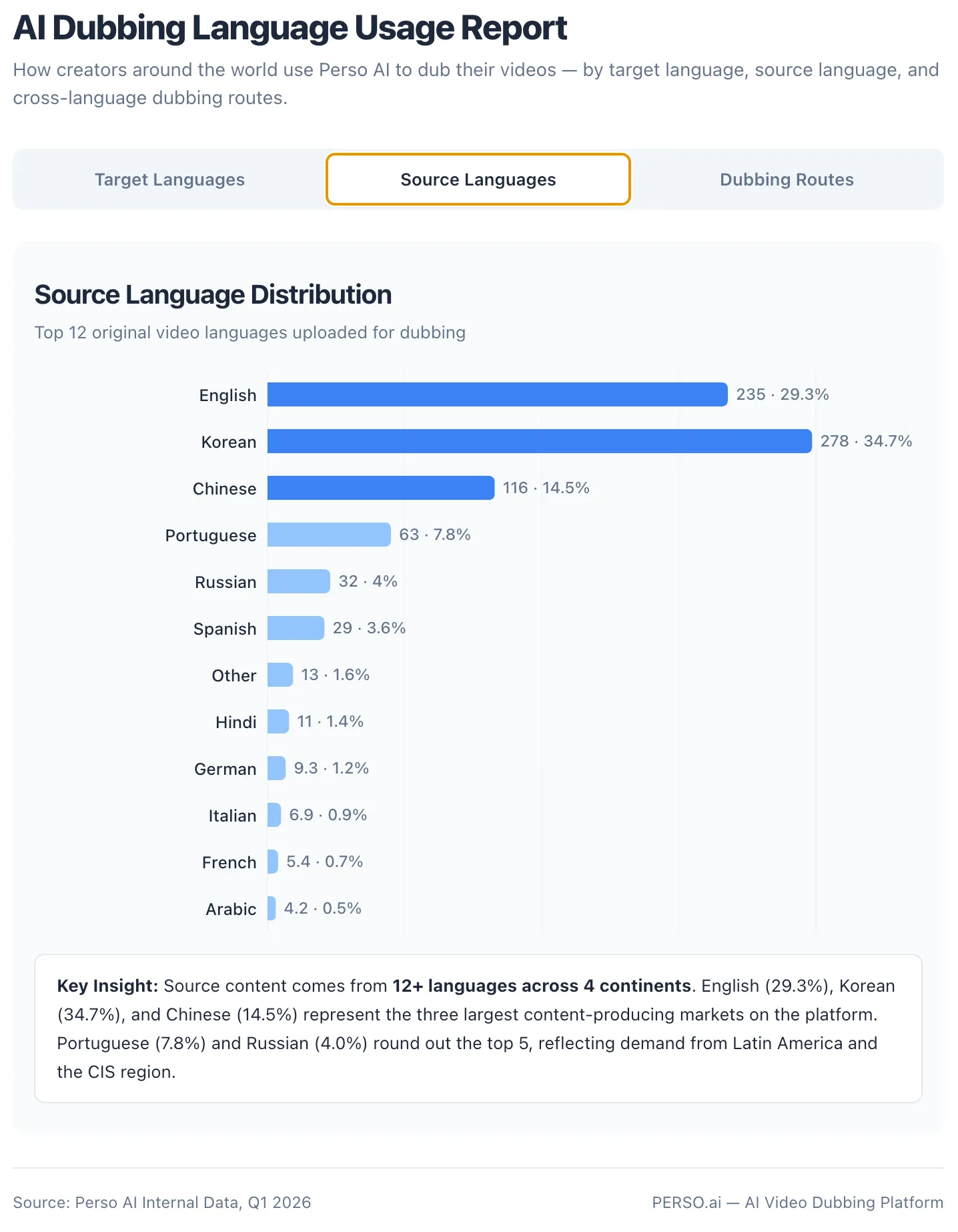
Q1 2026 project-count sample. Historical sample, not the v2 cumulative platform dataset or the paid cohort.
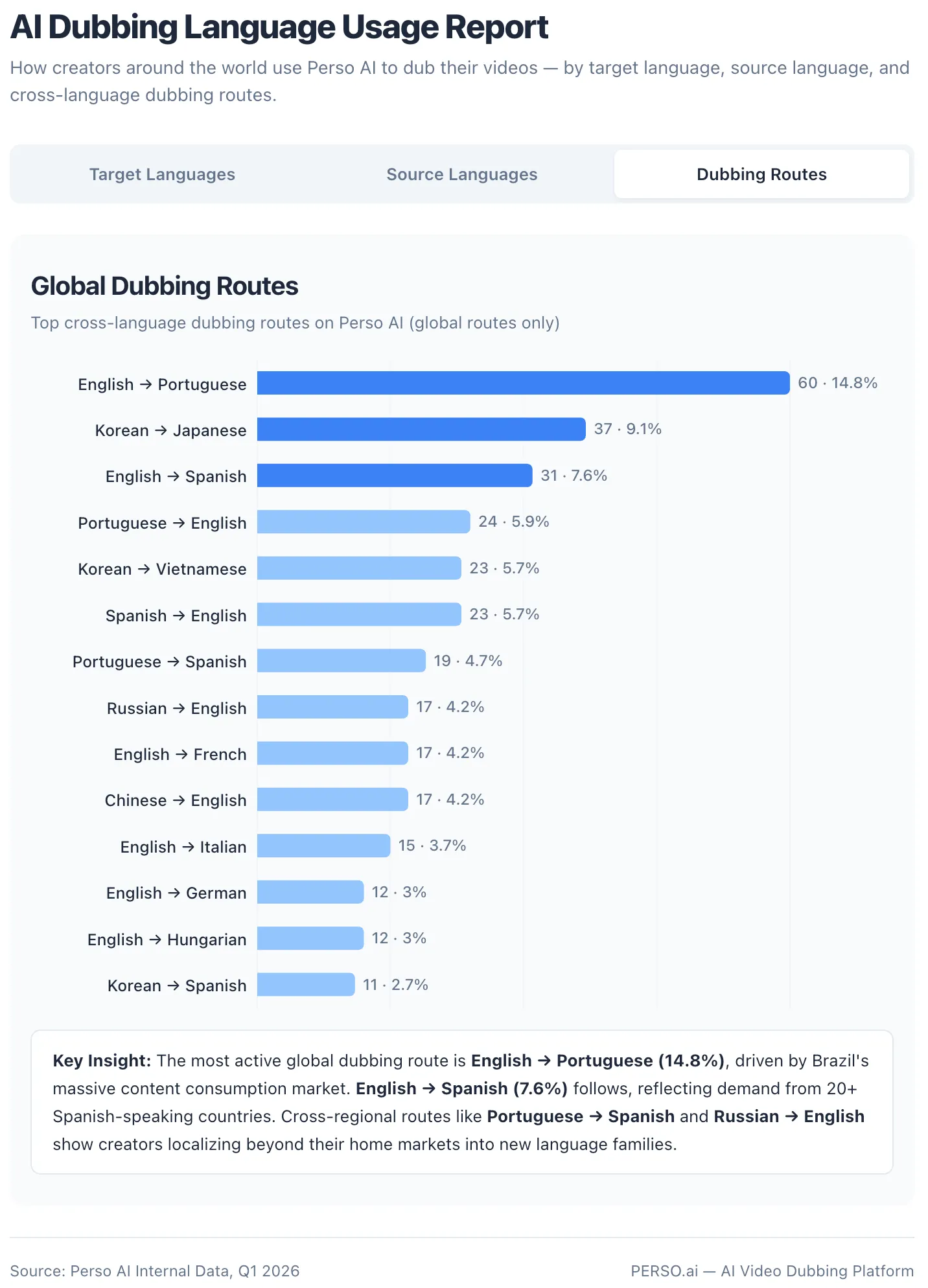
Q1 2026 project-count sample. Key insight: AI dubbing demand has shifted from English-only consumption toward bidirectional global flow, with English-to-Portuguese now leading at 14.8% of all dubbing routes in Q1 2026, ahead of traditional Spanish-language markets. Historical sample, not the v2 cumulative platform dataset or the paid cohort.
E-Learning & Online Education
Course creators and universities use AI dubbing platforms like Perso Dubbing to dub lecture videos into students’ native languages. AI dubbing preserves the instructor’s voice and teaching style, which improves comprehension and engagement.
Captions and dubbed audio offer different ways to access learning material. Choose according to your learners’ language and accessibility needs, and evaluate completion using your own audience data. Related discussions: Dubverse, 2024, 3Play Media, 2025.
Marketing & Advertising
Global marketing teams use Perso Dubbing to localize product demos, explainer videos, and ad campaigns across multiple markets simultaneously. Instead of producing separate video assets per region, a single source video becomes 99+ localized versions, reducing both production cost and time-to-market.
Enterprise Communications
Companies with global workforces dub internal training, compliance videos, and corporate announcements using AI dubbing to ensure consistent messaging across all offices and languages. Perso Dubbing’s multi-speaker detection handles panel discussions and multi-presenter formats without manual speaker tagging.
What to Look For in an AI Dubbing Platform
Not all AI dubbing tools offer the same capabilities. The features below separate professional-grade platforms from basic tools. When evaluating options, consider how each platform handles voice quality, lip-sync, multi-speaker content, translation accuracy, and pricing.
Voice Cloning Quality
The best AI dubbing platforms clone the original speaker’s voice, not just translate with a generic AI voice. Perso Dubbing integrates advanced voice synthesis technology to maintain each speaker’s unique vocal characteristics across all 99+ supported languages.
Automatic Lip-Sync
Lip-sync alignment makes dubbed videos look natural. Without it, the audio and mouth movements are misaligned, creating an uncanny viewing experience. Perso Dubbing offers automatic lip-sync on all paid plans, with a monthly lip-sync allowance in each tier. Lip-sync is a separate processing step on every platform, so check how each one meters it before comparing headline per-minute prices.
Multi-Speaker Detection
Videos often feature multiple speakers. A quality AI dubbing platform automatically detects and distinguishes each speaker, applying the correct voice clone to each one. Perso Dubbing handles multi-speaker content without manual tagging.
Translation Accuracy
Translation quality directly affects viewer trust. Perso Dubbing provides real-time script editing tools, allowing users to fine-tune specific terms or brand names before finalizing the dub, ensuring translated content accurately reflects the intended meaning.
Platform Comparison
The AI dubbing market includes platforms with different strengths. Some focus on video dubbing end-to-end, while others specialize in voice synthesis or AI avatar generation. The table below compares creator-class plans on effective price per dubbed minute, based on each platform’s published pricing and credit rates.
Platform | Focus | Creator-class plan | Dubbing minutes included | Effective $/min | Lip-sync |
|---|---|---|---|---|---|
Perso Dubbing | AI video dubbing | Creator $29/mo (entry from $6.99/mo) | 40 | $0.73 | Available on all paid plans |
HeyGen | AI avatars + dubbing | Creator $29/mo | 120 | $0.24 | Included (credits shared with avatar generation) |
ElevenLabs | Voice synthesis + audio dubbing | Creator $22/mo | 40 (audio only) | $0.55 | Not offered (audio-only platform) |
Synthesia | AI avatar videos | Starter $29/mo | 10 | $2.90 | Available (minutes shared with avatar videos) |
Rask AI | AI video dubbing | Creator $60/mo | ~8 with enhanced lip-sync | $7.20 | Enhanced lip-sync (beta) consumes 3x minutes |
Note: HeyGen offers the lowest per-minute rate, but its credits are shared with avatar generation, so heavy avatar users have fewer minutes left for dubbing. ElevenLabs dubs audio only and does not produce lip-synced video. Synthesia’s dubbing minutes draw from the same pool as its avatar videos. Effective per-minute figures are derived from each platform’s published plan price and credit rate. Pricing verified as of August 31, 2026 via each platform’s public pricing page (HeyGen, Synthesia, ElevenLabs, Rask AI). Full plan details for Perso Dubbing are on the pricing page.
Related comparison: For a deeper feature-by-feature analysis, see AI Dubbing Tools Compared: Perso Dubbing vs HeyGen vs Synthesia in 2026.
How to Start AI Dubbing with Perso Dubbing
Getting started with AI dubbing on Perso Dubbing takes less than five minutes. No software installation is required. Everything runs in your browser at perso.ai.
Step 1: Upload Your Video
Go to perso.ai and upload your video file. Perso Dubbing accepts most common video formats including MP4, MOV, and AVI.
Step 2: Select Target Languages
Choose one or more of the 99+ supported languages. Perso Dubbing will automatically transcribe, translate, clone your voice, and sync lip movements for each selected language.
Step 3: Review and Download Your Dubbed Video
Once processing is complete, review the translated script using Perso Dubbing’s built-in editor. You can adjust specific words, brand terminology, or phrasing before finalizing. Then download your dubbed video with embedded audio and lip-sync.
Start free: Create your first AI-dubbed video with Perso Dubbing. No credit card required.
AI Dubbing vs. Subtitles: Which Is Better?
AI dubbing and subtitles serve different purposes and work best in different contexts. Neither is universally superior. The right choice depends on your content type, audience, and goals.
Use subtitles when:
Your audience is accustomed to reading subtitles (e.g., anime fans, film festival audiences)
You need the lowest possible production cost
The video is short-form content (under 60 seconds)
You want to preserve the original audio experience
Use AI dubbing when:
You want viewers to focus on visuals, not reading text
Your content is educational or instructional (lectures, tutorials, training)
You need to match the emotional tone of the original speaker
You are targeting markets where dubbed content is the cultural norm (e.g., Brazil, Germany, Japan, France)
Performance Comparison
Metric | Subtitles | AI Dubbing |
|---|---|---|
Production cost | Lower | Higher (but decreasing with AI) |
Viewer engagement | Moderate | Higher for long-form content |
Accessibility | Good for hearing-impaired | Better for low-literacy audiences |
E-learning completion | Baseline | Limited direct evidence |
For educational and marketing content longer than 2 minutes, dubbing removes the reading load from the viewer, which matters most for audiences with lower reading proficiency in the target language. Direct completion-rate comparisons between dubbed and subtitled versions are still limited, so test both formats with your own audience.
Platform activity in the 2026 report
The State of AI Dubbing 2026 Mid-Year Update records 386,068 Perso Dubbing platform projects of every type and status from January 1, 2025 to August 31, 2026.
The total includes dubbing, lip-sync, audio-separation and transcription projects, including cancelled projects, internal and demo workspaces, and accounts flagged for multi-account abuse. It is a cumulative activity count with no exclusions.
This figure measures platform activity across several workflows. It is not a count of completed projects.
Source: State of AI Dubbing 2026, Mid-Year Update (v2.0), Kwon, T., & Perso Dubbing Data Team.
Frequently Asked Questions
What is AI dubbing?
AI dubbing automatically replaces a video’s original audio with an AI-generated voice in another language while preserving the original speaker’s tone, pacing, and emotional delivery. Modern AI dubbing platforms like Perso Dubbing complete the entire process, transcription, translation, and voice synthesis, in minutes for a typical video, supporting 99+ output dubbing languages.
How does AI dubbing work?
AI dubbing follows three steps: (1) speech-to-text transcribes the original audio, (2) machine translation converts the transcript into the target language, and (3) AI voice synthesis generates the new audio with cloned voice characteristics. Perso Dubbing executes all three steps automatically. Short videos typically complete in about 3 minutes, and the median across completed projects is 4 minutes 23 seconds (Perso AI platform data, Jan 2025 to Apr 2026).
How many languages does Perso Dubbing support for AI dubbing?
Perso Dubbing supports 99+ languages for AI video dubbing, including English, Spanish, Portuguese, Japanese, Korean, French, German, Hindi, and Arabic. New languages are added regularly.
How much does AI dubbing cost?
Costs depend on the billing period, included usage, and optional features. Perso Dubbing starts at $6.99 per month; paid plans include a monthly allowance for optional automatic lip-sync. Check pricing page for current terms.
When should you not use AI dubbing?
Skip AI dubbing when acting performance is the core of the content, such as character-driven films and prestige drama, where professional voice actors still deliver better emotional nuance. Regulated legal or medical content should also pass certified human translation review before publication. For those cases, use traditional dubbing or a hybrid workflow with human review.
Is AI dubbing better than subtitles?
It depends on the use case. AI dubbing is generally more effective for educational content and marketing videos, where viewer focus on visuals matters. Subtitles remain a strong choice for short-form content and audiences that prefer reading original-language audio.
Can AI dubbing preserve the original speaker’s voice?
Yes. Perso Dubbing uses voice cloning technology to replicate the original speaker’s pitch, tone, and emotion in the target language. The result sounds like the original speaker delivering the content in the new language.
AI dubbing automatically replaces a video’s original audio with an AI-generated voice in another language while preserving the speaker’s tone, timing, and emotional delivery. Where traditional studio dubbing once required voice actors, recording sessions, and 1-2 weeks of post-production per language, AI dubbing compresses that workflow into minutes, and a single video can be released in dozens of languages simultaneously, each in the original speaker’s cloned voice.
Two numbers define the 2026 AI dubbing market:
99+ output dubbing languages: the typical coverage range of leading platforms (Perso Dubbing supports 99+ output languages and recognizes 100 input languages for transcription)
$0.24 to $7.20 per dubbed minute: the effective price range across the 10 major AI dubbing platforms that publish usable per-minute rates (Perso AI pricing survey of 11 vendors, August 2026), vs. $50-$500 per minute for traditional studio dubbing
AI dubbing transcribes the source speech, translates the transcript, and synthesizes speech in the target language. Voice characteristics depend on the selected service and settings.
AI dubbing is distinct from two adjacent techniques. Subtitles display translated text on screen while the original audio continues to play. Voiceover layers a new voice on top of the original audio without replacing it. AI dubbing alone fully substitutes the original audio with a synthesized voice that matches the original speaker’s pitch, cadence, and emotional tone in the new language, making the localized version feel as if the speaker had natively spoken that language.
This guide covers how AI dubbing works, when it is the right choice (and when it is not), what it costs, and the platforms creators and enterprises rely on in 2026.
📅 Last updated: September 2026. Includes an August 2026 pricing survey of 11 AI dubbing vendors and platform data from the State of AI Dubbing 2026 report.
The global AI dubbing tools market was valued at $783 million in 2023 and is projected to reach $1.88 billion by 2030 (Valuates Reports, 2024). This guide explains how AI dubbing works, how it compares to manual dubbing, and how you can start dubbing your videos today.
How AI Dubbing Works
The workflow below covers transcription, translation and voice synthesis, plus optional lip-sync. Reviewing each stage helps you understand how your voice and content are processed.
Speech Recognition (ASR): The AI transcribes the original audio, identifying each speaker and their dialogue timestamps. ASR (Automatic Speech Recognition) converts spoken words into text with speaker diarization, the process of separating individual speakers in multi-person audio.
Machine Translation: The transcript is translated into the target language using neural machine translation, maintaining context and meaning.
Voice Synthesis (TTS): A cloned version of the original speaker’s voice delivers the translated script, preserving pitch, emotion, and speaking style. TTS (Text-to-Speech) generates human-like audio from written text.
Lip-Sync Alignment (optional): The AI adjusts the dubbed audio timing and the speaker’s visual mouth movements to match the translated dialogue, creating a natural viewing experience.
Perso Dubbing, an AI video dubbing platform by ESTsoft, automates the dubbing workflow, with lip-sync available as an optional paid feature. Users upload a video, choose from 99+ supported languages, and receive a fully dubbed video, typically within minutes. The platform handles multi-speaker content without manual intervention. Across completed projects processed on Perso AI, the median completion time was 4 minutes 23 seconds, and 56.6% finished in under 5 minutes (Perso AI platform data, Jan 2025 to Apr 2026).
“The biggest barrier to global content distribution has always been language. AI dubbing removes that barrier by letting creators publish in 99+ languages from a single source video, without re-recording a single word.” (Untae Bae, Head of Growth & Product Owner at Perso Dubbing)
Try it now: Upload your first video to Perso Dubbing and get a free dubbed clip in minutes.
AI Dubbing vs. Traditional Dubbing
The differences between AI dubbing and manual dubbing are significant in cost, speed, and scalability. Here is a side-by-side comparison of both workflows.
Before: Traditional Dubbing Workflow
A typical manual dubbing project follows this process:
Transcribe the original audio (1-2 days)
Translate the script (2-5 days per language)
Hire voice actors for each language (1-2 weeks)
Record in a studio (1-3 days per language)
Edit and sync audio to video (2-5 days)
Quality review and revisions (1-2 days)
Total: 2-6 weeks per language. Cost: $50-$500+ per finished minute for standard content, and up to $700-$1,200 per minute for complex character-driven work, depending on language, voice talent, studio time, and revision rounds (Verbolabs, 2025; Vozo AI, 2025).
After: AI Dubbing Workflow
With Perso Dubbing, the same project takes three steps:
Upload your video
Select target languages (up to 99+ at once)
Download the dubbed video, with optional lip-sync
Total: Minutes per language. Cost: Starting at $6.99/month.
Comparison Table
Factor | Traditional Dubbing | Perso Dubbing |
|---|---|---|
Time per language | 2-6 weeks | Minutes |
Cost per minute | $50-$500 | Included in subscription |
Languages at once | 1 at a time | 99+ simultaneously |
Voice consistency | Varies by actor | Original voice preserved |
Lip-sync | Manual post-production | Automatic (paid plans) |
Scalability | Linear (each language = new project) | Parallel (all languages at once) |
Based on industry average timelines of 2-6 weeks for traditional dubbing per language, AI dubbing platforms like Perso Dubbing can complete in minutes what previously took weeks.
When Should You Use AI Dubbing?
AI dubbing is not the right tool for every video. The decision depends on how much your content relies on acting performance, how many languages you need, and how fast you need to publish.
AI dubbing is the right choice when:
The speaker is informing, not performing. Tutorials, lectures, product demos, news commentary, interviews, and corporate training carry meaning through words, not dramatic delivery. This is where AI dubbing quality is already strong. Education is the largest categorized use case on Perso AI at 11.0% of categorized projects (State of AI Dubbing 2026).
You need more than 2-3 languages. Traditional dubbing scales linearly: each new language means new actors, new studio time, and new costs. AI dubbing generates all target languages from one upload, so the per-language cost drops as you add markets.
Speed matters more than perfection. If your content is time-sensitive (product launches, trend commentary, weekly episodes), a dub that ships in minutes beats a studio dub that ships in six weeks.
Your budget is under roughly $50 per finished minute. Below the entry price of traditional studio work, AI dubbing is effectively the only option for voice localization.
Traditional dubbing still wins when:
Acting performance is the product. Character-driven films, prestige drama, and animation with distinct character voices still benefit from professional voice actors who can direct emotional nuance scene by scene. Studios often use a hybrid workflow: AI for the first pass, human actors for hero content.
The content carries legal or medical liability. Regulated content should go through certified human translation review. AI dubbing can produce the draft, but a human should sign off before publication.
Your audience expects subtitles. Some viewer communities, such as anime audiences and film festival viewers, prefer original audio with subtitles. Dubbing of any kind, AI or human, works against that expectation.
AI dubbing fits informational and instructional content at scale, while traditional dubbing keeps an edge for performance-driven entertainment. Nothing forces a single choice: teams can run AI dubbing for scale content and reserve studio work for hero titles.
Who Uses AI Dubbing?
AI dubbing serves a wide range of content creators and businesses. Below are four key segments where AI dubbing delivers the highest impact.
Content Creators & YouTubers
Perso Dubbing, an AI dubbing platform supporting 99+ languages, enables YouTube creators to reach global audiences without recording in multiple languages. A creator with an English channel can instantly publish in Spanish, Portuguese, Japanese, and 30 other languages, multiplying potential viewership without additional production effort.
Q1 2026 project-count sample. According to Perso Dubbing platform data (Q1 2026), the top 5 target languages users dub their videos into are English (37.2%), Portuguese (9.1%), Spanish (9.1%), Chinese (6.7%), and Japanese (6.3%), together accounting for over 68% of all dubbing output. The most active global dubbing route is English → Portuguese (14.8%), driven by Brazil’s content consumption market, followed by English → Spanish (7.6%) across 20+ Spanish-speaking countries. Emerging markets like Vietnamese (4.2%) and Hungarian (1.6%) also appear in the top 12 target languages, which points to localization demand beyond traditional Western European markets (Perso Dubbing Internal Data, Q1 2026). Historical sample, not the v2 cumulative platform dataset or the paid cohort.
Earlier platform statistics describe historical reporting periods. Compare language distributions only when the reporting period and project population match; they do not establish current market demand.
From January 1, 2025 to August 31, 2026, the platform dataset covers all project types and statuses. Counts use grouped base languages and retain AutoDetect and OtherLanguages categories. These platform records do not measure market demand or supported languages.
Q1 2026 project-count sample. Historical sample, not the v2 cumulative platform dataset or the paid cohort.
Q1 2026 project-count sample. Historical sample, not the v2 cumulative platform dataset or the paid cohort.
Q1 2026 project-count sample. Key insight: AI dubbing demand has shifted from English-only consumption toward bidirectional global flow, with English-to-Portuguese now leading at 14.8% of all dubbing routes in Q1 2026, ahead of traditional Spanish-language markets. Historical sample, not the v2 cumulative platform dataset or the paid cohort.
E-Learning & Online Education
Course creators and universities use AI dubbing platforms like Perso Dubbing to dub lecture videos into students’ native languages. AI dubbing preserves the instructor’s voice and teaching style, which improves comprehension and engagement.
Captions and dubbed audio offer different ways to access learning material. Choose according to your learners’ language and accessibility needs, and evaluate completion using your own audience data. Related discussions: Dubverse, 2024, 3Play Media, 2025.
Marketing & Advertising
Global marketing teams use Perso Dubbing to localize product demos, explainer videos, and ad campaigns across multiple markets simultaneously. Instead of producing separate video assets per region, a single source video becomes 99+ localized versions, reducing both production cost and time-to-market.
Enterprise Communications
Companies with global workforces dub internal training, compliance videos, and corporate announcements using AI dubbing to ensure consistent messaging across all offices and languages. Perso Dubbing’s multi-speaker detection handles panel discussions and multi-presenter formats without manual speaker tagging.
What to Look For in an AI Dubbing Platform
Not all AI dubbing tools offer the same capabilities. The features below separate professional-grade platforms from basic tools. When evaluating options, consider how each platform handles voice quality, lip-sync, multi-speaker content, translation accuracy, and pricing.
Voice Cloning Quality
The best AI dubbing platforms clone the original speaker’s voice, not just translate with a generic AI voice. Perso Dubbing integrates advanced voice synthesis technology to maintain each speaker’s unique vocal characteristics across all 99+ supported languages.
Automatic Lip-Sync
Lip-sync alignment makes dubbed videos look natural. Without it, the audio and mouth movements are misaligned, creating an uncanny viewing experience. Perso Dubbing offers automatic lip-sync on all paid plans, with a monthly lip-sync allowance in each tier. Lip-sync is a separate processing step on every platform, so check how each one meters it before comparing headline per-minute prices.
Multi-Speaker Detection
Videos often feature multiple speakers. A quality AI dubbing platform automatically detects and distinguishes each speaker, applying the correct voice clone to each one. Perso Dubbing handles multi-speaker content without manual tagging.
Translation Accuracy
Translation quality directly affects viewer trust. Perso Dubbing provides real-time script editing tools, allowing users to fine-tune specific terms or brand names before finalizing the dub, ensuring translated content accurately reflects the intended meaning.
Platform Comparison
The AI dubbing market includes platforms with different strengths. Some focus on video dubbing end-to-end, while others specialize in voice synthesis or AI avatar generation. The table below compares creator-class plans on effective price per dubbed minute, based on each platform’s published pricing and credit rates.
Platform | Focus | Creator-class plan | Dubbing minutes included | Effective $/min | Lip-sync |
|---|---|---|---|---|---|
Perso Dubbing | AI video dubbing | Creator $29/mo (entry from $6.99/mo) | 40 | $0.73 | Available on all paid plans |
HeyGen | AI avatars + dubbing | Creator $29/mo | 120 | $0.24 | Included (credits shared with avatar generation) |
ElevenLabs | Voice synthesis + audio dubbing | Creator $22/mo | 40 (audio only) | $0.55 | Not offered (audio-only platform) |
Synthesia | AI avatar videos | Starter $29/mo | 10 | $2.90 | Available (minutes shared with avatar videos) |
Rask AI | AI video dubbing | Creator $60/mo | ~8 with enhanced lip-sync | $7.20 | Enhanced lip-sync (beta) consumes 3x minutes |
Note: HeyGen offers the lowest per-minute rate, but its credits are shared with avatar generation, so heavy avatar users have fewer minutes left for dubbing. ElevenLabs dubs audio only and does not produce lip-synced video. Synthesia’s dubbing minutes draw from the same pool as its avatar videos. Effective per-minute figures are derived from each platform’s published plan price and credit rate. Pricing verified as of August 31, 2026 via each platform’s public pricing page (HeyGen, Synthesia, ElevenLabs, Rask AI). Full plan details for Perso Dubbing are on the pricing page.
Related comparison: For a deeper feature-by-feature analysis, see AI Dubbing Tools Compared: Perso Dubbing vs HeyGen vs Synthesia in 2026.
How to Start AI Dubbing with Perso Dubbing
Getting started with AI dubbing on Perso Dubbing takes less than five minutes. No software installation is required. Everything runs in your browser at perso.ai.
Step 1: Upload Your Video
Go to perso.ai and upload your video file. Perso Dubbing accepts most common video formats including MP4, MOV, and AVI.
Step 2: Select Target Languages
Choose one or more of the 99+ supported languages. Perso Dubbing will automatically transcribe, translate, clone your voice, and sync lip movements for each selected language.
Step 3: Review and Download Your Dubbed Video
Once processing is complete, review the translated script using Perso Dubbing’s built-in editor. You can adjust specific words, brand terminology, or phrasing before finalizing. Then download your dubbed video with embedded audio and lip-sync.
Start free: Create your first AI-dubbed video with Perso Dubbing. No credit card required.
AI Dubbing vs. Subtitles: Which Is Better?
AI dubbing and subtitles serve different purposes and work best in different contexts. Neither is universally superior. The right choice depends on your content type, audience, and goals.
Use subtitles when:
Your audience is accustomed to reading subtitles (e.g., anime fans, film festival audiences)
You need the lowest possible production cost
The video is short-form content (under 60 seconds)
You want to preserve the original audio experience
Use AI dubbing when:
You want viewers to focus on visuals, not reading text
Your content is educational or instructional (lectures, tutorials, training)
You need to match the emotional tone of the original speaker
You are targeting markets where dubbed content is the cultural norm (e.g., Brazil, Germany, Japan, France)
Performance Comparison
Metric | Subtitles | AI Dubbing |
|---|---|---|
Production cost | Lower | Higher (but decreasing with AI) |
Viewer engagement | Moderate | Higher for long-form content |
Accessibility | Good for hearing-impaired | Better for low-literacy audiences |
E-learning completion | Baseline | Limited direct evidence |
For educational and marketing content longer than 2 minutes, dubbing removes the reading load from the viewer, which matters most for audiences with lower reading proficiency in the target language. Direct completion-rate comparisons between dubbed and subtitled versions are still limited, so test both formats with your own audience.
Platform activity in the 2026 report
The State of AI Dubbing 2026 Mid-Year Update records 386,068 Perso Dubbing platform projects of every type and status from January 1, 2025 to August 31, 2026.
The total includes dubbing, lip-sync, audio-separation and transcription projects, including cancelled projects, internal and demo workspaces, and accounts flagged for multi-account abuse. It is a cumulative activity count with no exclusions.
This figure measures platform activity across several workflows. It is not a count of completed projects.
Source: State of AI Dubbing 2026, Mid-Year Update (v2.0), Kwon, T., & Perso Dubbing Data Team.
Frequently Asked Questions
What is AI dubbing?
AI dubbing automatically replaces a video’s original audio with an AI-generated voice in another language while preserving the original speaker’s tone, pacing, and emotional delivery. Modern AI dubbing platforms like Perso Dubbing complete the entire process, transcription, translation, and voice synthesis, in minutes for a typical video, supporting 99+ output dubbing languages.
How does AI dubbing work?
AI dubbing follows three steps: (1) speech-to-text transcribes the original audio, (2) machine translation converts the transcript into the target language, and (3) AI voice synthesis generates the new audio with cloned voice characteristics. Perso Dubbing executes all three steps automatically. Short videos typically complete in about 3 minutes, and the median across completed projects is 4 minutes 23 seconds (Perso AI platform data, Jan 2025 to Apr 2026).
How many languages does Perso Dubbing support for AI dubbing?
Perso Dubbing supports 99+ languages for AI video dubbing, including English, Spanish, Portuguese, Japanese, Korean, French, German, Hindi, and Arabic. New languages are added regularly.
How much does AI dubbing cost?
Costs depend on the billing period, included usage, and optional features. Perso Dubbing starts at $6.99 per month; paid plans include a monthly allowance for optional automatic lip-sync. Check pricing page for current terms.
When should you not use AI dubbing?
Skip AI dubbing when acting performance is the core of the content, such as character-driven films and prestige drama, where professional voice actors still deliver better emotional nuance. Regulated legal or medical content should also pass certified human translation review before publication. For those cases, use traditional dubbing or a hybrid workflow with human review.
Is AI dubbing better than subtitles?
It depends on the use case. AI dubbing is generally more effective for educational content and marketing videos, where viewer focus on visuals matters. Subtitles remain a strong choice for short-form content and audiences that prefer reading original-language audio.
Can AI dubbing preserve the original speaker’s voice?
Yes. Perso Dubbing uses voice cloning technology to replicate the original speaker’s pitch, tone, and emotion in the target language. The result sounds like the original speaker delivering the content in the new language.
AI dubbing automatically replaces a video’s original audio with an AI-generated voice in another language while preserving the speaker’s tone, timing, and emotional delivery. Where traditional studio dubbing once required voice actors, recording sessions, and 1-2 weeks of post-production per language, AI dubbing compresses that workflow into minutes, and a single video can be released in dozens of languages simultaneously, each in the original speaker’s cloned voice.
Two numbers define the 2026 AI dubbing market:
99+ output dubbing languages: the typical coverage range of leading platforms (Perso Dubbing supports 99+ output languages and recognizes 100 input languages for transcription)
$0.24 to $7.20 per dubbed minute: the effective price range across the 10 major AI dubbing platforms that publish usable per-minute rates (Perso AI pricing survey of 11 vendors, August 2026), vs. $50-$500 per minute for traditional studio dubbing
AI dubbing transcribes the source speech, translates the transcript, and synthesizes speech in the target language. Voice characteristics depend on the selected service and settings.
AI dubbing is distinct from two adjacent techniques. Subtitles display translated text on screen while the original audio continues to play. Voiceover layers a new voice on top of the original audio without replacing it. AI dubbing alone fully substitutes the original audio with a synthesized voice that matches the original speaker’s pitch, cadence, and emotional tone in the new language, making the localized version feel as if the speaker had natively spoken that language.
This guide covers how AI dubbing works, when it is the right choice (and when it is not), what it costs, and the platforms creators and enterprises rely on in 2026.
📅 Last updated: September 2026. Includes an August 2026 pricing survey of 11 AI dubbing vendors and platform data from the State of AI Dubbing 2026 report.
The global AI dubbing tools market was valued at $783 million in 2023 and is projected to reach $1.88 billion by 2030 (Valuates Reports, 2024). This guide explains how AI dubbing works, how it compares to manual dubbing, and how you can start dubbing your videos today.
How AI Dubbing Works
The workflow below covers transcription, translation and voice synthesis, plus optional lip-sync. Reviewing each stage helps you understand how your voice and content are processed.
Speech Recognition (ASR): The AI transcribes the original audio, identifying each speaker and their dialogue timestamps. ASR (Automatic Speech Recognition) converts spoken words into text with speaker diarization, the process of separating individual speakers in multi-person audio.
Machine Translation: The transcript is translated into the target language using neural machine translation, maintaining context and meaning.
Voice Synthesis (TTS): A cloned version of the original speaker’s voice delivers the translated script, preserving pitch, emotion, and speaking style. TTS (Text-to-Speech) generates human-like audio from written text.
Lip-Sync Alignment (optional): The AI adjusts the dubbed audio timing and the speaker’s visual mouth movements to match the translated dialogue, creating a natural viewing experience.
Perso Dubbing, an AI video dubbing platform by ESTsoft, automates the dubbing workflow, with lip-sync available as an optional paid feature. Users upload a video, choose from 99+ supported languages, and receive a fully dubbed video, typically within minutes. The platform handles multi-speaker content without manual intervention. Across completed projects processed on Perso AI, the median completion time was 4 minutes 23 seconds, and 56.6% finished in under 5 minutes (Perso AI platform data, Jan 2025 to Apr 2026).
“The biggest barrier to global content distribution has always been language. AI dubbing removes that barrier by letting creators publish in 99+ languages from a single source video, without re-recording a single word.” (Untae Bae, Head of Growth & Product Owner at Perso Dubbing)
Try it now: Upload your first video to Perso Dubbing and get a free dubbed clip in minutes.
AI Dubbing vs. Traditional Dubbing
The differences between AI dubbing and manual dubbing are significant in cost, speed, and scalability. Here is a side-by-side comparison of both workflows.
Before: Traditional Dubbing Workflow
A typical manual dubbing project follows this process:
Transcribe the original audio (1-2 days)
Translate the script (2-5 days per language)
Hire voice actors for each language (1-2 weeks)
Record in a studio (1-3 days per language)
Edit and sync audio to video (2-5 days)
Quality review and revisions (1-2 days)
Total: 2-6 weeks per language. Cost: $50-$500+ per finished minute for standard content, and up to $700-$1,200 per minute for complex character-driven work, depending on language, voice talent, studio time, and revision rounds (Verbolabs, 2025; Vozo AI, 2025).
After: AI Dubbing Workflow
With Perso Dubbing, the same project takes three steps:
Upload your video
Select target languages (up to 99+ at once)
Download the dubbed video, with optional lip-sync
Total: Minutes per language. Cost: Starting at $6.99/month.
Comparison Table
Factor | Traditional Dubbing | Perso Dubbing |
|---|---|---|
Time per language | 2-6 weeks | Minutes |
Cost per minute | $50-$500 | Included in subscription |
Languages at once | 1 at a time | 99+ simultaneously |
Voice consistency | Varies by actor | Original voice preserved |
Lip-sync | Manual post-production | Automatic (paid plans) |
Scalability | Linear (each language = new project) | Parallel (all languages at once) |
Based on industry average timelines of 2-6 weeks for traditional dubbing per language, AI dubbing platforms like Perso Dubbing can complete in minutes what previously took weeks.
When Should You Use AI Dubbing?
AI dubbing is not the right tool for every video. The decision depends on how much your content relies on acting performance, how many languages you need, and how fast you need to publish.
AI dubbing is the right choice when:
The speaker is informing, not performing. Tutorials, lectures, product demos, news commentary, interviews, and corporate training carry meaning through words, not dramatic delivery. This is where AI dubbing quality is already strong. Education is the largest categorized use case on Perso AI at 11.0% of categorized projects (State of AI Dubbing 2026).
You need more than 2-3 languages. Traditional dubbing scales linearly: each new language means new actors, new studio time, and new costs. AI dubbing generates all target languages from one upload, so the per-language cost drops as you add markets.
Speed matters more than perfection. If your content is time-sensitive (product launches, trend commentary, weekly episodes), a dub that ships in minutes beats a studio dub that ships in six weeks.
Your budget is under roughly $50 per finished minute. Below the entry price of traditional studio work, AI dubbing is effectively the only option for voice localization.
Traditional dubbing still wins when:
Acting performance is the product. Character-driven films, prestige drama, and animation with distinct character voices still benefit from professional voice actors who can direct emotional nuance scene by scene. Studios often use a hybrid workflow: AI for the first pass, human actors for hero content.
The content carries legal or medical liability. Regulated content should go through certified human translation review. AI dubbing can produce the draft, but a human should sign off before publication.
Your audience expects subtitles. Some viewer communities, such as anime audiences and film festival viewers, prefer original audio with subtitles. Dubbing of any kind, AI or human, works against that expectation.
AI dubbing fits informational and instructional content at scale, while traditional dubbing keeps an edge for performance-driven entertainment. Nothing forces a single choice: teams can run AI dubbing for scale content and reserve studio work for hero titles.
Who Uses AI Dubbing?
AI dubbing serves a wide range of content creators and businesses. Below are four key segments where AI dubbing delivers the highest impact.
Content Creators & YouTubers
Perso Dubbing, an AI dubbing platform supporting 99+ languages, enables YouTube creators to reach global audiences without recording in multiple languages. A creator with an English channel can instantly publish in Spanish, Portuguese, Japanese, and 30 other languages, multiplying potential viewership without additional production effort.
Q1 2026 project-count sample. According to Perso Dubbing platform data (Q1 2026), the top 5 target languages users dub their videos into are English (37.2%), Portuguese (9.1%), Spanish (9.1%), Chinese (6.7%), and Japanese (6.3%), together accounting for over 68% of all dubbing output. The most active global dubbing route is English → Portuguese (14.8%), driven by Brazil’s content consumption market, followed by English → Spanish (7.6%) across 20+ Spanish-speaking countries. Emerging markets like Vietnamese (4.2%) and Hungarian (1.6%) also appear in the top 12 target languages, which points to localization demand beyond traditional Western European markets (Perso Dubbing Internal Data, Q1 2026). Historical sample, not the v2 cumulative platform dataset or the paid cohort.
Earlier platform statistics describe historical reporting periods. Compare language distributions only when the reporting period and project population match; they do not establish current market demand.
From January 1, 2025 to August 31, 2026, the platform dataset covers all project types and statuses. Counts use grouped base languages and retain AutoDetect and OtherLanguages categories. These platform records do not measure market demand or supported languages.
Q1 2026 project-count sample. Historical sample, not the v2 cumulative platform dataset or the paid cohort.
Q1 2026 project-count sample. Historical sample, not the v2 cumulative platform dataset or the paid cohort.
Q1 2026 project-count sample. Key insight: AI dubbing demand has shifted from English-only consumption toward bidirectional global flow, with English-to-Portuguese now leading at 14.8% of all dubbing routes in Q1 2026, ahead of traditional Spanish-language markets. Historical sample, not the v2 cumulative platform dataset or the paid cohort.
E-Learning & Online Education
Course creators and universities use AI dubbing platforms like Perso Dubbing to dub lecture videos into students’ native languages. AI dubbing preserves the instructor’s voice and teaching style, which improves comprehension and engagement.
Captions and dubbed audio offer different ways to access learning material. Choose according to your learners’ language and accessibility needs, and evaluate completion using your own audience data. Related discussions: Dubverse, 2024, 3Play Media, 2025.
Marketing & Advertising
Global marketing teams use Perso Dubbing to localize product demos, explainer videos, and ad campaigns across multiple markets simultaneously. Instead of producing separate video assets per region, a single source video becomes 99+ localized versions, reducing both production cost and time-to-market.
Enterprise Communications
Companies with global workforces dub internal training, compliance videos, and corporate announcements using AI dubbing to ensure consistent messaging across all offices and languages. Perso Dubbing’s multi-speaker detection handles panel discussions and multi-presenter formats without manual speaker tagging.
What to Look For in an AI Dubbing Platform
Not all AI dubbing tools offer the same capabilities. The features below separate professional-grade platforms from basic tools. When evaluating options, consider how each platform handles voice quality, lip-sync, multi-speaker content, translation accuracy, and pricing.
Voice Cloning Quality
The best AI dubbing platforms clone the original speaker’s voice, not just translate with a generic AI voice. Perso Dubbing integrates advanced voice synthesis technology to maintain each speaker’s unique vocal characteristics across all 99+ supported languages.
Automatic Lip-Sync
Lip-sync alignment makes dubbed videos look natural. Without it, the audio and mouth movements are misaligned, creating an uncanny viewing experience. Perso Dubbing offers automatic lip-sync on all paid plans, with a monthly lip-sync allowance in each tier. Lip-sync is a separate processing step on every platform, so check how each one meters it before comparing headline per-minute prices.
Multi-Speaker Detection
Videos often feature multiple speakers. A quality AI dubbing platform automatically detects and distinguishes each speaker, applying the correct voice clone to each one. Perso Dubbing handles multi-speaker content without manual tagging.
Translation Accuracy
Translation quality directly affects viewer trust. Perso Dubbing provides real-time script editing tools, allowing users to fine-tune specific terms or brand names before finalizing the dub, ensuring translated content accurately reflects the intended meaning.
Platform Comparison
The AI dubbing market includes platforms with different strengths. Some focus on video dubbing end-to-end, while others specialize in voice synthesis or AI avatar generation. The table below compares creator-class plans on effective price per dubbed minute, based on each platform’s published pricing and credit rates.
Platform | Focus | Creator-class plan | Dubbing minutes included | Effective $/min | Lip-sync |
|---|---|---|---|---|---|
Perso Dubbing | AI video dubbing | Creator $29/mo (entry from $6.99/mo) | 40 | $0.73 | Available on all paid plans |
HeyGen | AI avatars + dubbing | Creator $29/mo | 120 | $0.24 | Included (credits shared with avatar generation) |
ElevenLabs | Voice synthesis + audio dubbing | Creator $22/mo | 40 (audio only) | $0.55 | Not offered (audio-only platform) |
Synthesia | AI avatar videos | Starter $29/mo | 10 | $2.90 | Available (minutes shared with avatar videos) |
Rask AI | AI video dubbing | Creator $60/mo | ~8 with enhanced lip-sync | $7.20 | Enhanced lip-sync (beta) consumes 3x minutes |
Note: HeyGen offers the lowest per-minute rate, but its credits are shared with avatar generation, so heavy avatar users have fewer minutes left for dubbing. ElevenLabs dubs audio only and does not produce lip-synced video. Synthesia’s dubbing minutes draw from the same pool as its avatar videos. Effective per-minute figures are derived from each platform’s published plan price and credit rate. Pricing verified as of August 31, 2026 via each platform’s public pricing page (HeyGen, Synthesia, ElevenLabs, Rask AI). Full plan details for Perso Dubbing are on the pricing page.
Related comparison: For a deeper feature-by-feature analysis, see AI Dubbing Tools Compared: Perso Dubbing vs HeyGen vs Synthesia in 2026.
How to Start AI Dubbing with Perso Dubbing
Getting started with AI dubbing on Perso Dubbing takes less than five minutes. No software installation is required. Everything runs in your browser at perso.ai.
Step 1: Upload Your Video
Go to perso.ai and upload your video file. Perso Dubbing accepts most common video formats including MP4, MOV, and AVI.
Step 2: Select Target Languages
Choose one or more of the 99+ supported languages. Perso Dubbing will automatically transcribe, translate, clone your voice, and sync lip movements for each selected language.
Step 3: Review and Download Your Dubbed Video
Once processing is complete, review the translated script using Perso Dubbing’s built-in editor. You can adjust specific words, brand terminology, or phrasing before finalizing. Then download your dubbed video with embedded audio and lip-sync.
Start free: Create your first AI-dubbed video with Perso Dubbing. No credit card required.
AI Dubbing vs. Subtitles: Which Is Better?
AI dubbing and subtitles serve different purposes and work best in different contexts. Neither is universally superior. The right choice depends on your content type, audience, and goals.
Use subtitles when:
Your audience is accustomed to reading subtitles (e.g., anime fans, film festival audiences)
You need the lowest possible production cost
The video is short-form content (under 60 seconds)
You want to preserve the original audio experience
Use AI dubbing when:
You want viewers to focus on visuals, not reading text
Your content is educational or instructional (lectures, tutorials, training)
You need to match the emotional tone of the original speaker
You are targeting markets where dubbed content is the cultural norm (e.g., Brazil, Germany, Japan, France)
Performance Comparison
Metric | Subtitles | AI Dubbing |
|---|---|---|
Production cost | Lower | Higher (but decreasing with AI) |
Viewer engagement | Moderate | Higher for long-form content |
Accessibility | Good for hearing-impaired | Better for low-literacy audiences |
E-learning completion | Baseline | Limited direct evidence |
For educational and marketing content longer than 2 minutes, dubbing removes the reading load from the viewer, which matters most for audiences with lower reading proficiency in the target language. Direct completion-rate comparisons between dubbed and subtitled versions are still limited, so test both formats with your own audience.
Platform activity in the 2026 report
The State of AI Dubbing 2026 Mid-Year Update records 386,068 Perso Dubbing platform projects of every type and status from January 1, 2025 to August 31, 2026.
The total includes dubbing, lip-sync, audio-separation and transcription projects, including cancelled projects, internal and demo workspaces, and accounts flagged for multi-account abuse. It is a cumulative activity count with no exclusions.
This figure measures platform activity across several workflows. It is not a count of completed projects.
Source: State of AI Dubbing 2026, Mid-Year Update (v2.0), Kwon, T., & Perso Dubbing Data Team.
Frequently Asked Questions
What is AI dubbing?
AI dubbing automatically replaces a video’s original audio with an AI-generated voice in another language while preserving the original speaker’s tone, pacing, and emotional delivery. Modern AI dubbing platforms like Perso Dubbing complete the entire process, transcription, translation, and voice synthesis, in minutes for a typical video, supporting 99+ output dubbing languages.
How does AI dubbing work?
AI dubbing follows three steps: (1) speech-to-text transcribes the original audio, (2) machine translation converts the transcript into the target language, and (3) AI voice synthesis generates the new audio with cloned voice characteristics. Perso Dubbing executes all three steps automatically. Short videos typically complete in about 3 minutes, and the median across completed projects is 4 minutes 23 seconds (Perso AI platform data, Jan 2025 to Apr 2026).
How many languages does Perso Dubbing support for AI dubbing?
Perso Dubbing supports 99+ languages for AI video dubbing, including English, Spanish, Portuguese, Japanese, Korean, French, German, Hindi, and Arabic. New languages are added regularly.
How much does AI dubbing cost?
Costs depend on the billing period, included usage, and optional features. Perso Dubbing starts at $6.99 per month; paid plans include a monthly allowance for optional automatic lip-sync. Check pricing page for current terms.
When should you not use AI dubbing?
Skip AI dubbing when acting performance is the core of the content, such as character-driven films and prestige drama, where professional voice actors still deliver better emotional nuance. Regulated legal or medical content should also pass certified human translation review before publication. For those cases, use traditional dubbing or a hybrid workflow with human review.
Is AI dubbing better than subtitles?
It depends on the use case. AI dubbing is generally more effective for educational content and marketing videos, where viewer focus on visuals matters. Subtitles remain a strong choice for short-form content and audiences that prefer reading original-language audio.
Can AI dubbing preserve the original speaker’s voice?
Yes. Perso Dubbing uses voice cloning technology to replicate the original speaker’s pitch, tone, and emotion in the target language. The result sounds like the original speaker delivering the content in the new language.
Continue Reading
Browse All