How AI Dubbing Works: Technology Behind Voice Translation
Last Updated




Jump to section
Jump to section

Share
Share
Share

AI Video Translator, Localization, and Dubbing Tool
Try it out for Free
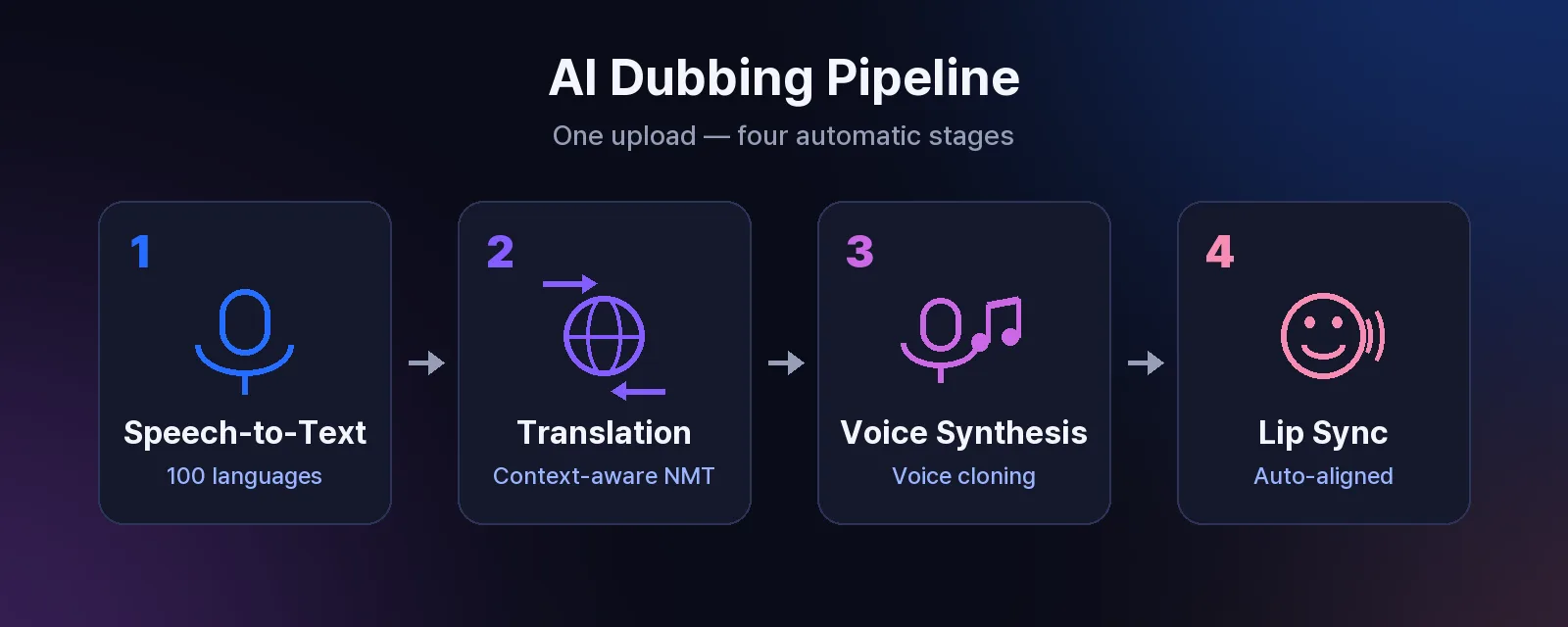
AI dubbing converts video audio from one language to another through a four-stage pipeline: speech recognition, neural translation, voice synthesis, and lip-sync alignment. Platforms like Perso Dubbing complete this process in about 3 minutes — replacing a workflow that traditionally takes days or weeks with voice actors, sound engineers, and post-production teams.
This article breaks down each stage of the AI dubbing pipeline, explains the technology that powers it, and shows where the quality differences emerge between tools.
From Manual Studios to Automated Pipelines
Traditional dubbing requires hiring voice actors for every target language, recording sessions in sound-treated studios, manual timing adjustments to match lip movements, and extensive post-production mixing. A single 10-minute video dubbed into five languages can take 2–4 weeks and cost thousands of dollars.
AI dubbing replaces this with an automated pipeline that handles all four stages — transcription, translation, voice generation, and lip synchronization — in a single pass. The result is dubbed video that preserves the original speaker’s voice characteristics, allowing creators to translate videos into 99+ languages from a single upload.
For a broader overview of what AI dubbing is and when to use it, see our complete AI dubbing guide.
The 4-Stage AI Dubbing Pipeline
Every AI dubbing platform follows the same fundamental architecture, though implementations vary in quality and capability. Here is how each stage works.
Stage 1: Speech Recognition (ASR / STT)
The pipeline begins with automatic speech recognition (ASR), also called speech-to-text (STT). This stage converts the original audio track into a timestamped transcript.
What happens technically:
The audio is separated from background music and sound effects using source separation algorithms (vocal isolation)
The speech recognition model transcribes spoken words into text, handling accents, dialects, and domain-specific terminology
Speaker diarization identifies and labels different speakers in multi-person videos
Each word or phrase receives precise timestamps, preserving the original pacing
Why it matters for quality: Errors at this stage cascade through the entire pipeline. A mistranscribed word becomes a mistranslated sentence, which becomes incorrect dubbed audio. Perso Dubbing’s speech recognition engine supports 100 languages as input, meaning virtually any source language can enter the pipeline.
Stage 2: Neural Machine Translation (NMT)
The timestamped transcript moves to the translation stage, where neural machine translation models convert the text to the target language.
What makes dubbing translation different from text translation:
Length matching: Translated sentences must approximate the duration of the original speech. A 3-second English phrase translated into German might take 5 seconds to speak — the translation model must compress or restructure to fit
Speakability: Written translations often sound unnatural when spoken aloud. Dubbing-optimized NMT models produce conversational output suitable for speech synthesis
Context preservation: Technical terms, proper nouns, and cultural references require handling that preserves meaning without literal word-for-word conversion
Timestamp alignment: Each translated segment inherits timing constraints from the original, ensuring the dubbed audio aligns with visual cues on screen
Modern AI dubbing platforms use large language models fine-tuned specifically for spoken-language translation, not general-purpose text translators. This distinction is critical for natural-sounding output.
Stage 3: Voice Synthesis and Cloning (TTS)
This is where the translated text becomes spoken audio. Text-to-speech (TTS) engines generate speech in the target language while preserving the original speaker’s voice characteristics.
The technology behind voice preservation:
Voice cloning: The system analyzes the original speaker’s voice — pitch, timbre, speaking rhythm, and emotional tone — then generates new speech that sounds like the same person speaking a different language
Prosody transfer: Beyond the voice itself, the system transfers speaking patterns: emphasis, pauses, intonation curves, and pacing
Emotion matching: Advanced models detect emotional states in the source audio (excitement, concern, humor) and replicate them in the synthesized output
Perso Dubbing combines its own dubbing models with global AI foundation models to produce natural-sounding speech while maintaining the original speaker’s vocal identity. Users can further adjust output through the VoiceTone selector, which lets creators fine-tune tone characteristics for their specific content type — whether educational lectures, marketing videos, or entertainment content.
Multi-speaker handling: In videos with multiple speakers, each voice is cloned and synthesized independently. The pipeline maintains distinct voice profiles throughout, so a conversation between two people sounds like two different people in the dubbed version.
Stage 4: Lip-Sync Alignment
The final stage addresses visual consistency. When the dubbed audio differs in length or rhythm from the original, the speaker’s mouth movements no longer match what viewers hear.
How lip-sync technology works:
Computer vision models analyze the speaker’s facial movements frame by frame, identifying mouth shapes (visemes) and their timing
The system either adjusts the synthesized speech timing to match existing mouth movements, or modifies the video’s facial region to match the new audio
Background audio (music, ambient sound, effects) is preserved and mixed back with the dubbed voice track
Perso Dubbing processes lip-synced dubbing automatically as part of the dubbing workflow — there is no separate step or additional cost. This is a meaningful differentiator, as some platforms charge extra for lip-sync processing or do not offer it at all. For a deeper dive into achieving natural lip sync, see our guide on how to achieve perfect lip-sync with AI dubbing.
What Separates Good AI Dubbing from Bad
Not all AI dubbing pipelines produce equal results. The quality differences typically emerge in five areas:
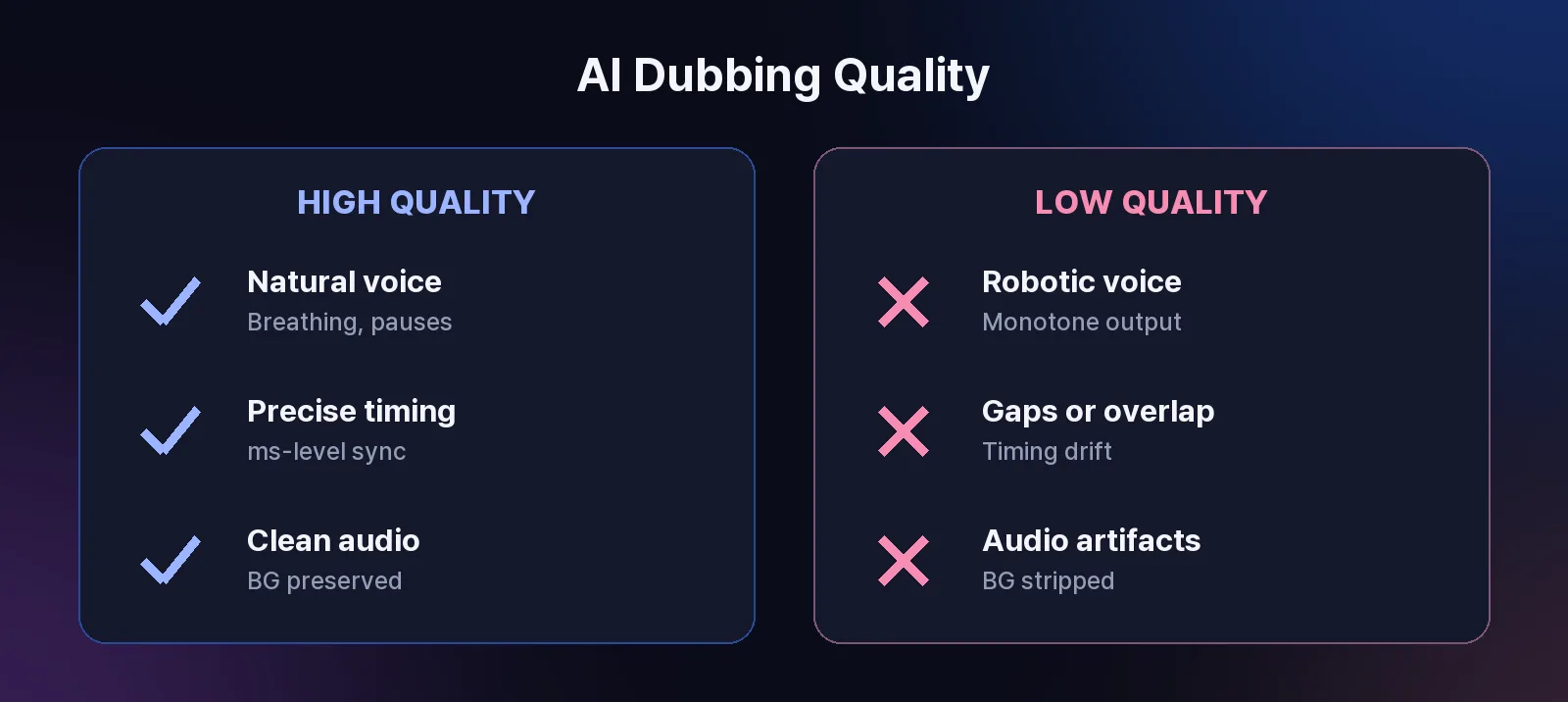
1. Voice naturalness Lower-quality systems produce robotic or monotone output. Higher-quality engines generate speech with natural rhythm, breathing patterns, and micro-pauses that sound human.
2. Timing precision Poor timing creates awkward gaps or overlapping audio. Advanced pipelines dynamically adjust speech rate and pause placement to match the original video’s pacing within milliseconds.
3. Background audio preservation Basic tools often strip background audio entirely or produce artifacts when separating vocals. Production-ready platforms preserve the original soundtrack and seamlessly blend dubbed voices back in.
4. Multi-speaker accuracy Single-speaker dubbing is relatively straightforward. The real challenge is maintaining distinct voice identities and natural turn-taking in multi-speaker content like interviews, podcasts, or panel discussions.
5. Language coverage and quality consistency Some platforms handle major languages well but produce noticeably lower quality for less-common language pairs. Consistent quality across a wide language range requires extensive training data and model optimization per language.
How Perso Dubbing Implements the Pipeline
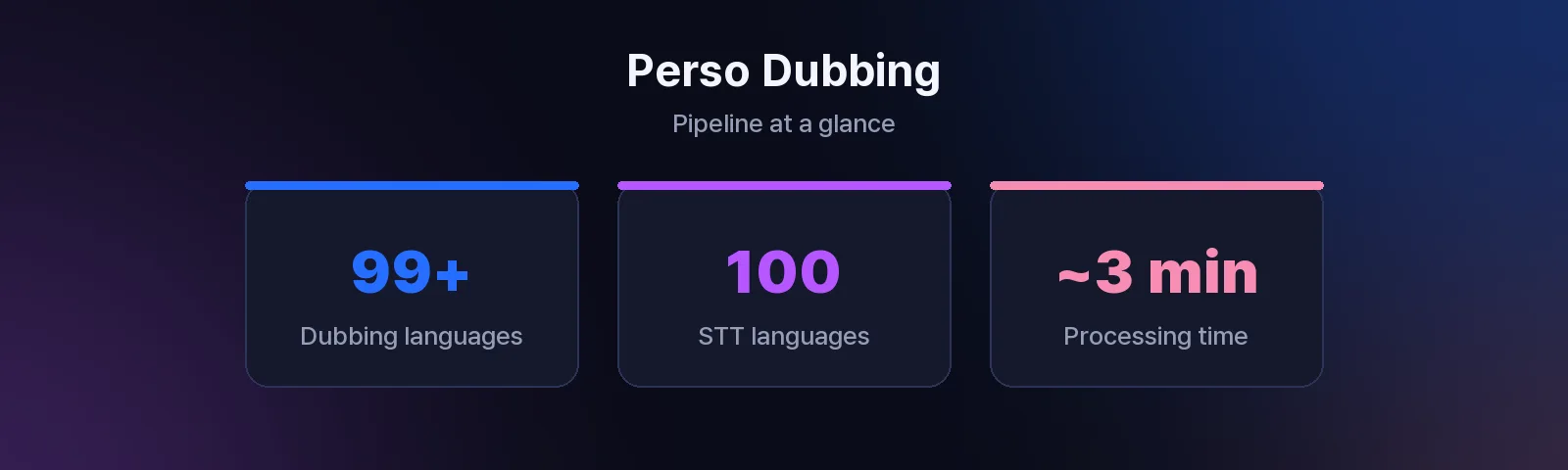
Perso Dubbing abstracts the four-stage pipeline into a three-step workflow:
Upload your video
Select the target language (from 99+ available languages)
Download the dubbed video
The platform handles speech recognition (100 languages input), translation, voice synthesis, and lip-sync alignment in a single automated pass. Average processing time is under 3 minutes for standard-length videos.
The entire process runs in the browser — no software installation required. Creators can dub into multiple languages simultaneously using the AI video dubbing tool, making it practical to produce content for global audiences without scaling production teams. To explore plans, start a free trial with no credit card required.
The Future of AI Dubbing Technology
AI dubbing technology continues advancing across all four pipeline stages. Current research directions include:
Real-time dubbing for live streams and video calls
Emotion-adaptive models that detect and transfer subtle emotional nuances more accurately
Improved speaker separation for complex multi-speaker environments like conference panels
Cultural adaptation beyond translation — adjusting humor, references, and idioms for local audiences
As these capabilities mature, the gap between AI-dubbed and professionally human-dubbed content continues to narrow, while the speed and cost advantages of AI dubbing grow.
Frequently Asked Questions
Q. How does AI dubbing work? A. AI dubbing works through a four-stage automated pipeline. First, speech recognition converts the original audio to text. Then, neural machine translation converts the transcript to the target language while preserving natural spoken pacing. Voice synthesis recreates the speech using the original speaker’s cloned voice. Finally, lip-sync alignment adjusts visual mouth movements to match the new audio. Platforms like Perso Dubbing complete this entire process in about 3 minutes.
Q. How long does AI dubbing take compared to traditional dubbing? A. AI dubbing platforms like Perso Dubbing process videos in an average of 3 minutes, compared to days or weeks for traditional studio dubbing. The speed difference comes from automating all four pipeline stages — transcription, translation, voice synthesis, and lip sync — that traditionally require separate teams and sessions.
Q. Can AI dubbing preserve the original speaker’s voice? A. Yes. Modern AI dubbing uses voice cloning technology to analyze the original speaker’s vocal characteristics — pitch, timbre, rhythm, and emotional tone — then generates dubbed audio that sounds like the same person speaking a different language. Perso Dubbing combines its own dubbing models with global AI foundation models for voice synthesis, maintaining vocal identity across 99+ target languages.
Q. What is the difference between AI dubbing and AI video translation? A. AI video translation is the broader category that includes subtitling, voiceover, and dubbing. AI dubbing specifically replaces the original spoken audio with synthesized speech in another language, including voice cloning and lip-sync alignment. It produces a more immersive viewing experience than subtitles alone, as viewers hear the content in their native language without reading on-screen text.
Taeksoon Kwon is Director of Perso AI, overseeing the AI dubbing technology stack and voice synthesis pipeline at Perso Dubbing.
AI dubbing converts video audio from one language to another through a four-stage pipeline: speech recognition, neural translation, voice synthesis, and lip-sync alignment. Platforms like Perso Dubbing complete this process in about 3 minutes — replacing a workflow that traditionally takes days or weeks with voice actors, sound engineers, and post-production teams.
This article breaks down each stage of the AI dubbing pipeline, explains the technology that powers it, and shows where the quality differences emerge between tools.
From Manual Studios to Automated Pipelines
Traditional dubbing requires hiring voice actors for every target language, recording sessions in sound-treated studios, manual timing adjustments to match lip movements, and extensive post-production mixing. A single 10-minute video dubbed into five languages can take 2–4 weeks and cost thousands of dollars.
AI dubbing replaces this with an automated pipeline that handles all four stages — transcription, translation, voice generation, and lip synchronization — in a single pass. The result is dubbed video that preserves the original speaker’s voice characteristics, allowing creators to translate videos into 99+ languages from a single upload.
For a broader overview of what AI dubbing is and when to use it, see our complete AI dubbing guide.
The 4-Stage AI Dubbing Pipeline
Every AI dubbing platform follows the same fundamental architecture, though implementations vary in quality and capability. Here is how each stage works.
Stage 1: Speech Recognition (ASR / STT)
The pipeline begins with automatic speech recognition (ASR), also called speech-to-text (STT). This stage converts the original audio track into a timestamped transcript.
What happens technically:
The audio is separated from background music and sound effects using source separation algorithms (vocal isolation)
The speech recognition model transcribes spoken words into text, handling accents, dialects, and domain-specific terminology
Speaker diarization identifies and labels different speakers in multi-person videos
Each word or phrase receives precise timestamps, preserving the original pacing
Why it matters for quality: Errors at this stage cascade through the entire pipeline. A mistranscribed word becomes a mistranslated sentence, which becomes incorrect dubbed audio. Perso Dubbing’s speech recognition engine supports 100 languages as input, meaning virtually any source language can enter the pipeline.
Stage 2: Neural Machine Translation (NMT)
The timestamped transcript moves to the translation stage, where neural machine translation models convert the text to the target language.
What makes dubbing translation different from text translation:
Length matching: Translated sentences must approximate the duration of the original speech. A 3-second English phrase translated into German might take 5 seconds to speak — the translation model must compress or restructure to fit
Speakability: Written translations often sound unnatural when spoken aloud. Dubbing-optimized NMT models produce conversational output suitable for speech synthesis
Context preservation: Technical terms, proper nouns, and cultural references require handling that preserves meaning without literal word-for-word conversion
Timestamp alignment: Each translated segment inherits timing constraints from the original, ensuring the dubbed audio aligns with visual cues on screen
Modern AI dubbing platforms use large language models fine-tuned specifically for spoken-language translation, not general-purpose text translators. This distinction is critical for natural-sounding output.
Stage 3: Voice Synthesis and Cloning (TTS)
This is where the translated text becomes spoken audio. Text-to-speech (TTS) engines generate speech in the target language while preserving the original speaker’s voice characteristics.
The technology behind voice preservation:
Voice cloning: The system analyzes the original speaker’s voice — pitch, timbre, speaking rhythm, and emotional tone — then generates new speech that sounds like the same person speaking a different language
Prosody transfer: Beyond the voice itself, the system transfers speaking patterns: emphasis, pauses, intonation curves, and pacing
Emotion matching: Advanced models detect emotional states in the source audio (excitement, concern, humor) and replicate them in the synthesized output
Perso Dubbing combines its own dubbing models with global AI foundation models to produce natural-sounding speech while maintaining the original speaker’s vocal identity. Users can further adjust output through the VoiceTone selector, which lets creators fine-tune tone characteristics for their specific content type — whether educational lectures, marketing videos, or entertainment content.
Multi-speaker handling: In videos with multiple speakers, each voice is cloned and synthesized independently. The pipeline maintains distinct voice profiles throughout, so a conversation between two people sounds like two different people in the dubbed version.
Stage 4: Lip-Sync Alignment
The final stage addresses visual consistency. When the dubbed audio differs in length or rhythm from the original, the speaker’s mouth movements no longer match what viewers hear.
How lip-sync technology works:
Computer vision models analyze the speaker’s facial movements frame by frame, identifying mouth shapes (visemes) and their timing
The system either adjusts the synthesized speech timing to match existing mouth movements, or modifies the video’s facial region to match the new audio
Background audio (music, ambient sound, effects) is preserved and mixed back with the dubbed voice track
Perso Dubbing processes lip-synced dubbing automatically as part of the dubbing workflow — there is no separate step or additional cost. This is a meaningful differentiator, as some platforms charge extra for lip-sync processing or do not offer it at all. For a deeper dive into achieving natural lip sync, see our guide on how to achieve perfect lip-sync with AI dubbing.
What Separates Good AI Dubbing from Bad
Not all AI dubbing pipelines produce equal results. The quality differences typically emerge in five areas:
1. Voice naturalness Lower-quality systems produce robotic or monotone output. Higher-quality engines generate speech with natural rhythm, breathing patterns, and micro-pauses that sound human.
2. Timing precision Poor timing creates awkward gaps or overlapping audio. Advanced pipelines dynamically adjust speech rate and pause placement to match the original video’s pacing within milliseconds.
3. Background audio preservation Basic tools often strip background audio entirely or produce artifacts when separating vocals. Production-ready platforms preserve the original soundtrack and seamlessly blend dubbed voices back in.
4. Multi-speaker accuracy Single-speaker dubbing is relatively straightforward. The real challenge is maintaining distinct voice identities and natural turn-taking in multi-speaker content like interviews, podcasts, or panel discussions.
5. Language coverage and quality consistency Some platforms handle major languages well but produce noticeably lower quality for less-common language pairs. Consistent quality across a wide language range requires extensive training data and model optimization per language.
How Perso Dubbing Implements the Pipeline
Perso Dubbing abstracts the four-stage pipeline into a three-step workflow:
Upload your video
Select the target language (from 99+ available languages)
Download the dubbed video
The platform handles speech recognition (100 languages input), translation, voice synthesis, and lip-sync alignment in a single automated pass. Average processing time is under 3 minutes for standard-length videos.
The entire process runs in the browser — no software installation required. Creators can dub into multiple languages simultaneously using the AI video dubbing tool, making it practical to produce content for global audiences without scaling production teams. To explore plans, start a free trial with no credit card required.
The Future of AI Dubbing Technology
AI dubbing technology continues advancing across all four pipeline stages. Current research directions include:
Real-time dubbing for live streams and video calls
Emotion-adaptive models that detect and transfer subtle emotional nuances more accurately
Improved speaker separation for complex multi-speaker environments like conference panels
Cultural adaptation beyond translation — adjusting humor, references, and idioms for local audiences
As these capabilities mature, the gap between AI-dubbed and professionally human-dubbed content continues to narrow, while the speed and cost advantages of AI dubbing grow.
Frequently Asked Questions
Q. How does AI dubbing work? A. AI dubbing works through a four-stage automated pipeline. First, speech recognition converts the original audio to text. Then, neural machine translation converts the transcript to the target language while preserving natural spoken pacing. Voice synthesis recreates the speech using the original speaker’s cloned voice. Finally, lip-sync alignment adjusts visual mouth movements to match the new audio. Platforms like Perso Dubbing complete this entire process in about 3 minutes.
Q. How long does AI dubbing take compared to traditional dubbing? A. AI dubbing platforms like Perso Dubbing process videos in an average of 3 minutes, compared to days or weeks for traditional studio dubbing. The speed difference comes from automating all four pipeline stages — transcription, translation, voice synthesis, and lip sync — that traditionally require separate teams and sessions.
Q. Can AI dubbing preserve the original speaker’s voice? A. Yes. Modern AI dubbing uses voice cloning technology to analyze the original speaker’s vocal characteristics — pitch, timbre, rhythm, and emotional tone — then generates dubbed audio that sounds like the same person speaking a different language. Perso Dubbing combines its own dubbing models with global AI foundation models for voice synthesis, maintaining vocal identity across 99+ target languages.
Q. What is the difference between AI dubbing and AI video translation? A. AI video translation is the broader category that includes subtitling, voiceover, and dubbing. AI dubbing specifically replaces the original spoken audio with synthesized speech in another language, including voice cloning and lip-sync alignment. It produces a more immersive viewing experience than subtitles alone, as viewers hear the content in their native language without reading on-screen text.
Taeksoon Kwon is Director of Perso AI, overseeing the AI dubbing technology stack and voice synthesis pipeline at Perso Dubbing.
AI dubbing converts video audio from one language to another through a four-stage pipeline: speech recognition, neural translation, voice synthesis, and lip-sync alignment. Platforms like Perso Dubbing complete this process in about 3 minutes — replacing a workflow that traditionally takes days or weeks with voice actors, sound engineers, and post-production teams.
This article breaks down each stage of the AI dubbing pipeline, explains the technology that powers it, and shows where the quality differences emerge between tools.
From Manual Studios to Automated Pipelines
Traditional dubbing requires hiring voice actors for every target language, recording sessions in sound-treated studios, manual timing adjustments to match lip movements, and extensive post-production mixing. A single 10-minute video dubbed into five languages can take 2–4 weeks and cost thousands of dollars.
AI dubbing replaces this with an automated pipeline that handles all four stages — transcription, translation, voice generation, and lip synchronization — in a single pass. The result is dubbed video that preserves the original speaker’s voice characteristics, allowing creators to translate videos into 99+ languages from a single upload.
For a broader overview of what AI dubbing is and when to use it, see our complete AI dubbing guide.
The 4-Stage AI Dubbing Pipeline
Every AI dubbing platform follows the same fundamental architecture, though implementations vary in quality and capability. Here is how each stage works.
Stage 1: Speech Recognition (ASR / STT)
The pipeline begins with automatic speech recognition (ASR), also called speech-to-text (STT). This stage converts the original audio track into a timestamped transcript.
What happens technically:
The audio is separated from background music and sound effects using source separation algorithms (vocal isolation)
The speech recognition model transcribes spoken words into text, handling accents, dialects, and domain-specific terminology
Speaker diarization identifies and labels different speakers in multi-person videos
Each word or phrase receives precise timestamps, preserving the original pacing
Why it matters for quality: Errors at this stage cascade through the entire pipeline. A mistranscribed word becomes a mistranslated sentence, which becomes incorrect dubbed audio. Perso Dubbing’s speech recognition engine supports 100 languages as input, meaning virtually any source language can enter the pipeline.
Stage 2: Neural Machine Translation (NMT)
The timestamped transcript moves to the translation stage, where neural machine translation models convert the text to the target language.
What makes dubbing translation different from text translation:
Length matching: Translated sentences must approximate the duration of the original speech. A 3-second English phrase translated into German might take 5 seconds to speak — the translation model must compress or restructure to fit
Speakability: Written translations often sound unnatural when spoken aloud. Dubbing-optimized NMT models produce conversational output suitable for speech synthesis
Context preservation: Technical terms, proper nouns, and cultural references require handling that preserves meaning without literal word-for-word conversion
Timestamp alignment: Each translated segment inherits timing constraints from the original, ensuring the dubbed audio aligns with visual cues on screen
Modern AI dubbing platforms use large language models fine-tuned specifically for spoken-language translation, not general-purpose text translators. This distinction is critical for natural-sounding output.
Stage 3: Voice Synthesis and Cloning (TTS)
This is where the translated text becomes spoken audio. Text-to-speech (TTS) engines generate speech in the target language while preserving the original speaker’s voice characteristics.
The technology behind voice preservation:
Voice cloning: The system analyzes the original speaker’s voice — pitch, timbre, speaking rhythm, and emotional tone — then generates new speech that sounds like the same person speaking a different language
Prosody transfer: Beyond the voice itself, the system transfers speaking patterns: emphasis, pauses, intonation curves, and pacing
Emotion matching: Advanced models detect emotional states in the source audio (excitement, concern, humor) and replicate them in the synthesized output
Perso Dubbing combines its own dubbing models with global AI foundation models to produce natural-sounding speech while maintaining the original speaker’s vocal identity. Users can further adjust output through the VoiceTone selector, which lets creators fine-tune tone characteristics for their specific content type — whether educational lectures, marketing videos, or entertainment content.
Multi-speaker handling: In videos with multiple speakers, each voice is cloned and synthesized independently. The pipeline maintains distinct voice profiles throughout, so a conversation between two people sounds like two different people in the dubbed version.
Stage 4: Lip-Sync Alignment
The final stage addresses visual consistency. When the dubbed audio differs in length or rhythm from the original, the speaker’s mouth movements no longer match what viewers hear.
How lip-sync technology works:
Computer vision models analyze the speaker’s facial movements frame by frame, identifying mouth shapes (visemes) and their timing
The system either adjusts the synthesized speech timing to match existing mouth movements, or modifies the video’s facial region to match the new audio
Background audio (music, ambient sound, effects) is preserved and mixed back with the dubbed voice track
Perso Dubbing processes lip-synced dubbing automatically as part of the dubbing workflow — there is no separate step or additional cost. This is a meaningful differentiator, as some platforms charge extra for lip-sync processing or do not offer it at all. For a deeper dive into achieving natural lip sync, see our guide on how to achieve perfect lip-sync with AI dubbing.
What Separates Good AI Dubbing from Bad
Not all AI dubbing pipelines produce equal results. The quality differences typically emerge in five areas:
1. Voice naturalness Lower-quality systems produce robotic or monotone output. Higher-quality engines generate speech with natural rhythm, breathing patterns, and micro-pauses that sound human.
2. Timing precision Poor timing creates awkward gaps or overlapping audio. Advanced pipelines dynamically adjust speech rate and pause placement to match the original video’s pacing within milliseconds.
3. Background audio preservation Basic tools often strip background audio entirely or produce artifacts when separating vocals. Production-ready platforms preserve the original soundtrack and seamlessly blend dubbed voices back in.
4. Multi-speaker accuracy Single-speaker dubbing is relatively straightforward. The real challenge is maintaining distinct voice identities and natural turn-taking in multi-speaker content like interviews, podcasts, or panel discussions.
5. Language coverage and quality consistency Some platforms handle major languages well but produce noticeably lower quality for less-common language pairs. Consistent quality across a wide language range requires extensive training data and model optimization per language.
How Perso Dubbing Implements the Pipeline
Perso Dubbing abstracts the four-stage pipeline into a three-step workflow:
Upload your video
Select the target language (from 99+ available languages)
Download the dubbed video
The platform handles speech recognition (100 languages input), translation, voice synthesis, and lip-sync alignment in a single automated pass. Average processing time is under 3 minutes for standard-length videos.
The entire process runs in the browser — no software installation required. Creators can dub into multiple languages simultaneously using the AI video dubbing tool, making it practical to produce content for global audiences without scaling production teams. To explore plans, start a free trial with no credit card required.
The Future of AI Dubbing Technology
AI dubbing technology continues advancing across all four pipeline stages. Current research directions include:
Real-time dubbing for live streams and video calls
Emotion-adaptive models that detect and transfer subtle emotional nuances more accurately
Improved speaker separation for complex multi-speaker environments like conference panels
Cultural adaptation beyond translation — adjusting humor, references, and idioms for local audiences
As these capabilities mature, the gap between AI-dubbed and professionally human-dubbed content continues to narrow, while the speed and cost advantages of AI dubbing grow.
Frequently Asked Questions
Q. How does AI dubbing work? A. AI dubbing works through a four-stage automated pipeline. First, speech recognition converts the original audio to text. Then, neural machine translation converts the transcript to the target language while preserving natural spoken pacing. Voice synthesis recreates the speech using the original speaker’s cloned voice. Finally, lip-sync alignment adjusts visual mouth movements to match the new audio. Platforms like Perso Dubbing complete this entire process in about 3 minutes.
Q. How long does AI dubbing take compared to traditional dubbing? A. AI dubbing platforms like Perso Dubbing process videos in an average of 3 minutes, compared to days or weeks for traditional studio dubbing. The speed difference comes from automating all four pipeline stages — transcription, translation, voice synthesis, and lip sync — that traditionally require separate teams and sessions.
Q. Can AI dubbing preserve the original speaker’s voice? A. Yes. Modern AI dubbing uses voice cloning technology to analyze the original speaker’s vocal characteristics — pitch, timbre, rhythm, and emotional tone — then generates dubbed audio that sounds like the same person speaking a different language. Perso Dubbing combines its own dubbing models with global AI foundation models for voice synthesis, maintaining vocal identity across 99+ target languages.
Q. What is the difference between AI dubbing and AI video translation? A. AI video translation is the broader category that includes subtitling, voiceover, and dubbing. AI dubbing specifically replaces the original spoken audio with synthesized speech in another language, including voice cloning and lip-sync alignment. It produces a more immersive viewing experience than subtitles alone, as viewers hear the content in their native language without reading on-screen text.
Taeksoon Kwon is Director of Perso AI, overseeing the AI dubbing technology stack and voice synthesis pipeline at Perso Dubbing.
Continue Reading
Browse All