How to Translate Chinese Videos to Hindi with AI




Jump to section
Jump to section

Share
Share
Share
AI Video Translator, Localization, and Dubbing Tool
Try it out for Free
💡 Translate any Chinese video to Hindi in under 5 minutes with Perso Dubbing. Free trial — no credit card required.
Answer-First Opening
Perso Dubbing translates Chinese videos to Hindi with AI dubbing in three steps, preserving the original speaker's voice tone while converting Mandarin's four-tone system into Hindi's non-tonal phonetic structure.
Over the past 12 months, Chinese → Hindi has become the #1 most-used language pair on the platform, driven by creators localizing Chinese short-drama and animation content for Indian audiences. A 10-minute Chinese video is dubbed into Hindi in under 5 minutes, roughly 10× faster than traditional studio dubbing.
The platform is optimized for short-form content averaging 74 seconds per clip — the format driving India's $5 billion micro-drama market. Multi-speaker detection automatically handles an average of 2.2 voices per project, with 99.3% of uploads coming as direct files rather than YouTube URLs.
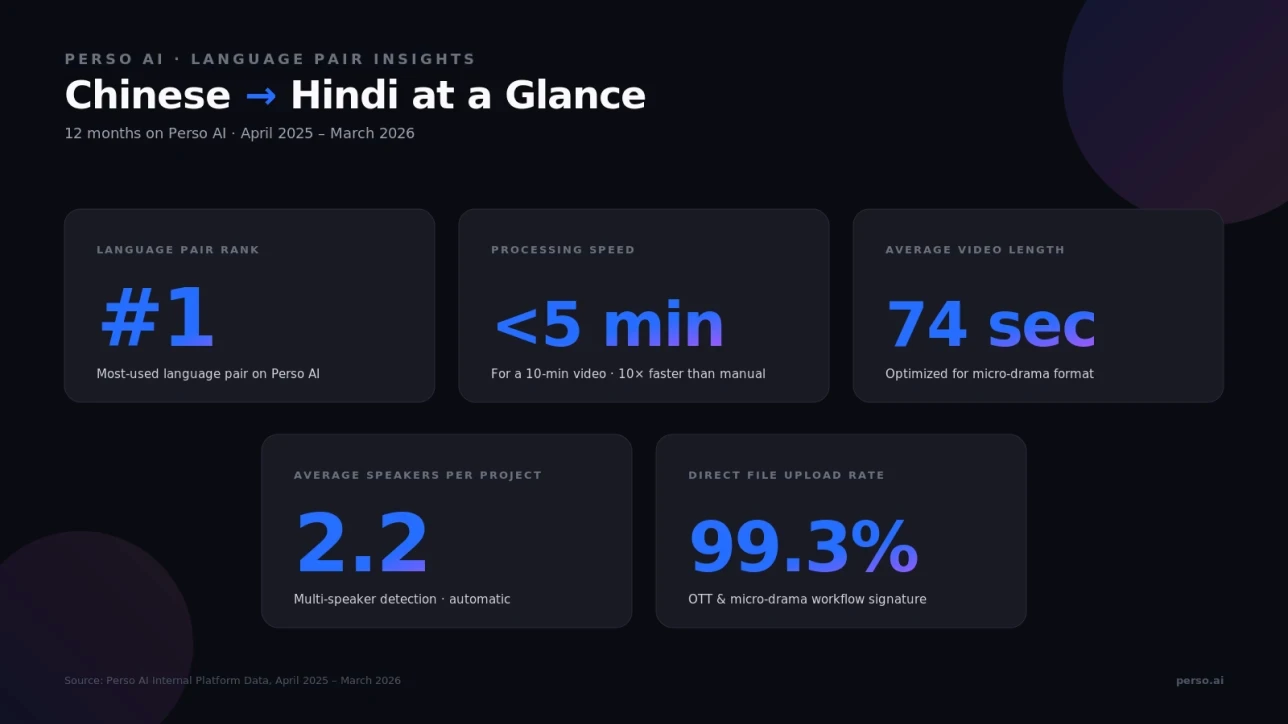
Source: Perso Dubbing Internal Platform Data, April 2025 – March 2026
How do I translate a Chinese video to Hindi with AI?
Perso Dubbing translates Chinese videos into Hindi in three steps. The entire process takes under five minutes for a typical 10-minute video and preserves the original speaker's voice. Supported formats: MP4, MOV, AVI, MKV up to 5 GB, plus direct YouTube URL imports.
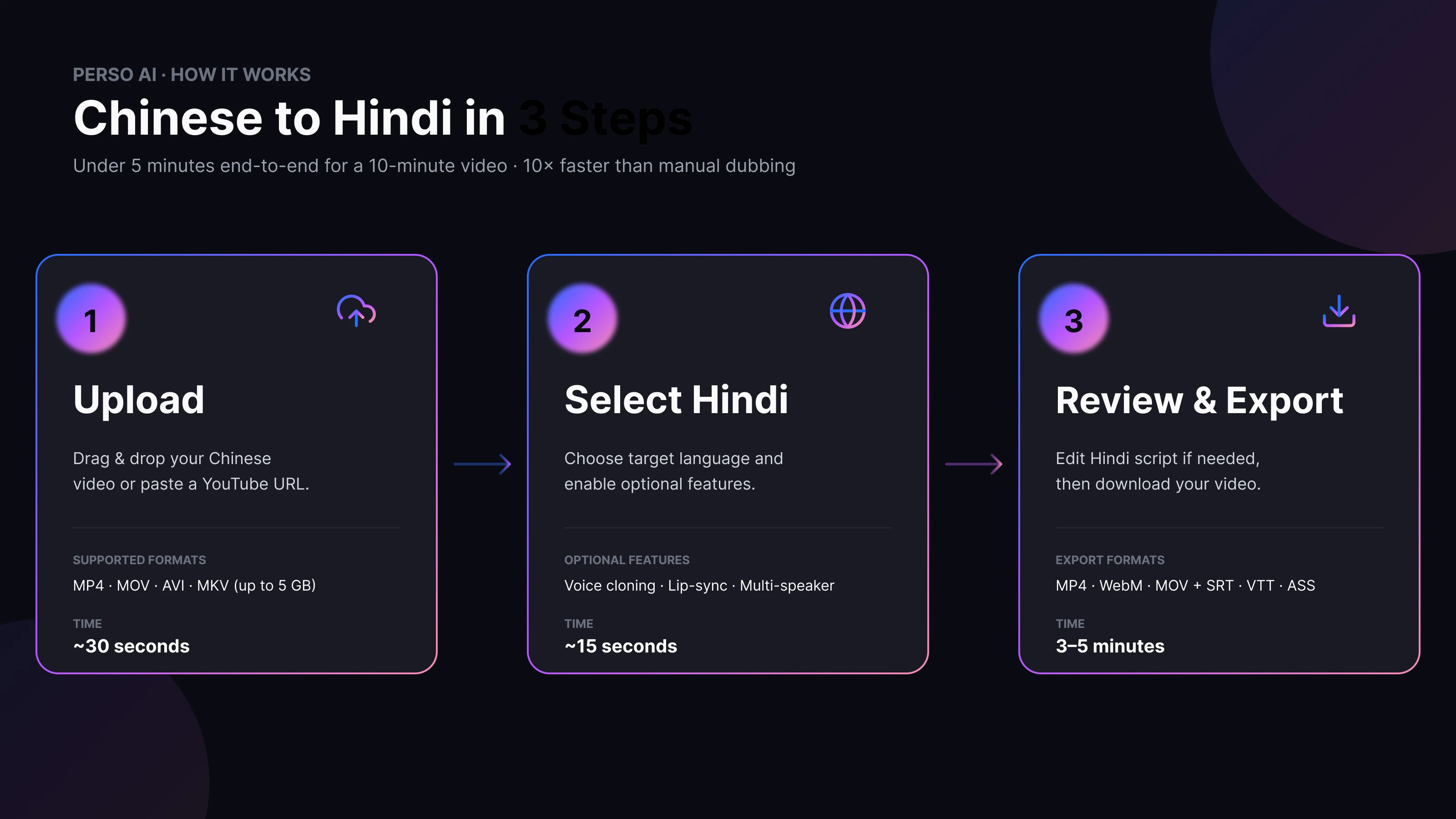
End-to-end workflow · 10× faster than manual dubbing
Step 1 — Upload notes
Direct file uploads dominate (99.3%) over YouTube URL imports (0.7%) for Chinese → Hindi projects, reflecting the typical OTT and short-drama workflow. Audio-only files (MP3, WAV, M4A) are also supported.
Step 2 — Optional features at language selection
Voice cloning — preserves the original speaker's tone in Hindi
Multi-speaker detection — automatic (average 2.2 speakers per Chinese → Hindi project)
Lip-sync — used in 0.3% of Chinese → Hindi projects; recommended for longer-form content
Step 3 — Review & export notes
Edit the Hindi script line-by-line in the built-in editor, then export the dubbed video. No re-rendering required for script tweaks.
Before / After: Traditional Chinese-to-Hindi studio dubbing takes 3–5 days and costs $30–$100 per episode (per Sukudo Studios micro-drama report). The same output is delivered in under 5 minutes per 10-minute video with AI dubbing.
🎬 Ready to try it? Upload your first Chinese video and get the Hindi dub in under 5 minutes.
The Indian micro-drama boom behind Chinese-to-Hindi dubbing
Chinese-to-Hindi dubbing is the fastest-growing cross-regional language corridor in AI dubbing, driven by India's micro-drama platform economy. According to Sukudo Studios, India's micro-drama market is projected to reach $5 billion, with cumulative app downloads crossing 250 million in 2025 — a 16× year-over-year increase. This demand pulls Chinese short-form content into Hindi localization at unprecedented scale.
The platforms driving demand
Platform | Monthly Active Users | Origin | Role in Chinese → Hindi Flow |
|---|---|---|---|
Kuku TV | 37 million | India | Largest Hindi localization destination |
DramaBox | 2.8 million | China | Adapts Chinese short-drama templates into Hindi |
ReelShort | 1.1 million | China | Chinese-origin format, Hindi-localized output |
Source: MPA estimates via Storyboard18, April 2025.
Kuku TV leads the Hindi micro-drama segment. DramaBox and ReelShort — both Chinese-origin platforms — adapt proven short-drama templates from China directly into Hindi markets, typically through AI-powered dubbing pipelines.
The economics of AI dubbing vs manual studio work
Traditional Chinese-to-Hindi studio dubbing costs $30–$100 per episode per language, according to the Sukudo Studios report. For a 100-episode micro-drama series, that translates to $3,000–$10,000 in dubbing costs per language — before studio time and voice actor availability. AI dubbing compresses this to a fraction of the cost and delivery time, which is why short-drama apps reached 370 million global downloads in Q1 2025 alone (Omdia report via Deadline).
Internal data on Perso Dubbing reflects this pattern. Chinese → Hindi is the single most-used language pair on the platform, and the average video length is just 74 seconds — matching the short-drama episode format that dominates Kuku TV, DramaBox, and ReelShort.
What makes Chinese-to-Hindi translation uniquely challenging?
Chinese-to-Hindi dubbing presents technical challenges that generic video translators cannot handle well. The core issue is the structural mismatch between tonal and non-tonal phonetic systems.
Mandarin vs Hindi — Linguistic Comparison
Feature | Mandarin Chinese | Hindi |
|---|---|---|
Tonal system | 4 primary tones + 1 neutral (tones change meaning) | Non-tonal |
Meaning distinction | Tone determines meaning (ma: mother 妈 / hemp 麻 / horse 马 / scold 骂) | Aspirated vs unaspirated consonants; vowel length |
Script | Logographic (Chinese characters) | Devanagari (syllabic alphabet) |
Length of same meaning | Baseline (compact) | 15–30% longer when written in Devanagari |
Special consonants | No retroflex, no aspiration distinction | Retroflex (ट, ड, ण) + aspirated stops (ख, छ, थ) |
Sources: Standard Chinese phonology (Wikipedia); Phonetic differences research, SciRP 2024.
The three-step conversion problem
Converting Mandarin audio into Hindi requires AI to perform three distinct phonetic operations:
Transcribe tonal Mandarin accurately — every syllable's tone must be identified to preserve semantic meaning
Translate meaning, not sound — the translation engine must discard tonal information and render the intended meaning in Hindi grammar
Synthesize Hindi audio with native prosody — Hindi has its own stress and intonation patterns that differ significantly from Mandarin
Why generic translators fail
Research on cross-linguistic phonetic differences (SciRP, 2024) shows that native phoneme systems significantly affect second-language pronunciation. When converting Mandarin audio to Hindi, AI must handle Hindi-specific sounds that don't exist in Mandarin — such as retroflex consonants and aspirated stops.
Generic translators that route through English as a pivot language — Mandarin → English → Hindi — introduce two rounds of phonetic approximation, degrading quality at each step. Perso Dubbing uses direct Mandarin-to-Hindi models, eliminating the English intermediate step.
Script length mismatch
A practical side effect of the 15–30% script length difference: timing adjustments are required for subtitle and lip-sync workflows. The platform compensates automatically during the dubbing pass — one reason 74-second Chinese clips often produce slightly longer Hindi audio when dubbed.
Content categories shaping Chinese-to-Hindi dubbing
Twelve months of platform data (April 2025 – March 2026) reveals a clear content pattern for Chinese → Hindi projects. The dominant format is short-form entertainment, aligned with India's micro-drama app economy.
Content category breakdown
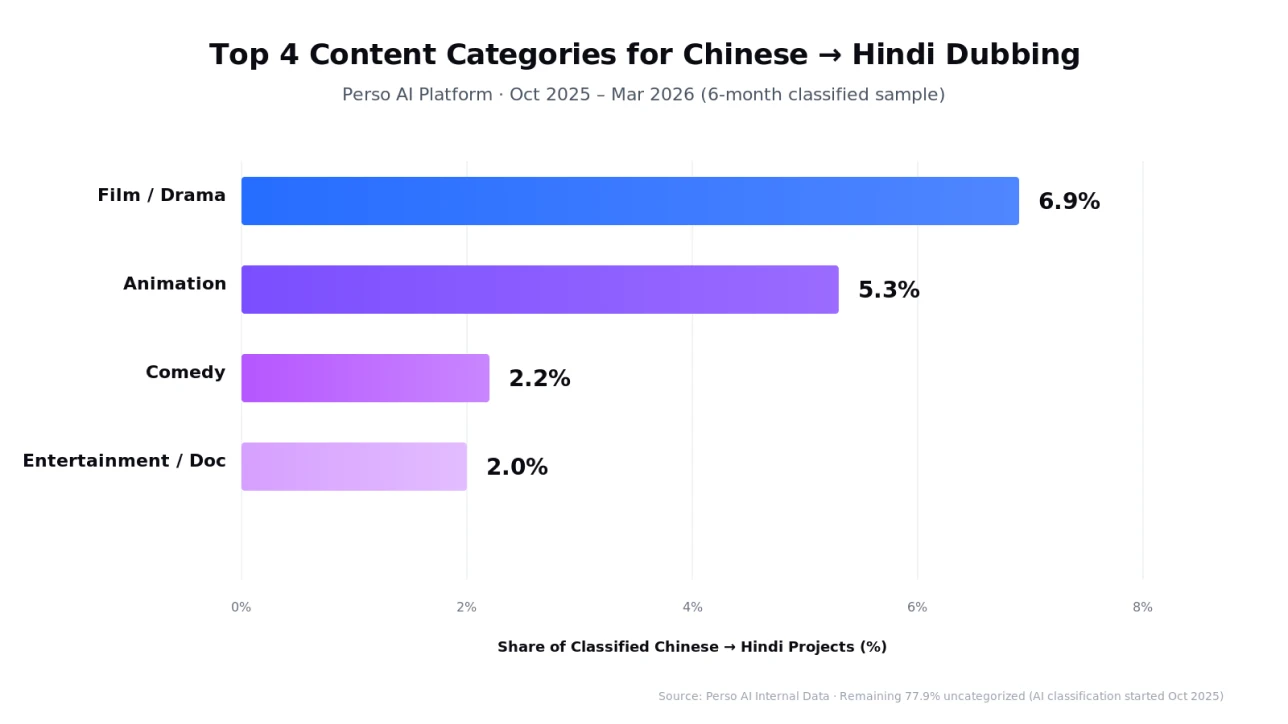
Source: Perso Dubbing Internal Data · Oct 2025 – Mar 2026 (6-month classified sample)
Film / Drama (6.9%) — Chinese short dramas localized for Indian OTT apps
Animation (5.3%) — Donghua (Chinese animation) exported to Hindi audiences
Comedy (2.2%) — Short-form comedy clips for social platforms
Entertainment / Documentary (2.0%) — Reality and entertainment content
Note: Category data reflects approximately 22% of Chinese-to-Hindi projects that received AI category classification (feature active from October 2025).
Format characteristics
Chinese → Hindi projects share a distinct format signature:
Average video length: 74 seconds — the shortest among the platform's top language pairs, aligned with micro-drama episode format
Average speakers per project: 2.2 — dialogue-driven content with multiple characters
Lip-sync activation: 0.3% — unusually low, reflecting short-form content where lip-sync precision matters less
Direct file upload: 99.3% — workflow matches OTT app delivery pipelines rather than YouTube sharing
What this means for creators
If you're producing Chinese-origin short-drama, donghua, or comedy content for Hindi audiences, your workflow will likely involve:
Direct file uploads (not YouTube links)
60–90 second clip lengths
2–3 speaker dialogue detection
Voice cloning to preserve character identity across episodes
The Perso Dubbing Chinese → Hindi pipeline is tuned for exactly this workflow, which explains why it dominates this specific language corridor.
How does Perso Dubbing handle Chinese-to-Hindi dubbing?
Perso Dubbing is an AI-powered video dubbing and translation platform supporting dubbing in 99+ languages. Its Chinese → Hindi pipeline combines direct-model translation, voice cloning, and multi-speaker detection — all tuned for the short-form drama use case that dominates this language pair.
Direct Mandarin-to-Hindi translation (no English pivot)
Most generic translators route through English: Mandarin → English → Hindi. This introduces phonetic approximation errors at each conversion step. Perso Dubbing uses a direct Mandarin → Hindi model, avoiding the intermediate English pass. The result is better preservation of idiomatic expressions, cultural context, and emotional tone.
Voice cloning preserves character identity across episodes
For episodic Chinese dramas localized into Hindi, character voice continuity matters. The platform clones the original speaker's vocal characteristics — pitch, timbre, speaking rate — and applies them to the Hindi output. Across all language pairs, 9.6% of projects activate premium voice cloning. For Chinese → Hindi specifically, the activation rate is 0.3%, reflecting short-form drama's priority on turnaround speed over voice fidelity.
Multi-speaker detection (averaging 2.2 voices per project)
Chinese → Hindi projects average 2.2 distinct speakers — higher than most language pairs on the platform. Speaker changes are detected automatically, and distinct Hindi voices are assigned to each character. No manual segmentation required.
Speed optimized for short-form workflows
A 10-minute Chinese video is dubbed into Hindi in under 5 minutes — approximately 10× faster than manual dubbing. For the 74-second clips that dominate Chinese → Hindi use cases, turnaround is typically under one minute per clip.
Export flexibility
Output formats include MP4, WebM, and MOV for video, and SRT, VTT, or ASS for subtitle files. This matches the delivery requirements of major Hindi micro-drama platforms.
Frequently Asked Questions
Q. How accurate is AI Chinese-to-Hindi video translation?
Perso Dubbing achieves approximately 98% translation accuracy for Chinese-to-Hindi dubbing, validated across short-form drama, animation, and entertainment content. Accuracy is higher for scripted content than unscripted or slang-heavy material. Chinese → Hindi is the #1 most-used language pair on the platform, giving the model extensive training signal for this specific language corridor.
Q. How long does it take to dub a Chinese video into Hindi?
A 10-minute Chinese video is dubbed into Hindi in under five minutes — roughly 10× faster than manual studio dubbing. The average Chinese-to-Hindi project is only 74 seconds (short-drama format), typically completing in under one minute end-to-end, including transcription, translation, and Hindi voice synthesis with multi-speaker assignment.
Q. Does Perso Dubbing preserve the original speaker's voice when dubbing Chinese to Hindi?
Yes. Voice cloning preserves the original speaker's tone, pitch, and emotional range when converting Chinese audio to Hindi. Multi-speaker detection is automatic, and Chinese-to-Hindi projects average 2.2 distinct speakers per video — each character is mapped to a separate Hindi voice, supporting episode-to-episode continuity in serialized drama content.
Q. Can the platform handle Chinese short dramas and micro-content for Hindi markets?
Yes. Chinese → Hindi is the #1 most-used language pair on Perso Dubbing, with the majority being short-drama content averaging 74 seconds per clip. The pipeline is optimized for micro-drama localization workflows used by Hindi OTT apps like Kuku TV, DramaBox, and ReelShort, supporting batch episode processing and consistent character voice mapping.
Q. What file formats are supported for Chinese-to-Hindi translation?
MP4, MOV, AVI, and MKV video formats plus MP3, WAV, and M4A audio files, up to 5 GB per upload. For Chinese-to-Hindi short-drama workflows, direct MP4 uploads are used in 99.3% of projects, with YouTube URL imports accounting for 0.7%.
Q. Is AI dubbing cheaper than traditional Chinese-to-Hindi studio dubbing?
Yes. According to the Sukudo Studios micro-drama report, traditional dubbing costs $30–$100 per episode per language. AI dubbing reduces this to a fraction of the cost while cutting delivery from days to minutes — one reason global short-drama apps hit 370 million quarterly downloads in Q1 2025.
Ready to translate your Chinese video to Hindi?
Start your first Chinese → Hindi dubbing project in under five minutes. Free trial — no credit card required.
Start dubbing your Chinese video now →
Data source: Perso Dubbing Internal Platform Data, April 2025 – March 2026. Market figures sourced from Sukudo Studios (linked), Storyboard18, Deadline / Omdia report, and SciRP 2024 research (linked). This post is part of Perso Dubbing's Language Pair Guide series. For broader AI dubbing trends, see our Q1 2026 AI Dubbing Language Trends Report.
💡 Translate any Chinese video to Hindi in under 5 minutes with Perso Dubbing. Free trial — no credit card required.
Answer-First Opening
Perso Dubbing translates Chinese videos to Hindi with AI dubbing in three steps, preserving the original speaker's voice tone while converting Mandarin's four-tone system into Hindi's non-tonal phonetic structure.
Over the past 12 months, Chinese → Hindi has become the #1 most-used language pair on the platform, driven by creators localizing Chinese short-drama and animation content for Indian audiences. A 10-minute Chinese video is dubbed into Hindi in under 5 minutes, roughly 10× faster than traditional studio dubbing.
The platform is optimized for short-form content averaging 74 seconds per clip — the format driving India's $5 billion micro-drama market. Multi-speaker detection automatically handles an average of 2.2 voices per project, with 99.3% of uploads coming as direct files rather than YouTube URLs.
Source: Perso Dubbing Internal Platform Data, April 2025 – March 2026
How do I translate a Chinese video to Hindi with AI?
Perso Dubbing translates Chinese videos into Hindi in three steps. The entire process takes under five minutes for a typical 10-minute video and preserves the original speaker's voice. Supported formats: MP4, MOV, AVI, MKV up to 5 GB, plus direct YouTube URL imports.
End-to-end workflow · 10× faster than manual dubbing
Step 1 — Upload notes
Direct file uploads dominate (99.3%) over YouTube URL imports (0.7%) for Chinese → Hindi projects, reflecting the typical OTT and short-drama workflow. Audio-only files (MP3, WAV, M4A) are also supported.
Step 2 — Optional features at language selection
Voice cloning — preserves the original speaker's tone in Hindi
Multi-speaker detection — automatic (average 2.2 speakers per Chinese → Hindi project)
Lip-sync — used in 0.3% of Chinese → Hindi projects; recommended for longer-form content
Step 3 — Review & export notes
Edit the Hindi script line-by-line in the built-in editor, then export the dubbed video. No re-rendering required for script tweaks.
Before / After: Traditional Chinese-to-Hindi studio dubbing takes 3–5 days and costs $30–$100 per episode (per Sukudo Studios micro-drama report). The same output is delivered in under 5 minutes per 10-minute video with AI dubbing.
🎬 Ready to try it? Upload your first Chinese video and get the Hindi dub in under 5 minutes.
The Indian micro-drama boom behind Chinese-to-Hindi dubbing
Chinese-to-Hindi dubbing is the fastest-growing cross-regional language corridor in AI dubbing, driven by India's micro-drama platform economy. According to Sukudo Studios, India's micro-drama market is projected to reach $5 billion, with cumulative app downloads crossing 250 million in 2025 — a 16× year-over-year increase. This demand pulls Chinese short-form content into Hindi localization at unprecedented scale.
The platforms driving demand
Platform | Monthly Active Users | Origin | Role in Chinese → Hindi Flow |
|---|---|---|---|
Kuku TV | 37 million | India | Largest Hindi localization destination |
DramaBox | 2.8 million | China | Adapts Chinese short-drama templates into Hindi |
ReelShort | 1.1 million | China | Chinese-origin format, Hindi-localized output |
Source: MPA estimates via Storyboard18, April 2025.
Kuku TV leads the Hindi micro-drama segment. DramaBox and ReelShort — both Chinese-origin platforms — adapt proven short-drama templates from China directly into Hindi markets, typically through AI-powered dubbing pipelines.
The economics of AI dubbing vs manual studio work
Traditional Chinese-to-Hindi studio dubbing costs $30–$100 per episode per language, according to the Sukudo Studios report. For a 100-episode micro-drama series, that translates to $3,000–$10,000 in dubbing costs per language — before studio time and voice actor availability. AI dubbing compresses this to a fraction of the cost and delivery time, which is why short-drama apps reached 370 million global downloads in Q1 2025 alone (Omdia report via Deadline).
Internal data on Perso Dubbing reflects this pattern. Chinese → Hindi is the single most-used language pair on the platform, and the average video length is just 74 seconds — matching the short-drama episode format that dominates Kuku TV, DramaBox, and ReelShort.
What makes Chinese-to-Hindi translation uniquely challenging?
Chinese-to-Hindi dubbing presents technical challenges that generic video translators cannot handle well. The core issue is the structural mismatch between tonal and non-tonal phonetic systems.
Mandarin vs Hindi — Linguistic Comparison
Feature | Mandarin Chinese | Hindi |
|---|---|---|
Tonal system | 4 primary tones + 1 neutral (tones change meaning) | Non-tonal |
Meaning distinction | Tone determines meaning (ma: mother 妈 / hemp 麻 / horse 马 / scold 骂) | Aspirated vs unaspirated consonants; vowel length |
Script | Logographic (Chinese characters) | Devanagari (syllabic alphabet) |
Length of same meaning | Baseline (compact) | 15–30% longer when written in Devanagari |
Special consonants | No retroflex, no aspiration distinction | Retroflex (ट, ड, ण) + aspirated stops (ख, छ, थ) |
Sources: Standard Chinese phonology (Wikipedia); Phonetic differences research, SciRP 2024.
The three-step conversion problem
Converting Mandarin audio into Hindi requires AI to perform three distinct phonetic operations:
Transcribe tonal Mandarin accurately — every syllable's tone must be identified to preserve semantic meaning
Translate meaning, not sound — the translation engine must discard tonal information and render the intended meaning in Hindi grammar
Synthesize Hindi audio with native prosody — Hindi has its own stress and intonation patterns that differ significantly from Mandarin
Why generic translators fail
Research on cross-linguistic phonetic differences (SciRP, 2024) shows that native phoneme systems significantly affect second-language pronunciation. When converting Mandarin audio to Hindi, AI must handle Hindi-specific sounds that don't exist in Mandarin — such as retroflex consonants and aspirated stops.
Generic translators that route through English as a pivot language — Mandarin → English → Hindi — introduce two rounds of phonetic approximation, degrading quality at each step. Perso Dubbing uses direct Mandarin-to-Hindi models, eliminating the English intermediate step.
Script length mismatch
A practical side effect of the 15–30% script length difference: timing adjustments are required for subtitle and lip-sync workflows. The platform compensates automatically during the dubbing pass — one reason 74-second Chinese clips often produce slightly longer Hindi audio when dubbed.
Content categories shaping Chinese-to-Hindi dubbing
Twelve months of platform data (April 2025 – March 2026) reveals a clear content pattern for Chinese → Hindi projects. The dominant format is short-form entertainment, aligned with India's micro-drama app economy.
Content category breakdown
Source: Perso Dubbing Internal Data · Oct 2025 – Mar 2026 (6-month classified sample)
Film / Drama (6.9%) — Chinese short dramas localized for Indian OTT apps
Animation (5.3%) — Donghua (Chinese animation) exported to Hindi audiences
Comedy (2.2%) — Short-form comedy clips for social platforms
Entertainment / Documentary (2.0%) — Reality and entertainment content
Note: Category data reflects approximately 22% of Chinese-to-Hindi projects that received AI category classification (feature active from October 2025).
Format characteristics
Chinese → Hindi projects share a distinct format signature:
Average video length: 74 seconds — the shortest among the platform's top language pairs, aligned with micro-drama episode format
Average speakers per project: 2.2 — dialogue-driven content with multiple characters
Lip-sync activation: 0.3% — unusually low, reflecting short-form content where lip-sync precision matters less
Direct file upload: 99.3% — workflow matches OTT app delivery pipelines rather than YouTube sharing
What this means for creators
If you're producing Chinese-origin short-drama, donghua, or comedy content for Hindi audiences, your workflow will likely involve:
Direct file uploads (not YouTube links)
60–90 second clip lengths
2–3 speaker dialogue detection
Voice cloning to preserve character identity across episodes
The Perso Dubbing Chinese → Hindi pipeline is tuned for exactly this workflow, which explains why it dominates this specific language corridor.
How does Perso Dubbing handle Chinese-to-Hindi dubbing?
Perso Dubbing is an AI-powered video dubbing and translation platform supporting dubbing in 99+ languages. Its Chinese → Hindi pipeline combines direct-model translation, voice cloning, and multi-speaker detection — all tuned for the short-form drama use case that dominates this language pair.
Direct Mandarin-to-Hindi translation (no English pivot)
Most generic translators route through English: Mandarin → English → Hindi. This introduces phonetic approximation errors at each conversion step. Perso Dubbing uses a direct Mandarin → Hindi model, avoiding the intermediate English pass. The result is better preservation of idiomatic expressions, cultural context, and emotional tone.
Voice cloning preserves character identity across episodes
For episodic Chinese dramas localized into Hindi, character voice continuity matters. The platform clones the original speaker's vocal characteristics — pitch, timbre, speaking rate — and applies them to the Hindi output. Across all language pairs, 9.6% of projects activate premium voice cloning. For Chinese → Hindi specifically, the activation rate is 0.3%, reflecting short-form drama's priority on turnaround speed over voice fidelity.
Multi-speaker detection (averaging 2.2 voices per project)
Chinese → Hindi projects average 2.2 distinct speakers — higher than most language pairs on the platform. Speaker changes are detected automatically, and distinct Hindi voices are assigned to each character. No manual segmentation required.
Speed optimized for short-form workflows
A 10-minute Chinese video is dubbed into Hindi in under 5 minutes — approximately 10× faster than manual dubbing. For the 74-second clips that dominate Chinese → Hindi use cases, turnaround is typically under one minute per clip.
Export flexibility
Output formats include MP4, WebM, and MOV for video, and SRT, VTT, or ASS for subtitle files. This matches the delivery requirements of major Hindi micro-drama platforms.
Frequently Asked Questions
Q. How accurate is AI Chinese-to-Hindi video translation?
Perso Dubbing achieves approximately 98% translation accuracy for Chinese-to-Hindi dubbing, validated across short-form drama, animation, and entertainment content. Accuracy is higher for scripted content than unscripted or slang-heavy material. Chinese → Hindi is the #1 most-used language pair on the platform, giving the model extensive training signal for this specific language corridor.
Q. How long does it take to dub a Chinese video into Hindi?
A 10-minute Chinese video is dubbed into Hindi in under five minutes — roughly 10× faster than manual studio dubbing. The average Chinese-to-Hindi project is only 74 seconds (short-drama format), typically completing in under one minute end-to-end, including transcription, translation, and Hindi voice synthesis with multi-speaker assignment.
Q. Does Perso Dubbing preserve the original speaker's voice when dubbing Chinese to Hindi?
Yes. Voice cloning preserves the original speaker's tone, pitch, and emotional range when converting Chinese audio to Hindi. Multi-speaker detection is automatic, and Chinese-to-Hindi projects average 2.2 distinct speakers per video — each character is mapped to a separate Hindi voice, supporting episode-to-episode continuity in serialized drama content.
Q. Can the platform handle Chinese short dramas and micro-content for Hindi markets?
Yes. Chinese → Hindi is the #1 most-used language pair on Perso Dubbing, with the majority being short-drama content averaging 74 seconds per clip. The pipeline is optimized for micro-drama localization workflows used by Hindi OTT apps like Kuku TV, DramaBox, and ReelShort, supporting batch episode processing and consistent character voice mapping.
Q. What file formats are supported for Chinese-to-Hindi translation?
MP4, MOV, AVI, and MKV video formats plus MP3, WAV, and M4A audio files, up to 5 GB per upload. For Chinese-to-Hindi short-drama workflows, direct MP4 uploads are used in 99.3% of projects, with YouTube URL imports accounting for 0.7%.
Q. Is AI dubbing cheaper than traditional Chinese-to-Hindi studio dubbing?
Yes. According to the Sukudo Studios micro-drama report, traditional dubbing costs $30–$100 per episode per language. AI dubbing reduces this to a fraction of the cost while cutting delivery from days to minutes — one reason global short-drama apps hit 370 million quarterly downloads in Q1 2025.
Ready to translate your Chinese video to Hindi?
Start your first Chinese → Hindi dubbing project in under five minutes. Free trial — no credit card required.
Start dubbing your Chinese video now →
Data source: Perso Dubbing Internal Platform Data, April 2025 – March 2026. Market figures sourced from Sukudo Studios (linked), Storyboard18, Deadline / Omdia report, and SciRP 2024 research (linked). This post is part of Perso Dubbing's Language Pair Guide series. For broader AI dubbing trends, see our Q1 2026 AI Dubbing Language Trends Report.
💡 Translate any Chinese video to Hindi in under 5 minutes with Perso Dubbing. Free trial — no credit card required.
Answer-First Opening
Perso Dubbing translates Chinese videos to Hindi with AI dubbing in three steps, preserving the original speaker's voice tone while converting Mandarin's four-tone system into Hindi's non-tonal phonetic structure.
Over the past 12 months, Chinese → Hindi has become the #1 most-used language pair on the platform, driven by creators localizing Chinese short-drama and animation content for Indian audiences. A 10-minute Chinese video is dubbed into Hindi in under 5 minutes, roughly 10× faster than traditional studio dubbing.
The platform is optimized for short-form content averaging 74 seconds per clip — the format driving India's $5 billion micro-drama market. Multi-speaker detection automatically handles an average of 2.2 voices per project, with 99.3% of uploads coming as direct files rather than YouTube URLs.
Source: Perso Dubbing Internal Platform Data, April 2025 – March 2026
How do I translate a Chinese video to Hindi with AI?
Perso Dubbing translates Chinese videos into Hindi in three steps. The entire process takes under five minutes for a typical 10-minute video and preserves the original speaker's voice. Supported formats: MP4, MOV, AVI, MKV up to 5 GB, plus direct YouTube URL imports.
End-to-end workflow · 10× faster than manual dubbing
Step 1 — Upload notes
Direct file uploads dominate (99.3%) over YouTube URL imports (0.7%) for Chinese → Hindi projects, reflecting the typical OTT and short-drama workflow. Audio-only files (MP3, WAV, M4A) are also supported.
Step 2 — Optional features at language selection
Voice cloning — preserves the original speaker's tone in Hindi
Multi-speaker detection — automatic (average 2.2 speakers per Chinese → Hindi project)
Lip-sync — used in 0.3% of Chinese → Hindi projects; recommended for longer-form content
Step 3 — Review & export notes
Edit the Hindi script line-by-line in the built-in editor, then export the dubbed video. No re-rendering required for script tweaks.
Before / After: Traditional Chinese-to-Hindi studio dubbing takes 3–5 days and costs $30–$100 per episode (per Sukudo Studios micro-drama report). The same output is delivered in under 5 minutes per 10-minute video with AI dubbing.
🎬 Ready to try it? Upload your first Chinese video and get the Hindi dub in under 5 minutes.
The Indian micro-drama boom behind Chinese-to-Hindi dubbing
Chinese-to-Hindi dubbing is the fastest-growing cross-regional language corridor in AI dubbing, driven by India's micro-drama platform economy. According to Sukudo Studios, India's micro-drama market is projected to reach $5 billion, with cumulative app downloads crossing 250 million in 2025 — a 16× year-over-year increase. This demand pulls Chinese short-form content into Hindi localization at unprecedented scale.
The platforms driving demand
Platform | Monthly Active Users | Origin | Role in Chinese → Hindi Flow |
|---|---|---|---|
Kuku TV | 37 million | India | Largest Hindi localization destination |
DramaBox | 2.8 million | China | Adapts Chinese short-drama templates into Hindi |
ReelShort | 1.1 million | China | Chinese-origin format, Hindi-localized output |
Source: MPA estimates via Storyboard18, April 2025.
Kuku TV leads the Hindi micro-drama segment. DramaBox and ReelShort — both Chinese-origin platforms — adapt proven short-drama templates from China directly into Hindi markets, typically through AI-powered dubbing pipelines.
The economics of AI dubbing vs manual studio work
Traditional Chinese-to-Hindi studio dubbing costs $30–$100 per episode per language, according to the Sukudo Studios report. For a 100-episode micro-drama series, that translates to $3,000–$10,000 in dubbing costs per language — before studio time and voice actor availability. AI dubbing compresses this to a fraction of the cost and delivery time, which is why short-drama apps reached 370 million global downloads in Q1 2025 alone (Omdia report via Deadline).
Internal data on Perso Dubbing reflects this pattern. Chinese → Hindi is the single most-used language pair on the platform, and the average video length is just 74 seconds — matching the short-drama episode format that dominates Kuku TV, DramaBox, and ReelShort.
What makes Chinese-to-Hindi translation uniquely challenging?
Chinese-to-Hindi dubbing presents technical challenges that generic video translators cannot handle well. The core issue is the structural mismatch between tonal and non-tonal phonetic systems.
Mandarin vs Hindi — Linguistic Comparison
Feature | Mandarin Chinese | Hindi |
|---|---|---|
Tonal system | 4 primary tones + 1 neutral (tones change meaning) | Non-tonal |
Meaning distinction | Tone determines meaning (ma: mother 妈 / hemp 麻 / horse 马 / scold 骂) | Aspirated vs unaspirated consonants; vowel length |
Script | Logographic (Chinese characters) | Devanagari (syllabic alphabet) |
Length of same meaning | Baseline (compact) | 15–30% longer when written in Devanagari |
Special consonants | No retroflex, no aspiration distinction | Retroflex (ट, ड, ण) + aspirated stops (ख, छ, थ) |
Sources: Standard Chinese phonology (Wikipedia); Phonetic differences research, SciRP 2024.
The three-step conversion problem
Converting Mandarin audio into Hindi requires AI to perform three distinct phonetic operations:
Transcribe tonal Mandarin accurately — every syllable's tone must be identified to preserve semantic meaning
Translate meaning, not sound — the translation engine must discard tonal information and render the intended meaning in Hindi grammar
Synthesize Hindi audio with native prosody — Hindi has its own stress and intonation patterns that differ significantly from Mandarin
Why generic translators fail
Research on cross-linguistic phonetic differences (SciRP, 2024) shows that native phoneme systems significantly affect second-language pronunciation. When converting Mandarin audio to Hindi, AI must handle Hindi-specific sounds that don't exist in Mandarin — such as retroflex consonants and aspirated stops.
Generic translators that route through English as a pivot language — Mandarin → English → Hindi — introduce two rounds of phonetic approximation, degrading quality at each step. Perso Dubbing uses direct Mandarin-to-Hindi models, eliminating the English intermediate step.
Script length mismatch
A practical side effect of the 15–30% script length difference: timing adjustments are required for subtitle and lip-sync workflows. The platform compensates automatically during the dubbing pass — one reason 74-second Chinese clips often produce slightly longer Hindi audio when dubbed.
Content categories shaping Chinese-to-Hindi dubbing
Twelve months of platform data (April 2025 – March 2026) reveals a clear content pattern for Chinese → Hindi projects. The dominant format is short-form entertainment, aligned with India's micro-drama app economy.
Content category breakdown
Source: Perso Dubbing Internal Data · Oct 2025 – Mar 2026 (6-month classified sample)
Film / Drama (6.9%) — Chinese short dramas localized for Indian OTT apps
Animation (5.3%) — Donghua (Chinese animation) exported to Hindi audiences
Comedy (2.2%) — Short-form comedy clips for social platforms
Entertainment / Documentary (2.0%) — Reality and entertainment content
Note: Category data reflects approximately 22% of Chinese-to-Hindi projects that received AI category classification (feature active from October 2025).
Format characteristics
Chinese → Hindi projects share a distinct format signature:
Average video length: 74 seconds — the shortest among the platform's top language pairs, aligned with micro-drama episode format
Average speakers per project: 2.2 — dialogue-driven content with multiple characters
Lip-sync activation: 0.3% — unusually low, reflecting short-form content where lip-sync precision matters less
Direct file upload: 99.3% — workflow matches OTT app delivery pipelines rather than YouTube sharing
What this means for creators
If you're producing Chinese-origin short-drama, donghua, or comedy content for Hindi audiences, your workflow will likely involve:
Direct file uploads (not YouTube links)
60–90 second clip lengths
2–3 speaker dialogue detection
Voice cloning to preserve character identity across episodes
The Perso Dubbing Chinese → Hindi pipeline is tuned for exactly this workflow, which explains why it dominates this specific language corridor.
How does Perso Dubbing handle Chinese-to-Hindi dubbing?
Perso Dubbing is an AI-powered video dubbing and translation platform supporting dubbing in 99+ languages. Its Chinese → Hindi pipeline combines direct-model translation, voice cloning, and multi-speaker detection — all tuned for the short-form drama use case that dominates this language pair.
Direct Mandarin-to-Hindi translation (no English pivot)
Most generic translators route through English: Mandarin → English → Hindi. This introduces phonetic approximation errors at each conversion step. Perso Dubbing uses a direct Mandarin → Hindi model, avoiding the intermediate English pass. The result is better preservation of idiomatic expressions, cultural context, and emotional tone.
Voice cloning preserves character identity across episodes
For episodic Chinese dramas localized into Hindi, character voice continuity matters. The platform clones the original speaker's vocal characteristics — pitch, timbre, speaking rate — and applies them to the Hindi output. Across all language pairs, 9.6% of projects activate premium voice cloning. For Chinese → Hindi specifically, the activation rate is 0.3%, reflecting short-form drama's priority on turnaround speed over voice fidelity.
Multi-speaker detection (averaging 2.2 voices per project)
Chinese → Hindi projects average 2.2 distinct speakers — higher than most language pairs on the platform. Speaker changes are detected automatically, and distinct Hindi voices are assigned to each character. No manual segmentation required.
Speed optimized for short-form workflows
A 10-minute Chinese video is dubbed into Hindi in under 5 minutes — approximately 10× faster than manual dubbing. For the 74-second clips that dominate Chinese → Hindi use cases, turnaround is typically under one minute per clip.
Export flexibility
Output formats include MP4, WebM, and MOV for video, and SRT, VTT, or ASS for subtitle files. This matches the delivery requirements of major Hindi micro-drama platforms.
Frequently Asked Questions
Q. How accurate is AI Chinese-to-Hindi video translation?
Perso Dubbing achieves approximately 98% translation accuracy for Chinese-to-Hindi dubbing, validated across short-form drama, animation, and entertainment content. Accuracy is higher for scripted content than unscripted or slang-heavy material. Chinese → Hindi is the #1 most-used language pair on the platform, giving the model extensive training signal for this specific language corridor.
Q. How long does it take to dub a Chinese video into Hindi?
A 10-minute Chinese video is dubbed into Hindi in under five minutes — roughly 10× faster than manual studio dubbing. The average Chinese-to-Hindi project is only 74 seconds (short-drama format), typically completing in under one minute end-to-end, including transcription, translation, and Hindi voice synthesis with multi-speaker assignment.
Q. Does Perso Dubbing preserve the original speaker's voice when dubbing Chinese to Hindi?
Yes. Voice cloning preserves the original speaker's tone, pitch, and emotional range when converting Chinese audio to Hindi. Multi-speaker detection is automatic, and Chinese-to-Hindi projects average 2.2 distinct speakers per video — each character is mapped to a separate Hindi voice, supporting episode-to-episode continuity in serialized drama content.
Q. Can the platform handle Chinese short dramas and micro-content for Hindi markets?
Yes. Chinese → Hindi is the #1 most-used language pair on Perso Dubbing, with the majority being short-drama content averaging 74 seconds per clip. The pipeline is optimized for micro-drama localization workflows used by Hindi OTT apps like Kuku TV, DramaBox, and ReelShort, supporting batch episode processing and consistent character voice mapping.
Q. What file formats are supported for Chinese-to-Hindi translation?
MP4, MOV, AVI, and MKV video formats plus MP3, WAV, and M4A audio files, up to 5 GB per upload. For Chinese-to-Hindi short-drama workflows, direct MP4 uploads are used in 99.3% of projects, with YouTube URL imports accounting for 0.7%.
Q. Is AI dubbing cheaper than traditional Chinese-to-Hindi studio dubbing?
Yes. According to the Sukudo Studios micro-drama report, traditional dubbing costs $30–$100 per episode per language. AI dubbing reduces this to a fraction of the cost while cutting delivery from days to minutes — one reason global short-drama apps hit 370 million quarterly downloads in Q1 2025.
Ready to translate your Chinese video to Hindi?
Start your first Chinese → Hindi dubbing project in under five minutes. Free trial — no credit card required.
Start dubbing your Chinese video now →
Data source: Perso Dubbing Internal Platform Data, April 2025 – March 2026. Market figures sourced from Sukudo Studios (linked), Storyboard18, Deadline / Omdia report, and SciRP 2024 research (linked). This post is part of Perso Dubbing's Language Pair Guide series. For broader AI dubbing trends, see our Q1 2026 AI Dubbing Language Trends Report.
Continue Reading
Browse All