What companies using AI Dubbing care more about than voice quality
Last Updated




Jump to section
Jump to section

Share
Share
Share
AI Video Translator, Localization, and Dubbing Tool
Try it out for Free
When people pick an AI dubbing tool, they usually start with the voice. Which one sounds most natural? Are the inflections off? But State of AI Dubbing 2026 reached a different conclusion. The report analyzed 316,856 dubbing projects from 4,023 professional creators across 80 countries, and global reach didn't come down to voice quality.
It came down to one thing: how many languages you ship in. The same video stays small in one language and finds a much larger audience in six. Yet most professional creators are still stuck on one. That gap is the opportunity. Adding a single language changes the size of the audience you reach, with no reshoot and no more expensive voice.
State of AI Dubbing 2026 — key figures
Metric | Value |
|---|---|
Dubbing projects analyzed | 316,856 (16 months) |
Professional creators | 4,023 · 80 countries |
Share rate | 96% |
Languages dubbed (median) | 1 |
Top 1% of creators | 15 languages on average |
Languages supported | 99+ |
Source: State of AI Dubbing 2026 (Perso Dubbing Data Team, 2026)
AI dubbing is a distribution step, not a production step
A quick note on the data first. State of AI Dubbing 2026 is Perso Dubbing's first annual industry report, published in June 2026. From 16 months of dubbing projects, the team isolated roughly 110,000 projects with a classified industry and cross-analyzed which industries dub into which languages.
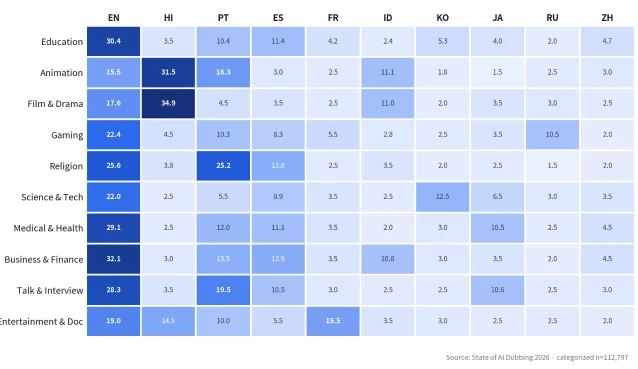
The report's industry × target-language map. Each industry clusters around different languages; the per-industry breakdown lives in "Still English-only? Money-Making Dubbing Languages Vary by Indestry"
AI dubbing takes a finished video and converts it into another language for immediate release. That definition is the report's starting point. Dubbing often gets grouped with voice cloning and avatar generation, but the job is different. Voice cloning and avatars are about making content. AI dubbing is about sending a finished video to viewers in another language. A cloned voice or an avatar is raw material you build once and reuse. A dubbed video is a parcel you ship the moment it's done.
Tool | Examples | Output | When it's used |
|---|---|---|---|
Voice cloning | ElevenLabs, Resemble | Synthetic voice | While creating |
Avatar generation | HeyGen, Synthesia | Synthetic presenter video | While creating |
Text translation | Google Translate, DeepL | Translated text file | Just before release |
AI dubbing | Perso Dubbing, etc. | Video shipped in several languages at once | At release |
If dubbing is closer to shipping a video than building one, then something matters more than how well it's made: how many language markets the video reached. That's exactly why language count, not voice quality, decides the outcome.
96% of dubbed videos are shared the moment they're made
Whether dubbing is really built for distribution shows up in what users do. 96% of videos made in Perso Dubbing were shared as soon as they were finished.
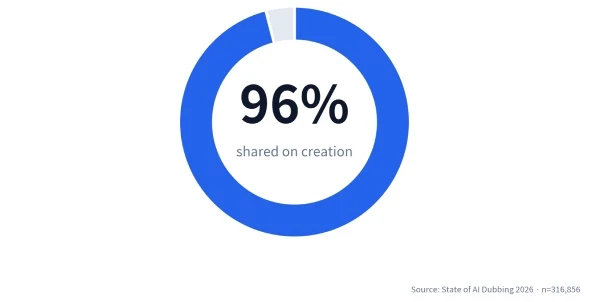
The 96% share rate covers all 316,856 projects. (Source: State of AI Dubbing 2026)
"Shared" means the link was copied and sent, or the video went up on a channel like YouTube, so it reached actual viewers. These videos weren't made and left to sit. They went out the door on completion. A 96% share rate makes one thing plain: dubbing is made to deliver, not to archive.
The number stands out because the behavior splits so cleanly from other tools. A synthetic voice usually gets saved for reuse. An avatar is a template you run again and again. A subtitle file is a stop along the way. Dubbing is the one output that reaches viewers the instant it exists.
The real variable was language count, not quality
So how many languages do creators actually reach? The "how many" is where most of them stop. Half of Perso Dubbing's 4,023 professional creators dub into exactly one language. The platform supports 99+ languages, yet only 12% have gone past five. Widening from one language to six moves global views far more than polishing the voice ever will.
Segment | Languages dubbed |
|---|---|
Median (half of creators) | 1 |
Average | 2.43 |
Top 5% | 8 |
Top 1% (47 creators) | 15 |
Platform support | 99+ |
Based on 4,023 professional creators. 5+ languages: 12% (484 creators); 10+ languages: 3.6% (143 creators). (Source: State of AI Dubbing 2026)
Right now the industry competes on whose voice sounds most natural. The data points somewhere else: who reaches viewers in the most language markets. Once you treat dubbing as a way of sending, the next question follows on its own:
"So which languages first, and how many should I add?"
You can start now
Treat AI dubbing as a voice-quality problem and your content tends to circle the same English-speaking audience. Treat it as distribution and the question changes. Not "should I make a better voice" but "how many language markets can I send this to at once?"
The question narrows to one: how many languages does your content reach today? Count them. If the answer is one, half of all creators are standing in the same spot. Turn that one into six and the same video meets a completely different number of people. No reshoot, no pricier voice.
Perso Dubbing supports dubbing in 99+ languages. It's built so a good video doesn't stop at English but reaches more viewers in Korean, in Japanese, in Portuguese, intact. Perso Dubbing makes the trip across the language barrier easy.
Frequently asked questions
Is choosing an AI dubbing tool with good voice quality enough?
Natural voice matters, but in the State of AI Dubbing 2026 data the bigger driver of global reach was the number of languages you reach. Half of professional creators stay on one language, and audience size grows most when you widen reach past five languages.
For global expansion, which works better: AI dubbing or subtitles?
They play different roles. A subtitle file is closer to a stop in the workflow, while a dubbed video goes to viewers the moment it's finished. In the data, 96% of dubbed videos were distributed right after production. Because it sends a finished video straight to viewers in another language, dubbing is closer to shipping than to making.
Can I dub a video I've already finished and release it in other languages?
Yes, that's the core use of AI dubbing. Without reshooting, you convert an existing video into another language and send it to viewers there. Adding one more language gets easier over time, so going from one to six is less work than it sounds.
All figures are from State of AI Dubbing 2026 (Perso Dubbing Data Team, 2026).
When people pick an AI dubbing tool, they usually start with the voice. Which one sounds most natural? Are the inflections off? But State of AI Dubbing 2026 reached a different conclusion. The report analyzed 316,856 dubbing projects from 4,023 professional creators across 80 countries, and global reach didn't come down to voice quality.
It came down to one thing: how many languages you ship in. The same video stays small in one language and finds a much larger audience in six. Yet most professional creators are still stuck on one. That gap is the opportunity. Adding a single language changes the size of the audience you reach, with no reshoot and no more expensive voice.
State of AI Dubbing 2026 — key figures
Metric | Value |
|---|---|
Dubbing projects analyzed | 316,856 (16 months) |
Professional creators | 4,023 · 80 countries |
Share rate | 96% |
Languages dubbed (median) | 1 |
Top 1% of creators | 15 languages on average |
Languages supported | 99+ |
Source: State of AI Dubbing 2026 (Perso Dubbing Data Team, 2026)
AI dubbing is a distribution step, not a production step
A quick note on the data first. State of AI Dubbing 2026 is Perso Dubbing's first annual industry report, published in June 2026. From 16 months of dubbing projects, the team isolated roughly 110,000 projects with a classified industry and cross-analyzed which industries dub into which languages.
The report's industry × target-language map. Each industry clusters around different languages; the per-industry breakdown lives in "Still English-only? Money-Making Dubbing Languages Vary by Indestry"
AI dubbing takes a finished video and converts it into another language for immediate release. That definition is the report's starting point. Dubbing often gets grouped with voice cloning and avatar generation, but the job is different. Voice cloning and avatars are about making content. AI dubbing is about sending a finished video to viewers in another language. A cloned voice or an avatar is raw material you build once and reuse. A dubbed video is a parcel you ship the moment it's done.
Tool | Examples | Output | When it's used |
|---|---|---|---|
Voice cloning | ElevenLabs, Resemble | Synthetic voice | While creating |
Avatar generation | HeyGen, Synthesia | Synthetic presenter video | While creating |
Text translation | Google Translate, DeepL | Translated text file | Just before release |
AI dubbing | Perso Dubbing, etc. | Video shipped in several languages at once | At release |
If dubbing is closer to shipping a video than building one, then something matters more than how well it's made: how many language markets the video reached. That's exactly why language count, not voice quality, decides the outcome.
96% of dubbed videos are shared the moment they're made
Whether dubbing is really built for distribution shows up in what users do. 96% of videos made in Perso Dubbing were shared as soon as they were finished.
The 96% share rate covers all 316,856 projects. (Source: State of AI Dubbing 2026)
"Shared" means the link was copied and sent, or the video went up on a channel like YouTube, so it reached actual viewers. These videos weren't made and left to sit. They went out the door on completion. A 96% share rate makes one thing plain: dubbing is made to deliver, not to archive.
The number stands out because the behavior splits so cleanly from other tools. A synthetic voice usually gets saved for reuse. An avatar is a template you run again and again. A subtitle file is a stop along the way. Dubbing is the one output that reaches viewers the instant it exists.
The real variable was language count, not quality
So how many languages do creators actually reach? The "how many" is where most of them stop. Half of Perso Dubbing's 4,023 professional creators dub into exactly one language. The platform supports 99+ languages, yet only 12% have gone past five. Widening from one language to six moves global views far more than polishing the voice ever will.
Segment | Languages dubbed |
|---|---|
Median (half of creators) | 1 |
Average | 2.43 |
Top 5% | 8 |
Top 1% (47 creators) | 15 |
Platform support | 99+ |
Based on 4,023 professional creators. 5+ languages: 12% (484 creators); 10+ languages: 3.6% (143 creators). (Source: State of AI Dubbing 2026)
Right now the industry competes on whose voice sounds most natural. The data points somewhere else: who reaches viewers in the most language markets. Once you treat dubbing as a way of sending, the next question follows on its own:
"So which languages first, and how many should I add?"
You can start now
Treat AI dubbing as a voice-quality problem and your content tends to circle the same English-speaking audience. Treat it as distribution and the question changes. Not "should I make a better voice" but "how many language markets can I send this to at once?"
The question narrows to one: how many languages does your content reach today? Count them. If the answer is one, half of all creators are standing in the same spot. Turn that one into six and the same video meets a completely different number of people. No reshoot, no pricier voice.
Perso Dubbing supports dubbing in 99+ languages. It's built so a good video doesn't stop at English but reaches more viewers in Korean, in Japanese, in Portuguese, intact. Perso Dubbing makes the trip across the language barrier easy.
Frequently asked questions
Is choosing an AI dubbing tool with good voice quality enough?
Natural voice matters, but in the State of AI Dubbing 2026 data the bigger driver of global reach was the number of languages you reach. Half of professional creators stay on one language, and audience size grows most when you widen reach past five languages.
For global expansion, which works better: AI dubbing or subtitles?
They play different roles. A subtitle file is closer to a stop in the workflow, while a dubbed video goes to viewers the moment it's finished. In the data, 96% of dubbed videos were distributed right after production. Because it sends a finished video straight to viewers in another language, dubbing is closer to shipping than to making.
Can I dub a video I've already finished and release it in other languages?
Yes, that's the core use of AI dubbing. Without reshooting, you convert an existing video into another language and send it to viewers there. Adding one more language gets easier over time, so going from one to six is less work than it sounds.
All figures are from State of AI Dubbing 2026 (Perso Dubbing Data Team, 2026).
When people pick an AI dubbing tool, they usually start with the voice. Which one sounds most natural? Are the inflections off? But State of AI Dubbing 2026 reached a different conclusion. The report analyzed 316,856 dubbing projects from 4,023 professional creators across 80 countries, and global reach didn't come down to voice quality.
It came down to one thing: how many languages you ship in. The same video stays small in one language and finds a much larger audience in six. Yet most professional creators are still stuck on one. That gap is the opportunity. Adding a single language changes the size of the audience you reach, with no reshoot and no more expensive voice.
State of AI Dubbing 2026 — key figures
Metric | Value |
|---|---|
Dubbing projects analyzed | 316,856 (16 months) |
Professional creators | 4,023 · 80 countries |
Share rate | 96% |
Languages dubbed (median) | 1 |
Top 1% of creators | 15 languages on average |
Languages supported | 99+ |
Source: State of AI Dubbing 2026 (Perso Dubbing Data Team, 2026)
AI dubbing is a distribution step, not a production step
A quick note on the data first. State of AI Dubbing 2026 is Perso Dubbing's first annual industry report, published in June 2026. From 16 months of dubbing projects, the team isolated roughly 110,000 projects with a classified industry and cross-analyzed which industries dub into which languages.
The report's industry × target-language map. Each industry clusters around different languages; the per-industry breakdown lives in "Still English-only? Money-Making Dubbing Languages Vary by Indestry"
AI dubbing takes a finished video and converts it into another language for immediate release. That definition is the report's starting point. Dubbing often gets grouped with voice cloning and avatar generation, but the job is different. Voice cloning and avatars are about making content. AI dubbing is about sending a finished video to viewers in another language. A cloned voice or an avatar is raw material you build once and reuse. A dubbed video is a parcel you ship the moment it's done.
Tool | Examples | Output | When it's used |
|---|---|---|---|
Voice cloning | ElevenLabs, Resemble | Synthetic voice | While creating |
Avatar generation | HeyGen, Synthesia | Synthetic presenter video | While creating |
Text translation | Google Translate, DeepL | Translated text file | Just before release |
AI dubbing | Perso Dubbing, etc. | Video shipped in several languages at once | At release |
If dubbing is closer to shipping a video than building one, then something matters more than how well it's made: how many language markets the video reached. That's exactly why language count, not voice quality, decides the outcome.
96% of dubbed videos are shared the moment they're made
Whether dubbing is really built for distribution shows up in what users do. 96% of videos made in Perso Dubbing were shared as soon as they were finished.
The 96% share rate covers all 316,856 projects. (Source: State of AI Dubbing 2026)
"Shared" means the link was copied and sent, or the video went up on a channel like YouTube, so it reached actual viewers. These videos weren't made and left to sit. They went out the door on completion. A 96% share rate makes one thing plain: dubbing is made to deliver, not to archive.
The number stands out because the behavior splits so cleanly from other tools. A synthetic voice usually gets saved for reuse. An avatar is a template you run again and again. A subtitle file is a stop along the way. Dubbing is the one output that reaches viewers the instant it exists.
The real variable was language count, not quality
So how many languages do creators actually reach? The "how many" is where most of them stop. Half of Perso Dubbing's 4,023 professional creators dub into exactly one language. The platform supports 99+ languages, yet only 12% have gone past five. Widening from one language to six moves global views far more than polishing the voice ever will.
Segment | Languages dubbed |
|---|---|
Median (half of creators) | 1 |
Average | 2.43 |
Top 5% | 8 |
Top 1% (47 creators) | 15 |
Platform support | 99+ |
Based on 4,023 professional creators. 5+ languages: 12% (484 creators); 10+ languages: 3.6% (143 creators). (Source: State of AI Dubbing 2026)
Right now the industry competes on whose voice sounds most natural. The data points somewhere else: who reaches viewers in the most language markets. Once you treat dubbing as a way of sending, the next question follows on its own:
"So which languages first, and how many should I add?"
You can start now
Treat AI dubbing as a voice-quality problem and your content tends to circle the same English-speaking audience. Treat it as distribution and the question changes. Not "should I make a better voice" but "how many language markets can I send this to at once?"
The question narrows to one: how many languages does your content reach today? Count them. If the answer is one, half of all creators are standing in the same spot. Turn that one into six and the same video meets a completely different number of people. No reshoot, no pricier voice.
Perso Dubbing supports dubbing in 99+ languages. It's built so a good video doesn't stop at English but reaches more viewers in Korean, in Japanese, in Portuguese, intact. Perso Dubbing makes the trip across the language barrier easy.
Frequently asked questions
Is choosing an AI dubbing tool with good voice quality enough?
Natural voice matters, but in the State of AI Dubbing 2026 data the bigger driver of global reach was the number of languages you reach. Half of professional creators stay on one language, and audience size grows most when you widen reach past five languages.
For global expansion, which works better: AI dubbing or subtitles?
They play different roles. A subtitle file is closer to a stop in the workflow, while a dubbed video goes to viewers the moment it's finished. In the data, 96% of dubbed videos were distributed right after production. Because it sends a finished video straight to viewers in another language, dubbing is closer to shipping than to making.
Can I dub a video I've already finished and release it in other languages?
Yes, that's the core use of AI dubbing. Without reshooting, you convert an existing video into another language and send it to viewers there. Adding one more language gets easier over time, so going from one to six is less work than it sounds.
All figures are from State of AI Dubbing 2026 (Perso Dubbing Data Team, 2026).
Continue Reading
Browse All