I Watched K-pop Interviews Videos Translated by AI - It's Insane




Jump to section
Jump to section

Share
Share
Share
AI Video Translator, Localization, and Dubbing Tool
Try it out for Free
Watching K-pop interviews with subtitles seems fine. It works: you get the information, you can follow the conversation, but the experience isn’t ideal, and subtitles split your attention. What’s worse, the experience becomes more about reading than watching.
Your typical AI video translator can’t solve this problem either, as most tools deliver unnatural and disconnected human voices that ruin the experience. Creators want their translated K-pop interview to be as engaging as the original. Fortunately, modern AI video translation tools can deliver a clear tone and natural pacing, with voices that are much closer to the original.
Keep reading to learn what makes this possible, and how AI-translated content can be great with the right tools.
Why subtitles hurt K-pop interviews
Subtitles have an essential role, but they also create a split-focus experience. It’s easy to miss key moments. Plus, it’s exhausting and takes the fun out of watching your favorite K-pop groups.
Subtitles also slow the pacing of the conversation. K-pop interviews move quickly, often favoring promotional goals over deep conversations. Group members also talk over each other, creating jumbled subtitles that make no sense.
That means the interview’s natural rhythm disappears, and your audience misses the moments that foster the connection to the group. Fan-made translations are an option, but they can take days to complete. Fans may turn to an AI video translator to share their favorite K-pop group, but not all solutions deliver the best experience.
They produce quick translations that work in a pinch, but fail to capture the elements that make K-pop interviews fun to watch.
Why K-pop interviews from your AI video translator sound unnatural?
Many creators turn to AI tools, hoping to create a smoother experience, but only find ones that rely on simpler video-to-text processing. Sure, this works, but the results are unnatural because AI translators struggle with:
Lack of context: Many AI models overlook humor, contextual references, sarcasm, slang, or emotional tone.
Training data bias: AI may paraphrase translations based on patterns in the training data, making the interview less authentic.
Technical limits: Older language models process speech as isolated text rather than as naturally flowing conversation.
Audio quality issues: Invasive background noise, fast speech, or unfamiliar accents lead to inaccurate transcriptions, hurting every step of the process.
These challenges come from a lack of localization. Many AI tools translate words, but localization adapts the aspects of K-pop culture so the audience experiences the interviews as intended. Without it, even accurate translations are flat and lifeless.
Perso Dubbing: How modern AI fixes these problems
Creating engaging, trending content requires modern AI transcribing tools. Perso Dubbing uses Emotional Science Technology designed with 30 years of experience and innovation to solve problems traditional tools can’t:
Multi-speaker detection: Perso Dubbing separates each member’s voice, preserving their tone and emotion, which is essential for interviewing K-pop groups.
Lip-sync technology: Natural lip movement is a major challenge in dubbed content, but Perso Dubbing aligns translated audio with on-screen lip movements, making it natural and non-distracting. Automatic lip-sync is available on all paid plans, with a monthly lip-sync allowance in each tier.
Hands-on script editing: Creators no longer have to accept awkward translations. Quickly customize or adjust AI translations wherever you need to, without redoing the entire script.
Comprehensive language support: Perso Dubbing helps you expand your reach with video content that adapts tone and context across 99+ languages.
Natural voice quality: Perso Dubbing combines its own dubbing models with global AI foundation models for natural AI voice cloning and voice dubbing audio.
AI that speaks culture: Perso Dubbing’s Cultural Intelligence Engine captures emotion, humor, and context, preserving the whole K-pop experience.
Instead of telling you how easy it is to translate a video with Perso Dubbing, we’ll just show you.
Quick guide to AI video translation with Perso Dubbing
Getting started with Perso Dubbing tools is straightforward, allowing you to translate any K-pop interview in just a few steps. Here’s how it works:
Step 1 - Upload your interview
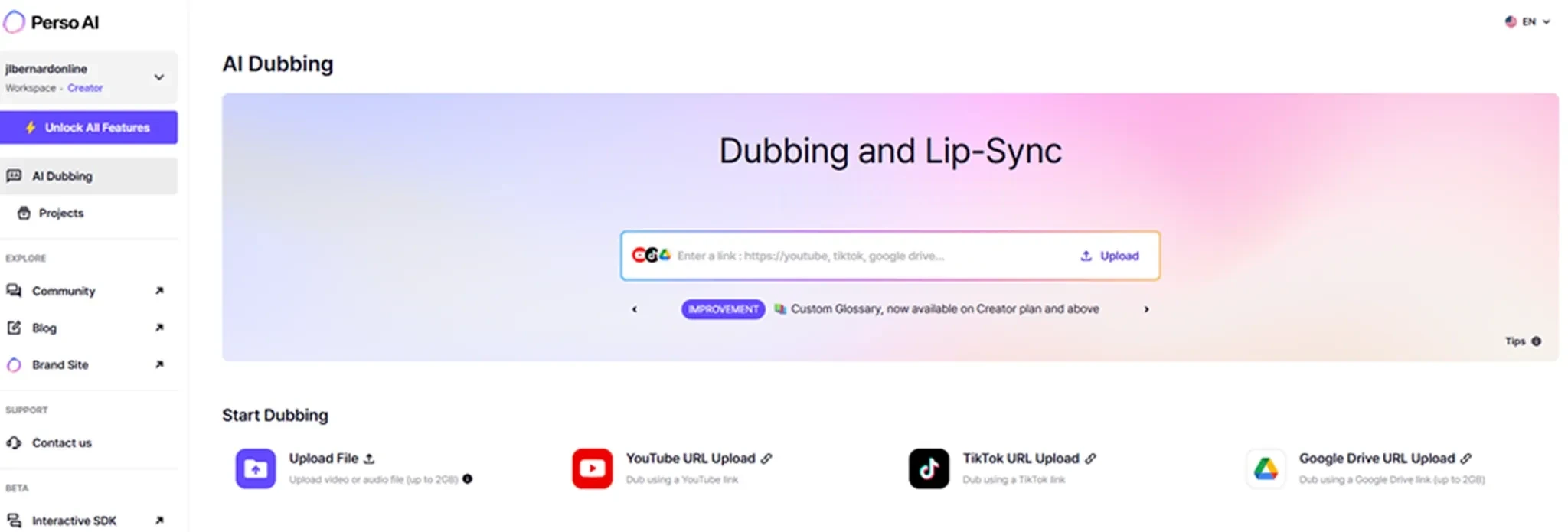
Paste your video links from YouTube, TikTok, Google Drive, or another platform, and click Upload.
Step 2 - Translation Settings
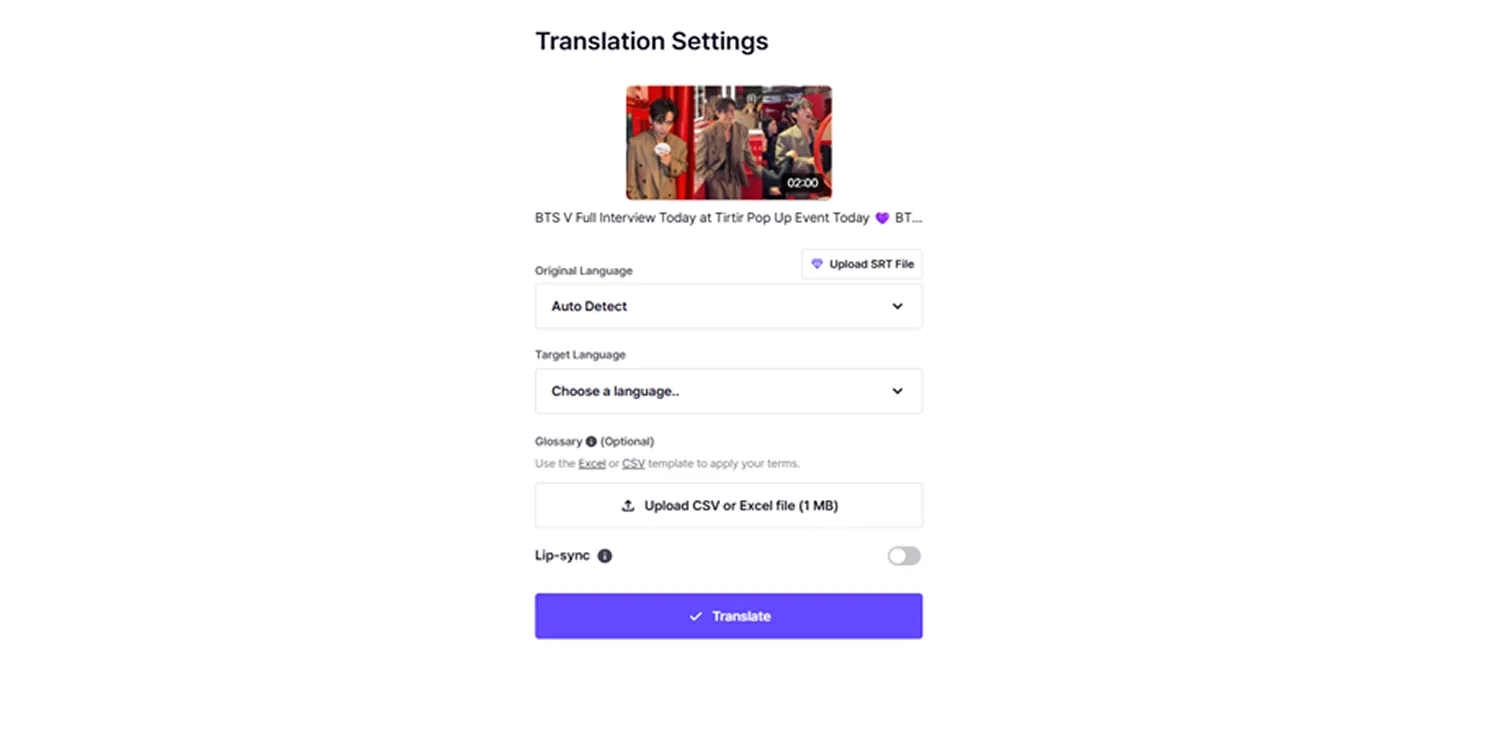
Perso Dubbing makes customizing your video translation quick and easy. Adjust your settings as needed:
Choose to detect the original language automatically or input the language you want to translate.
Next, choose the target language to reach your appropriate audience.
Upload a Glossary to help Perso Dubbing understand the meanings of specific terms.
Toggle on lip-sync to adjust the timing of the voice dubbing for your video and click ‘Translate.’
Step 3 - Preparing Your Video
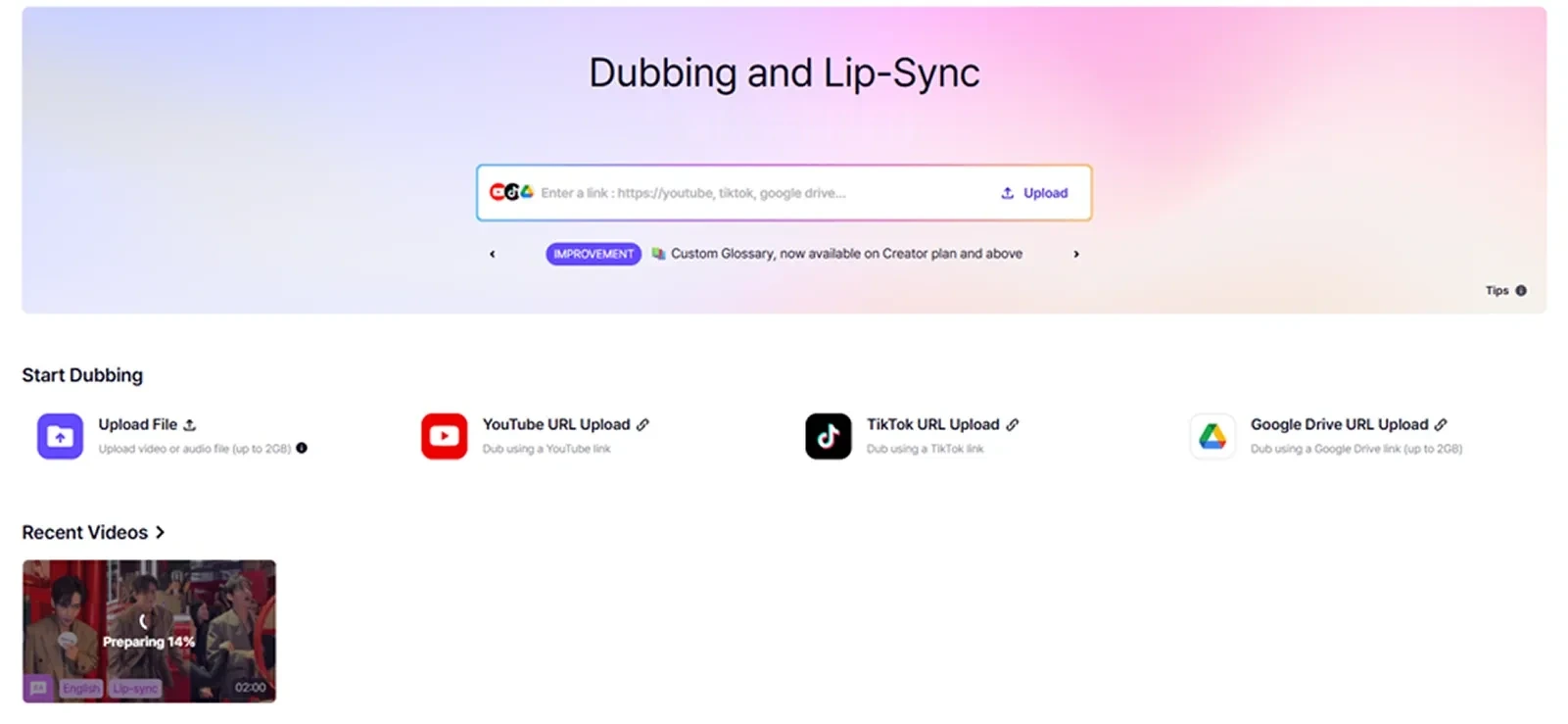
Now, Perso Dubbing begins the translation. You should see your new video under ‘Recent Videos,’ and receive an email once it’s ready.
Step 4 - Final Adjustments
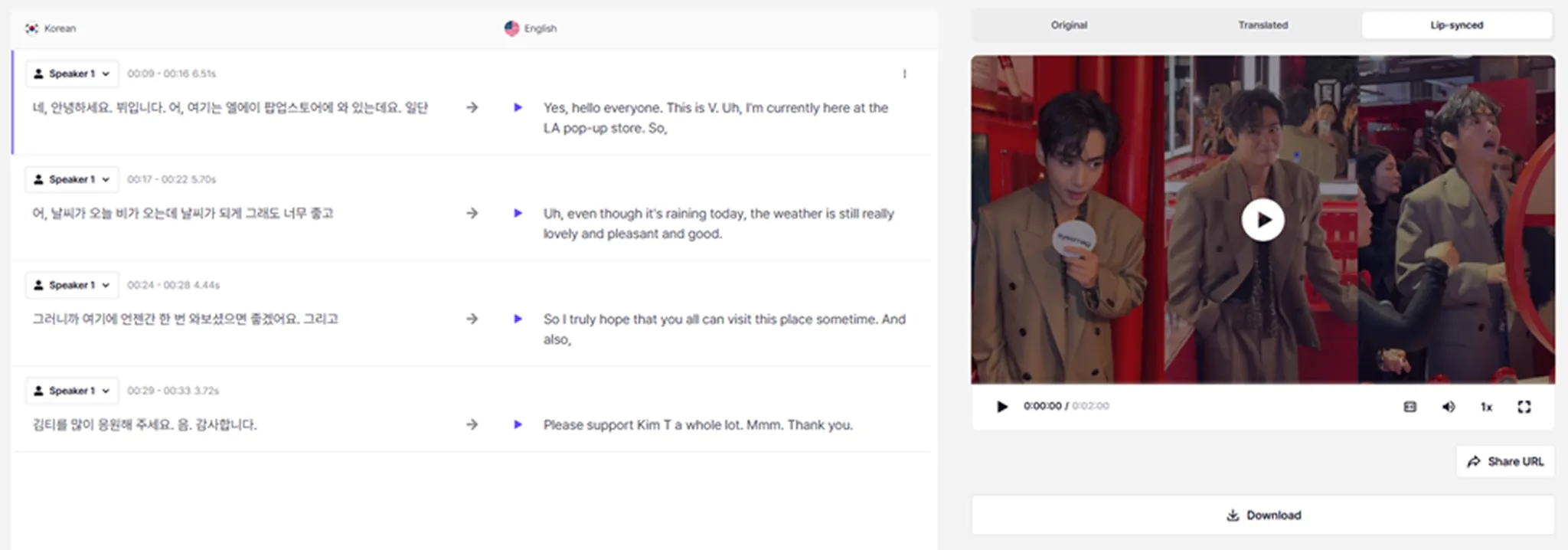
Once your video is ready, click the video thumbnail. This opens the dashboard, where you can tweak the script to ensure the translation feels as natural as possible.
Dubbing tools should bring the audience closer to K-pop stars
K-pop interviews should be experienced, not filtered through stiff, robotic audio. Perso Dubbing offers expressive, culturally aware translations that remain true to their favorite K-pop groups. Modern dubbing tools shouldn’t pull viewers out of the moment; they should provide an immersive viewing experience in any language.
If you’re trying to expand your audience and make K-pop accessible to anyone, start with an AI video translator designed for accuracy, emotion, and authenticity.
Watching K-pop interviews with subtitles seems fine. It works: you get the information, you can follow the conversation, but the experience isn’t ideal, and subtitles split your attention. What’s worse, the experience becomes more about reading than watching.
Your typical AI video translator can’t solve this problem either, as most tools deliver unnatural and disconnected human voices that ruin the experience. Creators want their translated K-pop interview to be as engaging as the original. Fortunately, modern AI video translation tools can deliver a clear tone and natural pacing, with voices that are much closer to the original.
Keep reading to learn what makes this possible, and how AI-translated content can be great with the right tools.
Why subtitles hurt K-pop interviews
Subtitles have an essential role, but they also create a split-focus experience. It’s easy to miss key moments. Plus, it’s exhausting and takes the fun out of watching your favorite K-pop groups.
Subtitles also slow the pacing of the conversation. K-pop interviews move quickly, often favoring promotional goals over deep conversations. Group members also talk over each other, creating jumbled subtitles that make no sense.
That means the interview’s natural rhythm disappears, and your audience misses the moments that foster the connection to the group. Fan-made translations are an option, but they can take days to complete. Fans may turn to an AI video translator to share their favorite K-pop group, but not all solutions deliver the best experience.
They produce quick translations that work in a pinch, but fail to capture the elements that make K-pop interviews fun to watch.
Why K-pop interviews from your AI video translator sound unnatural?
Many creators turn to AI tools, hoping to create a smoother experience, but only find ones that rely on simpler video-to-text processing. Sure, this works, but the results are unnatural because AI translators struggle with:
Lack of context: Many AI models overlook humor, contextual references, sarcasm, slang, or emotional tone.
Training data bias: AI may paraphrase translations based on patterns in the training data, making the interview less authentic.
Technical limits: Older language models process speech as isolated text rather than as naturally flowing conversation.
Audio quality issues: Invasive background noise, fast speech, or unfamiliar accents lead to inaccurate transcriptions, hurting every step of the process.
These challenges come from a lack of localization. Many AI tools translate words, but localization adapts the aspects of K-pop culture so the audience experiences the interviews as intended. Without it, even accurate translations are flat and lifeless.
Perso Dubbing: How modern AI fixes these problems
Creating engaging, trending content requires modern AI transcribing tools. Perso Dubbing uses Emotional Science Technology designed with 30 years of experience and innovation to solve problems traditional tools can’t:
Multi-speaker detection: Perso Dubbing separates each member’s voice, preserving their tone and emotion, which is essential for interviewing K-pop groups.
Lip-sync technology: Natural lip movement is a major challenge in dubbed content, but Perso Dubbing aligns translated audio with on-screen lip movements, making it natural and non-distracting. Automatic lip-sync is available on all paid plans, with a monthly lip-sync allowance in each tier.
Hands-on script editing: Creators no longer have to accept awkward translations. Quickly customize or adjust AI translations wherever you need to, without redoing the entire script.
Comprehensive language support: Perso Dubbing helps you expand your reach with video content that adapts tone and context across 99+ languages.
Natural voice quality: Perso Dubbing combines its own dubbing models with global AI foundation models for natural AI voice cloning and voice dubbing audio.
AI that speaks culture: Perso Dubbing’s Cultural Intelligence Engine captures emotion, humor, and context, preserving the whole K-pop experience.
Instead of telling you how easy it is to translate a video with Perso Dubbing, we’ll just show you.
Quick guide to AI video translation with Perso Dubbing
Getting started with Perso Dubbing tools is straightforward, allowing you to translate any K-pop interview in just a few steps. Here’s how it works:
Step 1 - Upload your interview
Paste your video links from YouTube, TikTok, Google Drive, or another platform, and click Upload.
Step 2 - Translation Settings
Perso Dubbing makes customizing your video translation quick and easy. Adjust your settings as needed:
Choose to detect the original language automatically or input the language you want to translate.
Next, choose the target language to reach your appropriate audience.
Upload a Glossary to help Perso Dubbing understand the meanings of specific terms.
Toggle on lip-sync to adjust the timing of the voice dubbing for your video and click ‘Translate.’
Step 3 - Preparing Your Video
Now, Perso Dubbing begins the translation. You should see your new video under ‘Recent Videos,’ and receive an email once it’s ready.
Step 4 - Final Adjustments
Once your video is ready, click the video thumbnail. This opens the dashboard, where you can tweak the script to ensure the translation feels as natural as possible.
Dubbing tools should bring the audience closer to K-pop stars
K-pop interviews should be experienced, not filtered through stiff, robotic audio. Perso Dubbing offers expressive, culturally aware translations that remain true to their favorite K-pop groups. Modern dubbing tools shouldn’t pull viewers out of the moment; they should provide an immersive viewing experience in any language.
If you’re trying to expand your audience and make K-pop accessible to anyone, start with an AI video translator designed for accuracy, emotion, and authenticity.
Watching K-pop interviews with subtitles seems fine. It works: you get the information, you can follow the conversation, but the experience isn’t ideal, and subtitles split your attention. What’s worse, the experience becomes more about reading than watching.
Your typical AI video translator can’t solve this problem either, as most tools deliver unnatural and disconnected human voices that ruin the experience. Creators want their translated K-pop interview to be as engaging as the original. Fortunately, modern AI video translation tools can deliver a clear tone and natural pacing, with voices that are much closer to the original.
Keep reading to learn what makes this possible, and how AI-translated content can be great with the right tools.
Why subtitles hurt K-pop interviews
Subtitles have an essential role, but they also create a split-focus experience. It’s easy to miss key moments. Plus, it’s exhausting and takes the fun out of watching your favorite K-pop groups.
Subtitles also slow the pacing of the conversation. K-pop interviews move quickly, often favoring promotional goals over deep conversations. Group members also talk over each other, creating jumbled subtitles that make no sense.
That means the interview’s natural rhythm disappears, and your audience misses the moments that foster the connection to the group. Fan-made translations are an option, but they can take days to complete. Fans may turn to an AI video translator to share their favorite K-pop group, but not all solutions deliver the best experience.
They produce quick translations that work in a pinch, but fail to capture the elements that make K-pop interviews fun to watch.
Why K-pop interviews from your AI video translator sound unnatural?
Many creators turn to AI tools, hoping to create a smoother experience, but only find ones that rely on simpler video-to-text processing. Sure, this works, but the results are unnatural because AI translators struggle with:
Lack of context: Many AI models overlook humor, contextual references, sarcasm, slang, or emotional tone.
Training data bias: AI may paraphrase translations based on patterns in the training data, making the interview less authentic.
Technical limits: Older language models process speech as isolated text rather than as naturally flowing conversation.
Audio quality issues: Invasive background noise, fast speech, or unfamiliar accents lead to inaccurate transcriptions, hurting every step of the process.
These challenges come from a lack of localization. Many AI tools translate words, but localization adapts the aspects of K-pop culture so the audience experiences the interviews as intended. Without it, even accurate translations are flat and lifeless.
Perso Dubbing: How modern AI fixes these problems
Creating engaging, trending content requires modern AI transcribing tools. Perso Dubbing uses Emotional Science Technology designed with 30 years of experience and innovation to solve problems traditional tools can’t:
Multi-speaker detection: Perso Dubbing separates each member’s voice, preserving their tone and emotion, which is essential for interviewing K-pop groups.
Lip-sync technology: Natural lip movement is a major challenge in dubbed content, but Perso Dubbing aligns translated audio with on-screen lip movements, making it natural and non-distracting. Automatic lip-sync is available on all paid plans, with a monthly lip-sync allowance in each tier.
Hands-on script editing: Creators no longer have to accept awkward translations. Quickly customize or adjust AI translations wherever you need to, without redoing the entire script.
Comprehensive language support: Perso Dubbing helps you expand your reach with video content that adapts tone and context across 99+ languages.
Natural voice quality: Perso Dubbing combines its own dubbing models with global AI foundation models for natural AI voice cloning and voice dubbing audio.
AI that speaks culture: Perso Dubbing’s Cultural Intelligence Engine captures emotion, humor, and context, preserving the whole K-pop experience.
Instead of telling you how easy it is to translate a video with Perso Dubbing, we’ll just show you.
Quick guide to AI video translation with Perso Dubbing
Getting started with Perso Dubbing tools is straightforward, allowing you to translate any K-pop interview in just a few steps. Here’s how it works:
Step 1 - Upload your interview
Paste your video links from YouTube, TikTok, Google Drive, or another platform, and click Upload.
Step 2 - Translation Settings
Perso Dubbing makes customizing your video translation quick and easy. Adjust your settings as needed:
Choose to detect the original language automatically or input the language you want to translate.
Next, choose the target language to reach your appropriate audience.
Upload a Glossary to help Perso Dubbing understand the meanings of specific terms.
Toggle on lip-sync to adjust the timing of the voice dubbing for your video and click ‘Translate.’
Step 3 - Preparing Your Video
Now, Perso Dubbing begins the translation. You should see your new video under ‘Recent Videos,’ and receive an email once it’s ready.
Step 4 - Final Adjustments
Once your video is ready, click the video thumbnail. This opens the dashboard, where you can tweak the script to ensure the translation feels as natural as possible.
Dubbing tools should bring the audience closer to K-pop stars
K-pop interviews should be experienced, not filtered through stiff, robotic audio. Perso Dubbing offers expressive, culturally aware translations that remain true to their favorite K-pop groups. Modern dubbing tools shouldn’t pull viewers out of the moment; they should provide an immersive viewing experience in any language.
If you’re trying to expand your audience and make K-pop accessible to anyone, start with an AI video translator designed for accuracy, emotion, and authenticity.
Continue Reading
Browse All