Cara Melakukan Dubbing Video Buatan AI (Sora, Veo, Kling) di 2026
Terakhir Diperbarui




Lompat ke bagian
Lompat ke bagian

Bagikan
Bagikan
Bagikan

Alat Penerjemah Video AI, Lokalisasi, dan Dubbing
Coba secara Gratis
Anda tidak perlu membuat ulang video AI untuk setiap bahasa — Anda hanya perlu melakukan dubbing. Membuat ulang satu menit footage AI menelan biaya $3 hingga $42 per bahasa berdasarkan harga resmi API (Veo 3.1, Sora 2 — Agustus 2026). Melakukan sulih suara AI (dubbing AI) pada menit yang sama hanya menghabiskan sekitar $0.73, mempertahankan footage yang sama di setiap versi bahasa (identik kecuali Anda mengaktifkan sinkronisasi bibir), dan diproses dengan median waktu 4 menit 23 detik. Panduan ini membahas hitungan biayanya serta alur kerja tiga langkah untuk melokalkan video yang dibuat dengan Sora, Veo, Kling, Seedance, atau model video generatif lainnya.
Mengapa kreator membuat ulang video — dan mengapa cara itu gagal saat diskalakan
Model video modern menghasilkan ucapan natif dari prompt Anda: tulis prompt dalam bahasa Jepang, dan karakternya akan berbicara bahasa Jepang. Maka cara paling intuitif untuk melokalkan video AI adalah menjalankan prompt yang sama sekali lagi dalam bahasa baru.
Intuisi itu keliru karena tiga alasan.
1. Anda membayar penuh biaya pembuatan lagi untuk setiap bahasa. Pembuatan video dihargai per detik output. Di Gemini API, Veo 3.1 mulai dari $0.05 per detik (Lite, 720p) hingga $0.40 per detik (standar, 720p/1080p). Di OpenAI API, Sora 2 berharga $0.10 per detik (720p) dan Sora 2 Pro $0.30–$0.70 per detik tergantung resolusi (semua harga per Agustus 2026). Melokalkan ke lima bahasa berarti membayar lima kali pembuatan penuh.
2. Anda tidak mendapatkan video yang sama. Model video bersifat non-deterministik — dan sebagian bahkan menulis ulang prompt Anda sebelum menghasilkan video. Dalam benchmark kami pada Juli 2026 di Higgsfield (20 klip mencakup 4 tipe adegan dan 5 model video), Veo 3.1 menyusun ulang prompt kami ke dalam format shot-nya sendiri bahkan saat peningkatan prompt sudah dinonaktifkan secara eksplisit — terulang di dua pekerjaan pembuatan terpisah — dan konsep visual abstrak bergeser menjadi objek harfiah. Mengulang prompt dalam bahasa baru memperbesar variansnya: versi Spanyol Anda kemungkinan besar memiliki wajah, gerakan kamera, dan tempo yang berbeda dari versi asli bahasa Inggris Anda. Untuk karakter brand atau sebuah serial, itu adalah putusnya kontinuitas, bukan terjemahan.
3. Output yang layak pakai tidak dijamin. Penyedia API hanya menagih pembuatan yang berhasil — tetapi "berhasil" berarti model mengembalikan sebuah video, bukan berarti video itu bisa Anda pakai. Dalam benchmark yang sama, teks di layar tampil sebagai karakter acak di kelima model yang kami uji, dan prompt yang meleset dari gaya yang diinginkan berarti harus membuat ulang lagi. Setiap versi bahasa baru memulai ulang siklus seleksi itu dari nol; dubbing tidak.
Dubbing membalik hitungan ekonominya: buat visualnya sekali, lalu ganti hanya trek suaranya. Perso Dubbing adalah alat dubbing video AI yang menerjemahkan dan men-dubbing footage yang sudah ada — ia dapat menerjemahkan video ke 99+ bahasa tanpa membuat ulang videonya.
Hitungan biaya: membuat ulang vs dubbing
Berikut biaya melokalkan satu video buatan AI berdurasi 60 detik ke lima bahasa dengan masing-masing pendekatan. Harga pembuatan adalah tarif resmi API per Agustus 2026, dengan asumsi satu output 60 detik (video yang lebih panjang mungkin memerlukan beberapa panggilan pembuatan). Harga dubbing memakai tarif efektif paket Creator Perso Dubbing ($29/bulan untuk 40 menit dubbing ≈ $0.73/menit).
Pendekatan | Per bahasa (60s) | × 5 bahasa | Footage sama di setiap versi? |
|---|---|---|---|
Buat ulang — tier termurah (Veo 3.1 Lite 720p, Sora 2 batch: $0.05/s) | $3.00 | $15.00 | ❌ video baru setiap kali |
Buat ulang — Sora 2 (720p, $0.10/s) | $6.00 | $30.00 | ❌ video baru setiap kali |
Buat ulang — Veo 3.1 standar (720p/1080p, $0.40/s) | $24.00 | $120.00 | ❌ video baru setiap kali |
Buat ulang — Sora 2 Pro (1080p, $0.70/s) | $42.00 | $210.00 | ❌ video baru setiap kali |
Dubbing master dengan Perso Dubbing (~$0.73/menit efektif) | $0.73 | $3.65 | ✅ footage sama (sinkronisasi bibir opsional) |
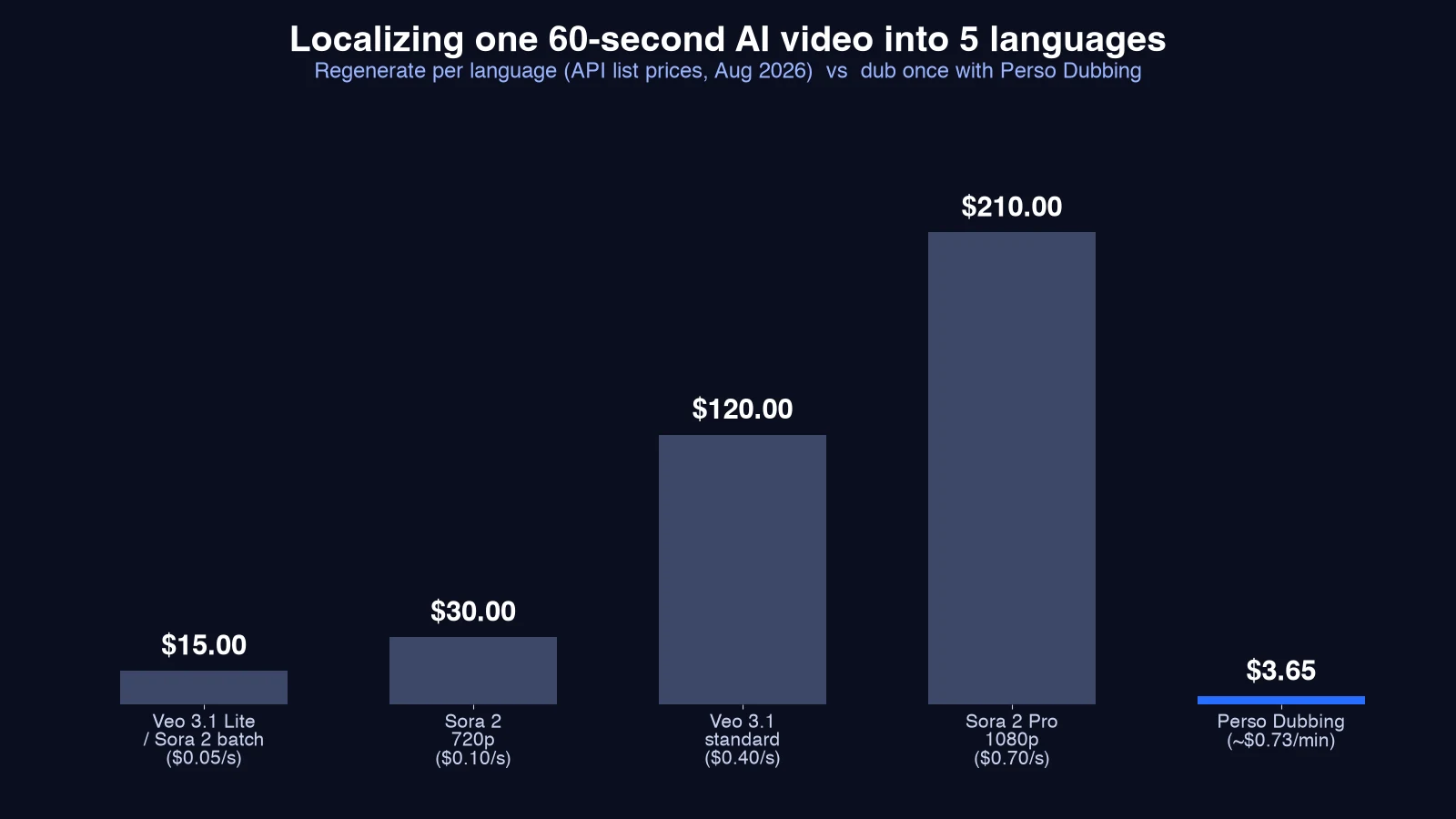
Membuat ulang satu menit video AI dalam lima bahasa menelan $15–$210 biaya pembuatan berdasarkan harga resmi; men-dubbing menit yang sama ke lima bahasa hanya sekitar $3.65 dalam kredit pada paket Creator Perso Dubbing — selisih 4× hingga 57×. (Dalam praktiknya, paket terkecil yang langsung menutup skenario lima menit ini adalah Starter seharga $6.99/bulan — tetap 2× hingga 30× di bawah biaya membuat ulang.) Dan selisihnya makin lebar dengan setiap bahasa yang Anda tambahkan: membuat ulang berskala dengan biaya produksi penuh, sedangkan dubbing hanya berskala dengan biaya audio per menit.
Jika Anda ingin suara hasil dubbing selaras dengan gerakan mulut, AI lip sync berbiaya 180 credits per menit — 3× tarif dubbing standar, atau sekitar $2.18/menit efektif pada paket Creator. Lima versi bahasa dengan lip-sync untuk video satu menit totalnya sekitar $10.88: masih 1.4× hingga 19× di bawah biaya membuat ulang, dengan adegan, karakter, dan tempo yang konsisten di setiap versi.
Sumber: harga Google Gemini API dan harga OpenAI API, keduanya diakses 21 Agustus 2026. Tarif Perso Dubbing: harga Perso Dubbing.
Alur kerja 3 langkah
Perso Dubbing adalah alat sulih suara AI (dubbing AI) yang menerima video jadi — hasil rekaman maupun buatan AI — dan menghasilkan video yang sama namun berbicara dalam bahasa lain. Alur kerjanya sama, entah footage Anda berasal dari Sora, Veo, Kling, atau kamera:
Buat video Anda sekali saja. Produksi versi utama dalam bahasa utama Anda. Kunci hasil editnya — dubbing dilakukan setelah proses edit, jadi dubbing ekspor final, bukan klip mentah.
Unggah ke Perso Dubbing dan pilih bahasa target. Unggah MP4 atau tempel URL YouTube. Perso Dubbing mentranskripsi audio dengan pengenalan ucapan 100 bahasa, menerjemahkannya, dan menghasilkan trek suara dubbing dengan ucapan AI yang terdengar alami. Anda dapat menyunting setiap baris terjemahan sebelum ekspor.
(Opsional) Aktifkan sinkronisasi bibir, lalu unduh. Untuk video talking-head atau yang digerakkan karakter, sinkronisasi bibir AI menyesuaikan gerakan mulut dengan bahasa baru. Di antara proyek yang selesai, median waktu pemrosesan adalah 4 menit 23 detik dan 56.6% selesai dalam kurang dari 5 menit; 95.1% dari seluruh proyek dubbing selesai dengan sukses (data platform Perso AI, Jan 2025–Apr 2026; waktu pemrosesan diukur pada 266,132 proyek selesai, tidak termasuk outlier di atas satu jam).
Coba pada video buatan AI Anda →
Mengapa video AI pendek dan dubbing saling melengkapi
Video buatan AI sangat didominasi format pendek — begitu pula permintaan dubbing. Di platform Perso AI, median durasi video yang di-dubbing adalah 60 detik, dan 55.8% dari semua video yang di-dubbing berdurasi satu menit atau kurang (data platform Perso AI, 316,856 proyek, Jan 2025–Apr 2026). Itu persis bentuk konten yang keluar dari Sora, Veo, dan Kling hari ini: klip 6–60 detik untuk Reels, Shorts, dan TikTok.
Potensi distribusinya nyata. Kreator di platform men-dubbing lintas 909 pasangan bahasa aktif, dan bahasa target #1 adalah Hindi (29.2% dari semua proyek) — mengungguli bahasa Inggris (24.1%). Jika konten buatan AI Anda hanya ada dalam bahasa Inggris, audiens dubbing terbesar justru yang belum Anda jangkau. Berikut cara menerjemahkan video ke banyak bahasa langkah demi langkah.
Kapan membuat ulang per bahasa memang pilihan yang tepat
Dubbing tidak selalu menjadi jawaban. Buat ulang alih-alih dubbing ketika:
Visualnya sendiri harus dilokalkan. Teks di layar, papan tanda, atau adegan spesifik budaya yang melekat di footage tidak akan berubah dengan dubbing. (Caption dan judul yang ditambahkan di editor tidak masalah — ganti saja per bahasa.)
Suara natif adalah inti kreatifnya. Jika performa suara bawaan model dalam satu bahasa tertentu adalah asetnya, dan Anda hanya butuh satu atau dua versi bahasa dari klip pendek, membuat ulang bisa lebih sederhana.
Anda masih dalam tahap iterasi. Jangan dubbing draf. Dubbing hasil edit final yang sudah dikunci — men-dubbing video yang belum selesai berarti men-dubbing ulang nanti.
Untuk selebihnya — karakter serial, maskot brand, video penjelasan produk, kanal tanpa wajah — dubbing versi masternya. Perso Dubbing mendukung 99+ bahasa dubbing dari satu kali unggah, sehingga biaya marjinal bahasa ke-6 hingga ke-20 hanyalah hitungan menit, bukan anggaran produksi baru. Lihat rincian ROI untuk kreator tentang bagaimana ekonomi dubbing bekerja di kanal nyata.
FAQ
Q. Bisakah Sora atau Veo membuat video dalam bahasa lain?
A. Bisa — Sora 2 dan Veo 3.1 dapat menghasilkan ucapan natif dalam bahasa prompt Anda. Namun setiap bahasa memerlukan pembuatan baru sepenuhnya dengan harga penuh ($0.05–$0.70 per detik output tergantung model dan tier, Agustus 2026), dan model menghasilkan footage yang berbeda setiap kali. Untuk mempertahankan footage yang sama di semua bahasa (identik kecuali sinkronisasi bibir diaktifkan), buat sekali lalu dubbing videonya.
Q. Berapa biaya men-dubbing video buatan AI?
A. Pada paket Creator Perso Dubbing ($29/bulan, 40 menit dubbing), dubbing berbiaya sekitar $0.73 per menit per bahasa. Video AI satu menit yang di-dubbing ke lima bahasa berbiaya sekitar $3.65 dalam kredit — dibandingkan $15–$210 untuk membuat ulang menit itu lima kali dengan harga resmi API Sora 2 dan Veo 3.1 (Agustus 2026).
Q. Apakah lip-sync AI bekerja pada karakter buatan AI?
A. Ya. Lip-sync AI menyelaraskan ulang gerakan mulut dengan audio hasil dubbing dan bekerja pada wajah buatan AI maupun animasi, sama seperti wajah hasil rekaman. Di Perso AI, 14.1% proyek dubbing mengaktifkan lip-sync otomatis (data platform, Jan 2025–Apr 2026). Biayanya 180 credits per menit, 3× tarif dubbing standar.
Q. Apa cara terbaik menerjemahkan konten video buatan AI ke berbagai bahasa?
A. Buat videonya sekali dalam bahasa utama Anda, lalu gunakan alat dubbing video AI untuk menerjemahkan audionya. Dubbing mempertahankan footage asli, mendukung 99+ bahasa di Perso Dubbing, dan pada harga resmi API Agustus 2026 biayanya kira-kira 4× hingga 57× lebih murah daripada membuat ulang video per bahasa. Simpan opsi membuat ulang untuk kasus ketika visualnya sendiri harus berubah per pasar.
Anda tidak perlu membuat ulang video AI untuk setiap bahasa — Anda hanya perlu melakukan dubbing. Membuat ulang satu menit footage AI menelan biaya $3 hingga $42 per bahasa berdasarkan harga resmi API (Veo 3.1, Sora 2 — Agustus 2026). Melakukan sulih suara AI (dubbing AI) pada menit yang sama hanya menghabiskan sekitar $0.73, mempertahankan footage yang sama di setiap versi bahasa (identik kecuali Anda mengaktifkan sinkronisasi bibir), dan diproses dengan median waktu 4 menit 23 detik. Panduan ini membahas hitungan biayanya serta alur kerja tiga langkah untuk melokalkan video yang dibuat dengan Sora, Veo, Kling, Seedance, atau model video generatif lainnya.
Mengapa kreator membuat ulang video — dan mengapa cara itu gagal saat diskalakan
Model video modern menghasilkan ucapan natif dari prompt Anda: tulis prompt dalam bahasa Jepang, dan karakternya akan berbicara bahasa Jepang. Maka cara paling intuitif untuk melokalkan video AI adalah menjalankan prompt yang sama sekali lagi dalam bahasa baru.
Intuisi itu keliru karena tiga alasan.
1. Anda membayar penuh biaya pembuatan lagi untuk setiap bahasa. Pembuatan video dihargai per detik output. Di Gemini API, Veo 3.1 mulai dari $0.05 per detik (Lite, 720p) hingga $0.40 per detik (standar, 720p/1080p). Di OpenAI API, Sora 2 berharga $0.10 per detik (720p) dan Sora 2 Pro $0.30–$0.70 per detik tergantung resolusi (semua harga per Agustus 2026). Melokalkan ke lima bahasa berarti membayar lima kali pembuatan penuh.
2. Anda tidak mendapatkan video yang sama. Model video bersifat non-deterministik — dan sebagian bahkan menulis ulang prompt Anda sebelum menghasilkan video. Dalam benchmark kami pada Juli 2026 di Higgsfield (20 klip mencakup 4 tipe adegan dan 5 model video), Veo 3.1 menyusun ulang prompt kami ke dalam format shot-nya sendiri bahkan saat peningkatan prompt sudah dinonaktifkan secara eksplisit — terulang di dua pekerjaan pembuatan terpisah — dan konsep visual abstrak bergeser menjadi objek harfiah. Mengulang prompt dalam bahasa baru memperbesar variansnya: versi Spanyol Anda kemungkinan besar memiliki wajah, gerakan kamera, dan tempo yang berbeda dari versi asli bahasa Inggris Anda. Untuk karakter brand atau sebuah serial, itu adalah putusnya kontinuitas, bukan terjemahan.
3. Output yang layak pakai tidak dijamin. Penyedia API hanya menagih pembuatan yang berhasil — tetapi "berhasil" berarti model mengembalikan sebuah video, bukan berarti video itu bisa Anda pakai. Dalam benchmark yang sama, teks di layar tampil sebagai karakter acak di kelima model yang kami uji, dan prompt yang meleset dari gaya yang diinginkan berarti harus membuat ulang lagi. Setiap versi bahasa baru memulai ulang siklus seleksi itu dari nol; dubbing tidak.
Dubbing membalik hitungan ekonominya: buat visualnya sekali, lalu ganti hanya trek suaranya. Perso Dubbing adalah alat dubbing video AI yang menerjemahkan dan men-dubbing footage yang sudah ada — ia dapat menerjemahkan video ke 99+ bahasa tanpa membuat ulang videonya.
Hitungan biaya: membuat ulang vs dubbing
Berikut biaya melokalkan satu video buatan AI berdurasi 60 detik ke lima bahasa dengan masing-masing pendekatan. Harga pembuatan adalah tarif resmi API per Agustus 2026, dengan asumsi satu output 60 detik (video yang lebih panjang mungkin memerlukan beberapa panggilan pembuatan). Harga dubbing memakai tarif efektif paket Creator Perso Dubbing ($29/bulan untuk 40 menit dubbing ≈ $0.73/menit).
Pendekatan | Per bahasa (60s) | × 5 bahasa | Footage sama di setiap versi? |
|---|---|---|---|
Buat ulang — tier termurah (Veo 3.1 Lite 720p, Sora 2 batch: $0.05/s) | $3.00 | $15.00 | ❌ video baru setiap kali |
Buat ulang — Sora 2 (720p, $0.10/s) | $6.00 | $30.00 | ❌ video baru setiap kali |
Buat ulang — Veo 3.1 standar (720p/1080p, $0.40/s) | $24.00 | $120.00 | ❌ video baru setiap kali |
Buat ulang — Sora 2 Pro (1080p, $0.70/s) | $42.00 | $210.00 | ❌ video baru setiap kali |
Dubbing master dengan Perso Dubbing (~$0.73/menit efektif) | $0.73 | $3.65 | ✅ footage sama (sinkronisasi bibir opsional) |
Membuat ulang satu menit video AI dalam lima bahasa menelan $15–$210 biaya pembuatan berdasarkan harga resmi; men-dubbing menit yang sama ke lima bahasa hanya sekitar $3.65 dalam kredit pada paket Creator Perso Dubbing — selisih 4× hingga 57×. (Dalam praktiknya, paket terkecil yang langsung menutup skenario lima menit ini adalah Starter seharga $6.99/bulan — tetap 2× hingga 30× di bawah biaya membuat ulang.) Dan selisihnya makin lebar dengan setiap bahasa yang Anda tambahkan: membuat ulang berskala dengan biaya produksi penuh, sedangkan dubbing hanya berskala dengan biaya audio per menit.
Jika Anda ingin suara hasil dubbing selaras dengan gerakan mulut, AI lip sync berbiaya 180 credits per menit — 3× tarif dubbing standar, atau sekitar $2.18/menit efektif pada paket Creator. Lima versi bahasa dengan lip-sync untuk video satu menit totalnya sekitar $10.88: masih 1.4× hingga 19× di bawah biaya membuat ulang, dengan adegan, karakter, dan tempo yang konsisten di setiap versi.
Sumber: harga Google Gemini API dan harga OpenAI API, keduanya diakses 21 Agustus 2026. Tarif Perso Dubbing: harga Perso Dubbing.
Alur kerja 3 langkah
Perso Dubbing adalah alat sulih suara AI (dubbing AI) yang menerima video jadi — hasil rekaman maupun buatan AI — dan menghasilkan video yang sama namun berbicara dalam bahasa lain. Alur kerjanya sama, entah footage Anda berasal dari Sora, Veo, Kling, atau kamera:
Buat video Anda sekali saja. Produksi versi utama dalam bahasa utama Anda. Kunci hasil editnya — dubbing dilakukan setelah proses edit, jadi dubbing ekspor final, bukan klip mentah.
Unggah ke Perso Dubbing dan pilih bahasa target. Unggah MP4 atau tempel URL YouTube. Perso Dubbing mentranskripsi audio dengan pengenalan ucapan 100 bahasa, menerjemahkannya, dan menghasilkan trek suara dubbing dengan ucapan AI yang terdengar alami. Anda dapat menyunting setiap baris terjemahan sebelum ekspor.
(Opsional) Aktifkan sinkronisasi bibir, lalu unduh. Untuk video talking-head atau yang digerakkan karakter, sinkronisasi bibir AI menyesuaikan gerakan mulut dengan bahasa baru. Di antara proyek yang selesai, median waktu pemrosesan adalah 4 menit 23 detik dan 56.6% selesai dalam kurang dari 5 menit; 95.1% dari seluruh proyek dubbing selesai dengan sukses (data platform Perso AI, Jan 2025–Apr 2026; waktu pemrosesan diukur pada 266,132 proyek selesai, tidak termasuk outlier di atas satu jam).
Coba pada video buatan AI Anda →
Mengapa video AI pendek dan dubbing saling melengkapi
Video buatan AI sangat didominasi format pendek — begitu pula permintaan dubbing. Di platform Perso AI, median durasi video yang di-dubbing adalah 60 detik, dan 55.8% dari semua video yang di-dubbing berdurasi satu menit atau kurang (data platform Perso AI, 316,856 proyek, Jan 2025–Apr 2026). Itu persis bentuk konten yang keluar dari Sora, Veo, dan Kling hari ini: klip 6–60 detik untuk Reels, Shorts, dan TikTok.
Potensi distribusinya nyata. Kreator di platform men-dubbing lintas 909 pasangan bahasa aktif, dan bahasa target #1 adalah Hindi (29.2% dari semua proyek) — mengungguli bahasa Inggris (24.1%). Jika konten buatan AI Anda hanya ada dalam bahasa Inggris, audiens dubbing terbesar justru yang belum Anda jangkau. Berikut cara menerjemahkan video ke banyak bahasa langkah demi langkah.
Kapan membuat ulang per bahasa memang pilihan yang tepat
Dubbing tidak selalu menjadi jawaban. Buat ulang alih-alih dubbing ketika:
Visualnya sendiri harus dilokalkan. Teks di layar, papan tanda, atau adegan spesifik budaya yang melekat di footage tidak akan berubah dengan dubbing. (Caption dan judul yang ditambahkan di editor tidak masalah — ganti saja per bahasa.)
Suara natif adalah inti kreatifnya. Jika performa suara bawaan model dalam satu bahasa tertentu adalah asetnya, dan Anda hanya butuh satu atau dua versi bahasa dari klip pendek, membuat ulang bisa lebih sederhana.
Anda masih dalam tahap iterasi. Jangan dubbing draf. Dubbing hasil edit final yang sudah dikunci — men-dubbing video yang belum selesai berarti men-dubbing ulang nanti.
Untuk selebihnya — karakter serial, maskot brand, video penjelasan produk, kanal tanpa wajah — dubbing versi masternya. Perso Dubbing mendukung 99+ bahasa dubbing dari satu kali unggah, sehingga biaya marjinal bahasa ke-6 hingga ke-20 hanyalah hitungan menit, bukan anggaran produksi baru. Lihat rincian ROI untuk kreator tentang bagaimana ekonomi dubbing bekerja di kanal nyata.
FAQ
Q. Bisakah Sora atau Veo membuat video dalam bahasa lain?
A. Bisa — Sora 2 dan Veo 3.1 dapat menghasilkan ucapan natif dalam bahasa prompt Anda. Namun setiap bahasa memerlukan pembuatan baru sepenuhnya dengan harga penuh ($0.05–$0.70 per detik output tergantung model dan tier, Agustus 2026), dan model menghasilkan footage yang berbeda setiap kali. Untuk mempertahankan footage yang sama di semua bahasa (identik kecuali sinkronisasi bibir diaktifkan), buat sekali lalu dubbing videonya.
Q. Berapa biaya men-dubbing video buatan AI?
A. Pada paket Creator Perso Dubbing ($29/bulan, 40 menit dubbing), dubbing berbiaya sekitar $0.73 per menit per bahasa. Video AI satu menit yang di-dubbing ke lima bahasa berbiaya sekitar $3.65 dalam kredit — dibandingkan $15–$210 untuk membuat ulang menit itu lima kali dengan harga resmi API Sora 2 dan Veo 3.1 (Agustus 2026).
Q. Apakah lip-sync AI bekerja pada karakter buatan AI?
A. Ya. Lip-sync AI menyelaraskan ulang gerakan mulut dengan audio hasil dubbing dan bekerja pada wajah buatan AI maupun animasi, sama seperti wajah hasil rekaman. Di Perso AI, 14.1% proyek dubbing mengaktifkan lip-sync otomatis (data platform, Jan 2025–Apr 2026). Biayanya 180 credits per menit, 3× tarif dubbing standar.
Q. Apa cara terbaik menerjemahkan konten video buatan AI ke berbagai bahasa?
A. Buat videonya sekali dalam bahasa utama Anda, lalu gunakan alat dubbing video AI untuk menerjemahkan audionya. Dubbing mempertahankan footage asli, mendukung 99+ bahasa di Perso Dubbing, dan pada harga resmi API Agustus 2026 biayanya kira-kira 4× hingga 57× lebih murah daripada membuat ulang video per bahasa. Simpan opsi membuat ulang untuk kasus ketika visualnya sendiri harus berubah per pasar.
Anda tidak perlu membuat ulang video AI untuk setiap bahasa — Anda hanya perlu melakukan dubbing. Membuat ulang satu menit footage AI menelan biaya $3 hingga $42 per bahasa berdasarkan harga resmi API (Veo 3.1, Sora 2 — Agustus 2026). Melakukan sulih suara AI (dubbing AI) pada menit yang sama hanya menghabiskan sekitar $0.73, mempertahankan footage yang sama di setiap versi bahasa (identik kecuali Anda mengaktifkan sinkronisasi bibir), dan diproses dengan median waktu 4 menit 23 detik. Panduan ini membahas hitungan biayanya serta alur kerja tiga langkah untuk melokalkan video yang dibuat dengan Sora, Veo, Kling, Seedance, atau model video generatif lainnya.
Mengapa kreator membuat ulang video — dan mengapa cara itu gagal saat diskalakan
Model video modern menghasilkan ucapan natif dari prompt Anda: tulis prompt dalam bahasa Jepang, dan karakternya akan berbicara bahasa Jepang. Maka cara paling intuitif untuk melokalkan video AI adalah menjalankan prompt yang sama sekali lagi dalam bahasa baru.
Intuisi itu keliru karena tiga alasan.
1. Anda membayar penuh biaya pembuatan lagi untuk setiap bahasa. Pembuatan video dihargai per detik output. Di Gemini API, Veo 3.1 mulai dari $0.05 per detik (Lite, 720p) hingga $0.40 per detik (standar, 720p/1080p). Di OpenAI API, Sora 2 berharga $0.10 per detik (720p) dan Sora 2 Pro $0.30–$0.70 per detik tergantung resolusi (semua harga per Agustus 2026). Melokalkan ke lima bahasa berarti membayar lima kali pembuatan penuh.
2. Anda tidak mendapatkan video yang sama. Model video bersifat non-deterministik — dan sebagian bahkan menulis ulang prompt Anda sebelum menghasilkan video. Dalam benchmark kami pada Juli 2026 di Higgsfield (20 klip mencakup 4 tipe adegan dan 5 model video), Veo 3.1 menyusun ulang prompt kami ke dalam format shot-nya sendiri bahkan saat peningkatan prompt sudah dinonaktifkan secara eksplisit — terulang di dua pekerjaan pembuatan terpisah — dan konsep visual abstrak bergeser menjadi objek harfiah. Mengulang prompt dalam bahasa baru memperbesar variansnya: versi Spanyol Anda kemungkinan besar memiliki wajah, gerakan kamera, dan tempo yang berbeda dari versi asli bahasa Inggris Anda. Untuk karakter brand atau sebuah serial, itu adalah putusnya kontinuitas, bukan terjemahan.
3. Output yang layak pakai tidak dijamin. Penyedia API hanya menagih pembuatan yang berhasil — tetapi "berhasil" berarti model mengembalikan sebuah video, bukan berarti video itu bisa Anda pakai. Dalam benchmark yang sama, teks di layar tampil sebagai karakter acak di kelima model yang kami uji, dan prompt yang meleset dari gaya yang diinginkan berarti harus membuat ulang lagi. Setiap versi bahasa baru memulai ulang siklus seleksi itu dari nol; dubbing tidak.
Dubbing membalik hitungan ekonominya: buat visualnya sekali, lalu ganti hanya trek suaranya. Perso Dubbing adalah alat dubbing video AI yang menerjemahkan dan men-dubbing footage yang sudah ada — ia dapat menerjemahkan video ke 99+ bahasa tanpa membuat ulang videonya.
Hitungan biaya: membuat ulang vs dubbing
Berikut biaya melokalkan satu video buatan AI berdurasi 60 detik ke lima bahasa dengan masing-masing pendekatan. Harga pembuatan adalah tarif resmi API per Agustus 2026, dengan asumsi satu output 60 detik (video yang lebih panjang mungkin memerlukan beberapa panggilan pembuatan). Harga dubbing memakai tarif efektif paket Creator Perso Dubbing ($29/bulan untuk 40 menit dubbing ≈ $0.73/menit).
Pendekatan | Per bahasa (60s) | × 5 bahasa | Footage sama di setiap versi? |
|---|---|---|---|
Buat ulang — tier termurah (Veo 3.1 Lite 720p, Sora 2 batch: $0.05/s) | $3.00 | $15.00 | ❌ video baru setiap kali |
Buat ulang — Sora 2 (720p, $0.10/s) | $6.00 | $30.00 | ❌ video baru setiap kali |
Buat ulang — Veo 3.1 standar (720p/1080p, $0.40/s) | $24.00 | $120.00 | ❌ video baru setiap kali |
Buat ulang — Sora 2 Pro (1080p, $0.70/s) | $42.00 | $210.00 | ❌ video baru setiap kali |
Dubbing master dengan Perso Dubbing (~$0.73/menit efektif) | $0.73 | $3.65 | ✅ footage sama (sinkronisasi bibir opsional) |
Membuat ulang satu menit video AI dalam lima bahasa menelan $15–$210 biaya pembuatan berdasarkan harga resmi; men-dubbing menit yang sama ke lima bahasa hanya sekitar $3.65 dalam kredit pada paket Creator Perso Dubbing — selisih 4× hingga 57×. (Dalam praktiknya, paket terkecil yang langsung menutup skenario lima menit ini adalah Starter seharga $6.99/bulan — tetap 2× hingga 30× di bawah biaya membuat ulang.) Dan selisihnya makin lebar dengan setiap bahasa yang Anda tambahkan: membuat ulang berskala dengan biaya produksi penuh, sedangkan dubbing hanya berskala dengan biaya audio per menit.
Jika Anda ingin suara hasil dubbing selaras dengan gerakan mulut, AI lip sync berbiaya 180 credits per menit — 3× tarif dubbing standar, atau sekitar $2.18/menit efektif pada paket Creator. Lima versi bahasa dengan lip-sync untuk video satu menit totalnya sekitar $10.88: masih 1.4× hingga 19× di bawah biaya membuat ulang, dengan adegan, karakter, dan tempo yang konsisten di setiap versi.
Sumber: harga Google Gemini API dan harga OpenAI API, keduanya diakses 21 Agustus 2026. Tarif Perso Dubbing: harga Perso Dubbing.
Alur kerja 3 langkah
Perso Dubbing adalah alat sulih suara AI (dubbing AI) yang menerima video jadi — hasil rekaman maupun buatan AI — dan menghasilkan video yang sama namun berbicara dalam bahasa lain. Alur kerjanya sama, entah footage Anda berasal dari Sora, Veo, Kling, atau kamera:
Buat video Anda sekali saja. Produksi versi utama dalam bahasa utama Anda. Kunci hasil editnya — dubbing dilakukan setelah proses edit, jadi dubbing ekspor final, bukan klip mentah.
Unggah ke Perso Dubbing dan pilih bahasa target. Unggah MP4 atau tempel URL YouTube. Perso Dubbing mentranskripsi audio dengan pengenalan ucapan 100 bahasa, menerjemahkannya, dan menghasilkan trek suara dubbing dengan ucapan AI yang terdengar alami. Anda dapat menyunting setiap baris terjemahan sebelum ekspor.
(Opsional) Aktifkan sinkronisasi bibir, lalu unduh. Untuk video talking-head atau yang digerakkan karakter, sinkronisasi bibir AI menyesuaikan gerakan mulut dengan bahasa baru. Di antara proyek yang selesai, median waktu pemrosesan adalah 4 menit 23 detik dan 56.6% selesai dalam kurang dari 5 menit; 95.1% dari seluruh proyek dubbing selesai dengan sukses (data platform Perso AI, Jan 2025–Apr 2026; waktu pemrosesan diukur pada 266,132 proyek selesai, tidak termasuk outlier di atas satu jam).
Coba pada video buatan AI Anda →
Mengapa video AI pendek dan dubbing saling melengkapi
Video buatan AI sangat didominasi format pendek — begitu pula permintaan dubbing. Di platform Perso AI, median durasi video yang di-dubbing adalah 60 detik, dan 55.8% dari semua video yang di-dubbing berdurasi satu menit atau kurang (data platform Perso AI, 316,856 proyek, Jan 2025–Apr 2026). Itu persis bentuk konten yang keluar dari Sora, Veo, dan Kling hari ini: klip 6–60 detik untuk Reels, Shorts, dan TikTok.
Potensi distribusinya nyata. Kreator di platform men-dubbing lintas 909 pasangan bahasa aktif, dan bahasa target #1 adalah Hindi (29.2% dari semua proyek) — mengungguli bahasa Inggris (24.1%). Jika konten buatan AI Anda hanya ada dalam bahasa Inggris, audiens dubbing terbesar justru yang belum Anda jangkau. Berikut cara menerjemahkan video ke banyak bahasa langkah demi langkah.
Kapan membuat ulang per bahasa memang pilihan yang tepat
Dubbing tidak selalu menjadi jawaban. Buat ulang alih-alih dubbing ketika:
Visualnya sendiri harus dilokalkan. Teks di layar, papan tanda, atau adegan spesifik budaya yang melekat di footage tidak akan berubah dengan dubbing. (Caption dan judul yang ditambahkan di editor tidak masalah — ganti saja per bahasa.)
Suara natif adalah inti kreatifnya. Jika performa suara bawaan model dalam satu bahasa tertentu adalah asetnya, dan Anda hanya butuh satu atau dua versi bahasa dari klip pendek, membuat ulang bisa lebih sederhana.
Anda masih dalam tahap iterasi. Jangan dubbing draf. Dubbing hasil edit final yang sudah dikunci — men-dubbing video yang belum selesai berarti men-dubbing ulang nanti.
Untuk selebihnya — karakter serial, maskot brand, video penjelasan produk, kanal tanpa wajah — dubbing versi masternya. Perso Dubbing mendukung 99+ bahasa dubbing dari satu kali unggah, sehingga biaya marjinal bahasa ke-6 hingga ke-20 hanyalah hitungan menit, bukan anggaran produksi baru. Lihat rincian ROI untuk kreator tentang bagaimana ekonomi dubbing bekerja di kanal nyata.
FAQ
Q. Bisakah Sora atau Veo membuat video dalam bahasa lain?
A. Bisa — Sora 2 dan Veo 3.1 dapat menghasilkan ucapan natif dalam bahasa prompt Anda. Namun setiap bahasa memerlukan pembuatan baru sepenuhnya dengan harga penuh ($0.05–$0.70 per detik output tergantung model dan tier, Agustus 2026), dan model menghasilkan footage yang berbeda setiap kali. Untuk mempertahankan footage yang sama di semua bahasa (identik kecuali sinkronisasi bibir diaktifkan), buat sekali lalu dubbing videonya.
Q. Berapa biaya men-dubbing video buatan AI?
A. Pada paket Creator Perso Dubbing ($29/bulan, 40 menit dubbing), dubbing berbiaya sekitar $0.73 per menit per bahasa. Video AI satu menit yang di-dubbing ke lima bahasa berbiaya sekitar $3.65 dalam kredit — dibandingkan $15–$210 untuk membuat ulang menit itu lima kali dengan harga resmi API Sora 2 dan Veo 3.1 (Agustus 2026).
Q. Apakah lip-sync AI bekerja pada karakter buatan AI?
A. Ya. Lip-sync AI menyelaraskan ulang gerakan mulut dengan audio hasil dubbing dan bekerja pada wajah buatan AI maupun animasi, sama seperti wajah hasil rekaman. Di Perso AI, 14.1% proyek dubbing mengaktifkan lip-sync otomatis (data platform, Jan 2025–Apr 2026). Biayanya 180 credits per menit, 3× tarif dubbing standar.
Q. Apa cara terbaik menerjemahkan konten video buatan AI ke berbagai bahasa?
A. Buat videonya sekali dalam bahasa utama Anda, lalu gunakan alat dubbing video AI untuk menerjemahkan audionya. Dubbing mempertahankan footage asli, mendukung 99+ bahasa di Perso Dubbing, dan pada harga resmi API Agustus 2026 biayanya kira-kira 4× hingga 57× lebih murah daripada membuat ulang video per bahasa. Simpan opsi membuat ulang untuk kasus ketika visualnya sendiri harus berubah per pasar.
Lanjutkan Membaca
Jelajahi Semua